
The question of what year Bitcoin came out is more than a simple chronological inquiry; it marks the definitive starting point of the decentralization movement that has fundamentally altered the global financial landscape. While the seeds of digital currency were sown by various “cypherpunks” and cryptographers throughout the 1990s, the Bitcoin we know today officially transitioned from concept to reality between late 2008 and early 2009. Understanding the timing of Bitcoin’s emergence is critical for any modern investor, as its birth was not a random technological fluke but a direct response to a global economic catastrophe.
The 2008 Financial Crisis and the Birth of Satoshi’s Vision
To understand why Bitcoin was created, one must look at the specific economic climate of 2008. This was the year of the Great Recession, characterized by the collapse of Lehman Brothers, the subprime mortgage meltdown, and a series of controversial government bailouts for major financial institutions. It was against this backdrop of systemic instability and a profound loss of public trust in centralized banking that an anonymous entity known as Satoshi Nakamoto published the Bitcoin whitepaper.
The Whitepaper: October 31, 2008
On Halloween of 2008, Nakamoto released a document titled “Bitcoin: A Peer-to-Peer Electronic Cash System” to a cryptography mailing list. This document did not just propose a new way to send money; it proposed a way to remove the “trusted third party” (the bank) from the equation. In the eyes of Nakamoto, the central failure of conventional currency was the requirement of trust. Banks must be trusted to hold our money and transfer it electronically, but they frequently lend it out in waves of credit bubbles with barely a fraction in reserve.
The timing of this release was surgical. As the world watched central banks print trillions of dollars to stabilize failing markets, Bitcoin offered an alternative: a mathematical, deflationary protocol where the rules were written in code rather than dictated by policy.
The Genesis Block: January 3, 2009
While the “idea” of Bitcoin arrived in 2008, the network itself went live on January 3, 2009. This is the year Bitcoin officially “came out” as a functional software. Satoshi mined the first block of the Bitcoin blockchain, known as the “Genesis Block” or Block 0.
Encoded within the Genesis Block was a message that forever linked Bitcoin’s existence to the failures of the traditional financial system: “The Times 03/Jan/2009 Chancellor on brink of second bailout for banks.” This headline from The London Times served as a timestamp and a manifesto, ensuring that anyone who looked at the foundation of the Bitcoin ledger would understand its purpose as an alternative to a banking system prone to inflation and corruption.
Early Valuation and the Transition to an Investable Asset
In its first year of existence, Bitcoin had no market value. It was a project shared among enthusiasts, mined on home computers, and sent back and forth to test the network’s integrity. However, the transition from a niche hobby to a financial asset happened with surprising speed, driven by the realization that Bitcoin possessed the qualities of “hard money.”
The First Market Prices: 2010
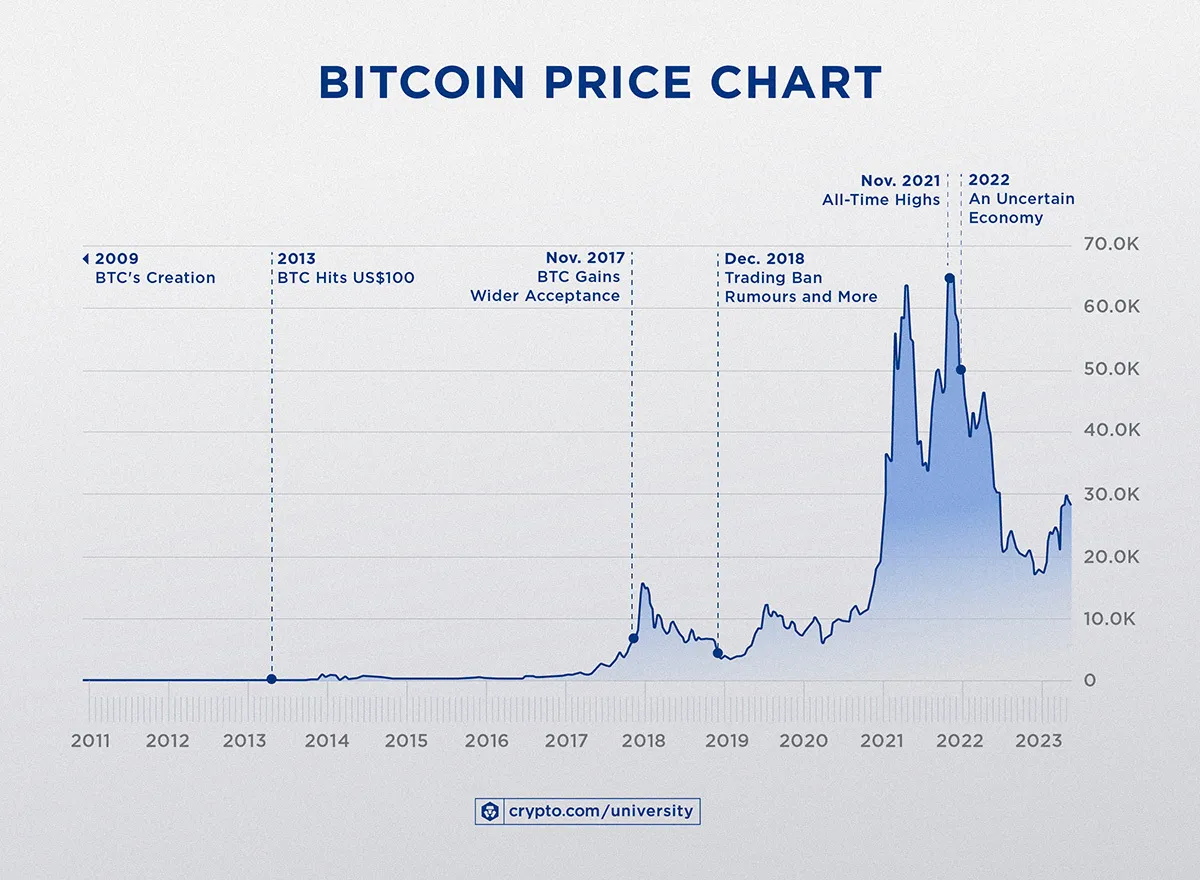
It wasn’t until 2010 that Bitcoin established its first real-world price. The most famous example of this is “Bitcoin Pizza Day” on May 22, 2010, when a programmer named Laszlo Hanyecz paid 10,000 BTC for two pizzas. At the time, those 10,000 coins were worth roughly $41. This event was a watershed moment because it proved that Bitcoin could be used as a medium of exchange. Later that year, the first major exchange, Mt. Gox, launched, allowing people to trade Bitcoin for U.S. dollars. By the end of 2010, Bitcoin’s price had reached a high of roughly $0.39.
Parity and the First Bubble: 2011
In February 2011, Bitcoin reached a milestone that many thought impossible: it achieved parity with the U.S. dollar. For the first time, 1 BTC was worth $1.00. This psychological barrier being broken attracted a new wave of investors and media attention, leading to the first major “bull run” where the price spiked to $30 before crashing back down to $2. This volatility became a hallmark of the asset class, but it also highlighted the massive potential for asymmetrical returns that would eventually draw in institutional capital.
Understanding Bitcoin as a Modern Investment Vehicle

As we move further away from the year Bitcoin came out, its role in a financial portfolio has evolved from a speculative experiment to a legitimate store of value, often referred to as “Digital Gold.” The reason for this shift lies in the protocol’s inherent scarcity and its programmatic monetary policy.
The Power of Scarcity: The 21 Million Cap
Unlike fiat currencies (USD, EUR, GBP), which central banks can print in unlimited quantities, Bitcoin has a hard cap of 21 million coins. This supply limit is hard-coded into the protocol. For investors, this represents a hedge against the debasement of traditional currency. When the money supply increases, the purchasing power of each individual unit typically decreases. Bitcoin’s fixed supply ensures that it cannot be devalued by any government or central entity, making it an attractive asset for those looking to preserve wealth over long time horizons.
The Halving Cycles
A key feature of Bitcoin’s economic model is the “halving.” Approximately every four years, the reward that miners receive for securing the network is cut in half. This reduces the rate at which new Bitcoins enter circulation. Historically, these halving events have served as catalysts for massive price appreciation.
-
The 2012 Halving: Led to the 2013 peak of $1,100.
-
The 2016 Halving: Led to the 2017 peak of nearly $20,000.
-
The 2020 Halving: Led to the 2021 peak of $69,000.
By understanding the year Bitcoin came out and the subsequent halving schedule, investors can identify the cyclical nature of the market.
Institutional Adoption and the Spot ETF
The most significant development since Bitcoin’s inception was the entry of institutional giants. For years, Bitcoin was dismissed by Wall Street. However, the narrative shifted as companies like MicroStrategy began adding Bitcoin to their corporate balance sheets, and legendary investors like Paul Tudor Jones recognized it as an inflation hedge.
The crowning achievement of this institutional era occurred in early 2024 with the approval of Spot Bitcoin ETFs (Exchange Traded Funds) in the United States. This allowed traditional investors to gain exposure to Bitcoin through their standard brokerage accounts without the need to manage private keys or navigate crypto exchanges. This development effectively bridged the gap between the radical experiment of 2009 and the global financial establishment.
The Role of Bitcoin in a Diversified Portfolio
Deciding to invest in Bitcoin requires a different mindset than traditional equity or bond investing. Because Bitcoin was born outside the traditional system, it often moves independently of other asset classes, though it has shown increased correlation with tech stocks in recent years.
Risk Management and Volatility
Investors must acknowledge that while Bitcoin has been the best-performing asset of the last decade, it comes with extreme volatility. Drawdowns of 50% to 80% are not uncommon in its history. Therefore, most financial advisors who are “crypto-friendly” suggest a small allocation—typically 1% to 5% of a total portfolio—to capture the upside potential while mitigating the risk of a total loss.
Store of Value vs. Medium of Exchange
There is an ongoing debate about whether Bitcoin is “money” or “an investment.” While its use as a day-to-day medium of exchange is limited by its transaction fees and speed, its utility as a store of value is unmatched in the digital age. It is portable, divisible, censorship-resistant, and globally accessible. In a world where geopolitical instability can lead to the freezing of bank accounts or the collapse of local currencies, the ability to hold one’s wealth in a borderless, neutral asset is a powerful financial tool.

The Legacy of 2009: A Shift in Financial Sovereignty
When we look back at what year Bitcoin came out, we see a line in the sand. Before 2009, financial sovereignty was an illusion; your “money” in the bank was actually a liability on the bank’s balance sheet. After 2009, true digital ownership became possible.
The launch of Bitcoin didn’t just create a new way to get rich; it created a new way to think about the nature of value. It proved that trust could be replaced by verification and that a global, decentralized ledger could operate without a CEO, a marketing department, or a central bank.
For the modern investor, Bitcoin represents the ultimate “opt-out” from a system of perpetual debt and currency inflation. Whether it is viewed as a speculative asset, a hedge against disaster, or the future of the internet’s economy, its origin in the ashes of the 2008 crisis remains its most important characteristic. As the legacy of that year continues to influence global fiscal policy, the importance of Satoshi Nakamoto’s 2009 creation only grows. Bitcoin is no longer just a year in history; it is a permanent fixture in the future of finance.
aViewFromTheCave is a participant in the Amazon Services LLC Associates Program, an affiliate advertising program designed to provide a means for sites to earn advertising fees by advertising and linking to Amazon.com. Amazon, the Amazon logo, AmazonSupply, and the AmazonSupply logo are trademarks of Amazon.com, Inc. or its affiliates. As an Amazon Associate we earn affiliate commissions from qualifying purchases.