
Planning for retirement is one of the most critical financial journeys an individual can undertake. While employer-sponsored plans like 401(k)s are common, they often lack the flexibility and investment variety that many savvy investors crave. This is where the Traditional Individual Retirement Account (IRA) becomes a cornerstone of a robust financial strategy. A Traditional IRA is more than just a savings account; it is a tax-advantaged vehicle designed to help your wealth grow over decades.
Opening a Traditional IRA is a straightforward process, but it requires a clear understanding of tax laws, investment options, and long-term financial goals. Whether you are just starting your career or looking to supplement your existing retirement portfolio, this guide will walk you through the essential steps and strategic considerations for opening and managing a Traditional IRA.
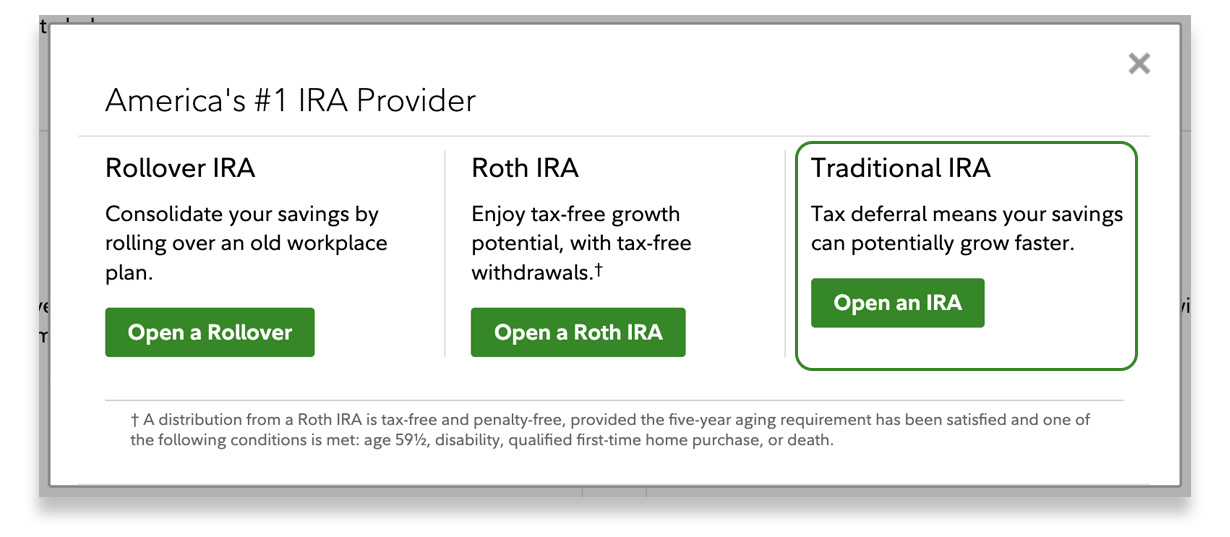
Step 1: Choosing the Right Custodian for Your IRA
The first and perhaps most important decision you will make is selecting a custodian. A custodian is the financial institution—usually a brokerage firm, bank, or credit union—that holds your IRA assets and ensures all transactions comply with IRS regulations.
Evaluating Brokerage Platforms
In the modern financial landscape, most investors opt for online brokerages. When comparing platforms, consider the following factors:
-
Fees and Commissions: Look for “no-transaction-fee” mutual funds and commission-free ETF trading. Most major brokerages have moved toward zero-commission models for stocks and ETFs, which is a major benefit for small-scale investors.
-
Investment Selection: Ensure the custodian offers a wide range of assets, including low-cost index funds, target-date funds, individual stocks, and bonds.
-
User Experience and Tools: If you are a hands-on investor, you might prefer a platform with robust research tools and technical charts. If you prefer a “set it and forget it” approach, a robo-advisor that automatically rebalances your portfolio might be more appropriate.
-
Customer Support: Retirement planning often involves complex questions regarding rollovers and tax forms. Having access to reliable customer service can be invaluable.
The Application Process
Once you have selected a custodian, you will need to provide specific personal information to open the account. This typically includes:
-
Your Social Security Number (SSN).
-
Your current employment information.
-
Bank account details (for funding the IRA).
-
Beneficiary designations (who will inherit the account in the event of your passing).
Most applications can be completed online in under 15 minutes. Once the account is approved, you are ready to move to the funding phase.
Step 2: Understanding Contribution Limits and Tax Deductibility
Before you transfer your first dollar, you must understand the rules governing how much you can contribute and how those contributions affect your taxes. The primary appeal of a Traditional IRA is the ability to contribute “pre-tax” dollars, which reduces your taxable income in the year you make the contribution.
Annual Contribution Caps
The IRS sets annual limits on how much you can contribute to an IRA. For 2024, the limit is $7,000 for individuals under age 50. If you are 50 or older, you are eligible for a “catch-up” contribution, bringing your total limit to $8,000. It is important to note that these limits apply to the total of all your IRAs; you cannot contribute $7,000 to a Traditional IRA and another $7,000 to a Roth IRA in the same tax year.
The Nuance of Tax Deductibility
While anyone with earned income can contribute to a Traditional IRA, not everyone can deduct those contributions from their taxes. If you or your spouse are covered by a retirement plan at work (like a 401(k)), your ability to deduct contributions depends on your Modified Adjusted Gross Income (MAGI).
-
If you have a workplace plan: The deduction begins to phase out once your income hits a certain threshold. For single filers in 2024, the phase-out starts at $77,000 and disappears entirely at $87,000.
-
If you do NOT have a workplace plan: You can typically deduct the full amount of your contribution regardless of your income level, provided your spouse does not have a plan either.
Funding Your Account
You can fund your Traditional IRA in several ways:
-
Electronic Transfer (ACH): Linking your checking or savings account for a one-time or recurring transfer.
-
Rollover: Moving funds from an old 401(k) or another qualified retirement plan into your new IRA. This is a common way for investors to consolidate their retirement savings without triggering a tax penalty.
-
Check Mailing: While less common today, most custodians still accept physical checks for account funding.
Step 3: Selecting Your Investment Strategy
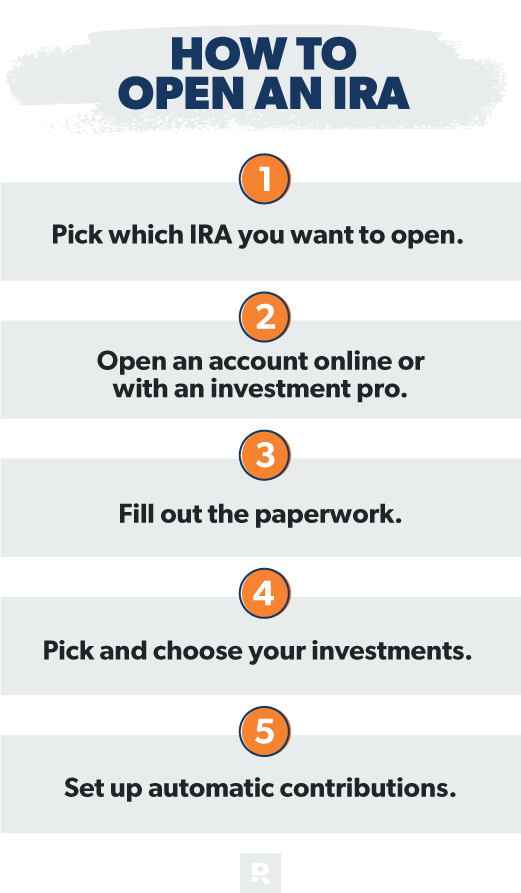
Opening and funding the account is only half the battle. Money sitting in an IRA as “cash” will not grow. You must actively select investments to put that money to work. Your investment strategy should be dictated by your time horizon (how many years until retirement) and your personal risk tolerance.
Asset Allocation: The Foundation of Growth
Asset allocation refers to how you divide your portfolio among different asset classes, such as stocks, bonds, and cash equivalents. Generally, younger investors can afford to be more aggressive, with a higher percentage of their portfolio in stocks (equities) to capture long-term growth. As you approach retirement, you may shift toward bonds (fixed income) to protect your capital from market volatility.
Low-Cost Index Funds and ETFs
For the majority of individual investors, low-cost index funds or Exchange-Traded Funds (ETFs) are the most efficient way to build wealth. These funds track a specific market index, such as the S&P 500, providing instant diversification across hundreds of companies. Because they are passively managed, their expense ratios (annual fees) are significantly lower than actively managed mutual funds, leaving more money in your pocket to compound over time.
Target-Date Funds
If you find the prospect of picking individual funds daunting, consider a Target-Date Fund (TDF). You simply select the fund with the year closest to your expected retirement date (e.g., “Target 2055”). The fund manager automatically adjusts the asset allocation over time, moving from aggressive growth to conservative preservation as you get closer to your goal.
The Power of Compounding
The most critical factor in your IRA’s success is time. Because Traditional IRAs offer tax-deferred growth, you do not pay taxes on capital gains or dividends as long as the money stays in the account. This allows your earnings to generate their own earnings, creating a snowball effect that can turn modest monthly contributions into a substantial nest egg over 30 or 40 years.
Step 4: Navigating Withdrawals and IRS Regulations
The Traditional IRA is designed specifically for retirement, and the IRS imposes strict rules to ensure the money is used for that purpose. Understanding these rules is essential to avoid unnecessary penalties.
The 59.5 Rule and Early Withdrawals
Generally, any money you withdraw from a Traditional IRA before the age of 59.5 is subject to a 10% early withdrawal penalty, in addition to regular income tax. There are, however, a few exceptions to this rule, including:
-
Up to $10,000 for a first-time home purchase.
-
Qualified higher education expenses.
-
Certain medical expenses or health insurance premiums while unemployed.
-
Permanent disability or death.
Tax Treatment of Distributions
When you eventually begin taking distributions in retirement, the withdrawals are taxed as ordinary income. This is the “trade-off” for the tax deduction you received when you initially contributed the money. Because your income is often lower in retirement than during your peak earning years, you may end up paying a lower tax rate on that money than you would have when you earned it.
Required Minimum Distributions (RMDs)
You cannot keep money in a Traditional IRA forever. The IRS requires you to start taking distributions once you reach a certain age—currently 73 (as of the SECURE Act 2.0). These are known as Required Minimum Distributions (RMDs). The amount you must withdraw is calculated based on your life expectancy and account balance. Failing to take an RMD can result in a massive tax penalty, often up to 25% of the amount that should have been withdrawn.
Final Strategic Considerations
As you move forward with opening your Traditional IRA, keep the big picture in mind. Financial success is rarely the result of a single brilliant move; it is the result of consistent, disciplined habits.
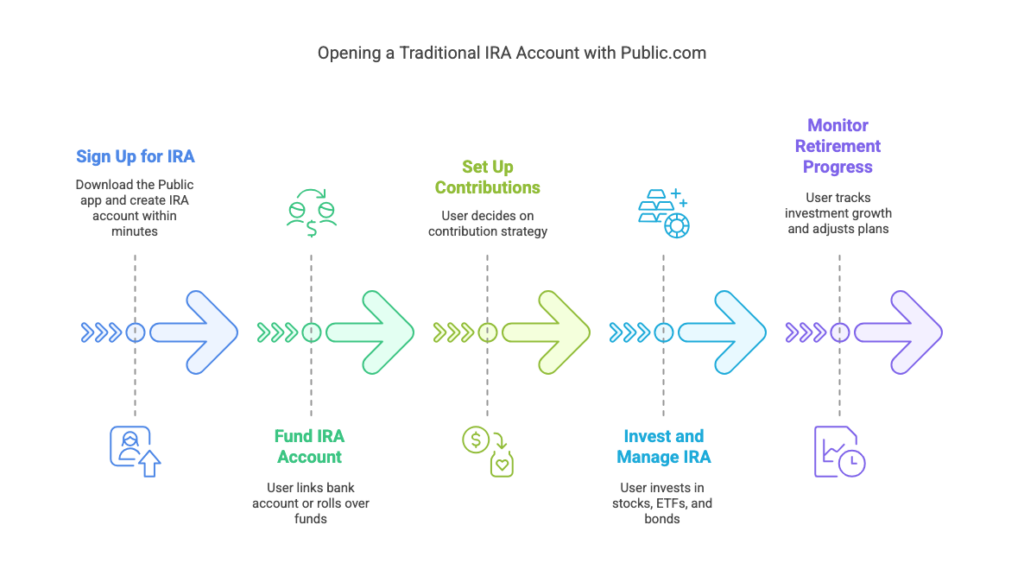
Consider setting up an automatic monthly contribution. By automating your savings, you remove the emotional hurdle of “deciding” to save each month and benefit from dollar-cost averaging—buying more shares when prices are low and fewer when prices are high.
Furthermore, review your IRA at least once a year. As your life circumstances change—marriage, children, career shifts—your retirement strategy may need to evolve. Rebalancing your portfolio annually ensures that your risk level remains aligned with your goals.
Opening a Traditional IRA is a powerful declaration of financial independence. By taking advantage of tax-deductible contributions and the miracle of compounding interest, you are not just saving money; you are building the foundation for a secure, comfortable, and dignified retirement. The best time to start was yesterday; the second best time is today.
aViewFromTheCave is a participant in the Amazon Services LLC Associates Program, an affiliate advertising program designed to provide a means for sites to earn advertising fees by advertising and linking to Amazon.com. Amazon, the Amazon logo, AmazonSupply, and the AmazonSupply logo are trademarks of Amazon.com, Inc. or its affiliates. As an Amazon Associate we earn affiliate commissions from qualifying purchases.