
In the rapidly evolving landscape of electric vehicles (EVs), the question of what is the “newest” Tesla requires a multifaceted answer. While the company frequently iterates on its existing lineup through over-the-air software updates, two major milestones currently define the cutting edge of the Tesla ecosystem: the mass-market rollout of the Cybertruck and the recent hardware and software overhaul of the Model 3, internally known as project “Highland.” Beyond these physical releases, the “newest” version of a Tesla is also defined by the revolutionary Version 12 of Full Self-Driving (FSD) software, which represents a fundamental shift in how artificial intelligence perceives and interacts with the physical world.

The Cybertruck: A Paradigm Shift in Automotive Engineering
The Tesla Cybertruck is arguably the most significant technological departure from traditional automotive manufacturing in decades. It is not merely a new model; it is a laboratory for several first-to-market technologies that Tesla intends to scale across its future fleet.
The Stainless Steel Exoskeleton and Material Science
Unlike traditional vehicles that use a body-on-frame construction or a standard unibody with painted aluminum or steel panels, the Cybertruck utilizes an “Exoskeleton” made of Ultra-Hard 30X Cold-Rolled stainless steel. From a tech perspective, this is a massive undertaking in material science. The alloy is designed to be structural, providing the vehicle’s outer skin with the strength to resist dents and long-term corrosion without the need for traditional paint. This eliminates the environmental impact of paint shops and adds a layer of durability previously unseen in consumer vehicles. However, the rigidity of this material required Tesla to develop new manufacturing techniques, including “air bending” and laser-cutting, as traditional stamping presses would simply break under the tension of the alloy.
Steer-by-Wire and 48-Volt Architecture
Technologically, the Cybertruck’s most hidden but impactful innovations lie beneath the skin. It is the first high-volume production vehicle to implement a completely electronic “steer-by-wire” system. There is no physical steering column connecting the yoke to the wheels. Instead, redundant motors and sensors interpret the driver’s input and adjust the wheel angle based on vehicle speed. This allows for a variable steering ratio: at low speeds, a small turn of the yoke can fully lock the wheels for easy parking, while at high speeds, the sensitivity decreases for stability.
Furthermore, the Cybertruck marks Tesla’s transition to a 48-volt electrical architecture. For nearly a century, the automotive industry has relied on 12-volt systems. By quadrupling the voltage, Tesla can use significantly thinner wiring throughout the vehicle, reducing weight and increasing efficiency. This move is a masterclass in optimization, as it allows for more powerful components (like the steer-by-wire actuators) to operate with less heat and energy loss.
The Model 3 “Highland” Refresh: Refined Tech for the Masses
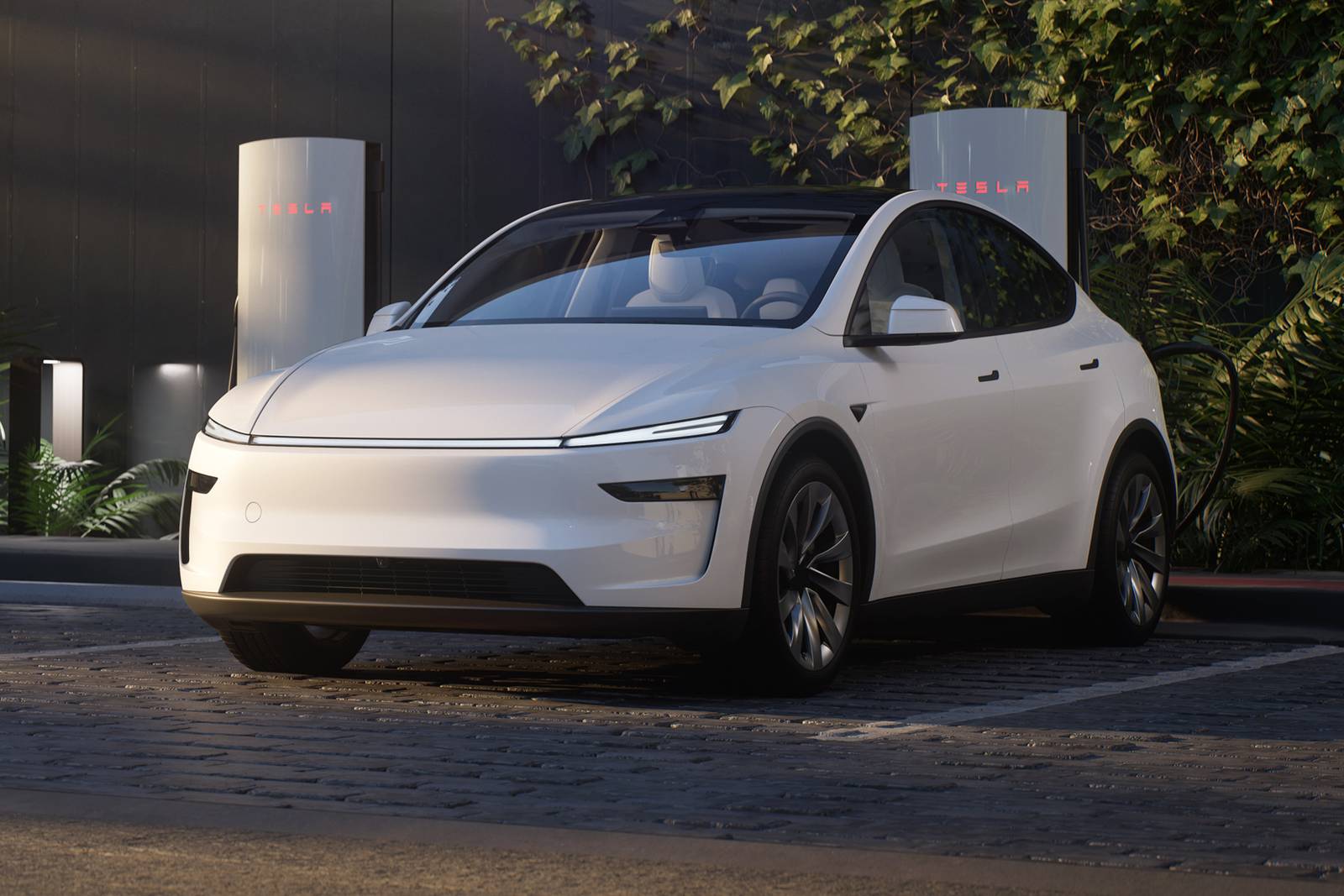
While the Cybertruck captures the headlines for its radical design, the “newest” Tesla for the average consumer is the refreshed Model 3, commonly referred to by its development codename, Highland. This update focuses on quietness, efficiency, and a refined user interface, bringing features previously reserved for the premium Model S and Model X to a more affordable price point.
Interior Tech and the Minimalist UX
The new Model 3 doubles down on the “software-first” philosophy. The most notable change for tech enthusiasts is the removal of physical stalks. Gear shifting is now handled via the central touchscreen (with a backup physical override on the ceiling), and turn signals are integrated as haptic buttons on the steering wheel. While controversial, this move aligns with Tesla’s goal of ultimate automation; the car uses “Auto Shift out of Park” to predict whether the driver intends to go forward or backward based on surroundings.
Inside, the tech experience is bolstered by a new 8-inch rear touchscreen that allows passengers to control climate, seat heating, and entertainment (including Netflix and YouTube) independently of the front screen. This dual-processor setup ensures a lag-free experience, treating the car more like a mobile living room or a high-end computing device than a traditional vehicle.
Efficiency and Acoustic Engineering
From a hardware engineering standpoint, the Highland refresh improved the vehicle’s drag coefficient to 0.219 Cd, making it the most aerodynamic Tesla ever built. This wasn’t achieved through engine tweaks but through meticulous digital modeling of airflow. Additionally, the introduction of 360-degree acoustic glass—which includes the rear windows and back glass—coupled with improved suspension bushings, addresses one of the primary criticisms of earlier Tesla models: cabin noise. The result is a tech-heavy vehicle that finally matches the interior serenity of legacy luxury brands.
Software as the Core: FSD v12 and the Neural Network Revolution
To discuss the newest Tesla without mentioning the software would be to miss the heart of the company’s value proposition. Tesla’s “newest” product is arguably Full Self-Driving (FSD) Version 12, which began wide release in late 2023 and early 2024. This version represents a “tectonic shift” in AI development.
The Shift to End-to-End Neural Networks
Previously, FSD relied on hundreds of thousands of lines of human-coded C++ logic. Engineers wrote rules such as “if a stop sign is detected, decelerate at X rate.” FSD v12 has discarded this heuristic approach in favor of “end-to-end neural networks.” The system was trained on millions of video clips of human driving behavior.
Instead of being told what a stop sign is, the AI learned by watching how humans interact with the world. It processes visual data from the cameras and outputs control commands (steering, braking, acceleration) directly. This “imitation learning” allows the car to handle complex, unmapped scenarios—like navigating around construction cones or yielding to a pedestrian in a nuanced way—that were nearly impossible to program manually. For the user, this means the newest Tesla drives with a “human-like” smoothness that previous iterations lacked.
The User Interface and Connectivity Ecosystem
Tesla’s V12 software update also introduced a refreshed UI for the Cybertruck and the New Model 3. It features high-fidelity 3D renderings of the surrounding environment, utilizing the car’s powerful onboard computer to visualize every vehicle, pedestrian, and traffic light in real-time. This isn’t just aesthetic; it builds “trust through transparency,” showing the driver exactly what the AI sees. With integrated support for high-bandwidth gaming, Zoom calls using the internal cabin camera, and a seamless mobile app that acts as the primary key, the Tesla ecosystem continues to function more like a smartphone on wheels than a traditional mechanical transport.
Looking Ahead: The Cybercab and the Autonomous Vision
While the Cybertruck and Model 3 Highland are the newest Teslas available to purchase today, the company’s recent “We, Robot” event introduced the next technological frontier: the Cybercab. This vehicle represents the absolute “newest” iteration of Tesla’s design language and autonomous philosophy, though it is currently in the pre-production phase.
Induction Charging and the Buttonless Future
The Cybercab is designed without a steering wheel, pedals, or even a charging port. It relies entirely on inductive (wireless) charging, a tech-forward solution that eliminates the need for robotic arms or human intervention to plug in a cable. This is a crucial step for a future fleet of autonomous robotaxis that can manage their own energy levels.
The vehicle is built on a “Vision-Only” architecture, eschewing expensive LiDAR sensors in favor of high-resolution cameras and massive compute power. This hardware choice is a gamble on the power of AI; Tesla believes that since humans drive using vision and biological neural networks, a car can do the same with digital cameras and silicon-based neural networks. The Cybercab serves as a bellwether for the “unboxed” manufacturing process, where the car is assembled in sub-sections simultaneously to reduce costs and increase throughput.

The Competitive Landscape: How Tesla’s Latest Tech Maintains the Edge
In the broader tech market, Tesla’s newest releases are often compared to the transition from feature phones to smartphones. While traditional automakers (OEMs) are catching up in terms of battery range and motor performance, Tesla remains the leader in “software-defined vehicle” architecture.
Most legacy vehicles have dozens of Electronic Control Units (ECUs) from various suppliers that rarely communicate with one another. Tesla’s newest models utilize a centralized compute architecture. This allows the company to push updates that can improve everything from the braking distance (via ABS software tweaks) to the efficiency of the heat pump.
The newest Tesla—whether you define it as the rugged Cybertruck, the refined Model 3 Highland, or the latest FSD software—is characterized by its refusal to remain static. By treating hardware as a platform for software innovation, Tesla ensures that even a car purchased today will technically become “newer” over time as its AI capabilities and user interface continue to evolve via the cloud. This intersection of material science, AI-driven autonomy, and centralized computing is what keeps Tesla at the forefront of the global technology conversation.
aViewFromTheCave is a participant in the Amazon Services LLC Associates Program, an affiliate advertising program designed to provide a means for sites to earn advertising fees by advertising and linking to Amazon.com. Amazon, the Amazon logo, AmazonSupply, and the AmazonSupply logo are trademarks of Amazon.com, Inc. or its affiliates. As an Amazon Associate we earn affiliate commissions from qualifying purchases.