
The Dow Jones Industrial Average (DJIA), often referred to simply as “the Dow,” is arguably the most recognized financial index in the world. Since its inception in 1896 by Charles Dow and Edward Jones, it has served as a primary pulse-check for the American stock market. For over a century, investors, journalists, and policymakers have turned to this single number to gauge the health of the economy. However, despite its ubiquity, the actual mathematics behind the Dow is frequently misunderstood. Unlike many modern indices that rely on market capitalization, the Dow utilizes a unique price-weighted methodology that prioritizes the share price of its thirty component companies.
Understanding the Mechanics of Price Weighting
To understand how the Dow is calculated, one must first distinguish between price weighting and market-capitalization weighting. Most modern indices, such as the S&P 500 or the Nasdaq Composite, are market-cap weighted. In those systems, the “weight” or influence of a company is determined by its total market value (share price multiplied by the number of outstanding shares). Consequently, a trillion-dollar company has a much larger impact on the index than a hundred-billion-dollar company.
The Dow Jones Industrial Average operates on a fundamentally different logic. It is a price-weighted index, meaning the companies with the highest share prices have the greatest influence on the index’s movement, regardless of their actual company size or total market value.
The Simple Arithmetic of the Early Years
In the late 19th century, the calculation was straightforward. Charles Dow originally included 12 companies in the index. To find the average, he simply added up the stock prices of those 12 companies and divided the total by 12. This was a literal arithmetic mean. If the sum of the stock prices was $1,200, the Dow stood at 100.
As the index grew to 30 companies in 1928, the basic principle remained the same, but the mathematical complexity increased. The goal was to ensure that the index remained a continuous and reliable benchmark even as the companies within it underwent changes.
The Influence of Share Price
In the modern DJIA, a $1 move in a high-priced stock like UnitedHealth Group or Goldman Sachs has exactly the same impact on the index as a $1 move in a lower-priced stock like Coca-Cola or Verizon. However, because a $1 move represents a much smaller percentage change for a $500 stock than for a $50 stock, the higher-priced stocks naturally “pull” the index more significantly. This quirk of the Dow means that a company’s “importance” in the index is tied directly to its nominal share price, a factor that is often influenced by management’s decisions regarding stock splits.
The Critical Role of the Dow Divisor
The most vital component of the modern Dow calculation is the “Dow Divisor.” If the index were still calculated by simply dividing the sum of the prices by 30, the average would be susceptible to massive, artificial fluctuations whenever a company performed a stock split or was replaced by another firm.
Why the Divisor Changes
When a company performs a stock split—for example, a 2-for-1 split—its share price is cut in half, while the number of shares doubles. In a market-cap weighted index, this event is neutral because the total market value remains the same. However, in a price-weighted index like the Dow, a 50% drop in one stock’s price would cause the entire index to plummet, even though the actual value of the company hadn’t changed.
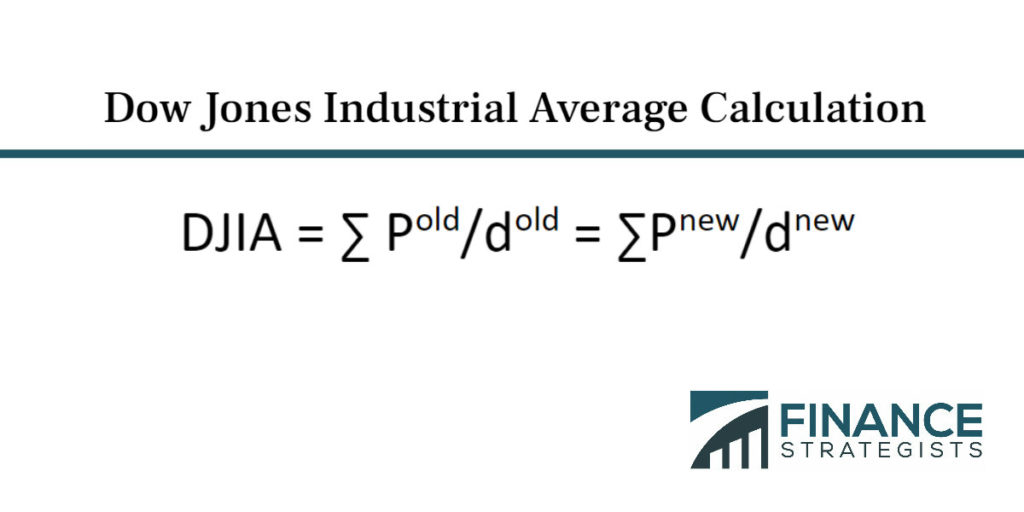
To prevent these mathematical distortions, the “divisor” is adjusted. The divisor is a figure that is used as the denominator in the Dow calculation. Whenever a stock split, a spin-off, or a change in the index components occurs, the S&P Dow Jones Indices (the entity that maintains the index) calculates a new divisor to ensure that the value of the index remains consistent before and after the event.
The Calculation Formula
The formula for the Dow Jones Industrial Average is:
DJIA = Σp / d
Where:
-
Σp is the sum of the stock prices of the 30 component companies.
-
d is the Dow Divisor.

Over the decades, as companies have split their stocks and the index has been rebalanced, the divisor has shrunk significantly. Originally, the divisor was 30 (for the 30 companies). Today, the divisor is a decimal much less than one (often around 0.15 or lower). Because the divisor is so small, a $1 change in the price of any single stock actually results in a move of several points in the index. This mathematical leverage is why we see the Dow move by hundreds of points in a single trading session even when individual stock prices only move by a few dollars.
Component Selection and the Averages Committee
While the math defines the daily movement, the “who” defines the index’s character. The Dow is not a computer-generated list of the 30 largest companies. Instead, the components are selected by a committee.
The Qualitative Approach
The selection process for the DJIA is overseen by the Averages Committee, which includes representatives from S&P Dow Jones Indices and The Wall Street Journal. Unlike the S&P 500, which has strict quantitative eligibility requirements regarding market cap and liquidity, the Dow’s selection process is largely qualitative.
The committee looks for companies that have an excellent reputation, demonstrate sustained growth, and are of interest to a large number of investors. Most importantly, the committee seeks to maintain adequate representation of the various sectors within the U.S. economy. This is why, over time, the index has transitioned from being dominated by heavy industrial, railway, and energy companies to including technology, healthcare, and consumer service giants like Apple, Microsoft, and Salesforce.
Maintaining Continuity
The committee changes the components of the Dow only when necessary. A change might be triggered by a company’s financial distress, a major acquisition, or a shift in the economy that renders a particular industry less representative of the broader market. When a company is removed and a new one is added, the Dow Divisor is adjusted simultaneously so that the index value does not experience a “jump” solely because of the substitution. This ensures that the long-term chart of the Dow remains a continuous reflection of market trends rather than a series of disjointed steps.
Comparative Analysis: DJIA vs. S&P 500
To truly understand the Dow’s calculation, it is helpful to contrast it with its main rival, the S&P 500. These two indices are the primary benchmarks for the U.S. stock market, yet they often tell slightly different stories due to their underlying formulas.
The Concentration Factor
The Dow is highly concentrated, consisting of only 30 stocks. This means it represents a “blue-chip” slice of the economy—the massive, established leaders. The S&P 500, with 500 components, provides a broader look at the equity market. Because the Dow is price-weighted and has fewer components, a massive move in a single high-priced stock can sway the entire index. In the S&P 500, the influence is spread across more companies and is dictated by total valuation.
Corporate Actions and Index Impact
In the S&P 500, if a company decides to issue more shares or buy back its own stock, the index reflects the change in total market value. In the Dow, these actions are largely ignored unless they affect the share price. Interestingly, the Dow’s methodology actually discourages companies from having extremely high share prices. If a company’s stock price rises to $1,000 or $2,000 per share, it would gain an “outsized” influence on the Dow, potentially leading the committee to request a stock split or reconsider the company’s place in the index to maintain balance.

The Modern Relevance of a Century-Old Metric
Critics often argue that the Dow Jones Industrial Average is an antiquated relic. They point out that price-weighting is an arbitrary way to measure the economy and that 30 stocks cannot possibly represent the complexity of the modern global market. However, despite these criticisms, the Dow remains incredibly relevant for several reasons.
First, the Dow is highly correlated with the S&P 500. Despite the differences in calculation, the two indices move in tandem the vast majority of the time. This suggests that the 30 blue-chip stocks selected for the Dow are indeed a powerful proxy for the broader market.
Second, the Dow’s longevity provides a unique historical perspective. It is one of the few benchmarks that allows investors to track economic progress from the industrial revolution through the digital age using a consistent (though adjusted) metric. It captures the “spirit” of the American industrial and commercial landscape in a way that more clinical, data-heavy indices sometimes miss.
Finally, the Dow is the “people’s index.” Because it is expressed in points rather than percentages in most news headlines, it provides a dramatic and easily digestible narrative of the market’s daily wins and losses. Whether it is a 1,000-point drop or a new all-time high, the Dow provides a psychological anchor for the investing public.
In conclusion, the calculation of the Dow Jones Industrial Average is a blend of historical tradition and mathematical adjustment. By utilizing a price-weighted sum and the fluctuating Dow Divisor, the index maintains a bridge between the simple arithmetic of the 19th century and the complex financial environment of the 21st. Understanding this calculation is essential for any investor who wishes to look beyond the headlines and grasp how the world’s most famous barometer actually functions.
aViewFromTheCave is a participant in the Amazon Services LLC Associates Program, an affiliate advertising program designed to provide a means for sites to earn advertising fees by advertising and linking to Amazon.com. Amazon, the Amazon logo, AmazonSupply, and the AmazonSupply logo are trademarks of Amazon.com, Inc. or its affiliates. As an Amazon Associate we earn affiliate commissions from qualifying purchases.