
The Dow Jones Industrial Average (DJIA), often referred to simply as “the Dow,” is arguably the most recognized stock market index in the world. Established in 1896 by Charles Dow and Edward Jones, it serves as a pulse for the American economy. While the index originally consisted of just 12 industrial companies—names like American Cotton Oil and Distilling & Cattle Feeding—it has evolved into a sophisticated collection of 30 “blue-chip” giants. These companies are leaders in their respective industries, representing the broad health of the U.S. equity markets.

Understanding which companies make up the DJIA is more than a trivia exercise for investors; it is a lesson in corporate endurance and economic shifts. Unlike the S&P 500, which tracks 500 of the largest U.S. companies based on market capitalization, the Dow is a price-weighted index. This means that companies with higher share prices exert more influence over the index’s movement than those with lower share prices, regardless of their total market value.
The Current 30: A Sector-by-Sector Breakdown
The composition of the DJIA is curated by a committee at S&P Dow Jones Indices. They select companies that possess an excellent reputation, demonstrate sustained growth, and are of interest to a large number of investors. As of late 2024, the index includes a diverse array of sectors, moving far beyond its “industrial” roots.
Technology and Communications
In the modern economy, technology is the engine of growth. The DJIA reflects this by including some of the most influential tech companies on the planet.
-
Apple Inc. (AAPL): A cornerstone of the consumer tech world, Apple’s influence spans hardware, software, and services.
-
Microsoft Corp. (MSFT): A leader in enterprise software, cloud computing (Azure), and personal computing.
-
NVIDIA Corp. (NVDA): A recent and historic addition, replacing Intel. NVIDIA represents the massive shift toward artificial intelligence and high-performance computing.
-
Salesforce Inc. (CRM): The pioneer of cloud-based Customer Relationship Management (CRM) software.
-
Cisco Systems Inc. (CSCO): A backbone of the internet, providing networking hardware and security.
-
International Business Machines Corp. (IBM): A legacy tech giant that has successfully pivoted toward hybrid cloud and AI.
Financial Services and Insurance
The financial sector is the lifeblood of capital markets, and the Dow’s financial components represent the titans of banking and payments.
-
Goldman Sachs Group Inc. (GS): As one of the highest-priced stocks in the index, this investment banking powerhouse carries significant weight.
-
JPMorgan Chase & Co. (JPM): The largest bank in the United States, representing commercial and retail banking.
-
American Express Co. (AXP): A leader in premium credit services and global travel.
-
Visa Inc. (V): A dominant force in global digital payments and transaction processing.
-
The Travelers Companies Inc. (TRV): A leading provider of property and casualty insurance.
Healthcare and Pharmaceuticals
Reflecting the aging population and the critical nature of biotech, healthcare is heavily represented.
-
UnitedHealth Group Inc. (UNH): Often the most influential stock in the Dow due to its high share price, it represents healthcare insurance and services.
-
Johnson & Johnson (JNJ): A healthcare conglomerate specializing in pharmaceuticals and medical devices.
-
Merck & Co. Inc. (MRK): A global leader in innovative health solutions and life-saving medicines.
-
Amgen Inc. (AMGN): A pioneer in biotechnology, focusing on serious illnesses with limited treatment options.
Consumer Discretionary and Staples
These companies reflect the spending habits of the American consumer, from daily necessities to luxury items and entertainment.
-
Amazon.com Inc. (AMZN): A recent addition that replaced Walgreens, Amazon represents the total dominance of e-commerce and cloud infrastructure.
-
Walmart Inc. (WMT): The world’s largest retailer, serving as a bellwether for the domestic consumer economy.
-
The Coca-Cola Company (KO): A classic “defensive” stock with a global footprint in the beverage industry.
-
The Procter & Gamble Company (PG): The parent company of brands like Tide and Gillette, representing consumer staples.
-
Home Depot Inc. (HD): The leader in home improvement and a key indicator of the housing market’s health.
-
McDonald’s Corp. (MCD): A global fast-food giant and a massive player in international real estate.
-
Nike Inc. (NKE): The world’s leading designer and marketer of athletic footwear and apparel.
-
The Walt Disney Company (DIS): A media powerhouse spanning theme parks, film studios, and streaming services.
Industrials, Energy, and Materials
These sectors represent the traditional “industrial” roots of the index, though even these companies are now highly digitized.
-
Boeing Co. (BA): Despite its recent challenges, Boeing remains a critical player in global aerospace and defense.
-
Caterpillar Inc. (CAT): A global leader in construction and mining equipment.
-
Honeywell International Inc. (HON): A diversified technology and manufacturing company.
-
3M Company (MMM): Known for scientific innovation and a vast array of industrial and consumer products.
-
Chevron Corp. (CVX): The sole energy representative in the Dow, reflecting the global oil and gas market.
-
Sherwin-Williams Co. (SHW): A recent addition (replacing Dow Inc.) that highlights the importance of the building materials and coatings industry.
-
Verizon Communications Inc. (VZ): Representing the telecommunications infrastructure of the United States.
The Mechanics of the Dow: Price-Weighting Explained
To truly understand what these companies mean to the index, an investor must grasp the “Dow Divisor.” Unlike most indices that are weighted by market cap (where a company’s total value determines its impact), the DJIA is price-weighted.
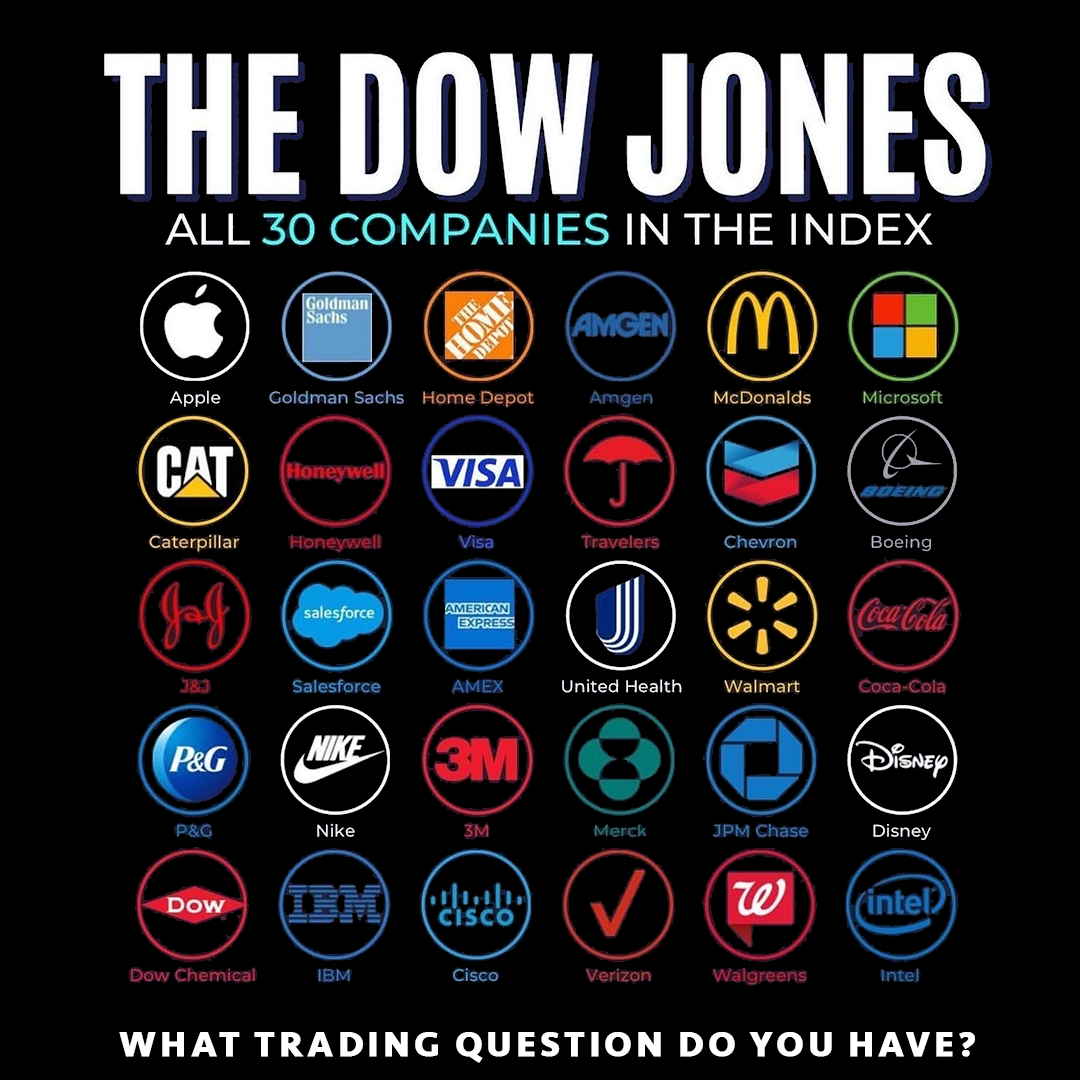
In a price-weighted system, if Stock A trades at $400 and Stock B trades at $40, a 1% move in Stock A will have ten times the impact on the index as a 1% move in Stock B. This is why UnitedHealth Group or Goldman Sachs often “move the Dow” more than Walmart or Coca-Cola, even if the latter companies have massive market capitalizations.
When a company in the index undergoes a stock split, its price drops, which would theoretically lower the index. To prevent this, the “Dow Divisor” is adjusted. The divisor is a mathematical constant used to maintain the continuity of the index. As of late 2024, the divisor is a decimal number significantly less than one, meaning that a $1 change in any component’s stock price translates into a much larger point move for the index.
How Companies Are Selected for the Dow
Becoming one of the “Dow 30” is an elite distinction. There are no hard-and-fast quantitative rules for inclusion, unlike the S&P 500’s strict market cap and profitability requirements. Instead, the selection process is somewhat subjective, managed by the Averages Committee.
The committee looks for companies that are “blue-chip”—a term borrowed from poker, where blue chips have the highest value. They seek companies that have a large following among investors and a long history of success. Industry representation is also a key factor; the committee strives to ensure the 30 companies reflect the current weight of sectors within the broader U.S. economy.
This is why we have seen significant turnover in recent years. The removal of General Electric (GE) in 2018—the last original member of the index—marked the end of an era. It was replaced by Walgreens Boots Alliance, which has since been replaced by Amazon. These changes signify the transition from a manufacturing-heavy economy to one driven by services, technology, and e-commerce.
The Significance of the DJIA for the Modern Investor
Critics often argue that the Dow is “too small” to be a reliable indicator because it only tracks 30 companies. They suggest the S&P 500 or the Nasdaq Composite provide a better picture of the market. However, the DJIA remains highly relevant for several reasons:
-
Concentrated Quality: By focusing on 30 massive, stable companies, the Dow serves as a proxy for the “stability” of the American corporate landscape. These are often the companies that pay consistent dividends and weather economic downturns more effectively than smaller firms.
-
Psychological Impact: Because the Dow has been around for over a century, it is the primary index quoted on evening news broadcasts. Its “points” are a psychological benchmark for the general public’s perception of economic prosperity.
-
Low Volatility: Because it lacks the thousands of small-cap or speculative stocks found in other indices, the Dow often exhibits lower volatility. For conservative investors, the companies within the Dow represent the “Goldilocks” of investing: large enough to be safe, yet innovative enough to grow.
For those looking to invest in these companies, the most common path is through an Exchange-Traded Fund (ETF) like the SPDR Dow Jones Industrial Average ETF Trust (DIA), often called “Diamonds.” This allows an investor to own a piece of all 30 companies in a single transaction, mirroring the performance of the index.

The Evolution of the Index: From Smokestacks to Semiconductors
The list of companies in the DJIA is never static. It is a living document of American capitalism. The recent inclusion of NVIDIA and Amazon highlights a pivotal moment where the index has fully embraced the digital age. By adding NVIDIA, the committee acknowledged that semiconductors and AI are now as fundamental to the global economy as steel and oil were 100 years ago.
As the economy continues to shift toward renewable energy, biotechnology, and artificial intelligence, the roster of the 30 companies will continue to change. What remains constant is the Dow’s role as the definitive list of the companies that define our era. For anyone interested in personal finance and business history, the DJIA isn’t just a list of stocks—it is the story of how the world’s largest economy builds, innovates, and grows.
aViewFromTheCave is a participant in the Amazon Services LLC Associates Program, an affiliate advertising program designed to provide a means for sites to earn advertising fees by advertising and linking to Amazon.com. Amazon, the Amazon logo, AmazonSupply, and the AmazonSupply logo are trademarks of Amazon.com, Inc. or its affiliates. As an Amazon Associate we earn affiliate commissions from qualifying purchases.