
In the world of real estate and personal finance, information is the most valuable currency. For those looking to build wealth through property acquisition, the Multiple Listing Service (MLS) represents the ultimate vault of data. It is the primary tool used by real estate professionals to list properties, share data, and facilitate transactions. However, because the MLS is a private database managed by regional boards of realtors, it is not openly accessible to the general public in its raw form. Gaining access requires either professional credentials or strategic partnerships. For the savvy investor or the financially conscious homebuyer, understanding how to navigate these gates is essential for securing the best deals and maximizing return on investment (ROI).
Understanding the Financial Value of MLS Access
Before diving into the “how,” it is critical to understand the “why” from a financial perspective. The MLS is not just a list of houses for sale; it is a comprehensive database of historical sales data, tax records, property dimensions, and detailed descriptions that public-facing sites like Zillow or Redfin often aggregate with a significant time lag or incomplete data.
What is the MLS and Why is it the Gold Standard for Data?
The MLS is a suite of approximately 600 regional databases where real estate brokers share information about properties they are representing. From a financial standpoint, the MLS provides “real-time” data. In a competitive market, a few hours can be the difference between securing a cash-flowing rental property and losing it to a rival bidder. The data within the MLS includes “Coming Soon” listings, expired listings (which are goldmines for investors looking for motivated sellers), and detailed “Comps” (comparative market analysis) that allow you to value a property with surgical precision.
The Cost-Benefit Analysis of Real-Time Information
For a serious investor, the cost of not having MLS access can be measured in thousands of dollars. Public platforms often lack the “Agent Notes” section, which might contain vital financial information such as the seller’s motivation, specific repair needs, or preferred closing timelines. Having direct access allows you to bypass the noise and move directly to the financial core of a deal. By seeing exactly what properties sold for—rather than just the listing price—you can build more accurate financial models for your portfolio.
Traditional Paths to Entry: The Licensed Professional Approach
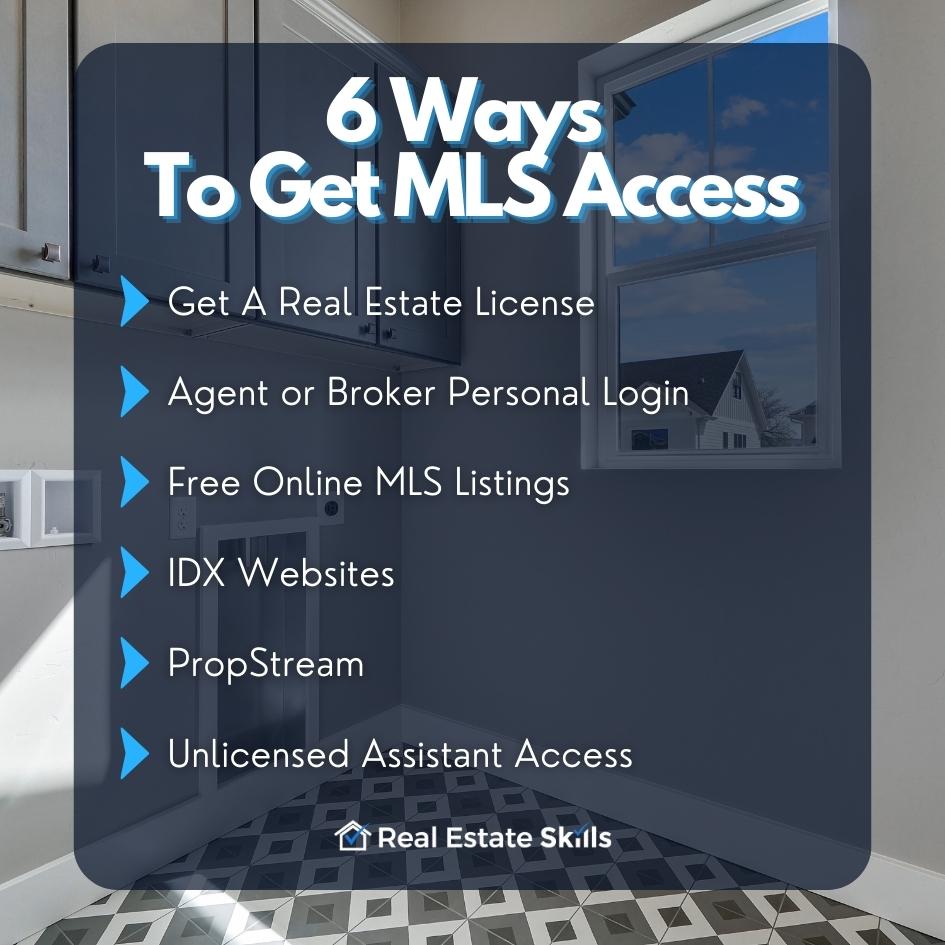
The most direct way to gain full, unfettered access to the MLS is to become a licensed real estate professional. While this path requires an upfront investment of time and capital, the long-term financial benefits can be substantial for someone dedicated to real estate as a primary wealth-building vehicle.
Becoming a Licensed Real Estate Agent
To get your own MLS login, you must typically earn a real estate salesperson license in your state. This involves completing a pre-licensing course (usually 60 to 180 hours), passing a state exam, and hanging your license with a sponsoring broker. Once licensed, you can join the National Association of Realtors (NAR) and your local real estate board, which grants you access to the regional MLS.
For a career investor, this is a strategic move. Beyond MLS access, being a licensed agent allows you to collect commissions on your own purchases. If you buy a $500,000 property, a 2.5% to 3% buyer’s agent commission ($12,500 to $15,000) effectively acts as an immediate discount on your purchase price or additional capital for renovations.
Dues, Fees, and Overhead: Calculating the ROI of a License
However, maintaining a license is not free. You must account for:
-
Pre-licensing education and exam fees ($300–$1,000)
-
Annual Board of Realtors dues ($500–$1,000)
-
Monthly MLS subscription fees ($50–$150)
-
Errors and Omissions (E&O) insurance ($500–$1,000 annually)
-
Brokerage splits or monthly desk fees
If you plan to buy or sell only one property every few years, the overhead of maintaining a license may outweigh the financial benefit. Conversely, if you are scaling a fix-and-flip business or a BRRRR (Buy, Rehab, Rent, Refinance, Repeat) strategy, these costs are a minor business expense compared to the value of the data and commission savings.
Alternative Access for Real Estate Investors and Savvy Financiers
If you do not wish to become a full-time agent, there are several alternative methods to tap into MLS data. These strategies allow you to maintain your focus on investment and financial management without the administrative burden of licensing.
Partnering with Licensed Professionals
The most common way for investors to get MLS data is by building a “Power Team” that includes a dedicated investor-friendly agent. Most MLS systems allow agents to set up automated “Client Portals.” While this doesn’t give you the raw backend access, it sends you real-time alerts the moment a property hitting your specific financial criteria (e.g., price per square foot, zip code, or days on market) is listed.
A sophisticated investor will often negotiate a “Transactional Broker” relationship or a “Buyer’s Agency Agreement” where the agent understands that the investor is a high-volume client. In exchange for the investor’s loyalty and frequent closings, the agent provides deep-dive MLS reports and historical data on demand.
Leveraging Unlicensed Assistant Roles
In many jurisdictions, a licensed agent can hire an unlicensed assistant. Under the agent’s supervision, these assistants can sometimes be granted “administrative access” to the MLS to perform data entry and research. If you are part of a larger investment group or real estate syndicate, having one member of the team licensed as an agent or assistant can provide the entire group with the necessary data flow.
PropTech Solutions: The “Shadow MLS” for Data-Driven Decisions
In recent years, the rise of Property Technology (PropTech) has created a “Shadow MLS” for those who prioritize data over direct listing capabilities. Platforms like PropStream, Privy, and DealMachine aggregate MLS data along with public records, liens, and pre-foreclosure information.
While these tools require a monthly subscription (often ranging from $50 to $200), they are purpose-built for investors. They offer features the standard MLS does not, such as the ability to filter for properties with high equity or owners who have held the property for 20+ years. From a business finance perspective, these tools are often a better investment than a real estate license because they provide actionable lead-generation data rather than just listing access.
Cost-Saving Strategies: Flat-Fee MLS Services
For those looking to sell a property without paying a traditional 6% commission, “Flat-Fee MLS” services offer a unique way to interact with the system. This is a common strategy for “For Sale By Owner” (FSBO) sellers who want to maximize their net proceeds.
How Entry-Only Listings Work for Sellers
A flat-fee or “entry-only” listing service is a licensed brokerage that, for a one-time fee (typically $300 to $500), will list your property on the local MLS. They do not represent you in negotiations, nor do they handle paperwork; their sole function is to provide you with the exposure that only the MLS can offer.
This is a powerful financial move. By listing on the MLS, your property is automatically syndicated to thousands of websites, including Zillow, Realtor.com, and local brokerage sites. This increases competition for your property, which can drive up the final sale price, while simultaneously saving you the 3% listing agent commission.
Navigating the Financial Risks and Rewards of Limited Service
While the savings are clear, the risks involve the lack of professional guidance. You are responsible for your own photography, descriptions, and legal disclosures. From a financial risk management perspective, you must ensure that you are still offering a competitive commission to the buyer’s agent (usually 2.5% to 3%). If you offer 0%, most agents will not show your property to their clients, significantly reducing your pool of buyers and potentially costing you more in “days on market” than you saved in commission.
Maximizing Your Investment Through Data Literacy
Accessing the MLS is only the first step; the true financial advantage comes from knowing how to interpret the data to protect your capital and identify growth opportunities.
Analyzing Market Comparables (Comps) for Valuation
The “Comp” is the cornerstone of real estate valuation. When you have MLS access, you can look at “Pending” and “Sold” data. Looking at what is currently “Active” only tells you what people hope to get for their homes. Looking at “Sold” data from the last 90 days tells you what the market is actually paying.
To maximize your ROI, you should look for “distressed” comps—properties in the same neighborhood that sold for significantly less due to condition. This allows you to calculate the “After Repair Value” (ARV) of a potential investment. If the average renovated home in a zip code sells for $400,000, and you can acquire a fixer-upper for $250,000 with $50,000 in repairs, your MLS data has just helped you identify a $100,000 equity gain.

Using Predictive Analytics to Protect Your Capital
Finally, the MLS allows for a macro-view of market health. By tracking “Absorption Rates” (how long it would take to sell all current inventory at the current pace of sales), you can predict price shifts before they happen. If inventory levels begin to rise and “Days on Market” increase, it is a signal to be more conservative with your offers. Conversely, a drop in inventory suggests a price surge, allowing you to buy aggressively before the general public realizes the market has shifted.
In conclusion, getting access to the MLS is a vital step for anyone serious about real estate as a financial instrument. Whether you choose the path of professional licensing, leverage PropTech tools, or partner with a seasoned agent, the goal remains the same: obtaining high-quality, real-time data to make informed financial decisions. In the high-stakes world of property investment, the person with the best data almost always wins.
aViewFromTheCave is a participant in the Amazon Services LLC Associates Program, an affiliate advertising program designed to provide a means for sites to earn advertising fees by advertising and linking to Amazon.com. Amazon, the Amazon logo, AmazonSupply, and the AmazonSupply logo are trademarks of Amazon.com, Inc. or its affiliates. As an Amazon Associate we earn affiliate commissions from qualifying purchases.