
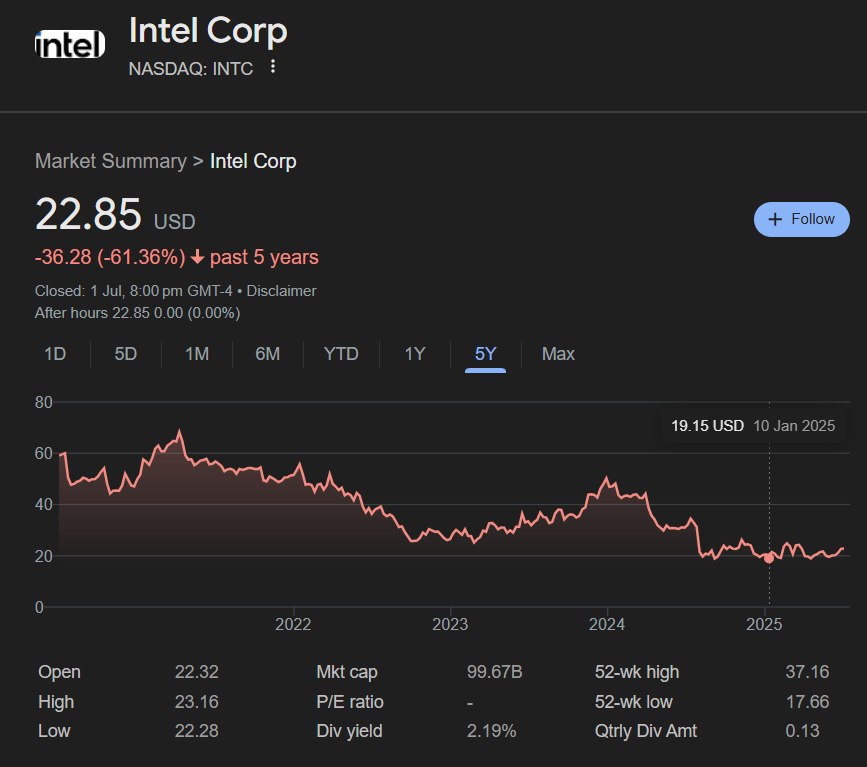
For decades, Intel was the undisputed king of the semiconductor world. It was the blue-chip backbone of many investment portfolios, known for its consistent dividends, dominant market share, and technical superiority. However, the last few years have seen a dramatic reversal of fortune. As of 2024, Intel’s stock price sits at levels that would have been unthinkable a decade ago, significantly underperforming the S&P 500 and trailing far behind its peers in the PHLX Semiconductor Sector (SOX) index.
To understand why Intel stock is so low, investors must look beyond simple market fluctuations. The company’s current valuation is the result of a “perfect storm” of fundamental financial shifts, high-stakes capital expenditures, loss of competitive edge, and a pivot in its core business model that has left Wall Street skeptical.

The Financial Erosion: Declining Margins and the Cost of Transformation
From an investor’s perspective, the most immediate reason for Intel’s low stock price is the deterioration of its fundamental financial metrics. For years, Intel enjoyed gross margins in the 60% range, a hallmark of a company with immense pricing power and manufacturing efficiency. Today, those margins have contracted significantly, often dipping into the high 30s or low 40s.
The Margin Squeeze and Profitability Concerns
The decline in margins is a direct reflection of several internal and external pressures. First, Intel has been forced to compete more aggressively on price to stave off market share gains by AMD. Second, the shift toward newer manufacturing nodes—specifically the move to “five nodes in four years”—is an incredibly expensive endeavor. In accounting terms, the underutilization of older factories and the massive depreciation costs associated with building new ones have weighed heavily on the bottom line.
Investors value companies based on their ability to generate free cash flow. For Intel, free cash flow has turned negative in recent quarters as the company pours tens of billions of dollars into its “IDM 2.0” strategy. When a company stops being a cash cow and starts requiring massive capital injections, the market naturally de-risks by lowering the stock’s valuation.
Revenue Stagnation in Key Segments
While the broader semiconductor market has grown, Intel’s revenue has largely stagnated or declined in its most important segments. The Client Computing Group (CCG), which handles PC processors, has faced a post-pandemic slump in consumer demand. Meanwhile, the Data Center and AI (DCAI) group—once Intel’s crown jewel—has seen revenue contract as cloud service providers shift their spending toward AI-specific hardware, where Intel currently lacks a dominant position.
The Opportunity Cost of Missing the AI Revolution
The stock market is a forward-looking mechanism. Currently, the most powerful driver of equity valuations in the tech sector is Artificial Intelligence (AI). While companies like Nvidia have seen their market caps skyrocket into the trillions, Intel has been largely left behind in the initial AI gold rush.
The Nvidia Dominance and the GPU Shift
The fundamental architecture of data centers is changing. The traditional Central Processing Unit (CPU), where Intel holds the majority of market share, is being sidelined in favor of Graphics Processing Units (GPUs) for training and deploying large language models. Nvidia’s H100 and Blackwell chips have become the industry standard, and Intel’s equivalent offerings, such as the Gaudi line, have struggled to gain meaningful traction or software ecosystem support.
Investors perceive Intel as being “behind the curve.” Even if Intel’s CPUs are still necessary, they are no longer the “high-margin” stars of the show. This perceived obsolescence in the high-growth AI sector has caused a massive rotation of capital out of Intel and into competitors who are better positioned to capture AI-related capital expenditures.
Data Center Market Share Shifts
It isn’t just Nvidia causing Intel’s stock to languish. AMD, Intel’s long-time rival in the x86 space, has made significant inroads into the data center market with its EPYC line of processors. By leveraging TSMC’s superior manufacturing nodes over the last five years, AMD was able to offer better performance-per-watt than Intel’s Xeon processors. This loss of market share is particularly painful for Intel because the data center market is where the highest margins are found. When a company loses the “high ground” in its most profitable niche, its stock multiple inevitably contracts.
IDM 2.0 and the High-Stakes Foundry Gamble
Under CEO Pat Gelsinger, Intel has embarked on a radical strategic pivot known as IDM 2.0 (Integrated Device Manufacturing). This plan involves not only design and manufacturing its own chips but also becoming a “Foundry” that builds chips for other companies, including its competitors.
Capital Expenditures and Cash Flow Pressure
Building a world-class semiconductor foundry is perhaps the most capital-intensive endeavor in modern business. Intel is currently building massive “fabs” in Ohio, Arizona, Germany, and Ireland. The price tag for these facilities runs into the hundreds of billions of dollars.
While the U.S. government has provided support through the CHIPS and Science Act, the subsidies only cover a fraction of the costs. To fund this expansion, Intel has had to take on significant debt and divert cash that would otherwise go to shareholders. For many investors, this transition represents a “show me” story. The market is unwilling to reward Intel for its future foundry potential until it sees actual, high-volume external customers signed on and generating revenue.
Competition with TSMC and Samsung
By entering the foundry business, Intel is going head-to-head with Taiwan Semiconductor Manufacturing Company (TSMC), the most efficient and technologically advanced manufacturer in the world. TSMC has spent decades perfecting the pure-play foundry model. Intel, by contrast, has historically only built chips for itself.
There is a significant cultural and operational hurdle in becoming a service-oriented manufacturer for others. Furthermore, potential customers like Apple or Nvidia may be hesitant to rely on Intel—a direct competitor in chip design—to manufacture their proprietary designs. This “conflict of interest” creates a risk premium on Intel’s stock that won’t dissipate until the Intel Foundry Services (IFS) division proves it can maintain a firewall between its design and manufacturing arms.
Investor Sentiment and the Disappearance of the Dividend Safety Net
For a long time, Intel was a “widows and orphans” stock—a safe, reliable dividend payer that investors held for income. That thesis crumbled in early 2023 when Intel slashed its dividend by over 60%, followed by a total suspension of the dividend in 2024 to preserve cash for its turnaround.
The End of an Era for Income Investors
The removal of the dividend caused a mass exodus of institutional and retail investors who held the stock specifically for its yield. When a stock loses its status as an “income play” but hasn’t yet proven itself as a “growth play,” it falls into a valuation vacuum. Without the floor provided by a dividend yield, the stock price became much more volatile and sensitive to every piece of negative news regarding earnings or product delays.
Valuation Ratios and the “Value Trap” Debate
Intel often looks “cheap” on paper. Its Price-to-Book (P/B) ratio is significantly lower than most of its peers, and its Price-to-Sales (P/S) ratio suggests a deep discount compared to the rest of the semiconductor sector. However, many analysts argue that Intel is a “value trap”—a company that appears inexpensive but is cheap for a reason.
A low valuation is only a bargain if the company’s earnings eventually recover. If Intel continues to lose market share and its massive capital investments do not yield a high Return on Invested Capital (ROIC), then the stock isn’t cheap; it’s simply priced for a future of lower relevance.
The Path Forward: What Investors Should Watch
While Intel’s stock is currently low, the story is not over. The company is in the middle of a multi-year turnaround attempt that is essentially a bet-the-company move. To see a recovery in the stock price, several “milestones of confidence” must be met.
Execution Milestones and the 18A Node
Intel’s technological roadmap hinges on its “18A” process node, which is expected to go into production in 2025. If Intel can successfully launch 18A and prove that it has regained “process leadership” over TSMC, the narrative will shift instantly. Achieving parity or superiority in manufacturing would allow Intel to produce more efficient chips at lower costs, restoring its margins and reclaiming market share in the data center.

The Long-term Outlook for the Semiconductor Cycle
The semiconductor industry is notoriously cyclical. We are currently in a period where AI is the only segment seeing massive growth, while PCs and traditional servers are in a lull. If the broader tech market sees a refresh cycle in 2025—driven by Windows 11 upgrades or the emergence of “AI PCs”—Intel stands to benefit significantly as the primary provider of laptop and desktop processors.
Furthermore, the geopolitical push for “geographic diversity” in chip manufacturing plays into Intel’s hands. As the only U.S.-based company with leading-edge manufacturing capabilities, Intel is a strategic asset for Western governments. This “sovereign” value isn’t always reflected in quarterly earnings, but it provides a long-term tailwind that could eventually justify a higher valuation.
In conclusion, Intel’s stock is low because the company is currently a “work in progress” with high capital needs and intense competitive pressure. It has lost its identity as a safe dividend stock and has yet to earn its identity as an AI or foundry leader. For investors, Intel represents one of the most significant “contrarian” bets in the market today: a fallen giant attempting to rebuild its throne from the ground up.
aViewFromTheCave is a participant in the Amazon Services LLC Associates Program, an affiliate advertising program designed to provide a means for sites to earn advertising fees by advertising and linking to Amazon.com. Amazon, the Amazon logo, AmazonSupply, and the AmazonSupply logo are trademarks of Amazon.com, Inc. or its affiliates. As an Amazon Associate we earn affiliate commissions from qualifying purchases.