
Navigating the landscape of tax preparation can be as complex as the tax code itself. For millions of Americans, H&R Block represents a primary gateway to compliance, offering a spectrum of services ranging from simple digital DIY tools to high-touch professional consultations. However, the question of cost is rarely answered with a single figure. Because tax situations are highly individualized, H&R Block utilizes a tiered pricing structure designed to scale with the complexity of a taxpayer’s financial life. Understanding these costs is essential for sound personal financial planning and ensuring that the value received justifies the expense.

Understanding the Structure of Modern Tax Preparation Fees
The pricing philosophy at H&R Block is built upon two distinct delivery channels: DIY Online/Software products and In-Office Professional services. Within these channels, the price is dictated by the forms required to accurately report income, claim deductions, and utilize tax credits. This “pay-for-what-you-need” model means that a student with a single W-2 will pay significantly less than a real estate investor with multiple 1099s and depreciation schedules.
The Factors That Drive Cost
Several variables influence the final invoice. The most significant factor is the volume and type of income reported. Standard employment income is straightforward, but as soon as a taxpayer introduces freelance earnings, capital gains from stock sales, or rental income, the complexity—and the price—increases. Furthermore, the choice between taking the standard deduction or itemizing deductions plays a role. Itemization requires additional schedules, which typically move the user into a higher pricing tier.
Regional and Seasonal Variability
It is also important to note that for in-office services, geography can impact pricing. Operating costs for retail offices in major metropolitan areas like New York City or San Francisco may result in higher base fees compared to rural locations. Additionally, H&R Block often employs dynamic pricing for its digital products. Early filers in January or February may benefit from promotional rates that vanish as the April filing deadline approaches. From a financial management perspective, filing early is not just about getting a refund sooner; it is a strategy to minimize the administrative cost of the filing itself.
The Digital Suite: H&R Block Online Pricing Tiers
For the tech-savvy individual looking to optimize their personal finances, H&R Block’s online platform is the most cost-effective route. The digital suite is divided into four primary tiers, each catering to different financial profiles.
The Free Online Edition
The “Free” tier is designed for those with the simplest financial footprints. This typically includes individuals whose income is limited to W-2 earnings, interest income (1099-INT), and those who do not intend to itemize. Notably, H&R Block’s free version often includes more forms than some competitors, such as the ability to claim the Earned Income Tax Credit (EITC) and student loan interest deductions without upgrading. However, it does not support more complex scenarios like HSA contributions or small business income.
Deluxe and Premium Tiers
As a taxpayer’s financial portfolio grows, so does the need for more robust software. The Deluxe Online version (usually ranging from $35 to $55 for federal filing) is the “sweet spot” for homeowners and those with significant charitable donations or health savings accounts.
The Premium tier (typically $55 to $85) is geared toward investors. If your financial year involved selling stocks, bonds, or cryptocurrency, or if you own rental property, this tier provides the necessary schedules to report these transactions. For the modern investor, the ability to import data from brokerage accounts is a value-add that saves time and reduces the risk of manual entry errors, which can lead to costly audits.
Self-Employed and Small Business
The highest digital tier is the Self-Employed version (typically $85 to $115). This is essential for freelancers, contractors, and side-hustlers who need to file a Schedule C. This version offers guidance on business expenses and depreciation, which are critical for lowering taxable income. Given that self-employment tax can be a significant financial burden, the cost of this software is often viewed as an investment in identifying every possible deduction to protect one’s bottom line.
The Retail Experience: In-Person Filing Costs and Variables
For many, the peace of mind that comes from sitting across from a tax professional is worth a premium. H&R Block’s retail offices provide a “Tax Pro” service where the expert handles the heavy lifting. However, this is the most expensive way to file.
Base Fees and Complexity Add-ons
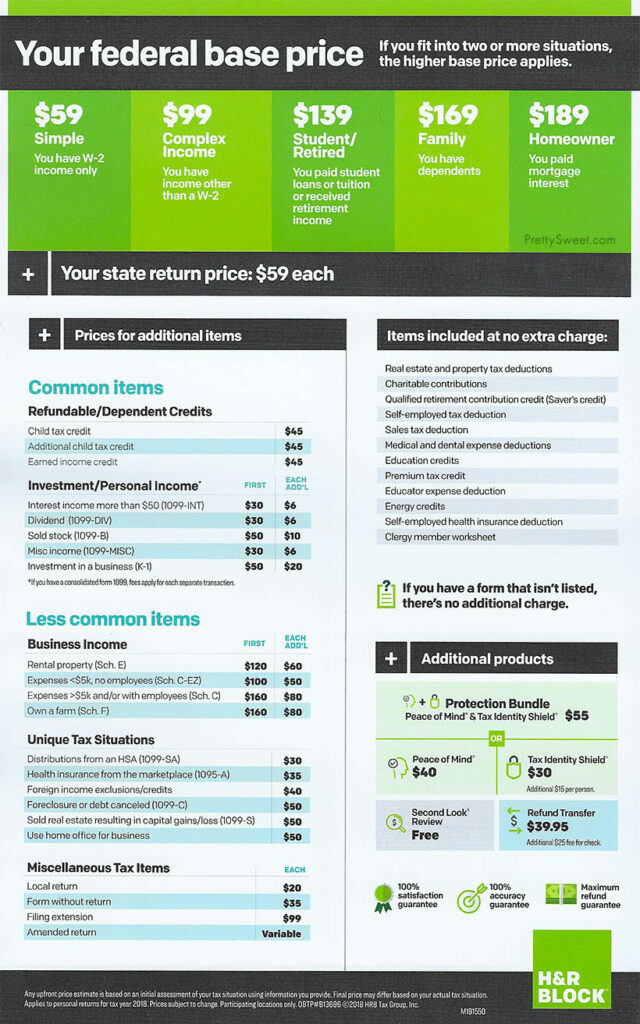
In-person filing does not have a flat fee. Instead, it starts with a base price—often around $80 to $100—and increases based on the number of forms and schedules required. On average, a mid-level taxpayer can expect to pay between $200 and $400 for a professionally prepared return. While this may seem steep compared to the $50 software, the financial logic lies in the professional’s ability to spot nuances that software might miss, potentially saving the taxpayer more than the fee itself.
State Returns: The “Second” Fee
A common point of confusion in tax preparation pricing is the treatment of state returns. Whether filing online or in-person, state returns almost always incur an additional fee. For online users, this fee typically ranges from $37 to $45 per state. For in-person filing, the cost is usually higher. If you lived or worked in multiple states during the year, these fees can stack quickly, making it a vital component to include in your tax-prep budget.
Tax Pro Review
A middle-ground option exists for those who want to use the software but desire a professional “sanity check.” The “Tax Pro Review” add-on allows a certified professional to look over your digital return before it is submitted. This service usually costs an additional $50 to $80 on top of the software price, providing a cost-effective layer of digital security and financial accuracy.
Beyond the Base Fee: Protection, Speed, and Add-ons
H&R Block generates significant revenue through ancillary services. While some of these offer genuine financial protection, others are convenience-based and should be scrutinized based on your personal financial goals.
Peace of Mind® Extended Service Plan
One of the most popular add-ons is the Peace of Mind® (POM) guarantee. For a fee (usually around $40), H&R Block provides representation in the event of an audit and assumes responsibility for interest and penalties resulting from an error made by the preparer. From a risk management perspective, this is essentially a form of “tax insurance.” For those with complex returns that might trigger IRS flags, this fee provides significant psychological and financial security.
Refund Transfer and Speed of Funds
Many taxpayers are eager to access their refund as quickly as possible. H&R Block offers “Refund Transfer” services, which allow the tax preparation fees to be deducted directly from the refund. While convenient because it requires no out-of-pocket payment, this service typically carries a fee of $39 or more.
Additionally, the “Emerald Advance” or “Refund Advance” loans provide a portion of the refund immediately. While these are often marketed as 0% interest loans, it is crucial to read the fine print regarding administrative fees. Using your refund to pay for convenience is a move that technically reduces your total net worth, so those focused on aggressive financial growth may prefer to pay fees upfront and wait for the standard IRS processing time.
Audit Support and Identity Theft
H&R Block also offers “Tax Identity Shield” for around $15 to $20. This service provides assistance in reducing the risk of tax identity theft and provides recovery services if your identity is compromised. In an era of increasing digital vulnerability, this small expense can be a proactive measure in safeguarding your broader financial identity.
The Financial ROI: Is the Cost of H&R Block Worth It?
When analyzing whether H&R Block’s charges are “worth it,” one must look beyond the price tag and consider the Return on Investment (ROI). Tax preparation is not just a recurring bill; it is a critical component of wealth management.
Value for Complex Financial Lives
For a business owner or a high-net-worth individual, a $400 fee for a professional return is a drop in the bucket if that professional identifies $2,000 in missed deductions or provides advice on tax-loss harvesting that offsets capital gains. In these cases, the expertise of a seasoned H&R Block professional acts as a consultant for your personal “Business of One.”
Value for the DIY Filer
For the average W-2 employee, the value of H&R Block lies in its user interface and its “guaranteed maximum refund.” The software is designed to be a financial roadmap, leading the user through a series of questions that ensure compliance while maximizing credits like the Child Tax Credit or the Lifetime Learning Credit. If the software prevents a single error that would have led to an IRS penalty, the $50 to $100 price point becomes a bargain.

The Opportunity Cost of Time
Finally, there is the factor of time. Financial experts often talk about the value of an hour. If it takes an individual ten hours to navigate free IRS forms manually, but only two hours to use H&R Block’s automated systems, the cost of the software is easily offset by the eight hours of time recovered. Whether that time is spent on a side hustle or with family, the “charge” from H&R Block is essentially a purchase of your own time.
Ultimately, H&R Block’s pricing is a reflection of the complexity of the American tax system. By understanding the tiered digital products, the variables of in-person services, and the cost-benefit ratio of various add-ons, taxpayers can make an informed decision that aligns with their overall financial strategy. Whether you are looking for the absolute lowest cost or the highest level of professional protection, knowing exactly what H&R Block charges allows you to navigate tax season with fiscal confidence.
aViewFromTheCave is a participant in the Amazon Services LLC Associates Program, an affiliate advertising program designed to provide a means for sites to earn advertising fees by advertising and linking to Amazon.com. Amazon, the Amazon logo, AmazonSupply, and the AmazonSupply logo are trademarks of Amazon.com, Inc. or its affiliates. As an Amazon Associate we earn affiliate commissions from qualifying purchases.