
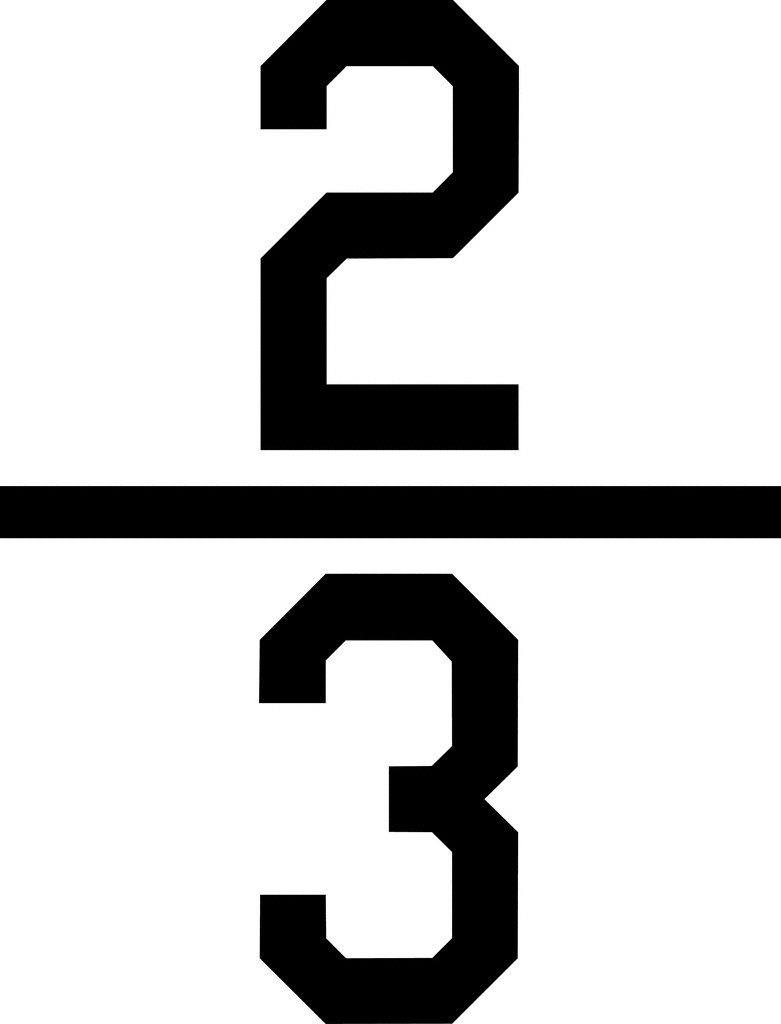
The simple fraction “2/3” might seem like a basic mathematical concept, yet its implications extend far beyond the classroom, holding significant weight in the world of money, finance, and business. At its core, 2/3 represents a proportion—approximately 66.67% of a whole. This seemingly arbitrary figure frequently appears as a critical threshold, a guiding principle, or a mandated requirement across various financial disciplines, influencing decisions from personal budgeting to corporate governance and investment strategy. Understanding “what is a 2/3” in a financial context means recognizing its power as a determinant of control, allocation, majority, and strategic direction.

The Fundamental Concept: A Proportion’s Power
To fully appreciate the financial significance of 2/3, it’s essential to first ground ourselves in its basic definition, then quickly pivot to why this specific proportion holds such sway. It’s more than just a number; it’s a standard of substantial majority, a rule of thumb, and often, a legal or contractual requirement that dictates outcomes.
Mathematical Basis
Mathematically, 2/3 is a proper fraction representing two parts out of an equally divided three-part whole. Converted to a decimal, it’s a repeating 0.666… and as a percentage, it’s 66.66…%. This means that taking 2/3 of something leaves you with a significant majority—more than half, but not quite the entire amount. It signifies a dominant portion without being absolute, often representing a supermajority or a substantial, but not overwhelming, controlling interest. This distinction from a simple majority (over 50%) is critical in many financial and corporate settings.
Significance in Real-World Contexts
The power of 2/3 stems from its role as a decisive threshold. It’s often used when a simple majority isn’t considered robust enough for significant decisions or allocations. In corporate structures, for instance, a 2/3 vote ensures that a substantial consensus, rather than a bare majority, is required for transformative actions like amending bylaws, approving mergers, or selling significant assets. In personal finance, it can represent a practical guideline for income allocation, ensuring that a significant portion of earnings is directed towards essential expenditures while leaving room for savings and discretionary spending. Its pervasive presence across diverse financial scenarios underscores its importance as a critical marker for control, stability, and prudent management.
2/3 in Personal Finance: Budgeting and Wealth Building
For individuals navigating their financial lives, the 2/3 proportion can serve as a powerful tool for structuring budgets, setting ambitious savings goals, and effectively managing debt. While not as rigid as a universally mandated rule, it offers a robust framework for financial discipline and long-term wealth accumulation.
The 2/3 Rule for Budgeting
One common application in personal finance is the “2/3 rule” (or often, the “60/40” or “70/30” rule, where 2/3 falls neatly in between) for allocating income. A popular variant suggests that roughly 2/3 of one’s net income should be allocated to needs and wants, while the remaining 1/3 is dedicated to savings and debt repayment. For example, if you adopt a “2/3 for living, 1/3 for future” philosophy, it means:
-
Two-thirds (66.67%) for “Living Expenses”: This covers housing (rent/mortgage), utilities, groceries, transportation, insurance, and perhaps a reasonable portion for discretionary spending like entertainment or dining out. The idea is to live comfortably within this substantial portion of your income.
-
One-third (33.33%) for “Financial Goals”: This portion is rigorously directed towards high-priority objectives such as retirement savings, building an emergency fund, investing for long-term growth, or aggressively paying down high-interest debt.
This framework provides a clear, actionable guideline that helps prevent overspending on immediate gratification while ensuring consistent progress towards financial independence.
Setting Savings and Investment Goals
Beyond general budgeting, the 2/3 concept can influence specific savings and investment goals. For instance, an individual might aim to save 2/3 of their desired down payment for a home within a specific timeframe, or commit to investing 2/3 of any bonus or windfall received. This proportion acts as an internal benchmark, pushing individuals to direct a substantial majority of available funds towards their future selves. It emphasizes a strong commitment to accumulation, making sure that a significant portion of disposable income contributes directly to wealth creation.
Debt Management Strategies
In debt management, the 2/3 principle can be applied to prioritize repayment. For example, if an individual has multiple debts, they might allocate 2/3 of their extra payment capacity towards the highest-interest debt (following the “debt avalanche” method) or the smallest debt (following the “debt snowball” method), reserving the remaining 1/3 for minimum payments on other obligations. This ensures a concentrated effort to tackle debt aggressively while maintaining good standing on all accounts. It’s about leveraging a significant portion of available resources to accelerate the path to becoming debt-free.

2/3 in Investing and Business Finance: Control and Allocation
When we shift to the realms of investing and business finance, the 2/3 proportion takes on a more formal and often legally binding role. Here, it frequently defines thresholds for control, dictates asset allocation, and structures equity ownership, playing a pivotal role in decision-making and power dynamics.
Majority Control and Corporate Governance
In corporate governance, a 2/3 majority vote (sometimes referred to as a “supermajority”) is a common requirement for passing resolutions deemed critical or transformative. Unlike a simple majority (50% + 1), a 2/3 majority ensures that major decisions have widespread approval from shareholders or board members, preventing a bare majority from imposing changes that might not align with the broader interests of the company or its stakeholders. Examples include:
-
Amending Articles of Incorporation or Bylaws: Fundamental changes to the company’s foundational documents often require a supermajority.
-
Mergers and Acquisitions: Approving a merger, acquisition, or sale of substantial company assets typically demands a 2/3 vote to ensure significant shareholder buy-in.
-
Issuing New Shares: Decisions that dilute existing shareholder equity, such as issuing a large number of new shares, may also require this threshold.
This threshold provides a safeguard against impulsive decisions and empowers minority shareholders to some extent, as their collective dissent can block significant actions even if a simple majority is in favor.
Investment Portfolio Allocation
While asset allocation strategies are highly individualized, the 2/3 proportion can implicitly or explicitly influence portfolio construction, particularly in specialized or conservative approaches. For instance, a conservative investor might decide to allocate 2/3 of their portfolio to stable assets like bonds and blue-chip stocks, reserving 1/3 for growth-oriented or riskier investments. Similarly, a retirement fund might mandate that 2/3 of its assets be held in low-volatility, income-generating securities as an individual approaches retirement age. This systematic allocation ensures that a substantial portion of the capital is aligned with the primary investment objective, whether it’s capital preservation, income generation, or a specific risk profile.
Capital Structure and Equity Distribution
In business financing, the 2/3 fraction can define significant ownership stakes or control points. For example, a venture capitalist might acquire a 2/3 stake in a startup, granting them significant control over the company’s strategic direction and major operational decisions. In a partnership, a 2/3 ownership might come with special voting rights or a disproportionate share of profits, reflecting a greater capital contribution or operational responsibility. When structuring equity, founders might agree that 2/3 of the company’s shares will be held by active members, ensuring that operational control remains primarily with those directly contributing to the business’s day-to-day success, while the remaining 1/3 might be reserved for passive investors or future employee stock options.
Legal and Operational Implications of a 2/3 Threshold
Beyond the financial mechanics, the 2/3 proportion carries substantial legal and operational weight, embedding itself in contracts, articles of association, and various regulatory frameworks to ensure stability, fairness, and robust decision-making.
Voting Rights and Special Resolutions
The requirement for a 2/3 majority vote is a cornerstone of corporate law and non-profit governance worldwide. It’s often stipulated in corporate charters, bylaws, or partnership agreements for “special resolutions” or “extraordinary resolutions.” These resolutions typically involve decisions that have a profound and lasting impact on the entity, such as:
-
Constitutional Amendments: Changing the fundamental rules that govern the organization.
-
Dissolution of the Entity: Winding down the company or organization.
-
Material Asset Sales: Selling off a significant portion of the company’s assets.
-
Changes in Business Scope: Fundamentally altering the nature of the business.
This supermajority acts as a protective mechanism, preventing a simple majority from overriding the interests of a substantial minority and ensuring that truly transformative decisions are backed by a broad consensus.
Partnership Agreements and Profit Sharing
In partnership agreements, the 2/3 rule can dictate not only voting rights but also profit distribution, capital contributions, or responsibilities. For example, a partnership might stipulate that a partner contributing 2/3 of the initial capital receives 2/3 of the profits, or that any decision regarding significant capital expenditure requires the approval of partners representing at least 2/3 of the total ownership. This clarity in defining proportional rights and responsibilities helps prevent disputes and ensures that the operational and financial benefits are aligned with each partner’s commitment and stake.
Contractual Obligations and Contingencies
Within complex contracts, especially those involving multiple parties or significant financial transactions, a 2/3 clause might be inserted as a condition for certain actions or the activation of contingencies. For instance, a loan agreement might state that 2/3 of the collateral must be maintained for the loan to remain in good standing, or that a release from an obligation requires the consent of parties representing 2/3 of the total value of the contract. These provisions introduce a higher bar for triggering or altering contractual terms, providing greater security and stability for all parties involved, ensuring that significant changes are not made lightly or by a slim majority.
In conclusion, “what is a 2/3” in the financial world transcends its basic mathematical definition. It is a critical proportion that imbues decisions with robustness, structures financial allocations, defines control, and safeguards interests across personal finance, investing, business operations, and legal agreements. Recognizing its role is key to understanding the nuanced power dynamics and strategic imperatives that drive financial outcomes in countless scenarios.
aViewFromTheCave is a participant in the Amazon Services LLC Associates Program, an affiliate advertising program designed to provide a means for sites to earn advertising fees by advertising and linking to Amazon.com. Amazon, the Amazon logo, AmazonSupply, and the AmazonSupply logo are trademarks of Amazon.com, Inc. or its affiliates. As an Amazon Associate we earn affiliate commissions from qualifying purchases.