
Understanding the conversion of fractions to decimals is more than a simple mathematical exercise; it’s a foundational skill for astute financial management. In the world of personal finance, investing, and business operations, numbers are the universal language. Being able to quickly and accurately translate concepts like “7/12” into a decimal equivalent unlocks a deeper comprehension of financial proportions, rates, and allocations. The ability to perform such conversions, even for seemingly straightforward fractions, empowers individuals and businesses to make informed decisions, manage budgets effectively, and interpret complex financial data with greater clarity.
The Financial Imperative: Why Fractions and Decimals Matter
At the heart of every financial transaction, investment strategy, or budgeting plan lies a fundamental understanding of numerical relationships. Fractions and decimals are two sides of the same coin, each representing parts of a whole, but offering different perspectives and utilities. While fractions intuitively convey proportional relationships (e.g., “half a budget,” “a quarter share”), decimals provide a standardized, universal format that is essential for precise calculations, comparisons, and digital processing.

Beyond Basic Arithmetic: The Real-World Impact
Consider the myriad ways numbers influence financial outcomes. Interest rates are typically expressed as decimals (e.g., 0.05 for 5%), investment returns are often compared using decimal percentages, and budget allocations are frequently based on proportional shares that translate easily into decimals. Without a firm grasp of these conversions, interpreting financial statements, calculating loan repayments, or assessing the true cost of a discount becomes a daunting task. The seemingly simple query, “what is 7/12 as a decimal,” thus serves as an entry point into a broader discussion about numerical literacy and its indispensable role in achieving financial success and stability. It’s not just about getting the answer; it’s about understanding why that answer is relevant and how it can be applied.
Bridging the Gap: From Abstract Math to Tangible Money
The transition from abstract mathematical concepts to tangible financial applications is crucial. For instance, understanding that 7/12 represents approximately 0.5833 (or 58.33%) allows you to quickly gauge what proportion of a budget, an investment portfolio, or even a workday is being dedicated to a specific category. This immediate comprehension of scale is vital for everything from personal budgeting to corporate financial planning. It helps in visualizing the impact of a particular allocation or in comparing different options when making financial choices. The elegance of decimals lies in their direct comparability and ease of use in further calculations, making them the preferred format for most financial analyses.
Decoding 7/12: Calculation and Financial Significance
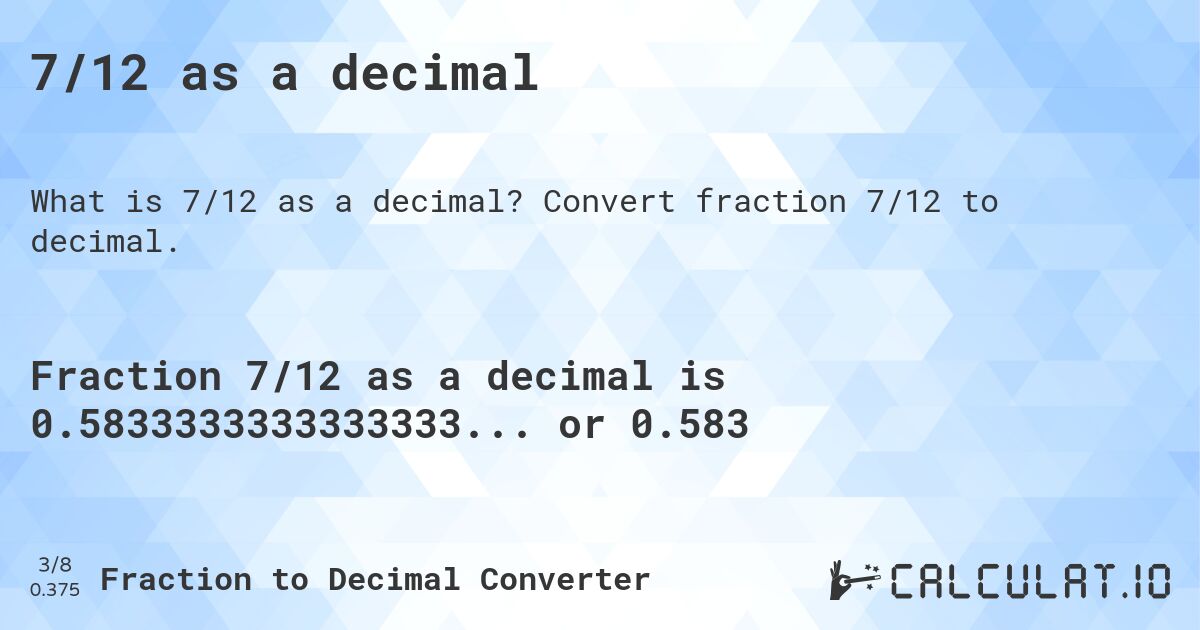
To convert the fraction 7/12 into a decimal, one simply divides the numerator (7) by the denominator (12). This direct operation is the gateway to transforming a relational concept into a precise, quantifiable value that can be easily integrated into financial models and analyses.
The Simple Conversion Process
Performing the division:
7 ÷ 12 = 0.583333…
The result is a repeating decimal. In financial contexts, it’s common practice to round such decimals to a specific number of decimal places, typically two, four, or sometimes more, depending on the required precision. For most practical applications in personal finance, rounding to two or four decimal places is sufficient.
-
Rounded to two decimal places: 0.58
-
Rounded to four decimal places: 0.5833
This numerical value, 0.5833, can also be expressed as a percentage by multiplying by 100, yielding approximately 58.33%. This percentage form is often more intuitive for many financial scenarios, such as discussing a percentage of income, a return on investment, or a proportion of assets.
The Significance of Repeating Decimals in Financial Contexts
The repeating nature of decimals like 0.583333… highlights an important consideration in finance: precision. While convenience often dictates rounding, it’s crucial to understand when high precision is paramount.
-
Interest Calculations: Small differences in interest rates, especially when compounded over long periods or large principal amounts, can lead to significant financial disparities. Using full decimal precision in formulas or financial software is crucial for accuracy.
-
Investment Performance: When comparing investment returns, even fractions of a percentage point can represent substantial sums over time. Analysts often use many decimal places to distinguish between competing investment vehicles.
-
Budgeting vs. Accounting: For personal budgeting, rounding to two decimal places (cents) is usually fine. However, in corporate accounting and financial reporting, precise figures down to multiple decimal places are often required to ensure balance and accuracy across all accounts.
-
Currency Exchange Rates: These are frequently quoted with several decimal places because minute fluctuations can impact large international transactions significantly.
Therefore, while “0.58” or “0.5833” may suffice for a quick understanding of 7/12, the underlying full decimal value is critical in situations where financial exactitude is non-negotiable.
Applying Decimal Knowledge in Personal Finance
The ability to convert fractions to decimals and understand their implications is a cornerstone of sound personal financial management. From day-to-day spending to long-term wealth building, decimals provide the precision needed to make smart choices.
Budgeting and Expense Allocation
Consider a scenario where you decide to allocate 7/12 of your monthly income towards essential living expenses like housing, utilities, and groceries. Knowing that 7/12 is approximately 0.5833 means you are committing about 58.33% of your income. This decimal representation makes it easier to:
-
Calculate Actual Amounts: If your monthly income is $4,000, then 0.5833 * $4,000 = $2,333.20. This precise dollar figure is essential for setting realistic budget limits.
-
Compare Allocations: You can easily compare this 58.33% allocation to recommended financial guidelines (e.g., the 50/30/20 rule) or to previous months’ spending patterns, identifying areas for adjustment.
-
Track Spending: When reviewing bank statements or credit card bills, understanding proportions as decimals helps in categorizing expenses and ensuring adherence to your planned budget.
Comparing Investment Returns and Growth Rates

Decimals are indispensable when evaluating investment performance. Imagine comparing two investment options: one promises a return of “seven-twelfths of a percent” per month, while another offers a flat 0.6% monthly.
-
Converting 7/12% to a decimal: (7/12) / 100 = 0.5833… / 100 = 0.005833…
-
Comparing 0.005833… with 0.006 (0.6% expressed as a decimal).
-
It immediately becomes clear that 0.6% (0.006) is slightly higher than 7/12% (approx. 0.0058), meaning the second investment option offers a marginally better return. This precision can be critical for large investments over long periods.
Understanding Loan Interest and Payment Structures
Loan terms, including interest rates, are universally expressed using decimals. A mortgage rate of 4.5% is 0.045 as a decimal. Calculating monthly interest payments, understanding the principal-to-interest ratio in amortization schedules, and comparing different loan offers all rely heavily on decimal proficiency. Even a slight variation in the decimal part of an interest rate can equate to thousands of dollars over the lifetime of a substantial loan.
Analyzing Discounts and Sales
From retail purchases to bulk investments, discounts are often presented as percentages or fractions (e.g., “save 1/3 off”). Converting these to decimals quickly reveals the actual savings. A “7/12 off” sale, for instance, translates to approximately 58.33% off, a significant markdown that is instantly comprehensible and actionable when presented as a decimal percentage.
The Impact of Decimal Precision on Investing and Business Finance
Beyond personal finance, the precise application of decimals is paramount in the complex landscapes of investing and business finance, where large sums and critical decisions hinge on accurate numerical interpretation.
Stock Market Valuations and Share Prices
Stock prices are quoted in decimals, reflecting the precise value of each share. When analyzing a company’s performance, metrics like Earnings Per Share (EPS) or Price-to-Earnings (P/E) ratios often involve fractions that are immediately converted to decimals for consistency and comparability. Even small decimal shifts in share prices can result in substantial gains or losses for large institutional investors.
Calculating Portfolio Diversification Ratios
Investors often diversify their portfolios across various asset classes (e.g., stocks, bonds, real estate). The allocation to each class is typically expressed as a percentage or decimal. For example, a target allocation might be “7/12 in equities.” This translates to approximately 58.33% of the total portfolio value. Maintaining these precise decimal allocations is crucial for managing risk and optimizing returns according to an investor’s strategy. Deviations from target allocations, whether due to market fluctuations or new investments, are identified and rebalanced based on these decimal ratios.
Financial Ratios and Performance Metrics
Businesses rely on an array of financial ratios—such as current ratio, debt-to-equity ratio, or profit margins—to assess their health, performance, and solvency. These ratios are almost always expressed as decimals. For instance, a profit margin of 0.15 means 15 cents of profit for every dollar of revenue. Understanding how to calculate and interpret these decimal ratios is fundamental for financial analysts, managers, and investors evaluating a company’s prospects. Slight variations in these decimal figures can indicate significant shifts in operational efficiency or financial stability.
Currency Exchange Rates and Global Transactions
In international trade and investing, currency exchange rates are quoted with high decimal precision (e.g., 1 USD = 0.9234 EUR). The value of global transactions, which can run into billions, depends entirely on these exact decimal figures. A difference in the fourth or fifth decimal place can lead to millions in profit or loss on large-scale currency exchanges or international transfers. Businesses engaging in cross-border operations must have a solid grasp of these decimal values to manage foreign exchange risk and ensure profitable transactions.
Leveraging Financial Tools for Decimal Management
While the foundational understanding of converting fractions to decimals is crucial, modern financial management heavily relies on tools that streamline these calculations and enhance precision.
Spreadsheets: The Powerhouse for Financial Calculations
Software like Microsoft Excel or Google Sheets are indispensable for anyone managing finances, from individuals tracking a budget to corporations forecasting revenue. Spreadsheets automatically handle decimal conversions and calculations with high precision, allowing users to:
-
Build Complex Models: Create detailed budgets, investment analysis sheets, or financial statements where multiple calculations rely on accurate decimal arithmetic.
-
Automate Processes: Use formulas to automatically convert fractional inputs, calculate percentages, and round results to desired decimal places, reducing manual errors.
-
Visualize Data: Convert decimal figures into charts and graphs, making financial data more accessible and easier to interpret, identifying trends and anomalies.
Online Calculators and Apps: Convenience and Accuracy
For quick conversions and specific financial tasks, online calculators and dedicated financial apps are incredibly useful. Mortgage calculators, investment return estimators, and currency converters all use decimals extensively. These tools provide instant, accurate results, freeing up users to focus on decision-making rather than manual computation. However, it’s always wise to understand the underlying principles to interpret the output correctly and critically evaluate the assumptions built into these tools.
The Importance of Critical Thinking Even with Tools
While tools greatly assist with decimal management, the human element of critical thinking remains paramount. Understanding “what is 7/12 as a decimal” is not just about the answer (0.5833); it’s about comprehending its meaning and implications in a financial context. Tools can compute, but only informed individuals can interpret, strategize, and make judicious financial decisions based on those computations. A strong conceptual understanding of decimals and their role in finance ensures that technology is used as an aid to intelligence, not a replacement for it.
aViewFromTheCave is a participant in the Amazon Services LLC Associates Program, an affiliate advertising program designed to provide a means for sites to earn advertising fees by advertising and linking to Amazon.com. Amazon, the Amazon logo, AmazonSupply, and the AmazonSupply logo are trademarks of Amazon.com, Inc. or its affiliates. As an Amazon Associate we earn affiliate commissions from qualifying purchases.