
In the intricate world of personal finance, investing, and business, the ability to grasp and apply fundamental mathematical concepts is paramount. Among these, understanding “how to find a fraction of something” stands out as a deceptively simple yet profoundly powerful skill. Far from being a mere academic exercise, this concept forms the bedrock for myriad financial calculations, from budgeting your monthly income to dissecting investment returns and optimizing business profitability.
While percentages often take center stage in financial discussions, they are, at their core, a specific type of fraction—one expressed out of a hundred. Mastering the underlying principle of finding a fraction of a whole allows individuals and entrepreneurs to make more informed decisions, interpret financial data with greater clarity, and ultimately take better control of their financial destiny. This article delves into the practical applications of fractions across the financial spectrum, offering insights into why this basic arithmetic skill is indispensable for anyone navigating the complexities of money.

The Core Concept: Understanding Fractions in Finance
At its heart, a fraction represents a part of a whole. In financial terms, this “whole” could be your total income, an investment portfolio, a company’s revenue, or even the total cost of a project. Learning how to extract a specific portion of that whole, represented as a fraction, is the gateway to precise financial planning and analysis.
What is a Fraction? A Financial Perspective
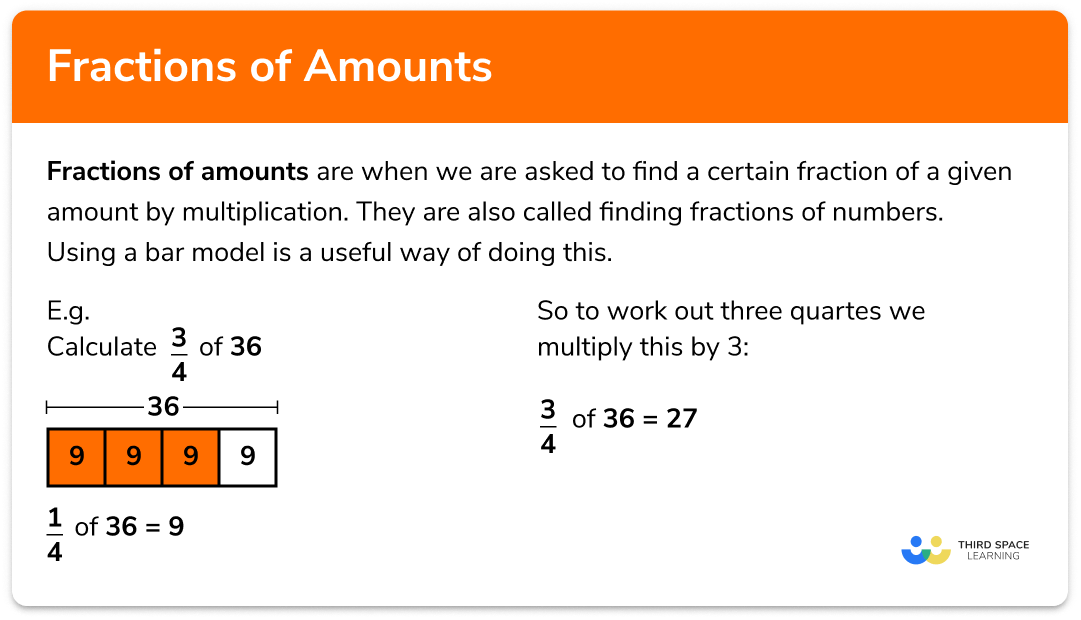
Mathematically, a fraction consists of a numerator (the top number) and a denominator (the bottom number). The denominator tells you how many equal parts the whole is divided into, and the numerator tells you how many of those parts you are considering. For example, if you allocate 1/4 of your income to savings, your income is the “whole,” divided into four equal parts, and you are taking one of those parts for savings.
In finance, fractions are ubiquitous, even if they often appear disguised as percentages or ratios. Understanding 25% of your income is the same as understanding 1/4 of your income. Knowing how to convert between these forms and apply them contextually is a critical skill. The process of finding a fraction of something involves a simple multiplication: multiply the whole amount by the numerator of the fraction, and then divide the result by the denominator. For instance, to find 1/4 of $2,000, you multiply $2,000 by 1 (which is $2,000) and then divide by 4, yielding $500. This straightforward calculation unlocks a wealth of financial insights.
Why Fractions Matter for Your Money
The relevance of fractions extends far beyond basic arithmetic. In finance, they provide a standardized way to compare proportions, allocate resources, and assess performance. Without a clear understanding of fractions, it’s challenging to:
-
Allocate Resources Effectively: How much of your paycheck should go to rent, savings, or discretionary spending? Fractions (or percentages derived from them) provide a framework.
-
Evaluate Investments: What fraction of your portfolio is in high-growth stocks versus stable bonds? How does a stock’s dividend yield, expressed as a fraction of its price, compare to others?
-
Understand Business Metrics: What fraction of sales revenue is profit? What fraction of operating expenses goes to salaries?
-
Negotiate and Plan: From understanding interest rates (a fraction of the principal) to calculating discounts (a fraction off the original price), fractions are integral to everyday financial transactions and long-term planning.
By demystifying fractions, individuals gain a more profound ability to dissect financial information, identify trends, and make decisions that align with their monetary goals.
Practical Applications: Fractions in Personal Finance
Personal finance is perhaps the most immediate arena where the concept of finding a fraction of something becomes a daily necessity. From managing household budgets to planning for future expenses, fractions serve as invaluable tools for gaining control over one’s money.
Budgeting and Income Allocation
One of the most common and crucial applications of fractions in personal finance is budgeting. A budget is essentially a plan for how you will allocate your total income (the “whole”) across various spending categories (the “fractions”). Popular budgeting rules, like the 50/30/20 rule, are direct applications of this concept:
-
50% for Needs: This means 1/2 of your after-tax income should cover essentials like housing, utilities, groceries, and transportation.
-
30% for Wants: This translates to 3/10 of your income for discretionary spending, such as dining out, entertainment, and hobbies.
-
20% for Savings & Debt Repayment: This allocates 1/5 of your income towards building wealth and reducing debt.
To implement such a budget, you must be able to calculate these fractions. If your monthly after-tax income is $4,000, you’d calculate:
-
Needs: 1/2 of $4,000 = $2,000
-
Wants: 3/10 of $4,000 = $1,200
-
Savings/Debt: 1/5 of $4,000 = $800
This systematic approach, driven by fractions, ensures that every dollar has a purpose and helps prevent overspending in one area at the expense of another.
Debt Management and Repayment Strategies
Fractions also play a significant role in managing debt. Understanding what fraction of your income goes towards debt payments can highlight the severity of your debt burden and inform repayment strategies. For example, if your total monthly debt payments (credit cards, loans, etc.) consume 40% (or 2/5) of your income, it indicates a high debt-to-income ratio, which might necessitate aggressive repayment plans or consolidation.
Furthermore, when paying down specific debts, you might decide to allocate an extra fraction of your discretionary income to accelerate repayment. By calculating this additional fraction, you can project how much faster you’ll become debt-free, providing motivation and a clear roadmap.
Saving for Goals
Whether you’re saving for a down payment on a house, a child’s education, or retirement, setting aside a consistent fraction of your income is a highly effective strategy. Instead of saving a fluctuating amount, committing to a percentage (e.g., 10% or 1/10 of every paycheck) creates a disciplined habit.
If you aim to save $50,000 for a down payment in five years and you decide to save 1/8 of your monthly income, you can calculate if this fraction will get you to your goal within the desired timeframe. This requires not only finding the fraction of your income but also projecting it over time, reinforcing the practical utility of this mathematical skill in achieving significant financial milestones.
Fractions in Investing and Wealth Building
The investment world thrives on numbers, ratios, and proportions, making a firm grasp of fractions absolutely critical for savvy investors. From constructing a diversified portfolio to evaluating the performance of assets, fractions provide the lens through which investment opportunities are often viewed and understood.
Portfolio Allocation and Diversification
One of the cornerstones of successful investing is portfolio diversification, which involves spreading your investments across different asset classes (e.g., stocks, bonds, real estate, commodities) to mitigate risk. This strategy is fundamentally an exercise in fractional allocation. An investor might decide to allocate:
-
1/2 of their portfolio to stocks: Aiming for growth.
-
1/3 to bonds: For stability and income.
-
1/6 to real estate or alternative investments: For further diversification.
To implement this, you need to calculate these fractions for your total investment capital. If your portfolio is worth $100,000, then:
-
Stocks: 1/2 of $100,000 = $50,000
-
Bonds: 1/3 of $100,000 = $33,333.33
-
Alternatives: 1/6 of $100,000 = $16,666.67
These fractional allocations are dynamic and can change based on market conditions, risk tolerance, and investment goals. Understanding how to calculate and adjust these fractions is essential for maintaining a balanced and resilient portfolio.

Understanding Returns and Dividends
When you invest, you’re often looking for a return on your capital. This return is frequently expressed as a fraction or percentage of your initial investment. For example, if you invest $1,000 and it grows to $1,100, your return is $100. As a fraction, this is $100/$1,000, or 1/10 (10%).
Similarly, many stocks pay dividends, which are a fraction of the company’s profits distributed to shareholders. A stock’s dividend yield is calculated as the annual dividend per share divided by the share price. If a stock pays an annual dividend of $2.00 and trades at $50 per share, its dividend yield is $2.00/$50.00 = 1/25, or 4%. Comparing these fractional yields allows investors to assess the income-generating potential of different stocks.
Fractional Shares and Accessibility
The rise of commission-free trading and micro-investing platforms has popularized the concept of “fractional shares.” Previously, investors had to buy whole shares of a company, which could be prohibitive for high-priced stocks (e.g., Amazon, Google). Now, you can buy a fraction of a share, allowing you to invest a specific dollar amount (e.g., $50) into a company regardless of its share price.
This innovation democratizes investing by making expensive stocks accessible to more people. It directly leverages the idea of owning a fraction of a company, enabling investors to build diversified portfolios with smaller capital outlays. Understanding how to manage and calculate the value of these fractional holdings is crucial for modern investors.
Business and Entrepreneurial Finance Through Fractions
For entrepreneurs and business owners, fractions are not just useful; they are indispensable for analyzing performance, making strategic decisions, and ensuring financial viability. From calculating profit margins to allocating budgets, fractions provide the quantitative insights needed to steer a business toward success.
Calculating Profit Margins
One of the most fundamental metrics in business is the profit margin, which expresses profit as a fraction of revenue. There are several types:
-
Gross Profit Margin: (Gross Profit / Revenue). This tells you what fraction of each sales dollar is left after subtracting the cost of goods sold.
-
Operating Profit Margin: (Operating Profit / Revenue). This indicates what fraction of revenue remains after covering operating expenses.
-
Net Profit Margin: (Net Profit / Revenue). This shows what fraction of revenue ultimately turns into profit after all expenses, including taxes and interest, are paid.
If a company has $1,000,000 in revenue and $300,000 in net profit, its net profit margin is $300,000/$1,000,000 = 3/10, or 30%. Monitoring these fractions over time and comparing them to industry benchmarks is critical for assessing a business’s efficiency and financial health.
Revenue Sharing and Commissions
Many business models involve revenue sharing or commission structures, which are inherently fractional. Salespeople often earn a commission that is a fraction of the sale price. Partners in a venture might agree to split profits according to predetermined fractions (e.g., one partner gets 2/3, the other 1/3).
Calculating these fractions accurately ensures fair compensation and transparent financial arrangements. For example, if a salesperson makes a $10,000 sale with a 15% commission rate (3/20), they would earn $1,500. For a business, understanding the collective fraction of revenue paid out in commissions is crucial for managing sales costs and overall profitability.
Cost Allocation and Efficiency
Businesses must meticulously track and allocate costs to various departments, projects, or products. Fractions help in this process by determining what proportion of total expenses is attributable to specific areas. For instance, a company might determine that 1/4 of its marketing budget should be allocated to digital advertising, or that 1/10 of its administrative costs are tied to a specific project.
By calculating these fractional allocations, businesses can identify areas of overspending, optimize resource deployment, and make data-driven decisions about where to invest or cut back. This leads to greater operational efficiency and improved financial performance.
Tools and Techniques for Fraction Calculation in Finance
While the core concept of finding a fraction of something is simple, applying it consistently and accurately across diverse financial scenarios benefits from various tools and techniques. These resources can simplify complex calculations and enhance financial decision-making.
Mental Math and Estimation
Developing a facility for mental math with fractions is a powerful skill. Being able to quickly estimate 1/3 of a number, or knowing that 20% is equivalent to 1/5, allows for rapid assessment of financial situations. For instance, when looking at a sale item discounted by “25% off,” being able to quickly calculate 1/4 of the original price in your head can aid in quick purchasing decisions. Similarly, knowing roughly what fraction of your salary goes to taxes provides an immediate sense of your net income.
While not always precise enough for formal accounting, mental estimation with fractions is invaluable for everyday financial interactions, quick budgeting checks, and initial investment analyses.
Using Spreadsheets and Financial Calculators
For more complex and accurate calculations, spreadsheets (like Microsoft Excel or Google Sheets) and financial calculators are indispensable.
-
Spreadsheets: These tools allow you to input financial data, define fractions (or percentages), and automate calculations across multiple rows and columns. For example, you can set up a budget spreadsheet where you input your income, and formulas automatically calculate 1/2 for needs, 1/5 for savings, etc. This is also ideal for projecting investment growth, analyzing profit margins, and managing multiple fractional allocations within a business. Formulas such as
= (fraction_numerator / fraction_denominator) * total_amountmake these calculations straightforward. -
Financial Calculators: Many online or physical financial calculators have functions for percentage calculations, which are direct derivatives of fractions. They can quickly compute a percentage of a number, which is effectively finding a specific fraction. Specialized financial calculators can also handle more advanced scenarios involving interest rates and compounded growth, all of which rely on fractional principles.
These tools reduce the risk of manual error, save time, and provide the precision required for critical financial planning and analysis.
The Power of Percentages (Fractions in Another Form)
It’s crucial to reiterate that percentages are simply fractions with a denominator of 100. Understanding this fundamental link empowers you to switch between these forms seamlessly.
-
From Fraction to Percentage: Divide the numerator by the denominator and multiply by 100. (e.g., 1/4 = 0.25 * 100 = 25%)
-
From Percentage to Fraction: Place the percentage over 100 and simplify. (e.g., 25% = 25/100 = 1/4)
This interchangeability is incredibly useful in finance. Financial reports often use percentages (e.g., “profit margin of 15%”), but sometimes it’s easier to mentally grasp “3/20 of every dollar is profit.” Being adept at converting between the two forms enhances your ability to interpret and communicate financial information effectively. Whether you’re discussing asset allocation with an advisor, analyzing a company’s financial statements, or planning your personal budget, recognizing the fractional nature of percentages unlocks a deeper level of financial literacy.
In conclusion, the simple act of understanding “how to find a fraction of something” is a foundational skill that permeates every aspect of financial life. From the minutiae of personal budgeting to the strategic complexities of investment portfolio management and the critical analyses of business profitability, fractions provide the clarity and precision needed to make informed, impactful decisions. By embracing this core mathematical concept, individuals and businesses alike can unlock greater financial control, cultivate sustainable wealth, and navigate the ever-evolving financial landscape with confidence and insight.
aViewFromTheCave is a participant in the Amazon Services LLC Associates Program, an affiliate advertising program designed to provide a means for sites to earn advertising fees by advertising and linking to Amazon.com. Amazon, the Amazon logo, AmazonSupply, and the AmazonSupply logo are trademarks of Amazon.com, Inc. or its affiliates. As an Amazon Associate we earn affiliate commissions from qualifying purchases.