
Understanding your annual income is one of the foundational steps in personal finance. Whether you’re considering a new job offer, planning a budget, or simply trying to get a clearer picture of your financial standing, converting an hourly wage into an annual salary is crucial. The question, “How much a year is 17 dollars an hour?” seems straightforward, but its answer opens the door to a deeper exploration of financial realities, from take-home pay to budgeting and long-term financial planning.
This article will not only provide the simple calculation but also delve into the nuances that affect your actual earnings and financial well-being. We’ll look beyond the gross figure to consider taxes, deductions, and the practical implications for budgeting and financial growth. By the end, you’ll have a comprehensive understanding of what $17 an hour truly means for your annual income and how to leverage this knowledge for a more secure financial future.
The Simple Calculation: From Hourly to Annual
At its core, converting an hourly wage to an annual salary is a matter of basic arithmetic. However, this calculation relies on a standard set of assumptions about the typical work year. Understanding these assumptions is key to getting an accurate initial figure.
Standard Work Year Assumptions
The most common assumption for a full-time work year is 40 hours per week. When calculating annual income, this weekly figure is then multiplied by the number of weeks in a year. While some professions might have variations, 52 weeks is the standard for annual salary calculations, accounting for all calendar weeks.
-
Hours per week: 40 hours
-
Weeks per year: 52 weeks
Multiplying these two figures gives us the total standard working hours in a year:
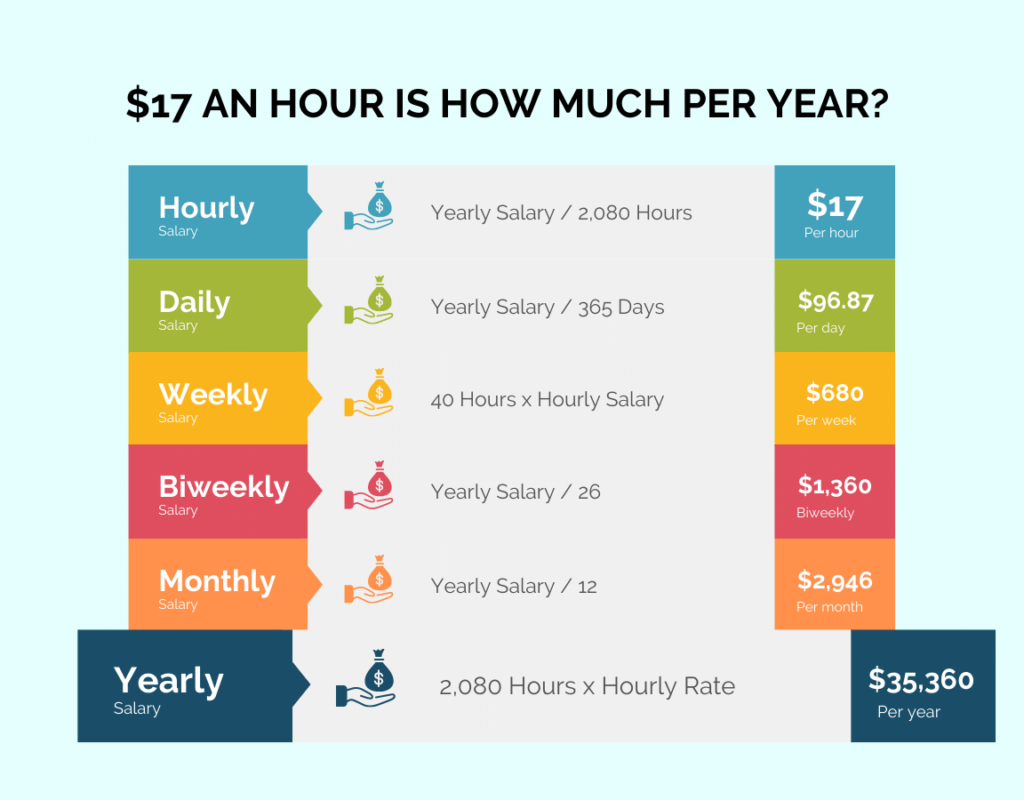
40 hours/week * 52 weeks/year = 2,080 hours/year.
This 2,080-hour figure is a cornerstone for many salary conversions and benefits calculations, providing a consistent baseline for comparison across different employment types.
The Core Formula and Initial Result
With the standard annual working hours established, we can now apply the hourly wage to find the gross annual income.
Formula:
Hourly Wage × Total Annual Working Hours = Gross Annual Income
For an hourly wage of $17:
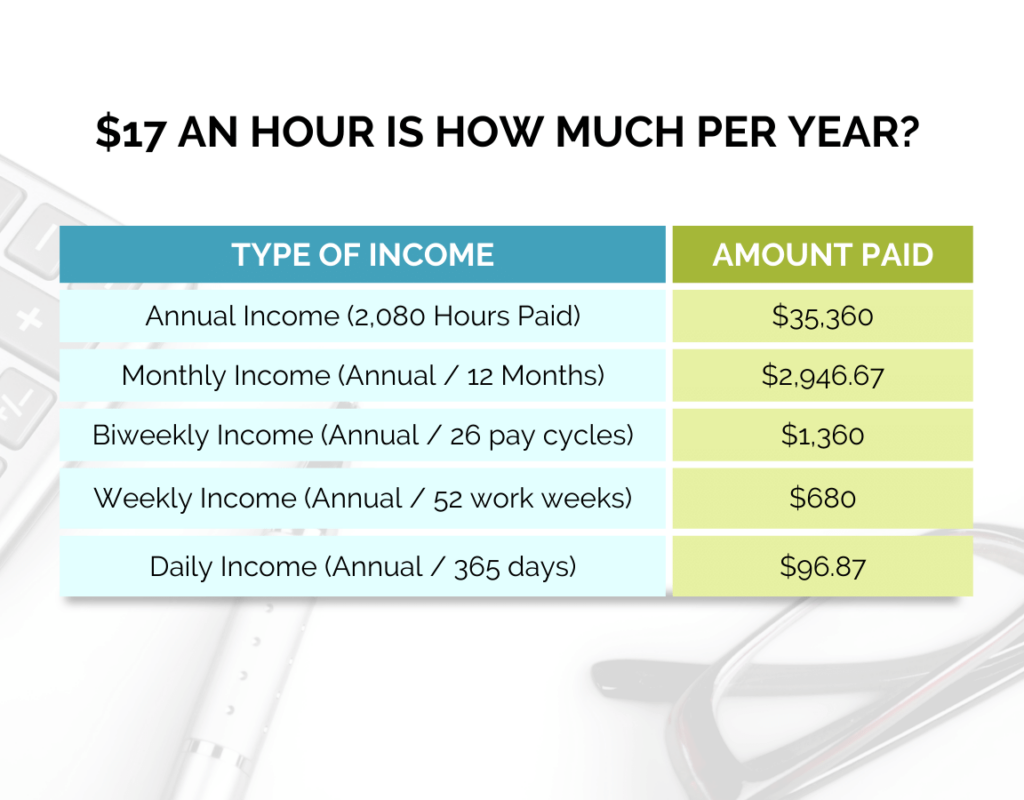
$17/hour × 2,080 hours/year = $35,360 per year
So, on a purely gross basis, earning $17 an hour for a standard full-time work year translates to an annual income of $35,360. This figure represents your income before any deductions, taxes, or contributions are taken out. It’s the starting point for all further financial analysis.
Accounting for Variations
While $35,360 is the standard gross annual income for $17 an hour, it’s important to acknowledge that real-world scenarios can vary.
-
Part-Time Employment: If you work fewer than 40 hours a week, your annual income will be proportionally lower. For example, 20 hours a week would yield half the annual income: $17 * 20 hours/week * 52 weeks/year = $17,680.
-
Overtime Hours: Many jobs offer the opportunity for overtime, typically paid at 1.5 times the regular hourly rate. Regularly working overtime can significantly boost your annual earnings beyond the base calculation. For instance, if you consistently work 5 hours of overtime per week:
-
Overtime pay: 5 hours * $17 * 1.5 = $127.50 per week
-
Additional annual income from overtime: $127.50 * 52 weeks = $6,630
-
Total annual income (with 5 hrs/week overtime): $35,360 + $6,630 = $41,990
-
-
Unpaid Leave or Seasonal Work: Conversely, jobs with frequent unpaid leave, seasonal breaks, or fewer than 52 weeks of work per year will result in a lower annual income. It’s crucial to factor in actual working weeks and hours when making personal financial plans.
-
Paid Time Off (PTO): Most full-time positions include paid holidays, sick days, and vacation time, which are already accounted for within the 52-week calculation. While you’re not physically working, you are still being paid, ensuring the standard 2,080 hours calculation remains accurate for gross pay.
Beyond Gross Pay: Understanding Your True Income
While $35,360 is the gross annual income, it’s not the amount that will land in your bank account. This is where the crucial distinction between gross pay and net pay (or “take-home pay”) comes into play. Various deductions are automatically withheld from your paycheck, significantly impacting your actual disposable income.
The Impact of Taxes
Taxes are perhaps the largest deduction from your gross pay. These contributions fund public services and government operations at various levels.
-
Federal Income Tax: This is a progressive tax, meaning higher earners pay a larger percentage. The amount withheld depends on your total income, filing status (single, married, head of household), and the number of allowances you claim on your W-4 form.
-
State Income Tax: Most states also levy an income tax, though some, like Florida or Texas, do not. State tax rates vary widely and can be flat or progressive.
-
Local Income Tax: Some cities and localities also impose their own income taxes, further reducing your take-home pay.
-
FICA Taxes (Social Security and Medicare): These are mandatory federal taxes that fund Social Security (for retirement, disability, and survivor benefits) and Medicare (for health insurance for seniors and certain disabled individuals).
-
Social Security tax is 6.2% of your gross wages up to an annual limit (which changes yearly).
-
Medicare tax is 1.45% of all your gross wages, with no income limit.
-
Together, FICA taxes represent 7.65% of your income up to the Social Security wage base, and 1.45% on income above that.
-
For someone earning $35,360 a year, let’s estimate the FICA tax alone: $35,360 * 7.65% = $2,704.04.
After estimating federal and potentially state/local taxes, the total tax burden can easily reduce your gross income by 15-25% or more, depending on your location and individual circumstances.
Deductions and Benefits
Beyond taxes, several other deductions can come directly from your paycheck. These often relate to employment benefits that provide significant value.
-
Health Insurance Premiums: If your employer offers health insurance, your share of the premium is typically deducted from your paycheck. This can be a substantial amount, though it’s often a pre-tax deduction, meaning it reduces your taxable income.
-
Retirement Contributions (e.g., 401(k)): Many employers offer retirement plans like a 401(k) or 403(b). Contributions you make to these plans are usually pre-tax, reducing your current taxable income, and grow tax-deferred until retirement. If your employer offers a matching contribution, it’s essentially free money and a crucial part of your overall compensation.
-
Other Pre-Tax Deductions: This can include contributions to a Health Savings Account (HSA) or Flexible Spending Account (FSA), commuter benefits, or life insurance premiums. These deductions reduce your taxable income.
-
Post-Tax Deductions: Some benefits, like certain types of life insurance, union dues, or charitable contributions made through payroll deduction, might be taken out after taxes.
Net Pay vs. Gross Pay – What Really Hits Your Bank Account
After all taxes and deductions, what’s left is your net pay. This is the amount you actually receive in your bank account or as a physical check. For someone earning $35,360 gross, it’s reasonable to expect their net annual income to be somewhere between $26,000 and $30,000, depending heavily on their tax situation, state of residence, and benefit elections.
Understanding your net pay is paramount for realistic financial planning. It’s the true measure of your disposable income, dictating how much you have for living expenses, savings, and discretionary spending.
Budgeting and Living on $35,360 a Year (Gross)
Living on an annual income of approximately $26,000-$30,000 (net) requires careful planning and disciplined budgeting. While challenging in some high-cost-of-living areas, it is absolutely manageable with the right financial strategies.
Creating a Realistic Budget
A budget is your roadmap for managing money. It helps you understand where your money goes and ensures you’re allocating funds effectively. A popular framework is the 50/30/20 rule:
-
50% for Needs: Essential expenses like housing (rent/mortgage), utilities, groceries, transportation, health insurance, and minimum loan payments.
-
30% for Wants: Discretionary spending like dining out, entertainment, subscriptions, hobbies, and shopping for non-essentials.
-
20% for Savings & Debt Repayment: Building an emergency fund, contributing to retirement, investing, and paying down high-interest debt beyond the minimum.
For a net income of $28,000 a year (roughly $2,333 per month):
-
Needs: $1,166 per month
-
Wants: $700 per month
-
Savings/Debt: $467 per month
These are guidelines, and personal circumstances will dictate adjustments. The key is to track your income and expenses to ensure you’re not spending more than you earn.
Key Expenses to Consider
When budgeting, it’s essential to be realistic about your major expenses:
-
Housing: This is often the largest expense. Aim for housing costs (rent/mortgage, utilities) to be no more than 30-35% of your net income. On $2,333 net income per month, this means aiming for around $700-$800 for housing, which might necessitate roommates or living in more affordable areas.
-
Transportation: Car payments, insurance, gas, and maintenance can quickly add up. Public transportation, carpooling, or cycling can be cost-effective alternatives.
-
Food: Groceries, dining out, and snacks. Meal planning and cooking at home are crucial for savings.
-
Utilities: Electricity, gas, water, internet, and phone. Look for ways to conserve energy and shop around for competitive plans.
-
Debt Payments: Student loans, credit card debt, personal loans. Prioritize paying down high-interest debt to free up cash flow.
Finding Savings and Cutting Costs
To make a $35,360 gross salary work, vigilance in cost-cutting is vital:
-
Cook at Home: Eating out is a major budget killer.
-
Limit Subscriptions: Review streaming services, gym memberships, and apps.
-
Shop Smart: Use coupons, buy in bulk (when practical), and choose generic brands.
-
Energy Conservation: Turn off lights, adjust thermostats, unplug unused electronics.
-
Negotiate Bills: Call service providers (internet, phone) annually to inquire about better rates.
-
Secondhand Shopping: For clothes, furniture, or other items, consider thrift stores or online marketplaces.
The Importance of an Emergency Fund
One of the most critical aspects of personal finance is building an emergency fund. This is a savings account specifically for unexpected expenses like job loss, medical emergencies, or car repairs. Aim to save at least 3-6 months’ worth of essential living expenses. For someone with a net income of $2,333 a month, this means having $7,000-$14,000 readily available. While it might seem daunting, even small, consistent contributions can grow significantly over time.
Strategic Financial Planning and Growth
Earning $17 an hour is a starting point. Strategic financial planning focuses not only on managing current income but also on growing wealth and improving your financial standing over time.
Setting Financial Goals
Clearly defined financial goals provide direction and motivation. These can be short-term (e.g., save $1,000 for an emergency fund in six months), medium-term (e.g., save for a down payment on a car in two years), or long-term (e.g., save for retirement, buy a house in five to ten years). Break down large goals into smaller, actionable steps.
Managing Debt Wisely
High-interest debt, particularly credit card debt, can be a significant drag on your financial progress. Develop a strategy to pay it down:
-
Snowball Method: Pay off the smallest debt first, then use the freed-up payment to tackle the next smallest.
-
Avalanche Method: Pay off the debt with the highest interest rate first, saving more money in the long run.
Avoid taking on new unnecessary debt, and always pay more than the minimum payment when possible.
Exploring Savings and Investment Opportunities
Even with a modest income, starting to save and invest early can yield substantial returns due to the power of compounding.
-
High-Yield Savings Accounts: A great place for your emergency fund and short-term savings, offering better interest rates than traditional banks.
-
Retirement Accounts: If available, contribute to your employer’s 401(k), especially if there’s a match. Otherwise, consider opening an Individual Retirement Account (IRA), particularly a Roth IRA, where contributions are after-tax but qualified withdrawals in retirement are tax-free.
-
Basic Investments: Once your emergency fund is solid and high-interest debt is managed, explore low-cost index funds or ETFs. Start small, educate yourself, and consider consulting a financial advisor for personalized guidance.
Strategies for Increasing Your Income
The most direct path to improving your financial situation is often to increase your earning potential.
-
Skill Development and Education: Invest in yourself. Acquire new skills, certifications, or pursue further education that can lead to higher-paying roles. Many online courses and community college programs are affordable.
-
Side Hustles: Consider taking on a side gig. This could be anything from freelancing, driving for a ride-share service, dog walking, tutoring, or selling crafts online. Even a few extra hundred dollars a month can significantly impact your budget and savings goals.
-
Career Advancement: Actively seek opportunities for promotion within your current company or explore positions with better pay at other organizations. Network, refine your resume, and practice interview skills.
-
Negotiate Salary: Don’t be afraid to negotiate your salary during job offers or when asking for a raise, especially if you can demonstrate added value to your employer.
Financial Tools and Resources for Success
Navigating personal finance can be complex, but a wealth of tools and resources are available to help you manage your money effectively.
Budgeting Apps and Software
Digital tools can simplify the budgeting process and provide real-time insights into your spending.
-
Mint: A popular free app that connects to your bank accounts and credit cards, categorizes transactions, and helps you track your budget.
-
YNAB (You Need A Budget): A paid app that emphasizes giving every dollar a job, helping users gain control over their spending.
-
Personal Capital (Empower): Offers budgeting features along with investment tracking and net worth analysis.
-
Spreadsheets: For those who prefer a more hands-on approach, a simple Excel or Google Sheet can be a powerful budgeting tool.
Online Calculators and Financial Planners
Numerous online calculators can help you project future savings, analyze debt repayment scenarios, or estimate your tax burden. Websites like Bankrate, NerdWallet, and Investopedia offer a wide array of financial calculators and educational content. For more complex financial situations, consider consulting a certified financial planner (CFP) who can provide tailored advice.
The Value of Financial Literacy
Ultimately, consistent financial success comes from ongoing education and a commitment to improving your financial literacy. Read books, listen to podcasts, follow reputable financial blogs, and attend workshops. The more you understand about money management, investing, and economic principles, the better equipped you will be to make informed decisions and achieve your financial aspirations.
Conclusion
Understanding “how much a year is 17 dollars an hour” goes far beyond a simple multiplication. While it translates to a gross annual income of $35,360, your take-home pay, typically in the range of $26,000-$30,000, is the real figure that dictates your lifestyle and financial potential.
This income level requires diligent budgeting, a focus on managing expenses, and a proactive approach to financial planning. By understanding your net pay, creating a realistic budget, building an emergency fund, and strategically paying down debt while exploring avenues for increased income and early investing, you can transform a moderate hourly wage into a solid foundation for financial stability and future growth. Your journey towards financial well-being is empowered by knowledge, discipline, and a commitment to making smart money choices every step of the way.
aViewFromTheCave is a participant in the Amazon Services LLC Associates Program, an affiliate advertising program designed to provide a means for sites to earn advertising fees by advertising and linking to Amazon.com. Amazon, the Amazon logo, AmazonSupply, and the AmazonSupply logo are trademarks of Amazon.com, Inc. or its affiliates. As an Amazon Associate we earn affiliate commissions from qualifying purchases.