
Understanding the true value of your earnings is a cornerstone of sound personal finance. While your pay stub might show a steady income, the real purchasing power of that money can fluctuate significantly. This is where the concept of “real wage” becomes indispensable. It allows individuals and businesses to gauge actual financial progress by accounting for the often-invisible erosion of money’s value due to inflation. Mastering its calculation is not just an academic exercise; it’s a vital skill for evaluating salary offers, assessing economic health, and making informed financial decisions.
Understanding Nominal vs. Real Wage
To truly grasp real wage, it’s crucial to first differentiate it from its more commonly cited counterpart: nominal wage. These two terms represent distinct measures of income, with the latter often presenting a misleading picture of one’s financial standing if viewed in isolation.

What is Nominal Wage?
Nominal wage refers to the actual amount of money you are paid by your employer. It’s the figure printed on your paycheck, the raw dollar amount you receive before taxes and deductions, and it typically forms the basis of salary negotiations. If you earn $60,000 annually, your nominal wage is $60,000. If you receive a 5% raise, increasing your salary to $63,000, your nominal wage has increased by $3,000. This figure is straightforward and easy to identify, making it the most common way people discuss their earnings.
Why Nominal Wage is Misleading
While nominal wage reflects the monetary sum you receive, it fails to account for one critical factor: what that money can actually buy. The value of money is not constant; it changes over time. An increase in nominal wage might feel like a raise, but if the cost of living has risen even faster, your actual ability to purchase goods and services might have diminished. Relying solely on nominal wage can lead to a false sense of financial improvement or stability, masking a decline in your purchasing power. This discrepancy is particularly pronounced during periods of high inflation.
The Impact of Inflation
Inflation is the primary force that differentiates nominal from real wages. It represents the rate at which the general level of prices for goods and services is rising, and consequently, the purchasing power of currency is falling. When inflation occurs, each dollar buys fewer goods and services than it could before. For instance, if your nominal wage increases by 3% in a year, but inflation for that same period is 5%, then despite earning more dollars, you are actually worse off in real terms. Your money buys 2% less than it did the previous year. Understanding inflation’s impact is paramount because it directly affects your household budget, savings, and overall economic well-being, making real wage a more accurate barometer of financial health.
The Core Formula for Real Wage
Calculating your real wage involves a straightforward formula that adjusts your nominal earnings for inflation. This calculation provides a more accurate picture of your income’s true value, allowing you to assess changes in your purchasing power over time.
Components of the Calculation
To calculate real wage, you primarily need two pieces of information:
-
Nominal Wage: Your current or past actual earnings (e.g., annual salary, hourly rate, monthly income).
-
Inflation Rate or Consumer Price Index (CPI): This is the measure of price changes in an economy. The Consumer Price Index (CPI) is a widely used indicator that measures the average change over time in the prices paid by urban consumers for a market basket of consumer goods and services.
Step-by-Step Calculation Using CPI
The most precise way to calculate real wage involves comparing your nominal wage in a current period to your nominal wage in a past period, adjusted by the change in the CPI between those two periods. This method gives you your current real wage relative to a chosen base period.
The formula is:
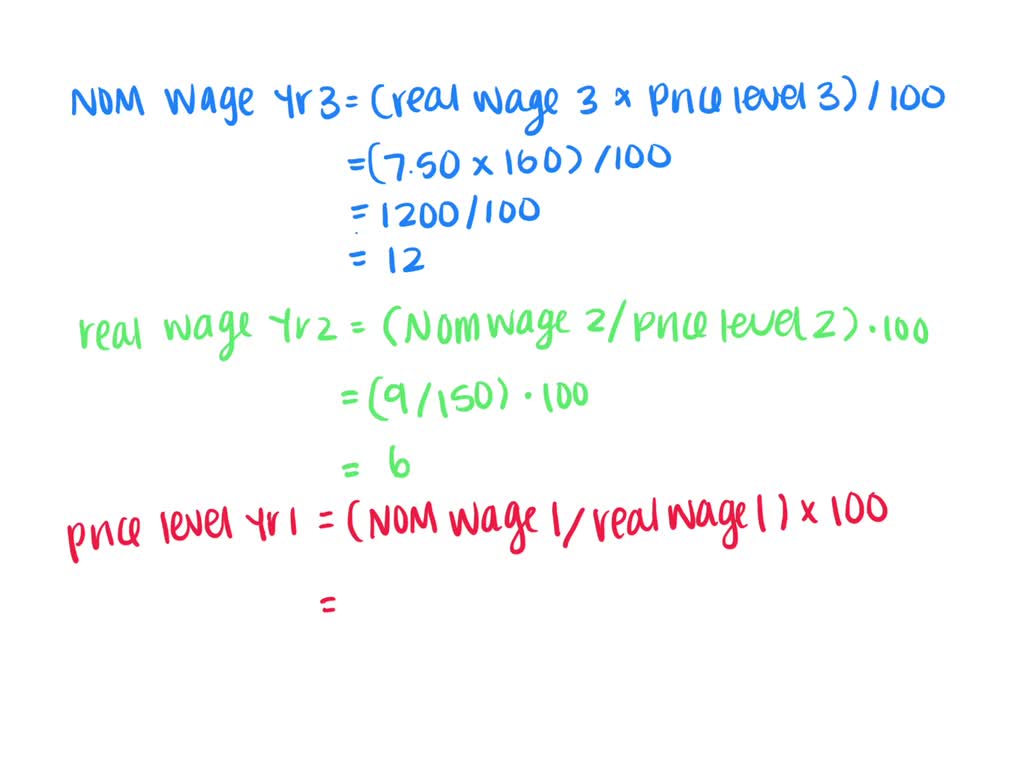
Real Wage (Current) = Nominal Wage (Current) / (CPI (Current) / CPI (Base Year))
Let’s walk through an example:
-
Find your nominal wage: Suppose your nominal annual salary in 2023 is $65,000.
-
Identify the CPI for two periods: Let’s say the CPI for your region was 250 in 2020 (your base year) and 290 in 2023 (the current year).
-
Apply the formula:
Real Wage (2023) = $65,000 / (290 / 250)
Real Wage (2023) = $65,000 / 1.16
Real Wage (2023) = $56,034.48
This means that your $65,000 salary in 2023 has the same purchasing power as $56,034.48 did in 2020. Despite a potential increase in your nominal wage since 2020, inflation has eroded some of that gain, resulting in a lower real wage when compared to the base year.
Alternative Calculation Using Inflation Rate
If you want to know if a specific raise kept pace with inflation, or you only have the inflation rate (as a percentage), you can use a simpler approximation:
Real Wage Growth (%) = Nominal Wage Growth (%) – Inflation Rate (%)
For example:
-
Your nominal wage increased by 5% this year.
-
The inflation rate for the same period was 3%.
-
Real Wage Growth = 5% – 3% = 2%.
This means your purchasing power effectively increased by 2%. If inflation was 6%, then your real wage growth would be 5% – 6% = -1%, indicating a 1% decrease in purchasing power. While less precise than the CPI method for long-term comparisons, this approximation is excellent for quick assessments of recent changes.
Sources for Inflation Data
Accurate real wage calculations depend heavily on reliable inflation data. Various institutions and reports regularly publish these crucial economic indicators, making them accessible to the public for personal and business financial planning.
Government Statistical Agencies
The most authoritative and frequently used sources for inflation data are national government statistical agencies. These bodies are tasked with collecting, processing, and disseminating a wide range of economic statistics, including consumer price indices.
-
United States: The Bureau of Labor Statistics (BLS) is the primary source, publishing the Consumer Price Index (CPI) monthly. The BLS offers various CPI data series, including CPI-U (for all urban consumers) and CPI-W (for urban wage earners and clerical workers), often broken down by region and specific expenditure categories.
-
United Kingdom: The Office for National Statistics (ONS) publishes the Consumer Prices Index (CPI) and the Retail Prices Index (RPI).
-
Canada: Statistics Canada provides the Consumer Price Index (CPI).
-
Eurozone: Eurostat publishes the Harmonized Index of Consumer Prices (HICP) for member states.
These agencies typically provide historical data, allowing for comparisons over extended periods, which is essential for accurate real wage analysis. Their data is considered robust due to rigorous collection methodologies and extensive sampling.
Economic Indicators and Reports
Beyond government agencies, several other sources provide valuable insights into inflation trends:
-
Central Banks: Institutions like the Federal Reserve (US), European Central Bank, and Bank of England regularly monitor and report on inflation as part of their monetary policy mandates. Their publications and speeches often contain inflation forecasts and analyses.
-
International Organizations: The International Monetary Fund (IMF) and the World Bank publish global and country-specific economic outlooks that include inflation projections.
-
Financial News Outlets and Research Firms: Reputable financial news organizations (e.g., Wall Street Journal, Financial Times, Bloomberg) and economic research firms often analyze and report on inflation data, frequently providing context and expert commentary.
These sources can be helpful for understanding the broader economic environment and how inflation might trend in the future, informing long-term financial planning.
Considerations for Accuracy
While government data is generally reliable, there are a few nuances to consider for the most accurate real wage calculation:
-
Regional vs. National CPI: National CPI figures represent an average across an entire country. However, the cost of living and inflation rates can vary significantly by region or even city. If available, using a local or regional CPI will provide a more accurate reflection of your personal cost of living changes.
-
Specific Goods/Services: The CPI tracks a “basket” of goods and services that may not perfectly match your personal spending habits. For example, if your primary expenses are in categories that have seen higher-than-average inflation (e.g., housing or specific healthcare costs), the general CPI might slightly understate your personal inflation experience.
-
Data Lag: Inflation data is typically released with a lag (e.g., monthly CPI figures are released a few weeks after the month ends). For real-time analysis, one must work with the most recently available data.
For most individuals, relying on the national CPI-U (or its equivalent in their country) is a sufficiently accurate and practical approach to calculating real wage.
Why Real Wage Matters for Your Financial Health
The real wage isn’t just an abstract economic indicator; it’s a direct measure of your personal financial well-being. Focusing on real wage provides critical insights that nominal wage alone cannot, guiding more effective financial planning and decision-making.
Assessing Purchasing Power
At its core, real wage tells you the true purchasing power of your income. It answers the fundamental question: “How much can my money actually buy?” If your nominal wage increases, but your real wage declines, it means that while you’re earning more dollars, those dollars are worth less. This erosion of purchasing power directly impacts your standard of living. Understanding this allows you to realistically assess your financial comfort and make adjustments to your spending or earning strategies. It’s the difference between feeling like you got a raise and actually being able to afford more.
Evaluating Salary Raises
One of the most common applications of real wage calculation is in evaluating the effectiveness of salary increases. A 5% raise sounds good on paper, but if inflation is 6%, your real wage has actually decreased by 1%. This means you’ve effectively taken a pay cut in terms of what you can afford. Knowing your real wage allows you to determine if your compensation is keeping pace with the cost of living, falling behind, or genuinely advancing your financial position. This knowledge is invaluable during salary negotiations, as it empowers you to argue for raises that truly improve your economic standing, not just maintain it.
Long-Term Financial Planning
For long-term goals like retirement planning, saving for a down payment, or funding education, understanding real wage growth is paramount. Inflation’s cumulative effect over decades can dramatically reduce the future value of current savings and fixed incomes. By factoring in real wage growth (or decline) into your financial models, you can set more realistic savings targets and investment expectations. If your real wage is stagnant or declining, it signals a need to increase savings rates or explore higher-return investment strategies to reach your long-term goals. Conversely, a robust real wage growth might allow for more aggressive spending or earlier retirement.
Economic Health Indicator
Beyond individual finance, real wage trends also serve as a crucial indicator of broader economic health. Widespread declines in real wages can signal a struggling economy, where productivity gains are not translating into improved living standards, potentially leading to reduced consumer spending and economic contraction. Conversely, sustained real wage growth is often a sign of a healthy, productive economy that benefits its workforce. For business owners, tracking real wages in the labor market can inform decisions about compensation strategies, talent retention, and overall business sustainability in a competitive environment.
Strategies to Increase Your Real Wage
Actively working to increase your real wage is a proactive step towards achieving greater financial security and improving your standard of living. It involves a multi-faceted approach, combining earning potential, smart financial management, and strategic investing.
Negotiating Salary
Regularly evaluating your market value and confidently negotiating your salary are direct ways to influence your nominal wage, and by extension, your real wage. Research industry benchmarks, understand the value you bring to your organization, and be prepared to articulate why you deserve higher compensation. Don’t wait for your annual review; proactive discussions can often lead to more frequent or substantial adjustments. Aim for raises that not only cover inflation but also provide a net increase in your purchasing power.
Acquiring New Skills
Investing in your human capital is one of the most effective long-term strategies to boost your earning potential. Acquiring in-demand skills, pursuing higher education, or obtaining professional certifications can open doors to higher-paying roles or promotions within your current field. As your skills become more specialized or valuable, your bargaining power increases, allowing you to command a higher nominal wage that is more likely to outpace inflation. Continuously learning ensures your skills remain relevant and sought after in the evolving job market.
Investment Growth
Making your money work for you through strategic investments is a powerful way to combat inflation and grow your real wealth. Investing in assets that historically outpace inflation, such as stocks, real estate, or inflation-indexed bonds, can help preserve and increase your purchasing power. While your salary contributes to your active income, investment returns contribute to your passive income, creating an additional stream of wealth that can help offset the effects of rising prices on your wages. Diversifying your investment portfolio is key to mitigating risks and maximizing potential real returns.
Smart Spending and Budgeting
While not directly increasing your income, optimizing your spending can effectively increase your real wage by making your existing income go further. Creating and sticking to a detailed budget allows you to identify unnecessary expenses and direct funds towards savings or essential purchases. Practicing mindful consumption, seeking value, and avoiding impulse buys can free up significant portions of your income, enhancing your effective purchasing power without a raise in nominal terms. Cutting down on high-interest debt also frees up more of your income for savings and investments, further boosting your real financial position.

Fighting Inflation Through Diversification
For those with significant savings or investment portfolios, strategic diversification is crucial in the fight against inflation. Holding a diverse range of assets that react differently to inflationary pressures can help protect your overall wealth. This might include a mix of equities (companies that can pass on higher costs to consumers), real estate (which often appreciates with inflation), commodities (like gold or oil, which can perform well during inflationary periods), and inflation-protected securities (like TIPS). By strategically allocating your assets, you aim to ensure that at least a portion of your portfolio grows at or above the rate of inflation, thereby preserving your real wealth.
aViewFromTheCave is a participant in the Amazon Services LLC Associates Program, an affiliate advertising program designed to provide a means for sites to earn advertising fees by advertising and linking to Amazon.com. Amazon, the Amazon logo, AmazonSupply, and the AmazonSupply logo are trademarks of Amazon.com, Inc. or its affiliates. As an Amazon Associate we earn affiliate commissions from qualifying purchases.