
Understanding “what percentage of a number” is far more than a basic arithmetic exercise; it is a foundational skill for navigating the complexities of personal finance, making informed investment decisions, and comprehending business performance. In the world of money, percentages provide the universal language for comparing values, measuring growth, assessing risk, and optimizing financial strategies. From budgeting your monthly income to analyzing stock market returns, a firm grasp of percentage calculations empowers individuals and businesses to make smarter, more profitable choices.
The Foundational Skill for Financial Literacy
At its core, a percentage is a way of expressing a number as a fraction of 100. It’s a standardized measurement that allows for clear comparisons regardless of the absolute values involved. This fundamental concept is the bedrock upon which much of financial analysis is built.

Understanding the Basics: What is a Percentage?
The term “percent” derives from the Latin “per centum,” meaning “by the hundred.” When we say “25 percent,” we mean 25 out of 100, or 25/100, which can also be expressed as the decimal 0.25. Percentages offer a relatable and scalable way to understand proportions. For instance, knowing that a company’s profit margin is 10% is more universally understood than stating it made $100,000 on $1,000,000 in sales, especially when comparing it to a competitor with higher or lower sales volumes.
The Core Formula: Part / Whole x 100
Calculating what percentage one number is of another follows a simple, yet powerful, formula:
(Part ÷ Whole) × 100 = Percentage
Let’s illustrate with a common financial scenario:
Imagine your monthly income (the “Whole”) is $4,000. If you allocate $800 (the “Part”) towards housing expenses, what percentage of your income goes to housing?
($800 ÷ $4,000) × 100 = 0.20 × 100 = 20%
This calculation immediately tells you that 20% of your income is dedicated to housing. This simple act of converting a raw number into a percentage provides context and allows you to compare it against budgeting guidelines, personal goals, or even national averages. This identical principle applies across all financial domains, from calculating investment returns to determining a discount amount.
Navigating Personal Finance with Percentages
For personal financial management, percentages are indispensable. They empower individuals to gain clarity over their spending, saving, and debt.
Budgeting and Income Allocation
Effective budgeting relies heavily on percentages. Popular rules like the 50/30/20 rule (50% for needs, 30% for wants, 20% for savings and debt repayment) are entirely percentage-based. By calculating the percentage of your income dedicated to each category, you can quickly assess whether you’re adhering to your financial plan or identify areas for adjustment. For example, if your food expenses consume 25% of your income but your target is 15%, you have a clear metric for adjustment. Similarly, setting a goal to save 10% or 15% of every paycheck provides a tangible, achievable target that scales with your income.
Interest Rates: Loans, Savings, and Credit Cards
Interest rates are perhaps the most pervasive application of percentages in personal finance. Whether you’re paying interest on a mortgage, car loan, or credit card debt, or earning interest on a savings account or certificate of deposit (CD), these figures are always expressed as percentages.
-
Annual Percentage Rate (APR): This tells you the annual cost of borrowing, expressed as a percentage of the loan amount. Understanding APR allows you to compare different loan offers effectively.
-
Annual Percentage Yield (APY): For savings and investments, APY indicates the real annual rate of return, taking into account the effect of compounding interest.
-
Compound Interest: The magic of compound interest, where your interest earns interest, is fundamentally a percentage calculation applied repeatedly over time. Understanding how even small percentage differences in interest rates can lead to significant variations in long-term debt or wealth accumulation is crucial.
Discounts, Sales, and Value Assessment
When shopping, percentages are key to understanding the true cost and savings of sales and promotions. A “30% off” sale immediately tells you how much less you’ll pay relative to the original price.
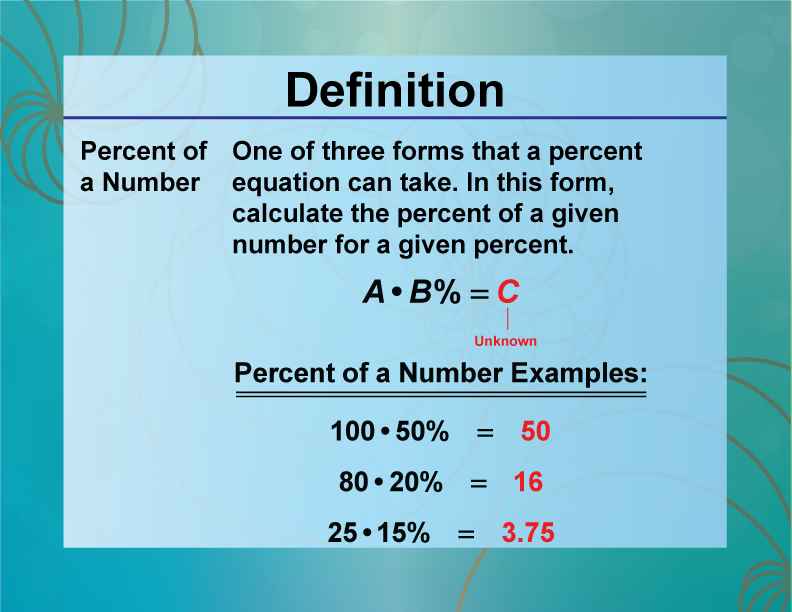
If an item originally costs $150 and is marked down by 20%, you calculate the discount as:
20% of $150 = 0.20 × $150 = $30.
The new price is $150 – $30 = $120.
This allows for quick mental math to assess the actual value proposition and ensure you’re getting a genuine deal.
Taxes and Deductions
Tax systems globally rely heavily on percentages. Income tax brackets specify a percentage of your income that goes to taxes. Sales tax is a percentage added to purchases. Property taxes are a percentage of your property’s assessed value. Understanding these percentages helps you calculate your tax liability, evaluate deductions and credits, and plan for your financial obligations accurately.
Strategic Investing and Wealth Growth

In the investment world, percentages are the primary language for measuring performance, assessing risk, and making strategic allocation decisions.
Return on Investment (ROI) and Portfolio Performance
Investors constantly use percentages to gauge the profitability of their investments. Return on Investment (ROI) is typically expressed as a percentage, showing the gain or loss relative to the initial cost.
If you invest $10,000 and it grows to $12,000, your gain is $2,000.
ROI = ($2,000 ÷ $10,000) × 100 = 20%.
Comparing the percentage ROI of different investments, regardless of their initial capital, provides a clear, apples-to-apples comparison of their effectiveness. Portfolio performance reports also use percentages to show quarterly or annual gains and losses, allowing investors to track progress against benchmarks.
Diversification Strategies
Modern portfolio theory emphasizes diversification to manage risk. This often involves allocating specific percentages of an investment portfolio to different asset classes (e.g., stocks, bonds, real estate, cash). A common strategy might be 60% stocks, 30% bonds, 10% cash. As market values fluctuate, these percentages shift, and investors rebalance their portfolios to maintain their desired percentage allocations, ensuring their risk profile remains consistent with their financial goals.
Understanding Market Volatility
Market news frequently reports percentage changes: “The stock market gained 1.5% today,” or “Company X’s shares dropped 5% after earnings.” These percentage figures convey the magnitude of market movements in a concise and comparable way, helping investors understand the impact on their portfolios.
Business Finance and Profitability
For entrepreneurs and business professionals, percentages are critical tools for analyzing operational efficiency, profitability, and growth.
Profit Margins
Businesses meticulously track profit margins, which are always expressed as percentages.
-
Gross Profit Margin: (Gross Profit ÷ Revenue) × 100. This indicates the percentage of revenue left after deducting the cost of goods sold.
-
Net Profit Margin: (Net Profit ÷ Revenue) × 100. This shows the percentage of revenue remaining after all expenses, including taxes, have been deducted.
These percentages are vital for benchmarking against competitors, assessing pricing strategies, and understanding the overall health and efficiency of a business.
Growth Rates and Market Share
Businesses measure their growth in percentage terms, whether it’s year-over-year revenue growth, customer acquisition rate, or market share. Knowing that a company increased its revenue by 15% offers a clear picture of its expansion. Similarly, understanding that a company holds 25% of a specific market allows for strategic positioning and competitive analysis.
Commissions and Royalties
Sales professionals often earn a commission, which is a specified percentage of their sales. Artists and authors receive royalties, a percentage of the revenue generated by their work. Calculating these earnings accurately depends entirely on understanding “what percentage of a number” applies to their sales or intellectual property.
Common Pitfalls and How to Avoid Them
While percentages are powerful, misinterpreting them can lead to significant financial errors.
Confusing Basis Points with Percentages
In finance, particularly with interest rates or bond yields, changes are sometimes expressed in “basis points.” One basis point (bp) is 0.01%, or 1/100th of a percentage point. A common mistake is to confuse basis points with a straight percentage. If an interest rate increases by 50 basis points, it means it increased by 0.50 percentage points (e.g., from 3.00% to 3.50%), not by 50% of the original rate.
Misinterpreting Percentage Changes
Be cautious when dealing with successive percentage changes. A 10% increase followed by a 10% decrease does not bring you back to the original amount.
Example: Starting with $100.
10% increase: $100 + ($100 × 0.10) = $110.
10% decrease: $110 – ($110 × 0.10) = $110 – $11 = $99.
The net result is a 1% decrease. Understanding the base upon which the percentage is applied is crucial.
The Power of Compounding
While beneficial for investments, compounding can be detrimental for debt. A small percentage interest rate on a credit card can balloon into a significant burden if only minimum payments are made, thanks to the continuous percentage calculation on the growing principal. Conversely, understanding how a small percentage of regular savings, compounded over decades, can lead to substantial wealth is a cornerstone of long-term financial planning.
In conclusion, the ability to calculate and interpret “what percentage of a number” is more than just a mathematical proficiency; it’s a vital financial literacy skill. From managing daily expenses and planning for retirement to making investment decisions and running a successful business, percentages provide the indispensable framework for financial clarity and strategic action. Mastering this concept empowers individuals and organizations to make informed, financially sound choices that drive growth and security.
aViewFromTheCave is a participant in the Amazon Services LLC Associates Program, an affiliate advertising program designed to provide a means for sites to earn advertising fees by advertising and linking to Amazon.com. Amazon, the Amazon logo, AmazonSupply, and the AmazonSupply logo are trademarks of Amazon.com, Inc. or its affiliates. As an Amazon Associate we earn affiliate commissions from qualifying purchases.