
The seemingly simple question, “what percent is 7 out of 10,” unlocks a fundamental concept that is indispensable for navigating the complex world of finance. Far from being a mere arithmetic exercise, understanding how to calculate and interpret percentages is the bedrock of financial literacy, impacting everything from personal budgeting and investment returns to business profitability and economic analysis. This foundational mathematical insight allows individuals and organizations to quantify relationships, compare values, and make informed decisions that drive financial success.
The Foundational Math of Financial Literacy
At its core, calculating “what percent is 7 out of 10” involves expressing a part of a whole as a fraction of 100. The process is straightforward: divide the part (7) by the whole (10) and then multiply the result by 100.
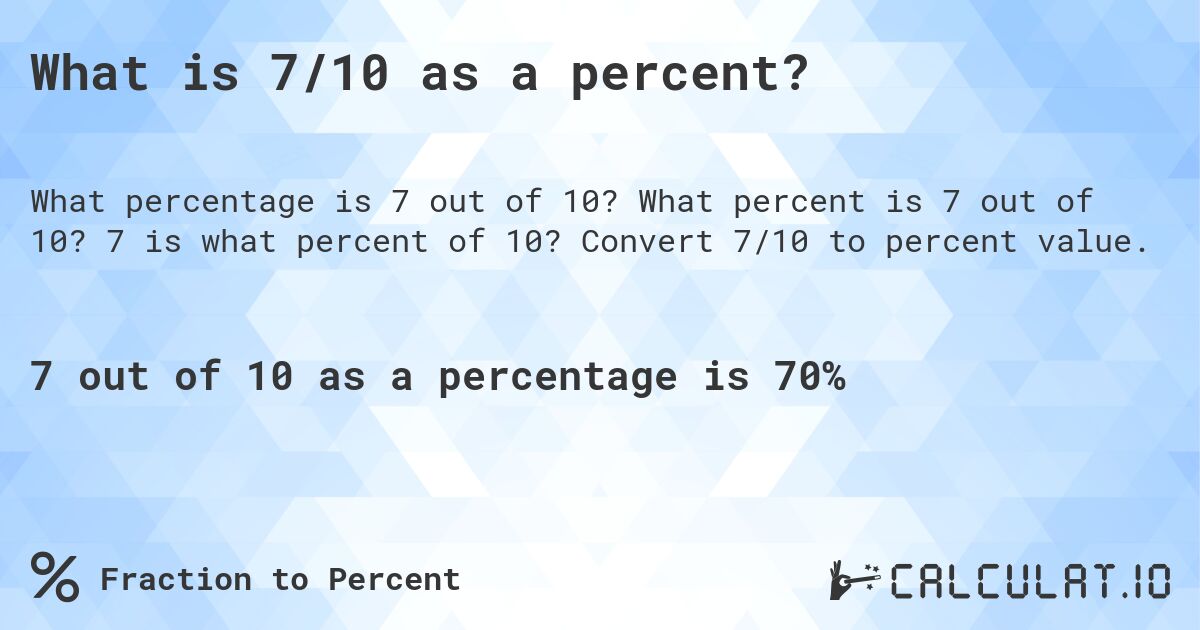
7 ÷ 10 = 0.7
0.7 × 100 = 70%
Thus, 7 out of 10 is 70%. This simple calculation, however, represents a powerful tool for financial analysis. It allows for standardization, making it possible to compare different amounts or rates on an equal footing, regardless of their initial scale. Without this ability to convert raw numbers into relatable percentages, financial data would remain fragmented and difficult to interpret meaningfully.
Why Percentages Matter Beyond Simple Fractions
While 7 out of 10 is easily recognizable as a majority, expressing it as 70% provides a universal metric. If you were comparing two situations – saving $7 out of $10 versus saving $700 out of $1,000 – the percentage (70%) immediately conveys that the proportion of savings is identical, even though the absolute amounts differ vastly. This standardization is critical in financial reporting, performance measurement, and comparative analysis, allowing for quick, accurate assessments of financial health and performance across varied contexts.
Applying Percentages in Personal Finance
In personal finance, the ability to understand and calculate percentages is not just useful; it’s essential for sound financial management. From managing daily expenses to planning for long-term wealth, percentages provide clarity and actionable insights.
Budgeting for Success: Allocating Your Income
One of the most practical applications of percentages in personal finance is budgeting. Financial experts often recommend allocating income using percentage-based rules, such as the 50/30/20 rule, where 50% goes to needs, 30% to wants, and 20% to savings and debt repayment. Understanding that 7 out of 10 (70%) of your income going towards needs might signal a tight budget, whereas saving 7 out of 10 (70%) indicates a strong financial position, allows for immediate assessment and adjustment.
For instance, if your monthly take-home pay is $4,000:
-
If $2,800 (70%) goes to rent, utilities, and groceries, you know a significant portion is committed to needs.
-
If you manage to save $1,200, calculating that as $1,200/$4,000 = 0.3 = 30% helps you track progress against a savings goal.
These percentages transform raw figures into meaningful ratios that guide spending and saving habits, ensuring you stay on track towards your financial objectives.
Debt Management: Understanding Interest Rates
Interest rates are perhaps the most common and impactful percentage in personal finance. Whether it’s the interest on a mortgage, car loan, credit card, or student loan, these percentages dictate the true cost of borrowing. A 7% interest rate on a loan means that for every $100 borrowed, you’ll pay an additional $7 per year in interest (ignoring compounding for simplicity).
Understanding how interest compounds, how rates affect minimum payments, and the total cost over the life of a loan empowers consumers to make smarter borrowing decisions. A slightly lower percentage rate on a large loan can save thousands over its term, making percentage comparison an invaluable skill for debt management and avoidance.
Savings Goals: Tracking Your Progress
Setting and achieving savings goals also heavily relies on percentages. If you aim to save 70% of a specific bonus or a tax refund, knowing the precise percentage allows you to quantify your effort and measure progress. Moreover, when you assess returns on a savings account or a certificate of deposit (CD), the Annual Percentage Yield (APY) tells you exactly how much your money will grow over a year, factoring in compounding interest. This allows for direct comparison between different savings vehicles, helping you choose the most profitable option.
Percentages in Investing and Returns
For investors, percentages are the universal language of performance and risk. From evaluating individual assets to managing an entire portfolio, a solid grasp of percentage calculations is critical for making informed investment decisions.
Calculating Return on Investment (ROI)
Return on Investment (ROI) is a primary metric expressed as a percentage, indicating the profitability of an investment. If you invest $100 and gain $70, your ROI is 70%. This simple calculation allows investors to compare the efficiency of different investments. An investment returning 70% might be considered exceptional, while one returning 7% might be more modest but potentially less risky.
The formula for ROI:
((Current Value of Investment – Cost of Investment) / Cost of Investment) × 100%
Understanding this helps in evaluating stocks, real estate, or business ventures, allowing investors to determine if the financial gain justifies the capital outlay and risk.
The Power of Compound Interest: Growth Over Time
Compound interest, often called the “eighth wonder of the world,” relies entirely on percentages. It’s the interest earned on both the initial principal and the accumulated interest from previous periods. Even a seemingly small annual percentage return, like 7%, can lead to substantial wealth accumulation over time when compounded regularly.
For example, $10,000 invested at a consistent 7% annual return would grow significantly more over 20-30 years than a simple interest calculation would suggest, due to the power of compounding. Financial calculators and spreadsheets can illustrate this growth, but the underlying principle is the consistent application of a percentage return on an increasing base amount.
Diversification and Portfolio Allocation
Modern portfolio theory emphasizes diversification to manage risk. This involves allocating investments across different asset classes (stocks, bonds, real estate) and sectors in specific percentages. An investor might decide to allocate 70% of their portfolio to equities and 30% to bonds, adjusting these percentages based on their risk tolerance, age, and financial goals.
Understanding that 7 out of 10 parts of your portfolio are in stocks (70%) immediately conveys the risk profile. Rebalancing a portfolio means adjusting these percentages back to the target allocation as market fluctuations cause them to drift. Without percentage calculations, strategic asset allocation and rebalancing would be impossible.
Business Applications: Profit, Loss, and Market Share
For businesses, percentages are indispensable for analyzing operational efficiency, market position, and financial health. They provide clear, comparative metrics for stakeholders.
Profit Margins: Understanding Business Health
Businesses constantly evaluate their profitability using various percentage-based margins:
-
Gross Profit Margin: (Gross Profit / Revenue) × 100% – This shows how much profit a company makes from its sales after deducting the cost of goods sold. A 70% gross profit margin is generally excellent, indicating strong pricing power or efficient production.
-
Operating Profit Margin: (Operating Income / Revenue) × 100% – This reveals profitability after accounting for operating expenses.
-
Net Profit Margin: (Net Income / Revenue) × 100% – This is the ultimate measure of a company’s profitability, showing what percentage of revenue is left after all expenses, taxes, and interest are paid. If a company retains 7% of every dollar of revenue as net profit, it provides a clear picture of its overall financial efficiency.
These percentages allow businesses to benchmark against competitors, identify areas for cost reduction, and make strategic decisions about pricing and production.
Sales Performance and Conversion Rates
In sales and marketing, conversion rates are frequently expressed as percentages. If a sales team generates 10 leads and successfully converts 7 of them into customers, their conversion rate is 70%. This metric is crucial for evaluating sales team effectiveness, marketing campaign success, and the overall efficiency of the customer acquisition funnel. Understanding and improving these percentages can directly impact revenue and growth.
Market Share: Positioning in the Industry
Market share, expressed as a percentage, indicates a company’s proportion of total sales within its industry. If a company captures 70% of a particular market, it signifies a dominant position, indicating strong brand loyalty, competitive pricing, or superior product offerings. Tracking changes in market share over time, whether gains or losses in percentage points, provides insights into a company’s competitive standing and strategic effectiveness.
Mastering Percentage Calculations with Financial Tools
While the fundamental calculation “what percent is 7 out of 10” is simple, real-world financial scenarios often involve more complex numbers and multiple variables. Fortunately, a wide array of financial tools can assist in these calculations, ensuring accuracy and efficiency.
Financial calculators, spreadsheet software like Microsoft Excel or Google Sheets, and specialized financial planning software are invaluable. These tools automate the percentage calculations, allowing individuals and businesses to focus on interpreting the results and making strategic decisions, rather than getting bogged down in arithmetic. Mastering the basic concept, however, remains paramount. It provides the intuition and critical thinking skills needed to correctly set up calculations, interpret outputs, and identify potential errors or misleading figures.
In conclusion, the seemingly simple question “what percent is 7 out of 10” serves as a powerful gateway to understanding the language of finance. From personal budgets to investment strategies and corporate profitability, percentages offer clarity, comparability, and actionable insights. A solid grasp of this fundamental mathematical concept is not just a desirable skill; it is an absolute necessity for anyone seeking to achieve financial literacy and make informed monetary decisions in an increasingly complex economic landscape.
aViewFromTheCave is a participant in the Amazon Services LLC Associates Program, an affiliate advertising program designed to provide a means for sites to earn advertising fees by advertising and linking to Amazon.com. Amazon, the Amazon logo, AmazonSupply, and the AmazonSupply logo are trademarks of Amazon.com, Inc. or its affiliates. As an Amazon Associate we earn affiliate commissions from qualifying purchases.