
In the world of finance, numbers tell a story. But often, the raw numbers alone don’t provide the full narrative. To truly grasp the significance of financial figures, we frequently turn to percentages. They offer a universal language for comparison, growth, risk, and allocation, transforming complex data into digestible insights. A seemingly simple question like “what is 2 out of 6 as a percentage?” isn’t just a basic math problem; it’s a gateway to understanding critical financial concepts that influence every aspect of our economic lives, from budgeting and investments to business strategies.
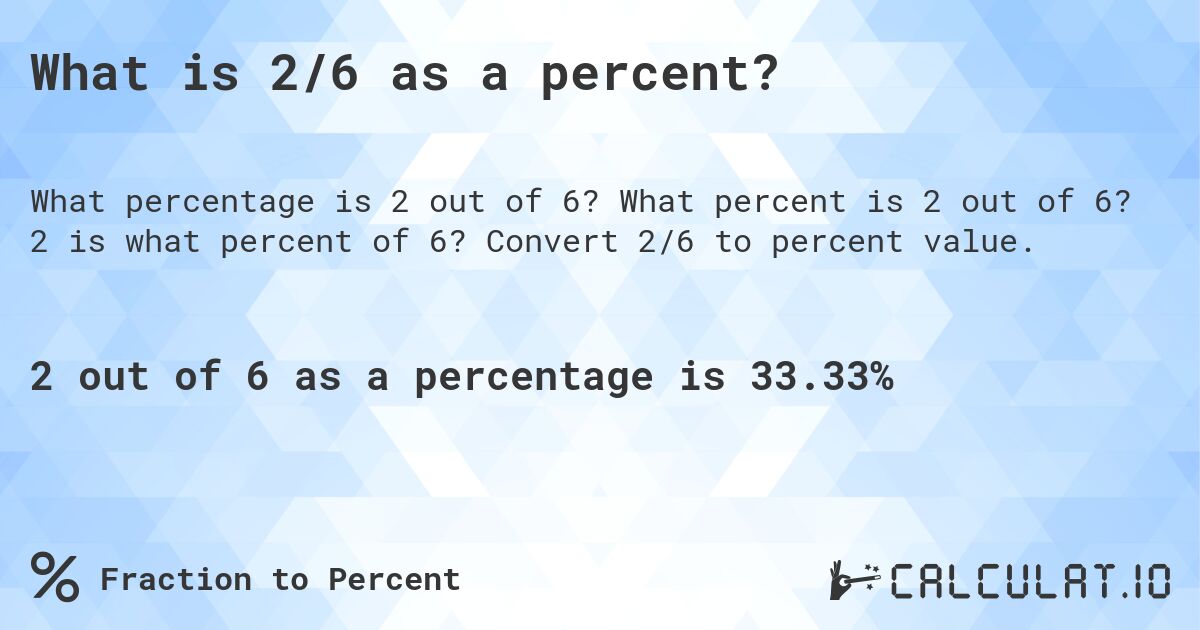
At its core, calculating “2 out of 6 as a percentage” involves converting a fraction into a percentage. The answer is approximately 33.33%. This seemingly innocuous number, one-third of a whole, carries profound implications when applied to your money. This article will delve into the mathematical underpinnings of this calculation and, more importantly, explore the myriad ways this fundamental understanding empowers smarter financial decisions across personal finance, investing, and business.
The Foundational Math: Understanding Percentages
Before we can appreciate the financial weight of “2 out of 6,” we must first solidify our understanding of what percentages are and how they are derived. Percentages are essentially fractions where the denominator is 100. They provide a standardized way to express a part of a whole, making comparisons intuitive and straightforward, regardless of the original scale of the numbers involved.
Decoding “Out of”: Fractions to Financial Insights
The phrase “2 out of 6” directly translates into a fraction: 2/6. This fraction represents two parts of a total of six parts. To convert any fraction into a percentage, you follow a simple two-step process:
-
Convert the fraction to a decimal: Divide the numerator (the top number) by the denominator (the bottom number).
- 2 ÷ 6 = 0.333333… (a repeating decimal)
-
Convert the decimal to a percentage: Multiply the decimal by 100.
- 0.333333… × 100 = 33.3333…%
Therefore, 2 out of 6 is approximately 33.33%. This calculation is not just a mathematical exercise; it’s a foundational skill for interpreting financial information. Whether you’re looking at a discount, an interest rate, or a segment of your budget, the ability to quickly perform or understand this conversion is invaluable. It’s the initial step in moving from raw data to meaningful financial intelligence.
Why Percentages Are the Universal Language of Finance
Percentages are ubiquitous in finance because they offer unparalleled clarity and context. Imagine trying to compare the performance of two investments: one that gained $2,000 from an initial $10,000, and another that gained $200 from an initial $500. Comparing the absolute dollar amounts ($2,000 vs. $200) tells only part of the story. However, converting these to percentages instantly reveals which investment performed better proportionally:
-
Investment 1: ($2,000 / $10,000) × 100 = 20% gain
-
Investment 2: ($200 / $500) × 100 = 40% gain
Suddenly, the smaller dollar gain is revealed to be a far more impressive proportional return. This power of simplified comparison makes percentages indispensable for analysts, investors, consumers, and businesses alike, enabling informed decisions across diverse financial landscapes.
Everyday Money Applications: Where 33.33% Pops Up
The percentage 33.33% might seem abstract, but its applications in everyday personal finance are surprisingly common and crucial for sound money management. Understanding this proportion helps in making clearer decisions about how you earn, spend, and save.
Budgeting and Expense Allocation
Effective budgeting is the cornerstone of personal finance, and percentages are its backbone. The “2 out of 6” scenario can manifest in several budgeting contexts:
-
Income Allocation: If you decide to allocate a third (33.33%) of your income to a specific goal, like aggressive debt repayment or building an emergency fund, you’re directly applying this concept. For example, if your net income is $6,000, dedicating $2,000 to savings means you’re putting away 33.33% of your earnings.
-
Expense Categories: Imagine your total monthly expenses are divided into 6 major categories. If 2 of these categories (e.g., housing and groceries) consume a third of your total budget, understanding this percentage helps you assess whether this allocation is sustainable or requires adjustment. For instance, if your total spending is $6000 and $2000 goes to housing, that’s 33.33%. If this feels high, you know which area to target for reductions.
-
The 50/30/20 Rule: While 33.33% isn’t one of the standard percentages in this popular budgeting rule (50% for needs, 30% for wants, 20% for savings/debt), it highlights how important understanding individual percentages is. If your “wants” category accidentally creeps up to 33.33% of your income, you might be overspending and eating into your savings potential.
Discounts, Sales, and Savings
Shopping often involves percentages, particularly with sales and discounts. While “2 out of 6” might not be a direct discount offer, the underlying principle is identical:
-
“Buy Two, Get One Free”: This common promotion can be translated into a percentage discount. If you buy 3 items for the price of 2, you’re essentially getting a 33.33% discount on the total original price of the three items (1 item free out of 3, or 1/3 discount). For instance, if 3 items cost $6 each originally, you pay $12 instead of $18. The $6 discount on $18 is (6/18) * 100 = 33.33%.
-
Calculating Price Reductions: Knowing how to quickly calculate percentages allows you to determine the true savings from a “20% off” or “30% off” sale, or to compare offers like “$2 off a $6 item” versus “25% off.” In the former case, $2 off $6 is 33.33% off, which is a significant saving.
Tips and Service Charges
In many service industries, tipping is customary, often calculated as a percentage of the total bill. While typical tips range from 15% to 20%, understanding how to calculate 33.33% can be useful in specific scenarios:
-
Exceptional Service: You might choose to give an exceptionally generous tip for outstanding service. Knowing that 33.33% is a third of the bill can make quick mental calculations easier, especially for smaller totals.
-
Service Charges: Some establishments include a mandatory service charge, which is a fixed percentage. Being able to verify this charge on your bill confirms you’re paying the correct amount.
Investing and Wealth Building: The Power of Proportions
Moving beyond daily spending, percentages are the bedrock of investment analysis and wealth management. The principle of “2 out of 6” helps in dissecting portfolio performance, assessing risk, and planning for future growth.
Portfolio Allocation and Diversification
Diversification is key to managing investment risk, and it’s inherently a game of percentages:
-
Asset Allocation: A common strategy is to allocate your portfolio across different asset classes (e.g., stocks, bonds, real estate, commodities). If you decide to put 2 out of every 6 dollars (33.33%) into a specific, potentially higher-risk but higher-reward asset like growth stocks, this percentage directly impacts your portfolio’s overall risk profile and potential returns. For a $60,000 portfolio, allocating $20,000 to a specific sector means 33.33% of your capital is exposed to that sector’s performance.
-
Sector-Specific Exposure: Within a stock portfolio, you might have holdings in various sectors. If 2 out of your 6 largest holdings are in the technology sector, that 33.33% concentration requires careful consideration, especially during market fluctuations. A general rule of thumb for diversification is often to limit exposure to any single stock or sector to a certain percentage to mitigate specific risks.
Return on Investment (ROI) and Growth Rates
Percentages are the primary metric for evaluating investment performance:
-
Calculating ROI: If you invested $6,000 in a venture and earned a profit of $2,000, your ROI is (Profit / Initial Investment) × 100 = ($2,000 / $6,000) × 100 = 33.33%. This percentage allows you to compare the profitability of this venture against other investment opportunities, irrespective of their initial capital requirements.
-
Understanding Compounding: Compound interest, often called the “eighth wonder of the world,” relies heavily on percentage growth. A 33.33% annual return (while exceptionally high and rare) would demonstrate rapid wealth accumulation due to the power of compounding percentages over time. Even more modest returns, when compounded, illustrate the long-term impact of consistent percentage growth.
Understanding Risk and Reward
Percentages are crucial for quantifying and understanding investment risks:
-
Success/Failure Rates: In venture capital or startup investing, investors might evaluate that 2 out of 6 (33.33%) of their investments typically succeed, or conversely, 4 out of 6 (66.67%) might fail. This percentage-based understanding helps in formulating investment strategies and setting realistic expectations for overall portfolio performance despite individual failures.
-
Volatility: Market volatility is often expressed in percentage terms, indicating how much an asset’s price fluctuates. Understanding these percentage swings helps investors gauge risk tolerance and make informed decisions about when to buy or sell.
Business Finance and Entrepreneurship: Beyond the Basics
For business owners and entrepreneurs, percentages move from personal financial management to strategic operational and growth decisions. The 33.33% figure, derived from “2 out of 6,” can signify crucial metrics in profitability, market analysis, and financial health.
Profit Margins and Cost Analysis
Profitability is the lifeblood of any business, and percentages provide the most meaningful way to measure it:
-
Gross Profit Margin: If a product sells for $6 and the cost of goods sold (COGS) is $4, resulting in a gross profit of $2, then the gross profit margin is ($2 Profit / $6 Revenue) × 100 = 33.33%. This metric indicates how efficiently a company produces its goods or services. A consistent 33.33% gross margin suggests a healthy operational efficiency for that specific product or service line.
-
Cost Structure: If a business’s total expenses are divided into 6 major categories, and 2 of these (e.g., raw materials and labor) represent 33.33% of the total costs, understanding this helps in identifying key cost drivers and areas for potential efficiency improvements. For example, if total costs are $60,000, and $20,000 goes to labor, that 33.33% allocation reveals a significant human capital expense that must be managed effectively.
Market Share and Business Growth
Percentages are essential for competitive analysis and growth tracking:
-
Market Share: If your company services 2 out of 6 major market segments, or captures 2 units of sales for every 6 units sold in the entire market, your market share is 33.33%. This is a vital indicator of your competitive position and influence within an industry. Growing this percentage is often a core strategic objective for businesses.
-
Year-over-Year Growth: Tracking growth as a percentage (e.g., 10% revenue growth, 5% customer acquisition growth) provides a standardized way to measure progress and set future targets, allowing for comparison across different periods or against competitors.
Debt Management and Financial Ratios
Businesses, like individuals, manage debt using percentages:
-
Debt-to-Equity Ratios: These ratios, expressed as percentages, assess a company’s leverage and financial risk. Understanding these helps in determining a healthy balance between borrowed capital and owner equity.
-
Operating Expense Ratios: If your operating expenses (excluding COGS) are 2 out of 6 parts of your total revenue, that 33.33% percentage indicates the efficiency of your non-production operations. This can guide decisions on overhead reduction or scaling operations.
Tools and Strategies for Mastering Financial Percentages
The ability to work with and interpret percentages is a financial superpower. Fortunately, mastering this skill is accessible through various tools and a commitment to continuous learning.
Leveraging Financial Calculators and Spreadsheets
In today’s digital age, you don’t always need to do complex percentage calculations by hand:
-
Online Calculators: Numerous free online tools can instantly convert fractions to percentages, calculate discounts, or determine interest accrual.
-
Spreadsheets (Excel, Google Sheets): These are indispensable for managing personal and business finances. Formulas like
=(2/6)*100or=(A1/B1)*100can automate percentage calculations, allowing you to build dynamic budgets, investment trackers, and financial models. Understanding these basic formulas empowers you to analyze data quickly and accurately. -
Financial Apps: Many budgeting and investing apps automatically display data in percentage terms, making it easy to see your spending allocations or portfolio gains at a glance.
Continuous Financial Education
While calculating “2 out of 6 as a percentage” is basic, the financial implications are profound. Continuous education is key to leveraging this understanding:
-
Read and Learn: Stay informed about financial news, read personal finance books, and follow reputable financial educators. Many financial concepts, from inflation to interest rates, are best understood through the lens of percentages.
-
Practice: Actively apply percentage calculations to your own finances. When you get a paycheck, calculate the percentage that goes to taxes, savings, or specific expenses. When you look at investment statements, calculate your percentage returns. This hands-on practice reinforces learning and builds confidence.
The Mindset Shift: From Numbers to Strategic Decisions
Ultimately, understanding what 2 out of 6 is as a percentage, and grasping percentages in general, isn’t just about arithmetic. It’s about cultivating a financial mindset that moves beyond raw figures to proportional thinking. This mindset allows you to:
-
Make Informed Comparisons: Evaluate opportunities and risks on a level playing field.
-
Set Realistic Goals: Understand what a 10% saving rate or a 7% investment return truly means for your financial future.
-
Identify Trends: Recognize when a particular expense category is growing disproportionately or an investment is underperforming relative to its peers.
-
Plan Strategically: Allocate resources effectively, whether it’s your personal income or a company’s budget.
By embracing the power of percentages, you transform from merely observing financial numbers to actively interpreting them and making strategic decisions that foster wealth, stability, and growth.
In conclusion, the simple question “what is 2 out of 6 as a percentage?” unlocks a fundamental principle of financial literacy. The answer—33.33%—is not just a static number but a dynamic concept that illuminates pathways to better budgeting, smarter investing, and more effective business management. By mastering this foundational understanding, individuals and entrepreneurs alike can navigate the complexities of the financial world with greater clarity and confidence, turning simple math into powerful financial insight.
aViewFromTheCave is a participant in the Amazon Services LLC Associates Program, an affiliate advertising program designed to provide a means for sites to earn advertising fees by advertising and linking to Amazon.com. Amazon, the Amazon logo, AmazonSupply, and the AmazonSupply logo are trademarks of Amazon.com, Inc. or its affiliates. As an Amazon Associate we earn affiliate commissions from qualifying purchases.