
The concept of compounding is one of the most fundamental and powerful principles in personal finance and investing. Often lauded as the “eighth wonder of the world,” it refers to the process of generating earnings on an asset’s accumulated earnings from previous periods, in addition to the initial principal. When we specify that money compounds “annually,” we’re pinpointing a specific frequency for this powerful financial phenomenon. Understanding this annual cycle is crucial for anyone looking to build substantial wealth over time.
Unpacking the Core Mechanism of Compounding
At its heart, compounding is about growth building upon growth. It’s the engine that can transform modest initial investments into significant sums, given enough time and consistency.
The Fundamental Difference: Simple vs. Compound Interest
To truly grasp annual compounding, it’s essential to distinguish it from its simpler counterpart: simple interest.
-
Simple Interest: This form of interest is calculated solely on the original principal amount of a loan or deposit. The interest earned (or paid) does not get added back to the principal for subsequent interest calculations. If you invest $1,000 at a simple interest rate of 5% per year, you’d earn $50 each year, and your total over five years would be $1,250 ($1,000 principal + $250 interest). The principal base never changes.
-
Compound Interest: This is where the magic happens. Compound interest is calculated on the initial principal and also on all of the accumulated interest from prior periods. The key idea is “interest on interest.” As interest is earned and added to the principal, the new, larger principal then earns even more interest in the next period.
Let’s use our previous example for compound interest: You invest $1,000 at an annual compound interest rate of 5%.
-
Year 1: $1,000 x 5% = $50. Your new principal is $1,050.
-
Year 2: $1,050 x 5% = $52.50. Your new principal is $1,102.50.
-
Year 3: $1,102.50 x 5% = $55.13. Your new principal is $1,157.63.
-
Year 4: $1,157.63 x 5% = $57.88. Your new principal is $1,215.51.
-
Year 5: $1,215.51 x 5% = $60.78. Your new principal is $1,276.29.
After five years, with compound interest, you have $1,276.29, compared to $1,250 with simple interest. While the difference might seem small over a short period, this gap widens dramatically over decades, highlighting the accelerating power of compounding.
The Engine of Growth: Reinvestment
The core principle that drives compound growth is the reinvestment of earnings. For your money to compound, the interest, dividends, or capital gains you earn must be added back into your initial investment. This enlarged base then serves as the new principal for the next compounding period, earning even more returns. Without reinvestment, you’re essentially earning simple interest, as the base for future calculations remains static. This continuous cycle of earning and reinvesting is what creates the snowball effect synonymous with long-term wealth accumulation.
Understanding “Annually” in the Compounding Equation
The term “annually” in “compounding annually” specifies the frequency at which this reinvestment and interest calculation occurs.
The Specificity of Annual Compounding
When money compounds annually, it means that the interest is calculated and added to your principal once every year. This is a common and straightforward compounding frequency.
While annual compounding is powerful, interest can also compound more frequently, such as quarterly (four times a year), monthly (12 times a year), daily (365 times a year), or even continuously. Generally, the more frequently interest is compounded, the slightly higher the total returns will be, because your money starts earning “interest on interest” sooner. For instance, $1,000 at 5% compounded monthly would yield slightly more than if compounded annually after a year. However, for most long-term investment planning and illustrative purposes, annual compounding provides a robust and easily understandable baseline for demonstrating the power of time and consistent growth.
Many financial products quote an Annual Percentage Rate (APR) and an Annual Percentage Yield (APY). The APR is the simple interest rate, while the APY (or Effective Annual Rate) takes into account the effect of compounding, giving you the true annual rate of return after factoring in the compounding frequency. For annual compounding, APR and APY would be the same.
Applying the Concept: The Annual Compounding Formula
While complex calculations aren’t necessary for everyday investing, understanding the basics of the compound interest formula can be insightful. The general formula for compound interest is:
A = P(1 + r/n)^(nt)
Where:
-
A = the future value of the investment/loan, including interest
-
P = the principal investment amount (the initial deposit or loan amount)
-
r = the annual interest rate (as a decimal)
-
n = the number of times that interest is compounded per year
-
t = the number of years the money is invested or borrowed for
For annual compounding, the critical variable is ‘n’. Since interest is compounded once per year, n = 1.
So, the formula simplifies to: A = P(1 + r)^t

Let’s apply this to an example: If you invest $5,000 at an annual interest rate of 7% compounded annually for 10 years:
-
P = $5,000
-
r = 0.07 (7% as a decimal)
-
t = 10 years
-
A = $5,000(1 + 0.07)^10
-
A = $5,000(1.07)^10
-
A = $5,000 * 1.96715
-
A ≈ $9,835.75
After 10 years, your initial $5,000 would have grown to approximately $9,835.75 due to annual compounding.
Practical Scenarios for Annual Compounding
Several real-world financial products and investment strategies demonstrate annual compounding:
-
Certificates of Deposit (CDs): Some CDs offer interest that compounds annually. If you choose to reinvest the interest, it gets added back to the principal, increasing the base for the next year’s calculation.
-
Bonds: Certain bonds pay interest (coupons) annually. If these coupon payments are reinvested into additional bonds or other assets, they contribute to an annually compounding portfolio.
-
Mutual Funds and ETFs: While their underlying assets may generate returns throughout the year, capital gains and dividends are often distributed and can be reinvested on an annual basis. The overall performance of these funds is typically assessed annually, reflecting compounded growth.
-
Retirement Accounts (e.g., 401(k), IRA): The investments held within these tax-advantaged accounts are designed for long-term growth. As these investments appreciate and generate returns year after year, the entire portfolio compounds annually (or more frequently depending on the underlying investments), driving significant wealth accumulation over decades.
The Indispensable Role of Time: The Compounding Snowball
The true magic of annual compounding is fully unleashed over extended periods. This is where the “snowball effect” becomes undeniable.
Visualizing Exponential Growth
Imagine a small snowball rolling down a hill. Initially, it grows slowly. But as it gathers more snow, its surface area increases, allowing it to pick up snow at an even faster rate. This is precisely how compounding works. In the early years, the growth from compounding might seem modest, but over time, it accelerates exponentially.
Consider an investment of $10,000 at a 7% annual compound interest rate:
-
After 10 years: It grows to approximately $19,671.
-
After 20 years: It reaches roughly $38,697.
-
After 30 years: It swells to about $76,123.
-
After 40 years: It approaches a staggering $149,744.
Notice how the growth in the later decades far surpasses that of the earlier ones. The initial $10,000 only increased by about $9,671 in the first decade, but by over $73,621 in the last decade ($149,744 – $76,123), even though the percentage return remained constant. This dramatic acceleration underscores the critical importance of time.
A useful mental shortcut is the Rule of 72, which estimates the number of years required to double an investment at a given annual fixed rate of return. You simply divide 72 by the annual interest rate. For example, at a 7% annual rate, it would take approximately 72 / 7 ≈ 10.3 years for your money to double.
The Power of Starting Early
Given the exponential nature of compounding, starting your investments as early as possible is perhaps the most impactful strategy. Time in the market is often far more crucial than trying to “time the market.”
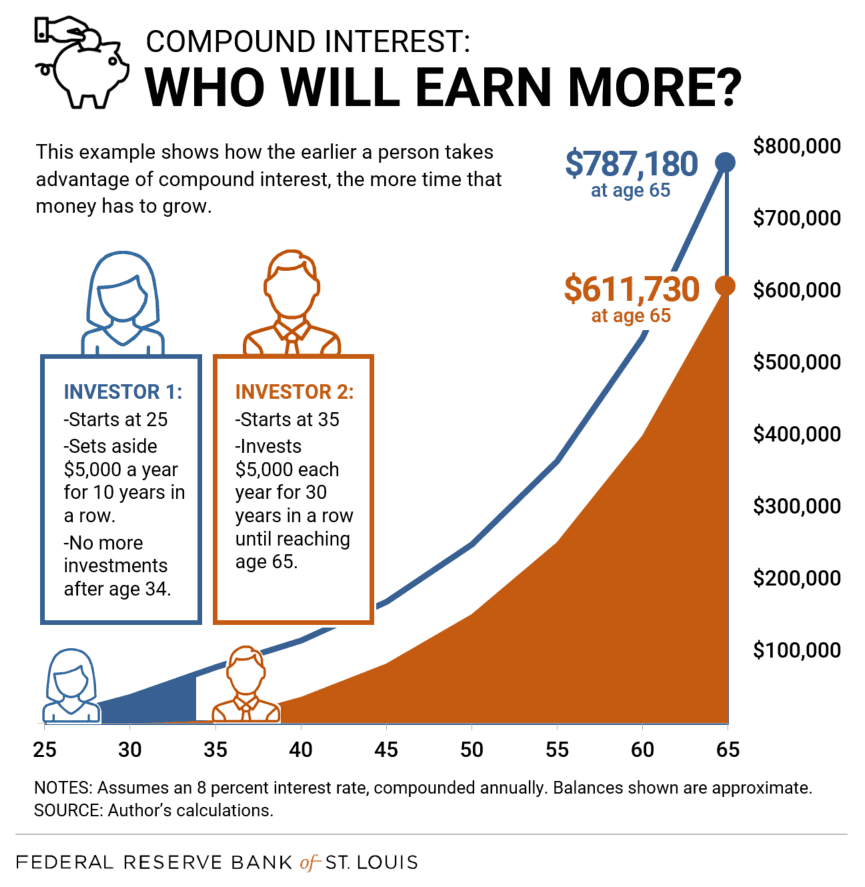
Consider two hypothetical investors:
-
Alice: Starts investing $5,000 annually at age 25 for 10 years (total invested: $50,000), then stops contributing but lets her money grow at 7% annually until age 65.
-
Bob: Waits until age 35 to start investing $5,000 annually, but he contributes for 30 years (total invested: $150,000) until age 65, also at 7% annually.
Despite investing three times more money, Bob will likely end up with significantly less than Alice, whose initial contributions had an extra decade of compounding. Alice’s early contributions had more time to benefit from the snowball effect, demonstrating that even smaller, earlier investments can outperform larger, later ones.
Strategic Approaches to Leverage Annual Compounding
To effectively harness the power of annual compounding for your financial goals, consider these strategic approaches:
Key Investment Vehicles for Compounding Growth
-
Stocks: Investing in stocks allows for growth through capital appreciation (the stock price increasing) and dividends. Reinvesting these dividends to buy more shares is a classic compounding strategy.
-
Bonds: Bonds offer interest payments. Reinvesting these “coupon payments” can help compound your returns, either by purchasing more bonds or by diversifying into other assets.
-
Mutual Funds & Exchange-Traded Funds (ETFs): These diversified investment vehicles pool money from many investors and invest in a variety of stocks, bonds, or other assets. They often distribute capital gains and dividends which can be automatically reinvested within the fund, accelerating growth.
-
Retirement Accounts (401(k)s, IRAs, Roth IRAs): These tax-advantaged accounts are specifically designed for long-term growth. Money grows tax-deferred in traditional accounts or tax-free in Roth accounts, allowing compounding to work its magic without annual tax drag, making them ideal environments for maximizing compounding.
-
Real Estate: While not always as liquid, real estate can compound through property appreciation over time and the reinvestment of rental income back into the property or other investments.

Maximizing Your Compounding Potential
-
Consistency is Key: Regular contributions to your investments, even modest amounts, significantly increase your principal base over time, giving compounding more fuel. Automating these contributions ensures consistency.
-
Always Reinvest Earnings: Make it a habit or set up automatic reinvestment for any dividends, interest, or capital gains you receive. This ensures that your money is continually working harder for you.
-
Minimize Fees: High investment fees (management fees, trading fees, expense ratios) directly reduce your returns, thereby shrinking the amount available to compound. Choose low-cost index funds or ETFs and platforms with minimal fees.
-
Strategic Use of Tax-Advantaged Accounts: Leverage the power of accounts like 401(k)s, IRAs, and Health Savings Accounts (HSAs) to allow your investments to compound tax-deferred or tax-free. This means a larger sum remains invested, leading to significantly higher wealth accumulation over decades.
-
Avoid High-Interest Debt: Just as positive compounding works for you, negative compounding works against you. High-interest debt, such as credit card balances, compounds rapidly, increasing the amount you owe exponentially. Prioritize paying off such debts to free up capital for positive compounding investments.
Understanding what it means for money to compound annually provides a clear roadmap for long-term financial success. By starting early, being consistent, and strategically choosing the right investment vehicles, you can put the power of compound interest to work and build substantial wealth over your lifetime.
aViewFromTheCave is a participant in the Amazon Services LLC Associates Program, an affiliate advertising program designed to provide a means for sites to earn advertising fees by advertising and linking to Amazon.com. Amazon, the Amazon logo, AmazonSupply, and the AmazonSupply logo are trademarks of Amazon.com, Inc. or its affiliates. As an Amazon Associate we earn affiliate commissions from qualifying purchases.