
In the dynamic world of personal finance, investing, and business management, numbers tell a story. But raw figures alone often lack the context needed for truly insightful decision-making. That’s where the ability to calculate a percent increase or decrease becomes not just useful, but absolutely indispensable. Whether you’re tracking the growth of your investment portfolio, analyzing a company’s sales performance, managing your household budget, or evaluating a salary offer, understanding percent change allows you to interpret fluctuations with precision and make informed choices.
This fundamental mathematical concept provides a standardized way to measure the relative change between two values over time, or between a projected and actual outcome. It transforms absolute dollar amounts, which can vary wildly in significance depending on the scale, into universally comparable percentages. A $100 increase might be negligible for a million-dollar business but transformative for a small side hustle. Expressed as a percentage, however, its true impact becomes clear. In this comprehensive guide, we’ll demystify percent increase and decrease, providing clear, step-by-step instructions and practical examples that empower you to wield this crucial financial tool with confidence.
The Core Concepts: Understanding Percent Change in Financial Context
At its heart, percent change is a measure of the relative difference between an initial value and a final value, expressed as a percentage of the initial value. It’s a powerful metric because it standardizes comparison, allowing us to gauge the magnitude of a change irrespective of the original numbers’ scale. Without this tool, evaluating financial performance would be like trying to compare the speed of two cars without a common unit of measurement.
Why Percent Change Matters in Money Management
For individuals, percent change is critical for managing personal finances. Did your utility bill increase by 15% this month? Is your investment account up 8% year-to-date? Understanding these percentages helps you identify trends, make adjustments to your spending, and assess the effectiveness of your financial strategies. For instance, a 5% increase in your annual salary might sound good, but if inflation is 7%, your purchasing power has actually decreased by 2%.
In the realm of investing, percent change is king. Stock market reports constantly refer to percentage gains or losses. Fund managers, analysts, and individual investors all rely on these calculations to evaluate the performance of assets, compare different investment opportunities, and understand the impact of market movements on their portfolios. A stock that rises by 2% is generally considered to be performing better than one that rises by 0.5%, regardless of their starting prices.
For businesses, from small startups to multinational corporations, percent change is integral to financial analysis and strategic planning. Sales growth, profit margins, cost reductions, market share fluctuations—all are frequently expressed as percentages. This allows management to set targets, monitor progress, identify areas for improvement, and communicate performance effectively to stakeholders. A company reporting a 10% increase in quarterly revenue signals healthy growth, while a 3% decrease in operating costs suggests improved efficiency.
Differentiating Between Increase and Decrease
While both calculations use similar components, the distinction between a percent increase and a percent decrease is fundamental. A percent increase occurs when the final value is greater than the initial value, indicating growth, gain, or positive change. A percent decrease occurs when the final value is less than the initial value, signifying shrinkage, loss, or negative change.
The common misconception is that you simply use the same formula and the sign will tell you if it’s an increase or decrease. While mathematically true for some approaches, it’s often clearer and more intuitive, especially in financial reporting, to conceptualize them as distinct scenarios, ensuring the result is always a positive percentage value accompanied by the descriptor “increase” or “decrease.” This avoids ambiguity and provides a clearer narrative.
Step-by-Step Guide: Calculating Percent Increase
Calculating a percent increase allows you to quantify growth, whether it’s the appreciation of an asset, the rise in income, or the expansion of a business metric. It’s a straightforward process that involves three simple steps.
The Formula for Percent Increase
The general formula for calculating percent increase is:
Percent Increase = ((Final Value - Initial Value) / Initial Value) * 100
Let’s break down each component:
-
Final Value: The new, larger number you are comparing to the initial value.
-
Initial Value: The original, smaller number from which the change began.
-
Difference (Final Value – Initial Value): This gives you the absolute amount of the increase.
-
Divide by Initial Value: This step normalizes the increase, showing it as a fraction of the original value.
-
Multiply by 100: This converts the resulting decimal or fraction into a percentage.
Practical Examples: Investment Growth and Revenue Boost
Let’s apply this formula to real-world financial scenarios.
Example 1: Investment Portfolio Growth
Imagine you invested $10,000 in a mutual fund at the beginning of the year. By the end of the year, your investment grew to $11,500. What is the percent increase in your investment?
-
Identify Initial Value: $10,000
-
Identify Final Value: $11,500
-
Calculate the Difference: $11,500 – $10,000 = $1,500
-
Divide by Initial Value: $1,500 / $10,000 = 0.15
-
Multiply by 100: 0.15 * 100 = 15%
Your investment saw a 15% increase. This metric is crucial for comparing its performance against benchmarks or other investment opportunities.
Example 2: Business Revenue Boost
A small business generated $50,000 in revenue last quarter. Due to a successful marketing campaign, their revenue this quarter jumped to $62,500. What is the percent increase in their revenue?
-
Identify Initial Value: $50,000
-
Identify Final Value: $62,500
-
Calculate the Difference: $62,500 – $50,000 = $12,500
-
Divide by Initial Value: $12,500 / $50,000 = 0.25
-
Multiply by 100: 0.25 * 100 = 25%
The business experienced a remarkable 25% increase in revenue. This significant jump provides clear evidence of the marketing campaign’s effectiveness.

Step-by-Step Guide: Calculating Percent Decrease
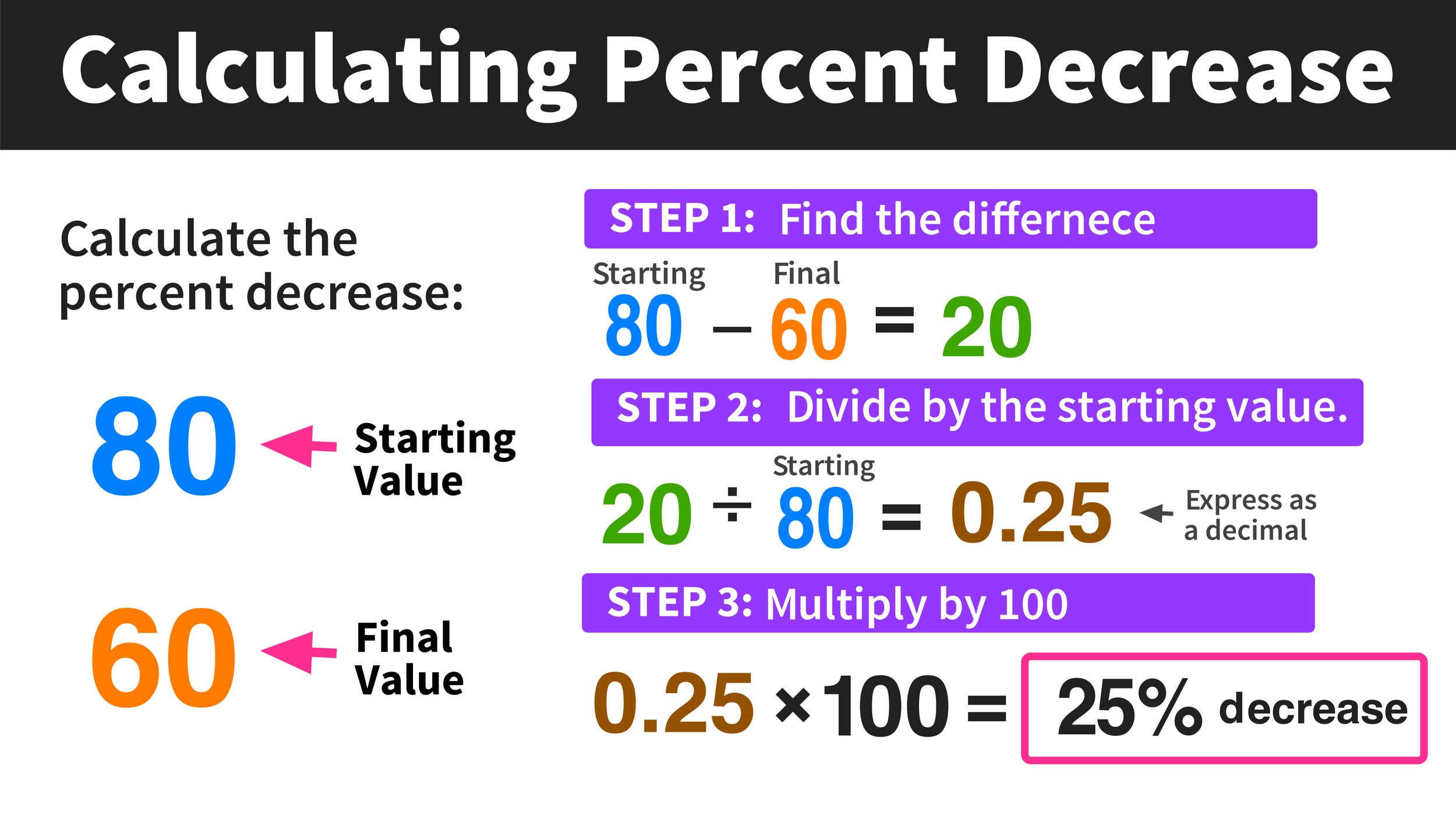
Just as important as measuring growth is understanding shrinkage or loss. Calculating a percent decrease helps you quantify reductions in expenses, declines in asset value, or drops in income. The process is very similar to calculating an increase, with a slight adjustment to the initial part of the formula.
The Formula for Percent Decrease
The general formula for calculating percent decrease is:
Percent Decrease = ((Initial Value - Final Value) / Initial Value) * 100
Again, let’s look at the components:
-
Initial Value: The original, larger number from which the change began.
-
Final Value: The new, smaller number you are comparing to the initial value.
-
Difference (Initial Value – Final Value): This gives you the absolute amount of the decrease. Note that we subtract the Final Value from the Initial Value to ensure a positive difference for the decrease calculation.
-
Divide by Initial Value: This normalizes the decrease, showing it as a fraction of the original value.
-
Multiply by 100: This converts the resulting decimal or fraction into a percentage.
Practical Examples: Budget Cuts and Stock Declines
Let’s apply this formula to common financial scenarios involving reduction.
Example 1: Personal Budget Cuts
Suppose your monthly discretionary spending was $800 last month. After reviewing your budget, you managed to cut it down to $640 this month. What is the percent decrease in your discretionary spending?
-
Identify Initial Value: $800
-
Identify Final Value: $640
-
Calculate the Difference: $800 – $640 = $160
-
Divide by Initial Value: $160 / $800 = 0.20
-
Multiply by 100: 0.20 * 100 = 20%
You achieved a 20% decrease in your discretionary spending, a significant improvement for your financial health.
Example 2: Stock Value Decline
You own shares in a company that were valued at $75 per share yesterday. Today, due to market volatility, the price dropped to $60 per share. What is the percent decrease in the stock’s value?
-
Identify Initial Value: $75
-
Identify Final Value: $60
-
Calculate the Difference: $75 – $60 = $15
-
Divide by Initial Value: $15 / $75 = 0.20
-
Multiply by 100: 0.20 * 100 = 20%
The stock experienced a 20% decrease in its value. This figure helps investors quickly gauge the severity of a price drop.
Common Pitfalls and Advanced Applications
While the core calculations are straightforward, several nuances and advanced applications make the understanding of percent change even more valuable in finance.
Avoiding Common Calculation Errors
-
Using the Wrong Base (Initial Value): This is the most common mistake. Always divide by the original or starting value. For instance, if a stock goes from $100 to $120 (20% increase) and then drops back to $100, the decrease is not 20% ($20/$120 = 16.67%). The base for the decrease is $120.
-
Confusing Absolute Change with Percent Change: A $100 change means very different things depending on whether the starting value was $1,000 or $100,000. Always ensure you’re using percent change for relative comparisons.
-
Order of Operations: Ensure you perform the subtraction first, then the division, and finally the multiplication by 100.
-
Rounding Errors: When dealing with financial figures, especially in large portfolios or business reports, be mindful of rounding. It’s often best to carry more decimal places through the calculation and round only the final percentage.
Annualized Returns and Compounding Interest
Percent change forms the bedrock of more complex financial concepts like annualized returns and compounding interest.
-
Annualized Return: If an investment gains 5% in three months, simply multiplying by four to get a 20% annual return is incorrect because it doesn’t account for compounding. Annualized returns use more complex formulas that effectively calculate the equivalent annual simple interest rate that would yield the same cumulative growth over a specified period. This allows for fair comparisons of investments held for different durations.
-
Compounding Interest: When you earn interest on your initial investment and on the accumulated interest from previous periods, you’re benefiting from compounding. Percent increase helps quantify this exponential growth. A savings account offering a “2% annual percentage yield (APY)” explicitly states the effective annual rate, taking compounding into account, rather than just the simple stated interest rate.
Using Financial Tools for Efficiency
While manual calculation is essential for understanding, in practice, financial professionals and savvy individuals often leverage tools to streamline the process:
-
Spreadsheets (e.g., Excel, Google Sheets): These are perhaps the most powerful and versatile tools. You can set up formulas (e.g.,
=(B2-A2)/A2and format as a percentage) to automatically calculate percent change for large datasets, track trends over time, and visualize changes with charts. -
Online Calculators: Numerous websites offer free percentage change calculators. These are quick for one-off calculations and ensure accuracy.
-
Financial Software and Apps: Most personal finance software, investment platforms, and accounting tools automatically display percent changes for your balances, investments, income, and expenses, making it easy to monitor your financial health at a glance. Understanding the underlying calculation still provides crucial context for interpreting these figures.

Mastering Percent Change for Financial Empowerment
The ability to accurately calculate a percent increase or decrease is more than just a mathematical skill; it’s a critical component of financial literacy and empowerment. It equips you with the analytical lens needed to critically evaluate financial news, assess investment opportunities, manage your personal budget effectively, and make strategic business decisions.
From understanding the true return on your retirement savings to negotiating a raise based on market value, or even simply decoding a discount during a sale, percent change provides the clarity necessary to navigate a world driven by numbers. By mastering these fundamental calculations, you transform from a passive observer of financial fluctuations into an active, informed participant, capable of making data-driven choices that align with your financial goals and lead to greater financial success. Start practicing these calculations today, and watch your financial acumen grow, much like a well-managed investment portfolio.
aViewFromTheCave is a participant in the Amazon Services LLC Associates Program, an affiliate advertising program designed to provide a means for sites to earn advertising fees by advertising and linking to Amazon.com. Amazon, the Amazon logo, AmazonSupply, and the AmazonSupply logo are trademarks of Amazon.com, Inc. or its affiliates. As an Amazon Associate we earn affiliate commissions from qualifying purchases.