
Understanding how monthly interest is calculated is a fundamental skill for anyone managing their finances. Whether you’re paying off a loan, growing your savings, or simply trying to make sense of your credit card statement, interest is a ubiquitous force in the financial world. Far from being a mere abstract concept, monthly interest directly impacts your financial well-being, influencing how much you pay for credit, how quickly your debt accumulates, and the pace at which your wealth can grow.
This guide aims to demystify the process, breaking down the essential components of interest calculation and providing you with the knowledge and tools to confidently figure out monthly interest in various financial scenarios. By the end, you’ll not only understand the “how” but also the “why” behind these crucial calculations, empowering you to make more informed financial decisions.
The Essential Role of Interest in Your Financial Life
At its core, interest is the cost of borrowing money or the reward for lending it. It’s the price you pay to use someone else’s money or the payment you receive for allowing someone else to use yours. While seemingly straightforward, the nuances of how interest is applied, particularly on a monthly basis, can significantly alter the total amount repaid or earned over time.
What Exactly Is Interest?
Interest can be defined as a fee paid by a borrower of assets to a lender as a form of compensation for the use of the assets. For consumers, this often translates to the extra money you pay on top of the principal amount borrowed for a mortgage, car loan, or credit card. Conversely, it’s the extra money banks pay you for keeping your funds in a savings account or certificate of deposit (CD). The rate at which this fee is charged or paid is typically expressed as a percentage of the principal amount.
Why Understanding Monthly Interest Matters
For individuals, grasping monthly interest is critical for several reasons. On the debt side, it allows you to accurately project your total repayment obligations and understand how quickly your balance can grow if left unchecked. This insight is crucial for developing effective debt repayment strategies, such as prioritizing high-interest debts or calculating the impact of extra payments. On the savings side, understanding monthly interest helps you project the growth of your investments and savings accounts, enabling better long-term financial planning and goal setting. Ignorance of monthly interest calculations can lead to unexpected debt burdens or missed opportunities for wealth accumulation.
Types of Interest: Simple vs. Compound
Before diving into calculations, it’s important to distinguish between the two primary types of interest:
-
Simple Interest: This is calculated only on the principal amount of a loan or deposit. It’s the easiest to calculate and is often used for short-term loans or bonds.
- Formula: Simple Interest = Principal × Interest Rate × Time
-
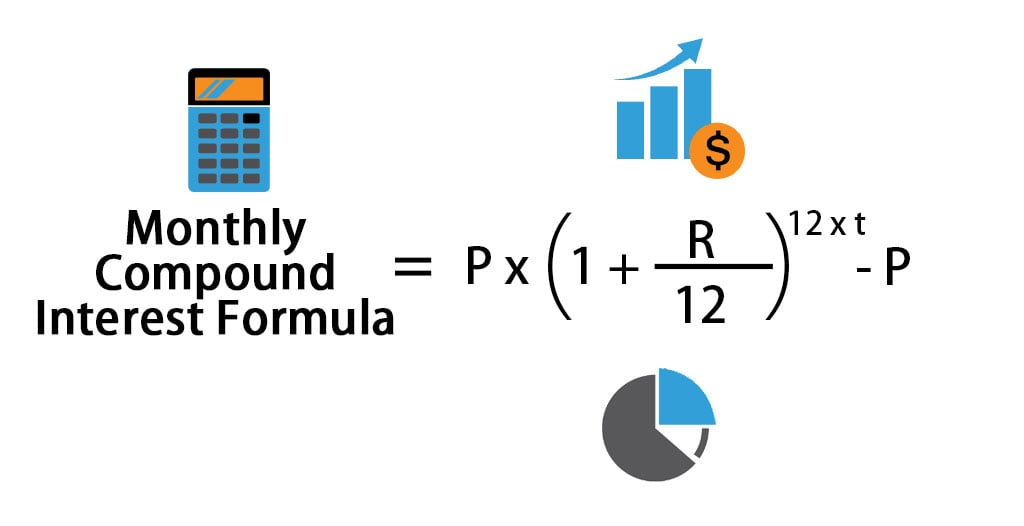
Compound Interest: This is interest calculated on the initial principal and also on all the accumulated interest from previous periods. It’s often referred to as “interest on interest” and is the dominant form of interest for most long-term loans (like mortgages) and savings accounts. The frequency of compounding (daily, monthly, quarterly, annually) significantly impacts the total amount. Monthly compounding, in particular, means that interest is added to your principal balance twelve times a year, causing your balance to grow or shrink more rapidly.
Deconstructing the Variables: What You Need to Know
To accurately calculate monthly interest, you need to be familiar with several key variables. Each plays a critical role in the final calculation, and a misunderstanding of any one can lead to inaccurate results.
Principal: The Starting Sum
The principal is the initial amount of money borrowed or invested. It’s the foundation upon which all interest calculations are built. For a loan, it’s the original amount you took out. For a savings account, it’s the amount you deposited. Subsequent interest calculations will apply to this principal, and for compound interest, to the growing principal balance.
The Interest Rate: APR vs. APY and Nominal vs. Effective
The interest rate is perhaps the most critical variable. It’s typically expressed as an annual percentage. However, understanding its nuances is crucial:
-
Annual Percentage Rate (APR): This represents the annual cost of borrowing money or earning on an investment, including any fees or additional costs associated with the transaction. For loans, APR gives you a broader picture of the loan’s total cost beyond just the interest rate itself.
-
Annual Percentage Yield (APY): This reflects the actual rate of return earned on an investment, taking into account the effect of compounding interest. APY is typically higher than the nominal interest rate when compounding occurs more frequently than once a year.
-
Nominal Interest Rate: This is the stated or advertised interest rate, often an annual rate, without taking into account the effect of compounding.
-
Effective Interest Rate: This is the actual interest rate earned or paid over a period, considering the effect of compounding. When interest is compounded monthly, the effective monthly rate is what we often need.
When calculating monthly interest, you’ll almost always need to convert the annual interest rate (APR) into a monthly rate. This is usually done by dividing the APR by 12. For example, a 12% APR becomes a 1% monthly interest rate.
Loan Term and Compounding Frequency: Time and How Often Interest Accrues
-
Loan Term: This is the duration over which the loan is to be repaid or the investment is to mature. It’s typically expressed in years, but for monthly calculations, it often needs to be converted into months (e.g., a 5-year loan is 60 months).
-
Compounding Frequency: As discussed, this refers to how often the interest is calculated and added to the principal balance. Monthly compounding is a very common frequency, especially for consumer loans and savings products. The more frequent the compounding, the greater the impact of compound interest.
The Impact of Payments: Amortization Schedules
For installment loans (like mortgages or car loans), your monthly payment includes both principal and interest. An amortization schedule details how each payment is applied, showing how the proportion of interest versus principal changes over the life of the loan. Early in a loan term, a larger portion of your payment goes towards interest, with less towards principal. As the principal balance decreases, a larger portion of subsequent payments goes towards reducing the principal. This dynamic is essential for understanding your long-term debt trajectory.
Practical Calculations: Your Step-by-Step Guide
Now, let’s get down to the actual formulas and steps for calculating monthly interest in various scenarios.
Calculating Simple Monthly Interest
While less common for long-term consumer debt, simple interest is straightforward:
-
Determine the Monthly Interest Rate: Divide the annual interest rate (APR) by 12.
- Example: If APR is 6%, then monthly rate = 0.06 / 12 = 0.005.
-
Calculate Monthly Simple Interest: Multiply the principal by the monthly interest rate.
-
Formula: Monthly Simple Interest = Principal × (APR / 12)
-
Example: On a $1,000 loan at 6% APR, monthly simple interest = $1,000 × 0.005 = $5.
-
Mastering Compound Monthly Interest
Compound interest is more complex because the principal changes each month. Here’s how it generally works for loans where payments are made:
-
Determine the Monthly Interest Rate: Divide the annual interest rate (APR) by 12.
- Example: 18% APR = 0.18 / 12 = 0.015 (monthly rate).
-
Calculate Interest for the Current Month: Multiply your outstanding principal balance by the monthly interest rate.
-
Apply Your Payment: Subtract your monthly payment from your outstanding balance.
-
Update Principal: Subtract the interest calculated in step 2 from the interest portion of your payment. The remaining part of your payment reduces the principal. Your new outstanding principal balance for the next month is the old principal minus the principal reduction.

A more common scenario is calculating interest on a fixed loan payment, which uses a specific loan amortization formula.
The Power of Amortization: Calculating Monthly Loan Payments
For fixed-payment loans like mortgages or auto loans, the monthly payment (which includes both principal and interest) is calculated using an amortization formula:
$$M = P [ i(1 + i)^n ] / [ (1 + i)^n – 1]$$
Where:
-
M = Monthly payment
-
P = Principal loan amount
-
i = Monthly interest rate (annual rate divided by 12)
-
n = Total number of payments (loan term in years multiplied by 12)
Once you have M, you can then figure out how much of each payment goes to interest in a given month:
-
Interest Paid for Month 1: Principal × Monthly Interest Rate
-
Principal Paid for Month 1: Monthly Payment (M) – Interest Paid for Month 1
-
New Principal Balance: Principal – Principal Paid for Month 1
You would repeat this for subsequent months, using the new principal balance for the next month’s interest calculation.
Examples for Clarity: Loans, Credit Cards, and Savings
-
Mortgage/Auto Loan: Suppose you have a $200,000 mortgage at 4% APR over 30 years (360 months).
-
Monthly interest rate (i) = 0.04 / 12 = 0.003333
-
Using the amortization formula, your monthly payment (M) would be approximately $954.83.
-
Month 1 Interest: $200,000 × 0.003333 = $666.60
-
Month 1 Principal Paid: $954.83 – $666.60 = $288.23
-
New Principal: $200,000 – $288.23 = $199,711.77
This process continues, with the interest portion decreasing and the principal portion increasing over time.
-
-
Credit Card Interest: Credit cards typically use an average daily balance method.
-
Assume a $1,000 balance with an 18% APR.
-
Monthly interest rate = 0.18 / 12 = 0.015.
-
If you carry the full $1,000 balance for the entire month, the interest charge would be $1,000 × 0.015 = $15.
-
However, credit card interest often accrues daily. Your APR is divided by 365 (or 360) to get a daily periodic rate, which is then applied to your daily balance.
-
-
Savings Account: A savings account with a $5,000 balance and a 0.5% APY, compounded monthly.
-
Monthly interest rate (assuming APY is already effective, or converting APR to effective monthly rate) would be roughly 0.005 / 12 = 0.0004167.
-
Month 1 Interest: $5,000 × 0.0004167 = $2.08
-
New Balance: $5,000 + $2.08 = $5,002.08
The next month’s interest would be calculated on $5,002.08, showcasing the power of compounding.
-
Real-World Scenarios: Applying Your Knowledge
The ability to calculate monthly interest is not just an academic exercise; it’s a practical skill with significant implications across various financial products.
Mortgage Interest: The Long-Term Commitment
Mortgages are perhaps the largest financial commitment for many, and understanding their monthly interest component is paramount. Early in a mortgage’s life, a substantial portion of your monthly payment goes towards interest. Knowing this can motivate you to make extra principal payments, even small ones, to significantly reduce the total interest paid and shorten the loan term. Conversely, understanding the interest structure helps you evaluate different mortgage products (fixed-rate vs. adjustable-rate) and their long-term cost.
Personal and Auto Loans: Fixed vs. Variable Rates
Personal loans and auto loans also involve monthly interest calculations, typically using a fixed interest rate and an amortization schedule. For these loans, understanding the monthly interest helps you budget accurately and compare offers from different lenders. If considering a variable-rate loan, knowing how interest rates can fluctuate and impact your monthly payment becomes even more critical for risk assessment.
Credit Card Interest: Understanding Revolving Debt
Credit card interest is notorious for its ability to quickly balloon debt. Unlike installment loans with a fixed term, credit cards offer revolving credit. If you don’t pay your balance in full each month, interest is charged on the average daily balance. High APRs and monthly compounding can make even small balances grow rapidly. Mastering credit card interest calculation empowers you to prioritize paying off high-interest debt and avoid accruing unnecessary charges by understanding payment due dates and grace periods.
Savings and Investment Accounts: Earning Interest on Your Money
On the flip side, understanding monthly interest is key to maximizing your earnings from savings accounts, certificates of deposit (CDs), and certain investment products. Knowing the compounding frequency and effective annual yield allows you to compare different savings vehicles and choose those that offer the best return on your money. The earlier you start saving and the more frequently interest compounds, the more powerful the effect of “interest on interest” becomes.
Leveraging Tools and Strategies for Optimal Management
While manual calculations are valuable for understanding, modern financial management often benefits from leveraging available tools and adopting smart strategies.
Online Calculators and Spreadsheet Formulas
You don’t need to be a math wizard to calculate monthly interest. Numerous online interest calculators are available for mortgages, loans, and savings accounts. These tools allow you to input your principal, interest rate, and term, and they instantly provide monthly payments, total interest paid, and often even full amortization schedules. For more customized scenarios, spreadsheet software like Microsoft Excel or Google Sheets can be invaluable. You can create your own amortization tables using formulas to track principal and interest payments over time.
Financial Apps and Software
Many personal finance apps and budgeting software integrate interest calculation features, often linked directly to your bank and loan accounts. These tools can track your current balances, show you how much interest you’re paying or earning, and help you visualize the impact of extra payments. Some even offer projections based on different repayment strategies.
Strategies for Minimizing Interest Paid (Debt Management)
-
Pay More Than the Minimum: Even small extra principal payments can significantly reduce the total interest paid over the life of a loan.
-
Prioritize High-Interest Debt: Use strategies like the “debt avalanche” (paying off highest interest rate debt first) to save money on interest.
-
Refinance Loans: If interest rates have dropped or your credit score has improved, refinancing can secure a lower APR, reducing your monthly interest charges.
-
Avoid Carrying Credit Card Balances: Pay your credit card bill in full every month to avoid interest charges altogether.

Strategies for Maximizing Interest Earned (Savings & Investments)
-
Seek High-Yield Accounts: Look for savings accounts or CDs with competitive APYs and frequent compounding.
-
Automate Savings: Set up automatic transfers to your savings or investment accounts to consistently benefit from compounding.
-
Start Early: The longer your money has to compound, the more substantial your earnings will be. Time is a powerful ally for compound interest.
-
Understand APY: Always compare APYs, not just stated interest rates, when evaluating savings products.
In conclusion, mastering how to figure out monthly interest is an indispensable component of financial literacy. It empowers you to navigate the complexities of loans, debt, and savings with confidence, enabling you to make strategic decisions that can profoundly impact your financial future. By understanding the core variables, utilizing available tools, and implementing smart strategies, you can minimize the cost of borrowing and maximize the power of your savings.
aViewFromTheCave is a participant in the Amazon Services LLC Associates Program, an affiliate advertising program designed to provide a means for sites to earn advertising fees by advertising and linking to Amazon.com. Amazon, the Amazon logo, AmazonSupply, and the AmazonSupply logo are trademarks of Amazon.com, Inc. or its affiliates. As an Amazon Associate we earn affiliate commissions from qualifying purchases.