
In the intricate world of finance, where every decision, every investment, and every budget allocation hinges on clear data, understanding growth is paramount. Whether you’re tracking the skyrocketing value of an investment, analyzing a company’s sales figures, or simply monitoring the creeping rise in your monthly expenses, the concept of percentage increase is a fundamental building block. It transcends mere numerical change, offering a contextual lens through which to gauge progress, identify trends, and make informed financial decisions. Far from being a complex mathematical enigma, calculating percentage increase is a straightforward skill, made even easier with the right tools and a clear understanding of its application. This article will guide you through the manual calculation, introduce you to powerful digital calculators, and, most importantly, illuminate why mastering this financial metric is indispensable for personal finance, investing, and business strategy alike.
The Fundamental Role of Percentage Increase in Finance
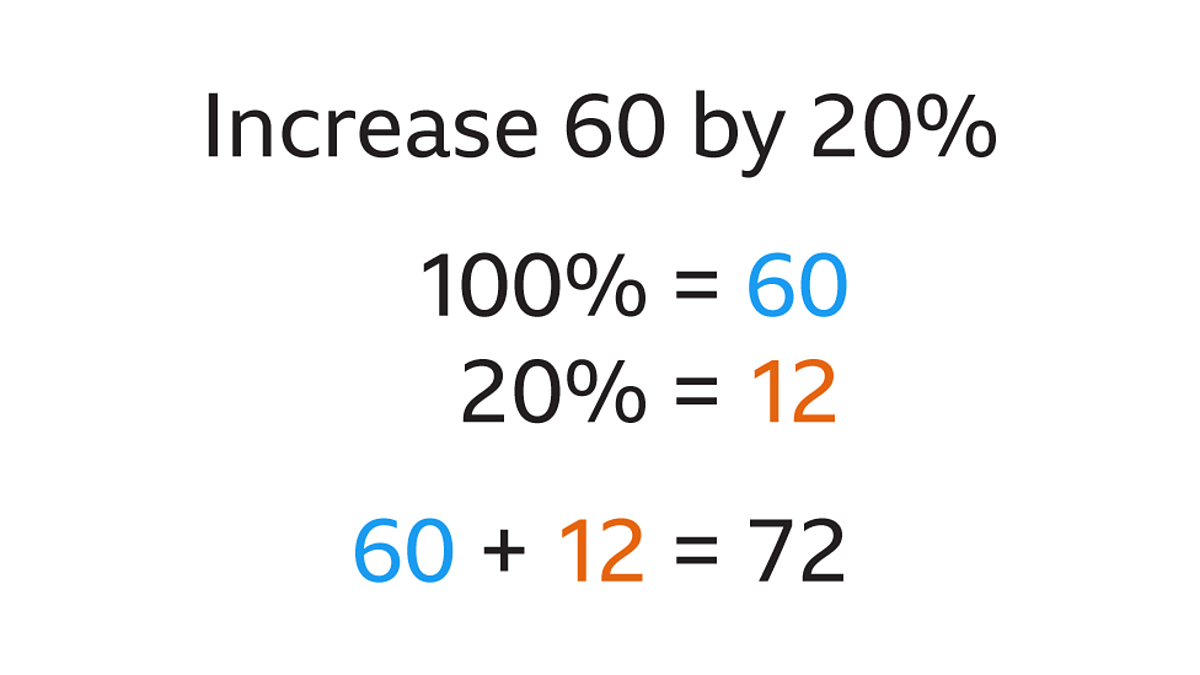
At its core, percentage increase quantifies the relative change between two values over time, expressing that change as a proportion of the initial value. Unlike a simple absolute increase, which only tells you the raw numerical difference, a percentage increase provides crucial context, allowing for meaningful comparisons and insights regardless of the scale of the numbers involved.
Defining Percentage Increase: More Than Just Numbers
Imagine your portfolio grew from $10,000 to $11,000. That’s a $1,000 absolute increase. Now, imagine another portfolio grew from $100,000 to $101,000. That’s also a $1,000 absolute increase. On the surface, they seem identical. However, when we express these changes as percentages, the story changes dramatically. The first portfolio saw a 10% increase ($1,000/$10,000), while the second experienced only a 1% increase ($1,000/$100,000). This simple example underscores the power of percentage increase in providing a standardized metric for growth, allowing us to accurately compare performance across different scales. It normalizes data, making it universally relatable and actionable.
Why Financial Professionals and Individuals Rely on It
For financial professionals—from fund managers to economists—percentage increase is a daily companion. It’s used to:
-
Evaluate investment returns: Comparing the percentage growth of different assets or portfolios over specific periods.
-
Analyze economic indicators: Tracking inflation rates, GDP growth, and employment changes.
-
Assess business performance: Monitoring sales growth, profit margins, and market share changes.
-
Forecast future trends: Projecting growth rates based on historical data.
For individuals, the utility is just as profound, though often less formally recognized. You might use it to:
-
Understand salary raises: Is a $5,000 raise significant on a $50,000 salary or a $150,000 salary?
-
Track personal net worth: Seeing how your assets grow year over year.
-
Gauge the impact of inflation: Understanding how much your purchasing power has decreased.
-
Compare loan interest rates or savings account yields: Making sure you’re getting the best deal.
Real-World Applications Across Your Financial Life
The applications of percentage increase are virtually limitless in the financial realm.
-
Personal Finance: Tracking the growth of your emergency fund, monitoring the interest accrual on debt, or evaluating the increase in your household budget over time. It helps in understanding the true cost of living adjustments or the impact of inflation on your expenses.
-
Investing: This is where percentage increase truly shines. Calculating the compound annual growth rate (CAGR) of an investment, comparing the performance of different stocks or mutual funds, or understanding the yield increase on bonds. It’s the language of investment performance.
-
Online Income & Side Hustles: If you’re building an online business or a side hustle, tracking the percentage increase in website traffic, sales conversions, or monthly recurring revenue is crucial for optimizing your strategy and scaling your operations.
-
Business Finance: From analyzing quarter-over-quarter sales growth to assessing the year-over-year increase in operating expenses or profit margins, percentage increase provides a clear snapshot of a business’s health and trajectory. It’s vital for stakeholders, investors, and management to make strategic decisions.
Mastering the Manual Calculation: The Foundation of Financial Literacy
While digital tools abound, understanding the manual calculation of percentage increase is fundamental. It not only demystifies the process but also empowers you to verify results and perform quick estimates when a calculator isn’t at hand.
The Core Formula: Step-by-Step Breakdown
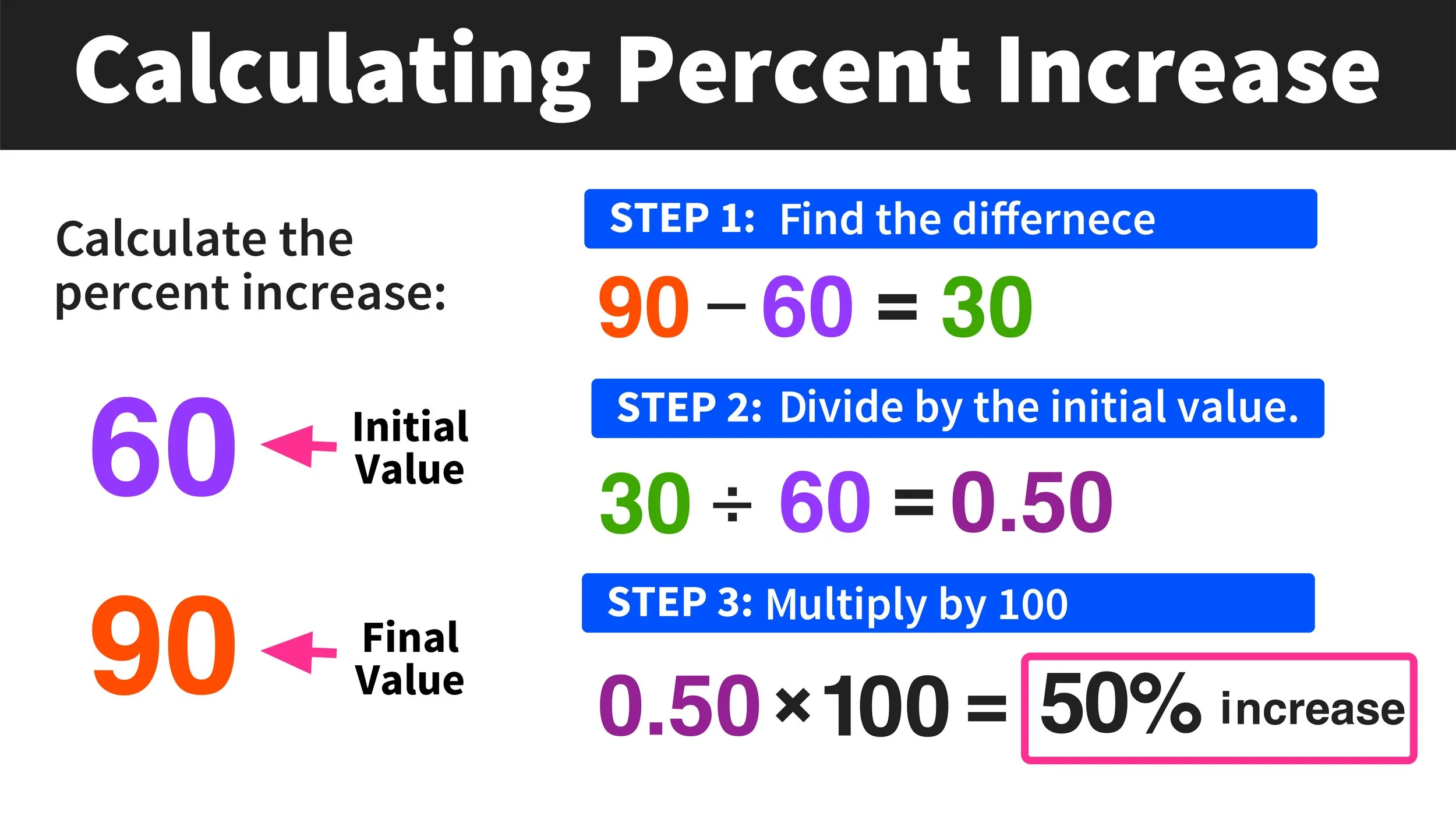
The formula for percentage increase is straightforward:
Percentage Increase = ((New Value – Original Value) / Original Value) * 100
Let’s break it down:
-
Find the Difference: Subtract the original value from the new value. This gives you the absolute increase.
- Example: If your stock value went from $50 to $60, the difference is $60 – $50 = $10.
-
Divide by the Original Value: Take the absolute increase and divide it by the original (starting) value. This expresses the increase as a decimal proportion of the original.
- Example: $10 / $50 = 0.20
-
Multiply by 100: To convert the decimal into a percentage, multiply by 100.
- Example: 0.20 * 100 = 20%
So, your stock experienced a 20% increase.
Practical Examples: From Savings Growth to Expense Hikes
Let’s apply this to a few financial scenarios:
Scenario 1: Savings Account Growth
-
Original Value: You started with $2,500 in your savings account.
-
New Value: After a year, your account balance is $2,650.
-
Calculation:
-
Difference: $2,650 – $2,500 = $150
-
Divide by Original: $150 / $2,500 = 0.06
-
Multiply by 100: 0.06 * 100 = 6%
-
-
Result: Your savings account grew by 6%.
Scenario 2: Business Sales Increase
-
Original Value: Last quarter’s sales were $75,000.
-
New Value: This quarter’s sales are $82,500.
-
Calculation:
-
Difference: $82,500 – $75,000 = $7,500
-
Divide by Original: $7,500 / $75,000 = 0.10
-
Multiply by 100: 0.10 * 100 = 10%
-
-
Result: Your business experienced a 10% increase in sales.
Scenario 3: Rent Increase
-
Original Value: Your monthly rent was $1,200.
-
New Value: Your landlord increased it to $1,260.
-
Calculation:
-
Difference: $1,260 – $1,200 = $60
-
Divide by Original: $60 / $1,200 = 0.05
-
Multiply by 100: 0.05 * 100 = 5%
-
-
Result: Your rent increased by 5%.
Common Mistakes to Avoid When Calculating Manually
Even with a simple formula, errors can creep in. Be mindful of:
-
Mixing up original and new values: Always subtract the original from the new, and always divide by the original value. Swapping them will lead to incorrect results (or a percentage decrease if the new value is smaller).
-
Forgetting to multiply by 100: This is a common oversight that leaves you with a decimal proportion instead of a percentage.
-
Rounding prematurely: For greater accuracy, especially in complex calculations involving multiple steps, it’s best to keep more decimal places during intermediate steps and only round the final percentage.
Leveraging Digital Power: Your Percentage Increase Calculator Toolkit
While manual calculation solidifies understanding, digital tools offer speed, accuracy, and the ability to handle large datasets effortlessly. They are indispensable for modern financial management.
Spreadsheet Solutions: Excel and Google Sheets for Dynamic Tracking
Spreadsheets are perhaps the most versatile and accessible digital calculators for financial analysis. They allow you to build dynamic models where you can change input values and instantly see updated percentage increases.
Excel/Google Sheets Formula:
If your original value is in cell A1 and your new value is in cell B1, the formula for percentage increase would be:
=(B1-A1)/A1 (This gives you the decimal change)
To display this as a percentage, format the cell as a “Percentage” style in the spreadsheet software, which will automatically multiply by 100 and add the percent symbol.
Alternatively, to directly get the percentage value without formatting:
=((B1-A1)/A1)*100
Benefits:
-
Customization: Create sophisticated financial models that track multiple metrics over time.
-
Automation: Set up formulas once, and they automatically update as you input new data.
-
Visualization: Easily generate charts and graphs to visualize percentage changes and trends.
-
Integration: Combine percentage increase calculations with other financial functions for budgeting, forecasting, and scenario planning.
Online Calculators and Mobile Apps: Speed and Convenience
For quick, one-off calculations or when you’re on the go, dedicated online calculators and mobile apps are invaluable. A quick search for “percentage increase calculator” will yield numerous options, often free to use.
Features to look for:
-
Simplicity: Easy-to-use interface with clear input fields for original and new values.
-
Instant Results: Calculates and displays the percentage increase immediately.
-
Reverse Calculation: Some advanced calculators can determine one of the values if the percentage change and another value are known.
-
Clear Labeling: Clearly identifies input and output fields to prevent confusion.
Benefits:
-
Accessibility: Available on any device with internet access.
-
Speed: Get instant results without setting up formulas.
-
User-Friendly: Designed for intuitive use by anyone, regardless of technical skill.
Business Finance Software: Integrated Analytics for Growth
For businesses, percentage increase calculations are often embedded within comprehensive financial software and accounting systems. Tools like QuickBooks, Xero, or more advanced ERP (Enterprise Resource Planning) systems automatically track and report on key performance indicators (KPIs) like revenue growth, profit margin increases, or expense reductions as percentages.
Benefits:
-
Automated Reporting: Generate financial statements and reports that include percentage changes without manual calculation.
-
Dashboards: Visual dashboards present real-time percentage growth metrics, allowing for quick insights.
-
Drill-Down Capabilities: Investigate the factors contributing to percentage changes in specific revenue streams or cost centers.
-
Historical Analysis: Easily compare current performance with past periods, highlighting growth trends or areas of concern.
These integrated solutions provide a robust framework for continuous financial monitoring and strategic decision-making, powered by percentage increase calculations.
Beyond the Basics: Interpreting and Applying Percentage Increase
Knowing how to calculate percentage increase is just the beginning. The true value lies in understanding what those percentages mean in a broader financial context and how to use them effectively.
Annualized vs. Simple Growth: Understanding the Nuances
It’s crucial to distinguish between simple percentage increase and annualized growth rates, especially in investing.
-
Simple Percentage Increase: This is what we’ve discussed—the change over a specific, often singular, period (e.g., a stock increased by 15% in one month).
-
Annualized Growth (CAGR – Compound Annual Growth Rate): This smooths out growth over multiple periods (typically years) to provide an average annual rate, assuming growth is compounded. It’s more complex to calculate but offers a more accurate representation of consistent long-term performance. For example, if an investment grew 10% in year one and 20% in year two, the simple two-year growth is 32%, but the annualized growth rate would be a more conservative figure, reflecting the compounding.
Understanding this distinction prevents misinterpretation of returns and allows for more accurate comparison of investments with different time horizons.
Context is King: What a Percentage Increase Really Tells You
A 5% increase in sales might sound good, but is it truly? The answer depends heavily on context:
-
Industry Benchmarks: Is 5% better or worse than the industry average? If competitors are growing at 15%, your 5% might be a red flag.
-
Inflation: If your investment grew by 3% but inflation was 5%, your real return was negative 2% (in terms of purchasing power).
-
Base Effect: A 100% increase on $10 is $10. A 1% increase on $1,000,000 is $10,000. While the percentage is small, the absolute impact is far greater. Always consider the base value.
-
Time Period: A 20% increase over a month is phenomenal; over five years, it might be mediocre.
Always analyze percentage increases within their relevant financial and economic context to extract meaningful insights.
Using Percentage Increase for Goal Setting and Performance Tracking
Percentage increase is a powerful tool for setting financial goals and tracking progress towards them.
-
Personal Finance: “I want to increase my emergency fund by 20% this year.” “I aim to reduce my debt by 15% annually.”
-
Investing: “My target is an average annual portfolio growth of 8%.” “I want to see a 10% increase in my retirement savings by year-end.”
-
Business: “We need to achieve a 15% increase in quarterly revenue.” “Our goal is to improve profit margins by 2% next fiscal year.”
By framing goals in terms of percentage increase, you create measurable targets that are relative to your current standing, making them more adaptable and comparable. Regular tracking of these percentages allows you to monitor performance, identify deviations, and adjust your strategies proactively.
Empowering Your Financial Journey with Percentage Insights
The ability to accurately calculate and critically interpret percentage increase is more than just a mathematical skill; it’s a fundamental aspect of financial literacy that empowers better decision-making across all facets of your economic life.
Making Informed Investment and Budgeting Decisions
Understanding percentage increases is crucial for evaluating investment opportunities. You can compare the historical percentage returns of different assets, analyze the percentage yield of various savings products, and assess the percentage risk associated with different investment strategies. In budgeting, tracking percentage increases in expenses (e.g., utilities, groceries) against percentage increases in income allows you to maintain financial control and identify areas for cost reduction or income enhancement. It helps you anticipate changes and adjust your spending habits before they become problematic.
Negotiating Salary, Loans, and Business Deals
When negotiating a salary, knowing the average percentage increase in your industry or for your role can strengthen your position. Similarly, when taking out a loan, understanding the percentage interest rate and how it compounds is critical to assessing the true cost. In business, negotiating supplier contracts, pricing products, or structuring partnerships often involves discussions around percentage discounts, margins, or profit shares. A solid grasp of these calculations gives you a significant advantage in securing favorable terms.

The Long-Term Impact of Small Percentage Changes
Perhaps one of the most profound insights offered by percentage increase is the power of compounding. Even small, consistent percentage increases over long periods can lead to astonishing growth. This principle is at the heart of long-term investing and wealth accumulation. A seemingly modest 7% annual return on an investment, when compounded over decades, can transform initial savings into a substantial nest egg. Conversely, a small percentage increase in debt interest, when compounded, can lead to a spiraling financial burden. Recognizing the long-term implications of these percentage shifts is vital for strategic financial planning and achieving lasting financial security.
In conclusion, the “how to do percentage increase calculator” is not merely about punching numbers into a device. It’s about gaining a deeper understanding of financial dynamics, leveraging essential tools, and applying these insights to navigate your personal and business finances with greater confidence and strategic foresight. Embrace this fundamental concept, and you will unlock a more informed and empowered financial future.
aViewFromTheCave is a participant in the Amazon Services LLC Associates Program, an affiliate advertising program designed to provide a means for sites to earn advertising fees by advertising and linking to Amazon.com. Amazon, the Amazon logo, AmazonSupply, and the AmazonSupply logo are trademarks of Amazon.com, Inc. or its affiliates. As an Amazon Associate we earn affiliate commissions from qualifying purchases.