
Percentages are more than just a mathematical concept; they are the bedrock of financial literacy, permeating every aspect of our monetary lives. From understanding the discount on a sale item to calculating investment returns, deciphering loan interest rates, or analyzing business profits, a firm grasp of “how to do percent” is not merely academic—it’s an essential life skill. In the realm of money, percentages provide a standardized way to compare parts to a whole, track changes, and evaluate performance, making complex financial information digestible and actionable.
This article delves into the indispensable role percentages play in personal finance, investing, business, and wealth creation. We will demystify their fundamental mechanics and then explore their myriad practical applications, equipping you with the knowledge to make more informed and strategic financial decisions.
The Fundamental Concept: What “Percent” Really Means
At its core, a percentage is a way to express a number as a fraction of 100. The term “percent” derives from the Latin “per centum,” meaning “by the hundred.” It’s a universal language for proportions, allowing us to compare different quantities on a common scale.
Deconstructing the Term “Percent”
When you see “25%”, it literally means 25 out of 100. This elegant simplicity makes percentages incredibly versatile for illustrating proportions without needing to know the actual total quantity involved initially. For instance, stating that 70% of your income goes to expenses is more immediately impactful and comparable than saying “$3,500 out of $5,000” if your total income varies. This standardized representation allows for easy comparison across different financial scenarios, whether you’re looking at sales figures for various products or allocating funds within distinct budgets. It provides a quick, intuitive snapshot of relative size or significance.
The Essential Conversions: Decimals, Fractions, and Percents
To effectively work with percentages in financial calculations, you must be comfortable converting between percentages, decimals, and fractions. These conversions are fundamental tools in your financial toolkit.
-
Percent to Decimal: To convert a percentage to a decimal, simply divide the percentage by 100 (or move the decimal point two places to the left).
-
Example: 45% = 45 / 100 = 0.45
-
Example: 5% = 5 / 100 = 0.05
-
-
Decimal to Percent: To convert a decimal to a percentage, multiply the decimal by 100 (or move the decimal point two places to the right).
-
Example: 0.75 = 0.75 * 100 = 75%
-
Example: 1.20 = 1.20 * 100 = 120%
-
-
Fraction to Decimal: Divide the numerator by the denominator.
- Example: 1/4 = 1 ÷ 4 = 0.25
-
Fraction to Percent: First convert the fraction to a decimal, then convert the decimal to a percentage.
- Example: 3/5 = 3 ÷ 5 = 0.60 = 60%
Mastering these conversions is crucial because most financial formulas and calculator functions operate using decimals, even when the input or output is conceptualized as a percentage. Understanding these relationships allows you to fluidly translate between the spoken language of finance (percentages) and the operational language of calculations (decimals).
The Universal Formula: Finding the Part, Whole, or Percent
The core of all percentage calculations revolves around one fundamental relationship: a part of a whole expressed as a percentage. This can be summarized by the formula:
(Part / Whole) x 100 = Percent
From this, you can derive other essential calculations:
-
Finding the Part: To find a certain percentage of a whole, convert the percentage to a decimal and multiply it by the whole.
-
Formula: (Percent / 100) * Whole = Part
-
Example: What is 30% of $200? (30 / 100) * $200 = 0.30 * $200 = $60.
-
-
Finding the Whole: If you know a part and the percentage it represents, you can find the whole by dividing the part by the percentage (expressed as a decimal).
-
Formula: Part / (Percent / 100) = Whole
-
Example: If $75 is 15% of your total budget, what is your total budget? $75 / (15 / 100) = $75 / 0.15 = $500.
-
-
Finding the Percent: To determine what percentage one number is of another, divide the part by the whole and multiply by 100.
- Example: What percentage is $40 of $160? ($40 / $160) * 100 = 0.25 * 100 = 25%.
These three variations of the fundamental percentage formula are the building blocks for nearly every financial calculation you’ll encounter.
Everyday Money: Percentages in Personal Finance Management
Percentages are interwoven into the fabric of daily financial life, impacting everything from shopping to budgeting and borrowing. Understanding these applications is key to smarter personal finance management.
Mastering Discounts, Sales Tax, and Tips
These are perhaps the most common percentage calculations we perform:
-
Discounts: When an item is “20% off,” you’re saving 20% of its original price.
-
Calculation: Discount Amount = Original Price * Discount Rate (as a decimal). New Price = Original Price – Discount Amount.
-
Example: A $50 shirt is 20% off. Discount = $50 * 0.20 = $10. New Price = $50 – $10 = $40.
-
-
Sales Tax: Added to the purchase price, sales tax is a percentage of the item’s cost.
-
Calculation: Tax Amount = Item Price * Tax Rate (as a decimal). Total Cost = Item Price + Tax Amount.
-
Example: A $100 purchase with an 8% sales tax. Tax = $100 * 0.08 = $8. Total Cost = $100 + $8 = $108.
-
-
Tips: A common practice in service industries, tips are usually a percentage of the bill.
-
Calculation: Tip Amount = Bill Amount * Tip Rate (as a decimal). Total Paid = Bill Amount + Tip Amount.
-
Example: A $60 dinner bill, with a 15% tip. Tip = $60 * 0.15 = $9. Total Paid = $60 + $9 = $69.
-
Being proficient in these calculations ensures you know the true cost of purchases and can quickly verify charges.
Decoding Interest Rates: Loans, Savings, and Credit Cards
Interest rates are the “price” of borrowing or lending money, expressed as a percentage. They profoundly impact your financial health:
-
Simple Interest: Often seen with basic loans or bonds, calculated as a percentage of the principal amount.
-
Formula: Interest = Principal * Rate (as a decimal) * Time (in years).
-
Example: A $1,000 loan at 5% simple interest for 2 years incurs $1,000 * 0.05 * 2 = $100 in interest.
-
-
Annual Percentage Rate (APR): For loans and credit cards, APR represents the annual cost of borrowing, including some fees. It helps compare different credit offers. A high APR means a higher cost to borrow.
-
Annual Percentage Yield (APY): For savings accounts and investments, APY reflects the effective annual rate of return, taking into account the effect of compounding interest. A higher APY means more earnings.
Even small differences in these percentage rates can translate into significant sums over time, underscoring the importance of understanding and comparing them.
Budgeting and Income Allocation for Financial Health
Budgeting effectively often involves allocating percentages of your income to different categories, providing a clear picture of your spending habits and financial priorities.
-
The 50/30/20 Rule: A popular guideline suggests allocating:
-
50% of your after-tax income to Needs (housing, utilities, groceries).
-
30% to Wants (dining out, entertainment, hobbies).
-
20% to Savings & Debt Repayment (emergency fund, retirement, extra principal payments).
-
-
Example: If your monthly after-tax income is $4,000:
-
Needs: 50% of $4,000 = $2,000
-
Wants: 30% of $4,000 = $1,200
-
Savings & Debt: 20% of $4,000 = $800
-
Using percentages for budgeting offers flexibility as your income changes; the proportions remain constant, allowing you to scale your spending and saving automatically.

Growing Your Wealth: Percentages in Investing and Financial Growth
For investors and wealth builders, percentages are indispensable tools for measuring performance, understanding growth, and managing risk.
Measuring Investment Returns: ROI and CAGR
Evaluating how well your investments are performing relies heavily on percentage-based metrics:
-
Return on Investment (ROI): A simple and widely used metric to assess the profitability of an investment relative to its cost.
-
Formula: ROI = ((Current Value – Original Cost) / Original Cost) * 100
-
Example: You invest $1,000 in a stock, which grows to $1,200. ROI = (($1,200 – $1,000) / $1,000) * 100 = (200 / 1000) * 100 = 20%.
-
-
Compound Annual Growth Rate (CAGR): Used to calculate the average annual growth rate of an investment over a specified period longer than one year, assuming the profits are reinvested. It provides a smoothed rate of return, useful for comparing investments with different volatility. While its formula is more complex, understanding what it represents—the average percentage growth per year—is key to comparing long-term investment performance accurately.
These metrics allow you to compare various investment opportunities on an “apples-to-apples” basis and understand the effectiveness of your investment strategies.
The Power of Compounding and Its Percentage Effect
Albert Einstein reportedly called compound interest the “eighth wonder of the world.” It’s the process where the interest you earn also starts earning interest, leading to exponential growth. This powerful effect is entirely percentage-driven.
-
Example: If you invest $1,000 at a 7% annual return, after one year you have $1,070. In the second year, you earn 7% on $1,070, not just the original $1,000, growing your capital even faster. Over decades, even modest percentage returns, compounded, can lead to substantial wealth accumulation.
-
The Rule of 72: A quick mental math trick to estimate how long it takes for an investment to double at a given annual percentage rate.
-
Formula: Years to Double = 72 / Annual Interest Rate (as a whole number).
-
Example: An investment growing at 8% per year will approximately double in 72 / 8 = 9 years.
-
Understanding the compounding effect empowers you to appreciate the value of starting early and consistently investing, even small amounts.
Portfolio Allocation and Risk Management
Investing involves balancing potential returns with risk, a task where percentages are critical for strategic portfolio allocation.
-
Asset Allocation: This refers to dividing your investment portfolio among different asset categories, such as stocks, bonds, and cash, using percentages. A common guideline might be 60% stocks, 30% bonds, 10% cash, tailored to your age, financial goals, and risk tolerance. For instance, younger investors might tolerate a higher percentage in stocks (higher risk, higher potential return), while those nearing retirement might opt for a higher percentage in bonds (lower risk, more stable returns).
-
Rebalancing: Over time, market fluctuations can shift your portfolio’s percentages away from your target allocation. Rebalancing involves adjusting your holdings back to your desired percentages, which is a crucial aspect of risk management and ensuring your portfolio aligns with your long-term strategy.
By using percentages to define and manage your portfolio’s composition, you gain a structured approach to risk and return.
Business and Beyond: Leveraging Percentages for Financial Success
Beyond personal finance, percentages are the lingua franca of business, essential for measuring performance, profitability, and growth.
Key Business Metrics: Profit Margins and Markup
For any business, understanding profitability means working with percentages:
-
Gross Profit Margin: Measures the percentage of revenue left after deducting the cost of goods sold (COGS).
-
Formula: ((Revenue – COGS) / Revenue) * 100
-
Example: If a business has $100,000 in revenue and $40,000 in COGS, its Gross Profit Margin is (($100,000 – $40,000) / $100,000) * 100 = 60%. This indicates how efficiently a business is producing its goods or services.
-
-
Net Profit Margin: Shows the percentage of revenue remaining after all expenses, including taxes and interest, have been deducted. It’s a key indicator of a company’s overall profitability.
- Formula: (Net Income / Revenue) * 100
-
Markup: The percentage added to a product’s cost to determine its selling price.
-
Formula: ((Selling Price – Cost) / Cost) * 100
-
Example: A product costs $10 to make and sells for $15. Markup = (($15 – $10) / $10) * 100 = 50%. This is crucial for pricing strategies and ensuring adequate revenue to cover costs and generate profit.
-
These margin percentages are vital for businesses to evaluate their financial health, compare performance against competitors, and make strategic pricing decisions.
Sales Commissions, Royalties, and Performance Incentives
Many income streams are directly tied to percentages:
-
Sales Commissions: Sales professionals often earn a percentage of the sales they generate.
- Example: A salesperson earns a 10% commission on sales. If they sell $5,000 worth of products, their commission is $5,000 * 0.10 = $500.
-
Royalties: Artists, authors, musicians, and inventors typically receive a percentage of the revenue generated from their creations.
- Example: An author earns a 15% royalty on book sales. If their book sells $10,000 worth of copies, they earn $1,500.
-
Performance Incentives: Bonuses or other compensation can be structured as a percentage of company profits or individual performance metrics.
Understanding these percentage-based compensation structures is essential for individuals to accurately project their earnings and for businesses to design effective incentive programs.
Analyzing Business Growth and Market Share
Percentages provide clear metrics for assessing a business’s expansion and competitive standing:
-
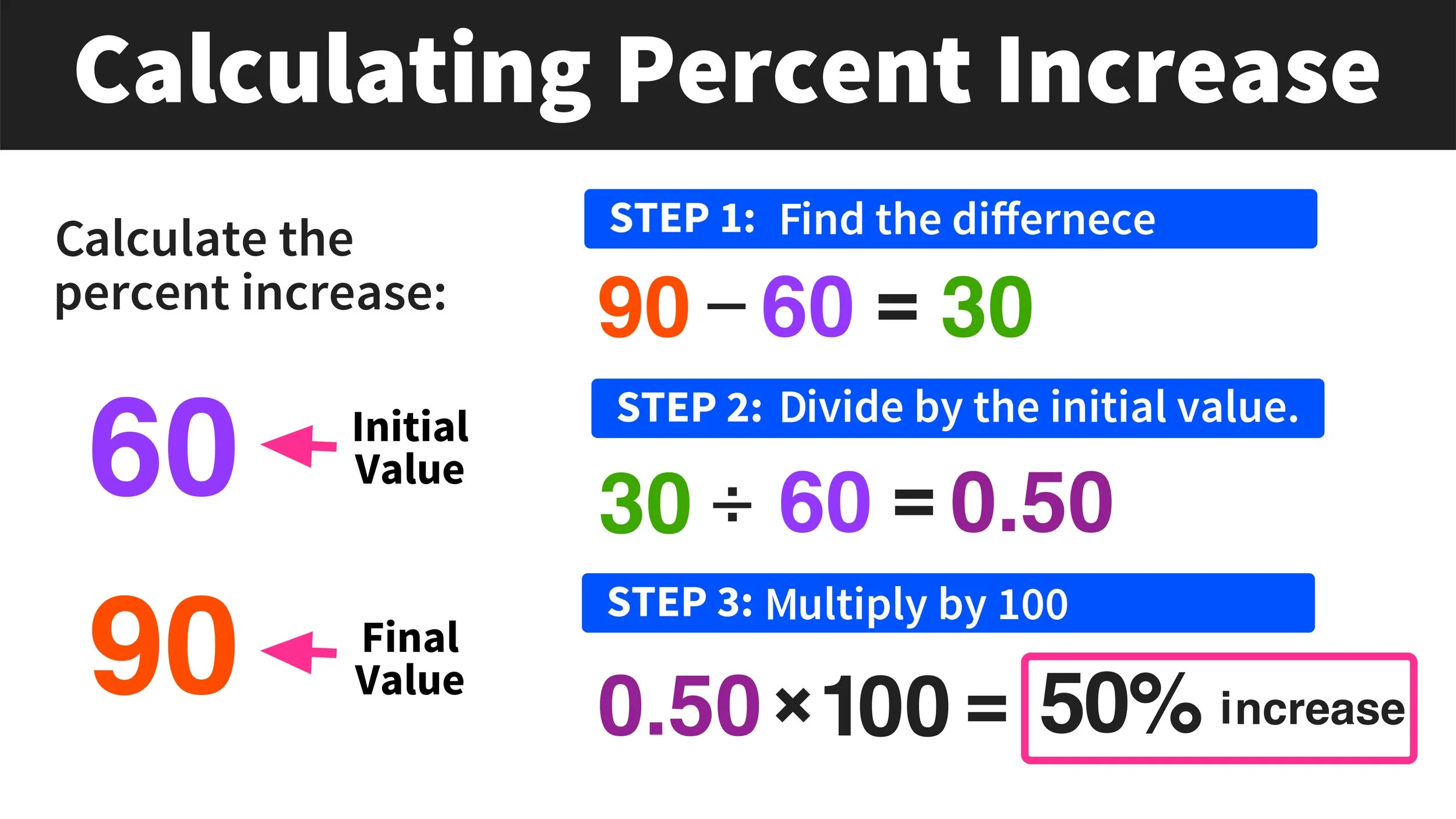
Percentage Growth: Businesses track growth as a percentage increase in various metrics—revenue, customer base, profit, or website traffic—over specific periods (e.g., month-over-month, year-over-year).
- Example: If a company’s revenue increased from $1 million to $1.2 million, its growth rate is (($1.2M – $1M) / $1M) * 100 = 20%.
-
Market Share: This metric represents a company’s sales as a percentage of the total sales within its industry or market.
-
Formula: (Company’s Sales / Total Market Sales) * 100
-
Example: If a company sells $2 million worth of products in a market with total sales of $10 million, its market share is ($2M / $10M) * 100 = 20%.
-
These percentages are critical for strategic planning, benchmarking performance against industry averages, and attracting investors by demonstrating growth potential and competitive strength.

Conclusion
From the daily minutiae of personal spending to the sophisticated strategies of investment and business growth, percentages are an undeniable force in the financial world. They offer a universal language for understanding proportions, tracking changes, and making informed comparisons across diverse monetary contexts. Mastering “how to do percent” is not merely about performing calculations; it’s about gaining clarity, confidence, and control over your financial narrative.
By understanding the fundamental concepts, applying them to your personal budgeting and spending, leveraging them for smarter investing, and recognizing their impact in the broader business landscape, you unlock a deeper level of financial literacy. The ability to interpret and utilize percentages empowers you to make strategic decisions, evaluate opportunities, and navigate the complexities of money with greater ease and insight. Make percentages your ally, and you will undoubtedly enhance your financial well-being and pave the way for a more secure and prosperous future.
aViewFromTheCave is a participant in the Amazon Services LLC Associates Program, an affiliate advertising program designed to provide a means for sites to earn advertising fees by advertising and linking to Amazon.com. Amazon, the Amazon logo, AmazonSupply, and the AmazonSupply logo are trademarks of Amazon.com, Inc. or its affiliates. As an Amazon Associate we earn affiliate commissions from qualifying purchases.