
Understanding how to calculate a percentage off a price is a fundamental skill for anyone managing their personal finances. Whether you’re a savvy shopper hunting for the best deals, a business owner pricing products, or simply trying to comprehend a discount advertised on a receipt, mastering this calculation empowers you to make informed financial decisions. This insight goes beyond mere arithmetic; it’s about discerning genuine value, optimizing spending, and building a stronger financial foundation.
Understanding the Power of a Discount
Discounts are ubiquitous in consumer culture, from seasonal sales to loyalty programs. While the allure of saving money is universal, the true value of a discount often lies in understanding its exact financial impact. A 20% off sign might seem straightforward, but knowing precisely how much that translates into actual savings, and subsequently, how much you will pay, is key to smart money management.

Why Percentage Discounts Matter
Percentage discounts are a primary tool retailers use to incentivize purchases. For consumers, these percentages directly influence purchasing power and budgeting. A significant percentage off can make an otherwise unaffordable item accessible, or it can free up funds for other essential expenditures. Conversely, misinterpreting a discount can lead to overspending or missing out on better deals elsewhere. For instance, knowing if “25% off” on one item is better than “buy one get one 50% off” on two similar items requires a clear understanding of percentage calculations. It’s not just about the absolute dollar amount saved; it’s about the proportional reduction in cost and its effect on your overall budget. This financial literacy allows you to compare offers effectively, evaluate the genuine benefit of a sale, and prevent impulse purchases driven by perceived, rather than actual, savings.
Common Scenarios for Percentage Off Calculations
The need to calculate percentages off a price arises in numerous daily financial interactions. These include:
-
Retail Shopping: Clearance sales, seasonal promotions, Black Friday deals, and store-wide discounts.
-
Coupon Usage: Applying percentage-based coupons at checkout, either in-store or online.
-
Service Discounts: Negotiating or understanding discounts on services like insurance premiums, subscription renewals, or professional fees.
-
Bill Reductions: Analyzing utility bills or credit card statements for promotional offers or waived fees.
-
Investment Decisions: Understanding fee reductions or promotional interest rates.
-
Budgeting: Allocating funds more effectively by factoring in anticipated savings from known discounts.
In each scenario, the ability to quickly and accurately determine the final price empowers you to manage your money more effectively, avoid overpaying, and ensure you’re getting the best possible deal.
The Fundamental Formula for Percentage Off
Calculating the percentage off a price is a straightforward two-step process that can be applied universally. Once you grasp the core formula, you can apply it to any discount scenario with confidence.
Step-by-Step Calculation
To calculate the percentage off a price, you need two pieces of information: the original price and the percentage discount.
-
Calculate the Discount Amount: Convert the percentage discount into a decimal and multiply it by the original price.
- Formula: Discount Amount = Original Price × (Percentage Discount / 100)
-
Calculate the Final Price: Subtract the discount amount from the original price.
- Formula: Final Price = Original Price – Discount Amount
Alternatively, you can combine these steps for a more direct calculation of the final price:
-
Calculate the Complementary Percentage: Subtract the percentage discount from 100%. This represents the percentage of the original price you will actually pay.
- Formula: Complementary Percentage = 100% – Percentage Discount
-
Calculate the Final Price: Convert the complementary percentage into a decimal and multiply it by the original price.
- Formula: Final Price = Original Price × (Complementary Percentage / 100)
This second method is often quicker, especially when you are primarily interested in the final cost.
Example 1: A Simple Discount
Let’s say you want to buy a jacket that originally costs $80, and it’s on sale for 25% off.
Using the first method (calculating discount amount first):
-
Discount Amount: $80 × (25 / 100) = $80 × 0.25 = $20
-
Final Price: $80 – $20 = $60
Using the second method (calculating complementary percentage first):
-
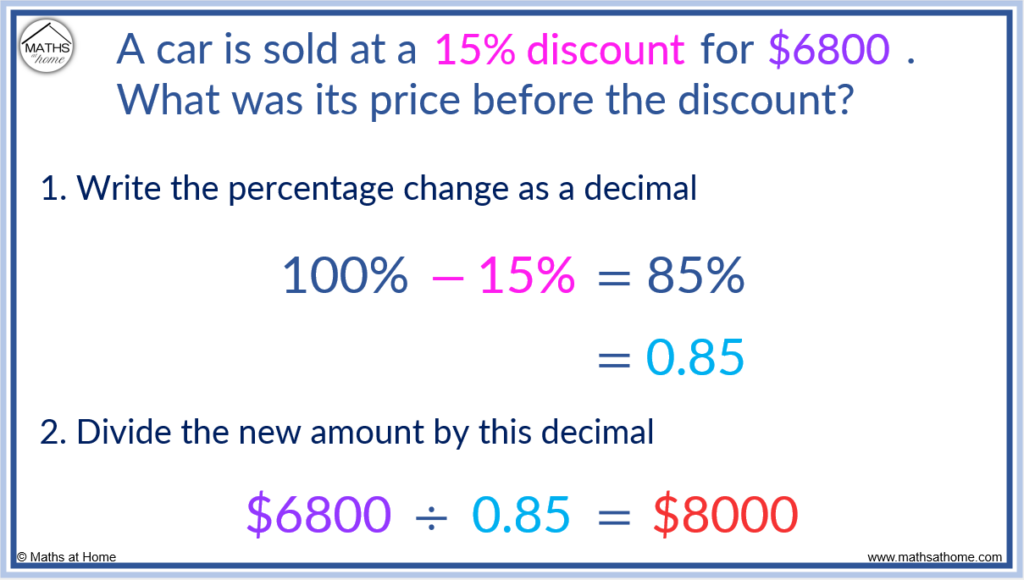
Complementary Percentage: 100% – 25% = 75%
-
Final Price: $80 × (75 / 100) = $80 × 0.75 = $60
In both cases, the final price of the jacket is $60, and you’ve saved $20.
Example 2: Multiple Discounts
Sometimes, you encounter situations with multiple discounts, such as an item already on sale and then an additional coupon applied at checkout. It’s crucial to apply these discounts sequentially, not combined, as a percentage off is always calculated on the current price.
Imagine an item priced at $100 is first discounted by 20%, and then you have an additional 10% off coupon.
-
First Discount (20% off original price):
- Price after 20% off = $100 × (100% – 20%) = $100 × 0.80 = $80

-
Second Discount (10% off the reduced price):
- Price after additional 10% off = $80 × (100% – 10%) = $80 × 0.90 = $72
If you incorrectly added the percentages (20% + 10% = 30% off total), you would calculate $100 × 0.70 = $70, which is incorrect. This difference of $2 might seem small, but on larger purchases or with multiple items, it can significantly impact your actual savings and budget. Always apply discounts one after the other to ensure accuracy.
Beyond Basic Calculations: Real-World Applications
The ability to calculate percentage off is not just a theoretical exercise; it has tangible benefits for your financial well-being in various real-world scenarios. It transforms you from a passive consumer into an active financial manager.
Budgeting and Smart Spending
When you’re able to quickly assess the true cost of a discounted item, you can make more informed decisions about whether a purchase fits within your budget. Instead of just seeing “50% off!” and feeling compelled to buy, you can calculate the exact amount you’ll spend and compare it against your allocated funds for that category. This prevents overspending on perceived deals and helps you stick to your financial plan. It also allows for strategic spending; if a high-value item you’ve been saving for goes on a significant sale, you can quickly determine if the new price aligns with your financial goals and adjust your budget accordingly.
Comparing Deals Across Retailers
Different retailers might offer varying discounts on similar products. One store might advertise a specific dollar amount off, while another offers a percentage. By converting all offers into a common metric (the final price or the percentage saved relative to the original price), you can accurately compare and determine which deal provides the most financial benefit. This eliminates guesswork and ensures you’re always getting the best return on your spending. For example, knowing that “save $20” on a $100 item is 20% off helps you compare it directly to a competing offer of “25% off” on a $90 item.
Identifying True Value vs. Perceived Savings
Retailers often employ marketing tactics that emphasize the “savings” rather than the final cost. A heavily discounted item might still be more expensive than a similar, non-discounted alternative if its original price was inflated. By calculating the actual percentage off and the final price, you can pierce through the marketing hype and assess whether the product truly represents good value for your money. This critical thinking fosters a healthier relationship with spending, encouraging purchases based on need and value rather than fleeting promotional appeal.
Avoiding Common Pitfalls and Maximizing Savings
While calculating percentage off is straightforward, certain nuances can lead to misinterpretations or missed opportunities for greater savings. Being aware of these pitfalls can further refine your financial acumen.
The “Original Price” Deception
Some retailers may inflate their “original price” before applying a discount, making the percentage off appear more substantial than it truly is. While illegal in many jurisdictions if not legitimate, it’s a good practice to research an item’s typical price history using price tracking tools or by checking competitors before assuming a discount is as good as it seems. Understanding an item’s historical pricing can help you gauge the authenticity of a “deal.” Your calculation of the percentage off should ideally be based on the item’s genuine market value, not just the stated “original” price.
Understanding Coupon Stacking
Coupon stacking, the practice of applying multiple discounts to a single purchase, can lead to significant savings. However, rules vary by retailer. Some allow manufacturer coupons with store coupons, while others limit you to one discount per item. Always clarify the policy. When allowed, remember to apply discounts sequentially. For example, if you have a 10% off store-wide coupon and a $5 off a specific item coupon, you’d apply the percentage off the total, and then the fixed dollar amount off the eligible item or vice-versa, depending on which order yields the lowest price. It’s often beneficial to apply percentage discounts first to a higher subtotal, then fixed dollar amounts.
Calculating Effective Savings on Bundles
“Buy One Get One Free” or “Buy Two Get One Half Price” deals can be enticing but require careful calculation to understand the true percentage off per item. For a “Buy One Get One Free” (BOGO) deal on two items of equal price, you’re essentially getting 50% off each item if you factor in the cost of both. For “Buy Two Get One Half Price,” if three items are $10 each, you’d pay $10 + $10 + $5 = $25 for three items. The average price per item is $25/3 = $8.33, meaning an average discount of $1.67 per item, or 16.7% off. Always break down bundle deals to an “per item” cost or a total percentage off the sum of individual original prices to truly compare them against simple percentage discounts.
Financial Tools and Mental Math Shortcuts
While a calculator is always reliable, developing mental math shortcuts can make you an even quicker and more confident financial decision-maker on the go.
Using Calculators and Spreadsheets
For complex calculations, multiple discounts, or when creating a budget, a physical calculator or a spreadsheet (like Excel or Google Sheets) is invaluable. Spreadsheets allow you to set up formulas once and apply them to numerous items, making budgeting and tracking sales effortless. Many online percentage calculators also offer quick solutions if you’re not comfortable with manual calculation. Utilizing these tools ensures accuracy, especially with large numbers or intricate discount structures.
Quick Mental Estimations
You can often quickly estimate a discount in your head for immediate decision-making:
-
10% off: Move the decimal point one place to the left (e.g., 10% off $80 is $8).
-
20% off: Calculate 10% and double it (e.g., 20% off $80 is $8 x 2 = $16).
-
25% off: Divide the original price by 4 (e.g., 25% off $80 is $80 / 4 = $20).
-
50% off: Halve the original price (e.g., 50% off $80 is $40).
For other percentages, you can combine these methods. For example, for 35% off, calculate 25% and add 10%. Or, calculate 10% ($8), multiply by 3 ($24), and then add 5% (half of 10%, which is $4) for a total of $28. This rapid estimation helps you gauge the impact of a discount without needing a device.
The Rule of 10s
This mental math strategy is highly effective for any percentage. To find X% of a number:
-
Find 10% of the number.
-
Multiply that 10% value by (X / 10).
For example, to find 30% off $120:
-
10% of $120 is $12.
-
(30 / 10) = 3.
-
$12 * 3 = $36 (the discount amount).
-
$120 – $36 = $84 (the final price).
This mental agility not only saves time but also builds confidence in managing your finances, ensuring you are always one step ahead in securing the best possible value for your money. The ability to calculate percentage off is more than just a math skill; it’s a powerful financial tool that empowers smarter spending, better budgeting, and ultimately, greater financial control.
aViewFromTheCave is a participant in the Amazon Services LLC Associates Program, an affiliate advertising program designed to provide a means for sites to earn advertising fees by advertising and linking to Amazon.com. Amazon, the Amazon logo, AmazonSupply, and the AmazonSupply logo are trademarks of Amazon.com, Inc. or its affiliates. As an Amazon Associate we earn affiliate commissions from qualifying purchases.