
In an increasingly data-driven world, understanding and applying percentages is a fundamental skill, transcending academic disciplines and professional fields. From calculating discounts during a shopping spree to determining interest rates on a loan, or analyzing growth statistics for a business, percentages are ubiquitous. While the mathematical concept itself is straightforward, efficiently performing these calculations, especially complex ones, often hinges on the effective use of a calculator. This guide delves into the nuances of using the percent function on various calculator types, transforming a seemingly simple button into a powerful tool for precision and productivity.

This article, firmly rooted in the Tech category, focuses on the tool itself – the calculator – and its specific functionalities. We will explore how different calculators interpret and execute percentage operations, offering a comprehensive tutorial designed to enhance your technological proficiency and computational accuracy.
Understanding the Core Functionality of the Percent Key
Before diving into specific calculations, it’s crucial to understand what the percent key (%) on your calculator actually does. Unlike a simple multiplication or division key, the percent key often acts as a multi-functional operator, whose behavior can subtly vary between different calculator models.
The Ubiquity of Percentage Calculations
Percentages are, at their core, a way to express a proportion of a whole as a fraction of 100. This standardization makes them incredibly useful for comparisons, scaling, and communicating relative change. While the practical applications often touch upon financial or statistical domains, the methodology of computing them accurately and efficiently relies heavily on the technological tool at hand – the calculator. Mastering its percent function is therefore a key skill in leveraging this technology.
Demystifying the Percent Button (%)
For many, the percent button is a mystery. Does pressing it automatically divide by 100? Sometimes, but not always. Its exact operation often depends on the preceding numbers and operations.
-
As a “divide by 100” operator: When you type “50 % =”, on many basic calculators, it might simply display “0.5”. This is its most fundamental interpretation.
-
As an “of” operator: When calculating “15% of 200”, you might type “200 * 15 %”. Here, the calculator understands that “15%” refers to 15 hundredths of the preceding number (200), and the result (30) is displayed immediately, often without needing an equals sign.
-
As an “add/subtract percentage” operator: For calculations like “200 + 15%”, the calculator might interpret “15%” as 15% of 200 (which is 30), and then perform the addition, yielding 230. This is where the percent key offers significant efficiency.
Understanding these different modes of operation is the first step towards truly mastering your calculator.
Types of Calculators and Their Percentage Peculiarities
Not all calculators are created equal, and their approach to the percent key can differ:
-
Basic Calculators: Often found in offices or homes, these are generally the most intuitive but can be the most varied in their percent key behavior. Experimentation is key.
-
Scientific Calculators: While primarily designed for complex mathematical functions (trigonometry, logarithms), most scientific calculators also include a percent key. Their logic often aligns with standard algebraic order of operations.
-
Graphing Calculators: These advanced devices, like those from TI or Casio, sometimes hide the percent function within menus or shift keys. They usually follow strict mathematical hierarchy.
-
Smartphone and Desktop Calculator Apps: These digital tools can offer the most flexibility, with some allowing you to toggle between different percentage calculation modes or providing clear visual feedback on intermediate steps. They often mimic basic or scientific calculator layouts.
Familiarizing yourself with your specific calculator’s manual (or performing a few test calculations) is always recommended to avoid surprises.
Fundamental Percentage Operations: Step-by-Step Guides
Let’s break down the most common percentage calculations and how to execute them efficiently using your calculator’s percent key.
Calculating a Percentage of a Number
This is perhaps the most frequent use case: finding a portion of a whole.
Example: What is 15% of 200?
-
Method 1 (Using the % key directly):
-
Enter the base number:
200 -
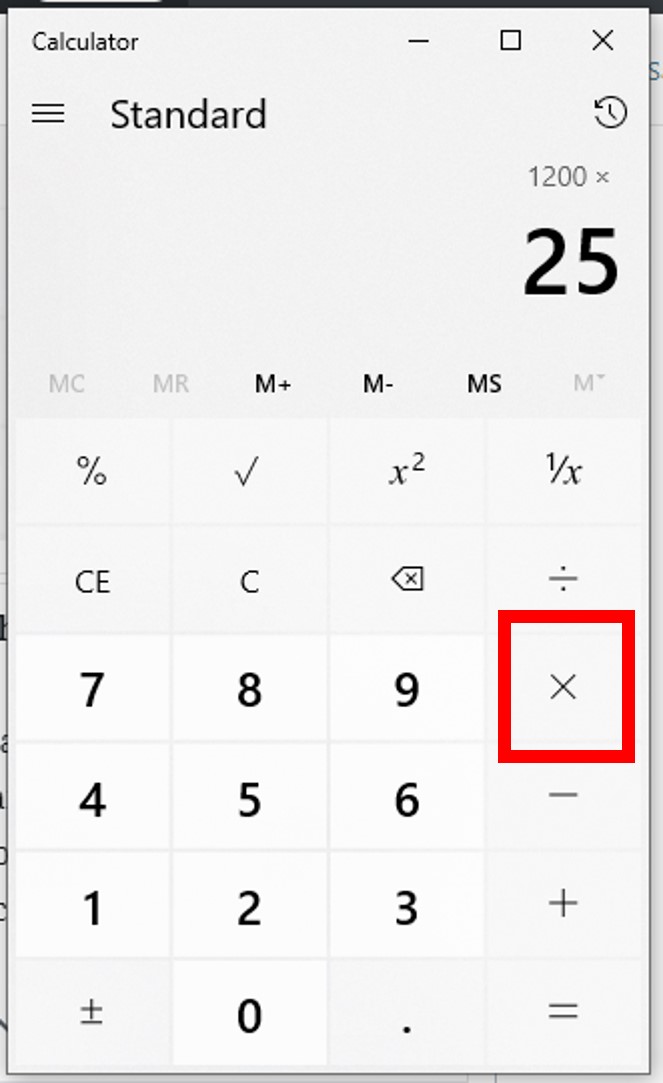
Press the multiplication key:
* -
Enter the percentage:
15 -
Press the percent key:
% -
The display should immediately show the result:
30(On some calculators, you might need to press=after%).
-
-
Method 2 (Manual Decimal Conversion): This method works on all calculators, regardless of their percent key’s behavior.
-
Convert the percentage to a decimal:
15 / 100 = 0.15 -
Multiply the base number by the decimal:
200 * 0.15 -
Press the equals key:
= -
Result:
30
-
Adding or Subtracting a Percentage (e.g., Sales Tax, Discounts)
This is a powerful shortcut for common financial calculations.
Example 1 (Adding a percentage – Sales Tax): A product costs $120, and there’s a 7% sales tax. What’s the total price?
-
Method 1 (Direct calculation with % key):
-
Enter the base number:
120 -
Press the addition key:
+ -
Enter the percentage:
7 -
Press the percent key:
% -
Press the equals key:
= -
Result:
128.40(The calculator automatically calculated 7% of 120 (which is 8.40) and added it to 120).
-
-
Method 2 (Step-by-step with % key):
-
Calculate the tax amount:
120 * 7 %(Result:8.40) -
Add the tax to the original price:
120 + 8.40 = 128.40
-
Example 2 (Subtracting a percentage – Discount): An item is $80 with a 25% discount. What’s the final price?
-
Method 1 (Direct calculation with % key):
-
Enter the base number:
80 -
Press the subtraction key:
- -
Enter the percentage:
25 -
Press the percent key:
% -
Press the equals key:
= -
Result:
60(The calculator automatically calculated 25% of 80 (which is 20) and subtracted it from 80).
-
Finding the Percentage One Number is of Another
This determines the proportional relationship between two numbers.
Example: 45 is what percentage of 180?
-
Method:
-
Enter the first number:
45 -
Press the division key:
/ -
Enter the second number:
180 -
Press the multiplication key:
*(or directly after division on some calculators) -
Enter
100(to convert the decimal to a percentage). -
Press the equals key:
= -
Result:
25(So, 45 is 25% of 180).
- Note: Some advanced calculators might allow
45 / 180 %directly, but it’s less common for this specific operation. The* 100step is universally reliable.
-
Determining Percentage Change (Increase/Decrease)
Calculating the percentage change between an old value and a new value is crucial for tracking growth, depreciation, or performance.
Formula: ((New Value - Old Value) / Old Value) * 100
Example: Your salary increased from $40,000 to $45,000. What is the percentage increase?
-
Calculate the difference:
45000 - 40000 = 5000 -
Divide the difference by the original value:
5000 / 40000 = 0.125 -
Multiply by 100 to get the percentage:
0.125 * 100 = 12.5- Result:
12.5%increase.
- Result:
While the percent key doesn’t typically automate the entire change calculation in one go, understanding its role in the intermediate steps (e.g., 5000 / 40000 * 100) is key.
Advanced Percentage Applications and Common Pitfalls
Beyond the basics, percentages can be combined and applied in more complex scenarios.
Chained Percentage Calculations
This involves applying multiple percentages sequentially, such as a discount followed by sales tax.
Example: A $500 item has a 20% discount, then a 5% sales tax is applied.
-
Calculate the discount:
500 - 20 % = 400(The item is now $400). -
Calculate the sales tax on the discounted price:
400 + 5 % = 420- Final price:
$420.
- Final price:
Crucial Point: The order of operations matters! Applying tax first then discount would yield a different result because the base number changes. Ensure you understand the sequence of events you’re trying to calculate.
Working with Negative Numbers and Percentages
While less common, percentages can be applied to negative numbers, especially in financial contexts involving losses or deficits. The principles remain the same: a percentage of a negative number will result in a negative number. Adding a percentage to a negative number will make it less negative (closer to zero), and subtracting will make it more negative.
The “What If” Scenarios: Backwards Calculations
Sometimes you know the final value after a percentage operation and need to find the original value.
Example: A shirt costs $33.60 after a 5% sales tax was added. What was the original price?
-
If the original price is
X, thenX + 5% of X = 33.60. -
This can be written as
X * (1 + 0.05) = 33.60orX * 1.05 = 33.60. -
So,
X = 33.60 / 1.05-
Enter
33.60 -
Press
/ -
Enter
1.05 -
Press
= -
Result:
32(The original price was $32).
-
This type of calculation typically doesn’t use the percent key directly for the division but relies on understanding the decimal equivalent of the percentage (e.g., 105% is 1.05).
Calculator Differences and Manual Overrides
Be aware that some calculators, particularly older basic models, might interpret chained operations differently. For instance, 200 * 10 % + 5 % might not correctly calculate 10% of 200 then add 5% of 200 to the sum. To ensure accuracy on all calculators, break down complex operations into smaller, manageable steps using the equals sign (=) after each intermediate calculation. When in doubt, perform manual decimal conversion (10% = 0.10) to override any ambiguous percent key behavior.
Leveraging Digital Calculators and Software Features
Modern technology offers far more than just handheld devices for percentage calculations. Digital tools provide enhanced features and integration that can streamline your work.
Smartphone Calculator Apps: Enhanced Functionality
The calculator app on your smartphone is often more powerful than you think. Many offer:
-
Scientific Mode: Rotating your phone horizontally often reveals advanced functions, including trigonometric, logarithmic, and sometimes dedicated financial functions.
-
History/Tape: Some apps keep a running history of your calculations, allowing you to review or copy previous results – a lifesaver for complex multi-step percentage problems.
-
Gestures and Customization: Some advanced apps allow for swipe gestures to clear entries, or even customizable layouts to prioritize frequently used functions, including the percent key.
Desktop Calculator Applications: Windows, macOS, Web-Based
Your computer’s built-in calculator (Windows Calculator, macOS Calculator) can switch between standard, scientific, and sometimes programmer or statistician modes. These often provide larger displays, clearer operation history, and easier input. Web-based calculators (like Google’s built-in calculator or dedicated online tools) offer immediate access without installation and often have intuitive interfaces. For quick conversions or simple percentage tasks, these are invaluable.
Spreadsheet Software (Excel, Google Sheets) for Complex Percentage Models
While beyond a simple calculator, spreadsheet software like Microsoft Excel or Google Sheets is the ultimate tech tool for complex percentage calculations and modeling. Here, you’re not just performing one-off calculations but building dynamic models where percentages can be easily adjusted to see their impact.
-
Formulas: Instead of a single percent key, you use formulas like
=A1*0.15for “15% of cell A1” or=(B2-A2)/A2for percentage change. -
References: Cells can refer to other cells, making it easy to build cascaded calculations (e.g., applying a discount percentage from one cell to a price in another).
-
Conditional Formatting: Visually highlight values based on percentage thresholds.
-
Data Analysis: Integrate percentages into larger datasets for financial analysis, sales forecasting, or scientific research.
Understanding how to transition your percentage calculation skills from a simple calculator to spreadsheet software marks a significant leap in leveraging technology for numerical analysis.
Best Practices for Accuracy and Efficiency
Mastering the calculator’s percent function isn’t just about knowing what keys to press; it’s also about developing good computational habits.
Double-Checking Your Inputs
The vast majority of calculation errors stem from incorrect data entry. Before pressing that final = or % key, take a split second to visually confirm the numbers you’ve entered. For long sequences, using a calculator with a display that shows the full input string can be incredibly helpful.
Understanding Display Limitations and Rounding
Calculators have finite display capacities. While internal calculations often maintain high precision, the displayed result may be rounded. Be mindful of this when working with currencies (round to two decimal places) or when precision is critical in scientific contexts. For very precise calculations, use more advanced tools or manual rounding rules.
When to Use the Percent Key vs. Manual Decimal Conversion
The percent key is fantastic for efficiency, especially for adding/subtracting percentages. However, if you’re ever unsure about your specific calculator’s behavior for a particular operation, default to manual decimal conversion (e.g., 25% becomes 0.25). This method is universally consistent and eliminates ambiguity. For highly complex or chained operations, breaking them down into separate decimal calculations can also reduce potential errors.
Practice Makes Perfect: Scenarios and Exercises
The best way to truly master percentage calculations on your calculator is through practice. Work through various real-world scenarios: calculate sale prices, figure out tips, determine interest on savings, or analyze growth rates. The more you use the tool, the more intuitive its functions will become, and the faster and more accurate your calculations will be.

Conclusion
The calculator, in its various forms from simple handheld gadgets to sophisticated software, remains an indispensable technological tool for navigating the numerical demands of modern life. While the concept of percentages is foundational, the efficiency and accuracy with which we apply them are heavily influenced by our proficiency with these devices. By demystifying the percent key, understanding its varied behaviors, and applying best practices, you can unlock the full potential of your calculator, transforming it from a basic arithmetic device into a powerful ally for precise, confident, and swift percentage calculations in any context. Embrace the tech, and empower your numbers.
aViewFromTheCave is a participant in the Amazon Services LLC Associates Program, an affiliate advertising program designed to provide a means for sites to earn advertising fees by advertising and linking to Amazon.com. Amazon, the Amazon logo, AmazonSupply, and the AmazonSupply logo are trademarks of Amazon.com, Inc. or its affiliates. As an Amazon Associate we earn affiliate commissions from qualifying purchases.