
In the world of finance, whether personal or corporate, numbers tell a story. But raw figures alone often lack the depth needed for truly insightful analysis. Understanding how to calculate the percentage increase between two numbers is not merely a mathematical exercise; it is a fundamental skill that unlocks the narrative of growth, change, and performance across every facet of the money landscape. From tracking investment returns and analyzing income growth to evaluating business expansion and understanding inflation, this calculation provides the critical context needed to make informed financial decisions.
This guide will demystify the percentage increase calculation, explain its profound importance in various financial contexts, and equip you with the knowledge to apply it effectively. By mastering this seemingly simple formula, you empower yourself to better interpret financial data, identify trends, and strategically navigate your financial journey, ultimately fostering smarter wealth management and greater financial literacy.
The Fundamental Formula: Unlocking Growth Potential
At its core, calculating the percentage increase is about quantifying relative change. It tells us how much a value has grown in proportion to its original size, offering a standardized way to compare growth rates across different scales. Without this metric, comparing, say, a $100 increase in a $1,000 investment to a $100 increase in a $100,000 investment would be misleading, as their impacts are vastly different.
Deconstructing the Percentage Increase Formula
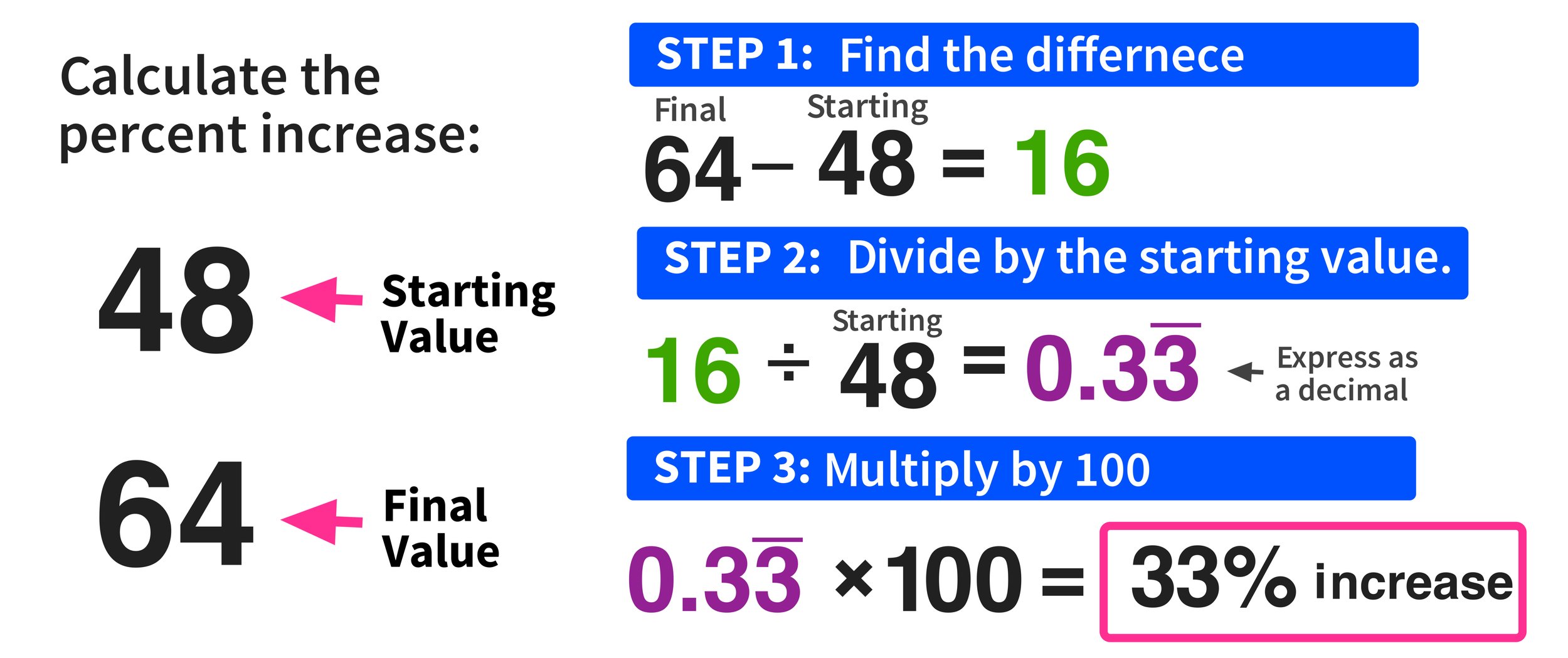
The formula for percentage increase is straightforward and intuitively logical:
Percentage Increase = ((New Value – Original Value) / Original Value) * 100
Let’s break down each component:
-
Original Value: This is the starting point, the baseline number from which you are measuring growth. In financial terms, it could be your initial investment, last year’s revenue, or your previous salary.
-
New Value: This is the ending point, the current or subsequent number that reflects the change. It might be your current portfolio value, this year’s revenue, or your updated salary.
-
Subtracting (New Value – Original Value): This step calculates the absolute increase or the raw difference between the two numbers. A positive result indicates growth.
-
Dividing by Original Value: This is the crucial step that normalizes the absolute increase. By dividing by the original value, you express the increase as a fraction of the starting amount. This fraction represents the proportional growth.
-
Multiplying by 100: Finally, multiplying by 100 converts this decimal or fractional proportion into a percentage, making it easier to read and compare.
Step-by-Step Calculation: A Practical Walkthrough
Let’s apply this to a common financial scenario: an investment.
Scenario: You invested $5,000 in a stock at the beginning of the year. By the end of the year, its value has grown to $5,750. What is the percentage increase in your investment?
-
Identify the Original Value: Original Value = $5,000
-
Identify the New Value: New Value = $5,750
-
Calculate the Absolute Increase:
New Value – Original Value = $5,750 – $5,000 = $750
-
Divide the Absolute Increase by the Original Value:
$750 / $5,000 = 0.15
-
Multiply by 100 to Get the Percentage:
0.15 * 100 = 15%
Therefore, your investment experienced a 15% increase. This clear, quantifiable metric allows you to easily understand the return on your capital.
Common Pitfalls and How to Avoid Them
While the formula is simple, certain errors can lead to incorrect financial analysis:
-
Mixing Up Original and New Values: Always ensure the “Original Value” is the starting point and the “New Value” is the ending point. Reversing them would incorrectly calculate a percentage decrease or an increase relative to the wrong base.
-
Misinterpreting “Percentage Points” vs. “Percentage Increase”: If an interest rate goes from 4% to 5%, that’s an increase of 1 percentage point. However, the percentage increase is ((5-4)/4)*100 = 25%. Understanding this distinction is vital in finance, especially when discussing interest rates or market share.
-
Using Zero as the Original Value: The formula involves division by the original value. If the original value is zero (e.g., starting a business with no revenue and now having some revenue), the percentage increase is undefined, as division by zero is impossible. In such cases, it’s usually better to just state the new value or that growth occurred from zero.
-
Negative Original Values: While less common in typical growth scenarios, calculating percentage increase from a negative number can yield counter-intuitive results and should be approached with extreme caution, often indicating a different type of analysis is required.
Why Percentage Increase is Indispensable in Personal Finance
For individuals managing their money, the percentage increase is more than just an academic calculation; it’s a powerful tool for informed decision-making and wealth accumulation.
Tracking Investment Returns and Portfolio Growth
Perhaps the most common application in personal finance, calculating the percentage increase allows investors to gauge the performance of their assets. Whether it’s stocks, mutual funds, real estate, or even a savings account, knowing the percentage return on investment (ROI) is crucial. A 10% return on your stock portfolio, a 3% increase in your home’s value, or a 0.5% interest rate on your savings account—these percentages allow for easy comparison across different investment vehicles and over various time horizons. This helps in rebalancing portfolios, making buy/sell decisions, and assessing whether investments are meeting financial goals.
Analyzing Income Growth and Salary Negotiations
Your income is arguably your most important financial asset. Tracking its percentage increase year-over-year provides a clear picture of your financial progress. If your salary increased from $60,000 to $63,000, that’s a 5% increase. Comparing this to inflation rates or industry averages can inform salary negotiation strategies. If the cost of living (inflation) increased by 3%, a 5% salary raise means a real increase in purchasing power. Conversely, a 2% raise in a 3% inflationary environment signifies a real decrease in buying power, crucial information for budgeting and future career planning.
Understanding Loan Interest and Debt Accumulation
While often framed as a percentage rate, understanding percentage increase helps in comprehending how interest accumulates on loans and credit cards. If you have a credit card balance of $1,000 and the interest rate is 20% APR (Annual Percentage Rate), knowing how that 20% translates to a percentage increase in your balance over time (especially if minimum payments are made) is vital for understanding debt growth and creating a payoff strategy. It highlights the exponential power of compounding, whether for growth (investments) or for accumulation (debt).
Budgeting and Expense Management
Living costs rarely remain static. Utility bills, groceries, housing, and transportation costs can all see increases over time. Calculating the percentage increase in these categories from month-to-month or year-to-year helps in accurate budgeting. If your grocery bill jumped from $400 to $450 in a month, that’s a 12.5% increase – a significant insight that might prompt a review of spending habits or seeking more affordable options. This proactive analysis ensures your budget remains realistic and effective.
Leveraging Percentage Increase in Business and Investing
Beyond personal finance, the percentage increase is a cornerstone of business analysis and investment strategy, offering insights into operational efficiency, market dynamics, and economic health.

Measuring Revenue and Profit Growth for Businesses
For businesses, tracking the percentage increase in key financial metrics is paramount. A company might report a 12% increase in quarterly revenue or a 7% increase in annual net profit. These figures are critical for investors assessing a company’s health and potential, for management making strategic decisions, and for stakeholders evaluating performance. Consistent, healthy percentage growth in revenue, profit margins, and customer acquisition indicates a strong and expanding business. Conversely, stagnant or declining percentages can signal underlying problems.
Evaluating Stock Performance and Market Trends
In the investment world, percentage increase is the lingua franca for discussing market performance. A stock might be up 2% today, or the S&P 500 might have gained 15% year-to-date. These percentages allow investors to quickly grasp market movements, compare the performance of different stocks or indices, and identify trends. Whether analyzing a stock’s daily fluctuations, its performance over a quarter, or its long-term growth trajectory, the percentage increase provides a normalized, easily digestible metric. It helps investors determine if an investment is meeting their expected returns or if it’s underperforming relative to benchmarks.
Assessing Inflation’s Impact on Purchasing Power
Inflation, the rate at which the general level of prices for goods and services is rising, directly impacts the purchasing power of money. Central banks and economists frequently report inflation as a percentage increase (e.g., “annual inflation rate hit 3.5%”). Understanding this percentage is crucial for individuals and businesses alike. A 3.5% inflation rate means that what cost $100 last year now costs $103.50. For businesses, this impacts pricing strategies, cost of goods sold, and wage negotiations. For individuals, it underscores the importance of investments that outpace inflation to preserve and grow real wealth.
Strategic Planning and Forecasting
Businesses constantly use historical percentage increases to project future performance. If a company has consistently achieved a 10% revenue growth year-over-year, that figure might be used to forecast next year’s revenue, inform budget allocations, or plan for expansion. Similarly, investors use past growth rates to estimate future returns, helping them build diversified portfolios aligned with their long-term financial goals. This forward-looking application of percentage increase is fundamental to strategic decision-making and risk management.
Tools and Technologies for Seamless Percentage Increase Calculations
While the basic formula is simple enough for manual calculation, modern financial analysis benefits greatly from various tools that automate and streamline the process, especially when dealing with large datasets or complex scenarios.
The Power of Spreadsheets: Excel and Google Sheets
Spreadsheet software like Microsoft Excel and Google Sheets are indispensable financial tools. They allow users to quickly calculate percentage increases for vast amounts of data, create dynamic models, and visualize trends.
-
Simple Calculation: In a cell, you can directly input the formula:
=(B2-A2)/A2*100, where A2 is the original value and B2 is the new value. -
Formatting: You can format the result as a percentage directly by applying the “Percentage” number format, often saving you the
*100step. -
Dynamic Analysis: Spreadsheets enable you to change original or new values and instantly see the updated percentage increase, making scenario planning efficient.
Financial Calculators and Online Tools
For quick, one-off calculations, dedicated financial calculators (both handheld and online) are highly convenient. Many websites offer free percentage increase calculators where you simply input your two numbers and get an instant result. These are particularly useful for on-the-go checks or verifying calculations. Some investment platforms and banking portals also integrate these calculators to show percentage changes in account balances or investment values directly.
Mobile Apps for On-the-Go Financial Analysis
The proliferation of financial apps means you can track and analyze percentage increases directly from your smartphone. Budgeting apps often show percentage changes in spending categories. Investment apps typically display the percentage gain or loss for individual stocks, mutual funds, and your overall portfolio. These apps provide immediate insights, allowing you to stay on top of your finances without needing a desktop.
Programming for Advanced Financial Modeling (Optional/Brief)
For finance professionals and advanced investors dealing with algorithmic trading, complex portfolio management, or large-scale data analysis, programming languages like Python or R offer unparalleled power. Libraries such as Pandas in Python allow for sophisticated manipulation of financial data, making it possible to calculate percentage increases across thousands of assets simultaneously, perform time-series analysis, and build predictive models. While overkill for basic needs, these tools highlight the scalability of the underlying percentage increase concept.
Beyond the Numbers: Interpreting Percentage Increase for Strategic Decisions
Calculating the percentage increase is just the first step. The true value lies in intelligently interpreting these figures to inform strategic financial decisions. A number without context is merely data; with proper interpretation, it becomes powerful insight.
Context is King: Relative vs. Absolute Growth
A 100% increase sounds phenomenal, but if it’s an increase from $1 to $2, its absolute impact is minimal. Conversely, a 1% increase on a $1 billion portfolio represents a $10 million gain, which is significant. Always consider the absolute values alongside the percentage increase. For businesses, a high percentage growth might be easier for a startup (low base) than for an established giant (high base). Understanding this context prevents misleading conclusions and focuses attention on what truly matters for your financial goals.
The Dangers of Cherry-Picking Data
Financial reporting can sometimes manipulate perceptions by selecting specific timeframes. For example, a company might boast a large percentage increase in revenue comparing a weak quarter to a strong one, rather than comparing it year-over-year or against industry averages. Always scrutinize the ‘original value’ and ‘new value’ dates. Ensure you’re comparing apples to apples (e.g., Q1 of this year vs. Q1 of last year, not Q4 of last year). Consistent, transparent comparison periods are vital for accurate analysis.
Combining with Other Financial Metrics
Percentage increase rarely tells the whole story in isolation. It’s most powerful when combined with other financial metrics. For example:
-
For investments: A stock with a 20% price increase might also have declining earnings per share (EPS), signaling that the price surge isn’t sustainable.
-
For businesses: High revenue growth (percentage increase) might be unsustainable if it comes with an even higher percentage increase in operational costs, leading to stagnant or declining profit margins.
-
For personal finance: A salary increase (percentage increase) should be weighed against the percentage increase in your cost of living and personal debt.
Integrate percentage increase insights into a broader financial picture for a holistic view.
Making Informed Financial Moves
Ultimately, the goal of understanding percentage increase is to empower better financial decisions.
-
Investing: Use it to compare potential returns on different investments, assess your portfolio’s performance against benchmarks, and adjust your strategy.
-
Budgeting: Identify areas where expenses are increasing disproportionately, prompting adjustments to spending habits.
-
Career: Negotiate salary increases based on your income growth, cost of living, and industry standards.
-
Business: Drive strategic initiatives, set realistic growth targets, and evaluate the success of new ventures.
By consistently applying this fundamental calculation and critically interpreting its results, you transition from passively observing financial numbers to actively shaping your financial future. It transforms raw data into actionable intelligence, making you a more astute investor, a more effective budgeter, and a more empowered financial decision-maker.
aViewFromTheCave is a participant in the Amazon Services LLC Associates Program, an affiliate advertising program designed to provide a means for sites to earn advertising fees by advertising and linking to Amazon.com. Amazon, the Amazon logo, AmazonSupply, and the AmazonSupply logo are trademarks of Amazon.com, Inc. or its affiliates. As an Amazon Associate we earn affiliate commissions from qualifying purchases.