
In the complex world of personal finance, investing, and business, percentages are more than just mathematical figures; they are the universal language that translates raw numbers into actionable insights. From understanding the discount on a new purchase to analyzing the return on an investment or comprehending the true cost of a loan, mastering how to calculate the percentage of two numbers is a foundational skill for anyone serious about managing their money effectively. This guide will demystify percentage calculations, grounding each explanation and example firmly within the realm of finance to help you make more informed decisions and gain a sharper perspective on your financial landscape.

The Foundational Importance of Percentages in Finance
Percentages provide context and allow for straightforward comparisons, making them indispensable across virtually every aspect of personal and business finance. Without them, we’d be drowning in absolute figures that offer little immediate meaning or comparability.
Everyday Financial Scenarios
Think about the myriad ways percentages pop up in your daily financial life. When you’re budgeting, you might allocate a certain percentage of your income to housing, another percentage to savings, and so on. During sales events, store discounts are advertised as percentages off the original price. The tax you pay on goods and services, the tip you leave at a restaurant, or the commission earned by a salesperson are all expressed as percentages. Even seemingly simple concepts like inflation, which erodes purchasing power, are measured in percentage terms, giving you a tangible sense of how much more expensive goods and services have become over time.
Key Financial Metrics
Beyond everyday transactions, percentages are the backbone of critical financial metrics that guide major decisions. Interest rates on savings accounts, credit cards, mortgages, and loans are all given as Annual Percentage Rates (APRs) or Annual Percentage Yields (APYs). When assessing investment performance, you look at percentage returns or Return on Investment (ROI). Businesses use profit margins (gross and net) expressed as percentages to gauge their efficiency and health. Understanding these metrics requires a solid grasp of how percentages are calculated and what they signify, transforming abstract numbers into concrete indicators of financial health and opportunity.
Mastering the Basic Percentage Calculation
At its core, calculating a percentage involves determining a portion of a whole. This fundamental concept underpins all more complex percentage-based financial analyses.
Formula Explained: Part/Whole x 100
The simplest way to calculate a percentage involves identifying two key components: the “part” and the “whole.”
-
The Part: This is the specific amount or quantity you want to express as a percentage.
-
The Whole: This is the total amount or quantity against which the part is being compared.
The formula is straightforward:
$text{Percentage} = left( frac{text{Part}}{text{Whole}} right) times 100$
Multiplying by 100 converts the decimal result of the division into a percentage, which is a number out of one hundred.
Step-by-Step Examples with Financial Context
Let’s illustrate this with practical financial examples:
Example 1: Budgeting – What Percentage of Income Goes to Housing?
Suppose your monthly net income (the “whole”) is $4,500, and your rent payment (the “part”) is $1,350. To find out what percentage of your income goes towards housing:
-
Identify the Part and Whole:
-
Part = $1,350 (rent)
-
Whole = $4,500 (income)
-
-
Divide the Part by the Whole:
- $1,350 div 4,500 = 0.30$
-
Multiply by 100:
-
$0.30 times 100 = 30%$
-
Conclusion: 30% of your monthly income goes to housing. This helps you adhere to budgeting rules like the 30% rule for housing costs.
-
Example 2: Sales Tax – Calculating the Tax Amount
You buy a new financial book for $30, and the sales tax rate is 7%. Here, you’re trying to find the “part” (the tax amount) when you know the “whole” (the book price) and the percentage.
-
Convert Percentage to Decimal:
- 7% = $7 div 100 = 0.07$
-
Multiply the Whole by the Decimal:
-
$30 times 0.07 = $2.10
-
Conclusion: The sales tax on the book is $2.10.
-
Example 3: Discounts – Finding the Original Price
You bought a financial software subscription at a 25% discount, saving you $15. What was the original price (the “whole”) of the subscription?
-
Understand the Relationship: If $15 is 25% of the original price, then $15 represents the “part,” and 25% is the known percentage.
-
Convert Percentage to Decimal:
- 25% = $25 div 100 = 0.25$
-
Divide the Part by the Decimal:
-
$15 div 0.25 = $60
-
Conclusion: The original price of the software subscription was $60.
-
Calculating Percentage Change: Growth, Loss, and Fluctuations
Beyond finding a part of a whole, understanding percentage change is crucial for evaluating financial performance over time. This calculation tells you how much something has increased or decreased relative to its initial value, offering a standardized way to compare growth or decline.
Understanding Percentage Increase
A percentage increase is used when a value grows from an initial (old) number to a new (larger) number. This is vital for assessing investment gains, income growth, or rising expenses.
The formula for percentage increase is:
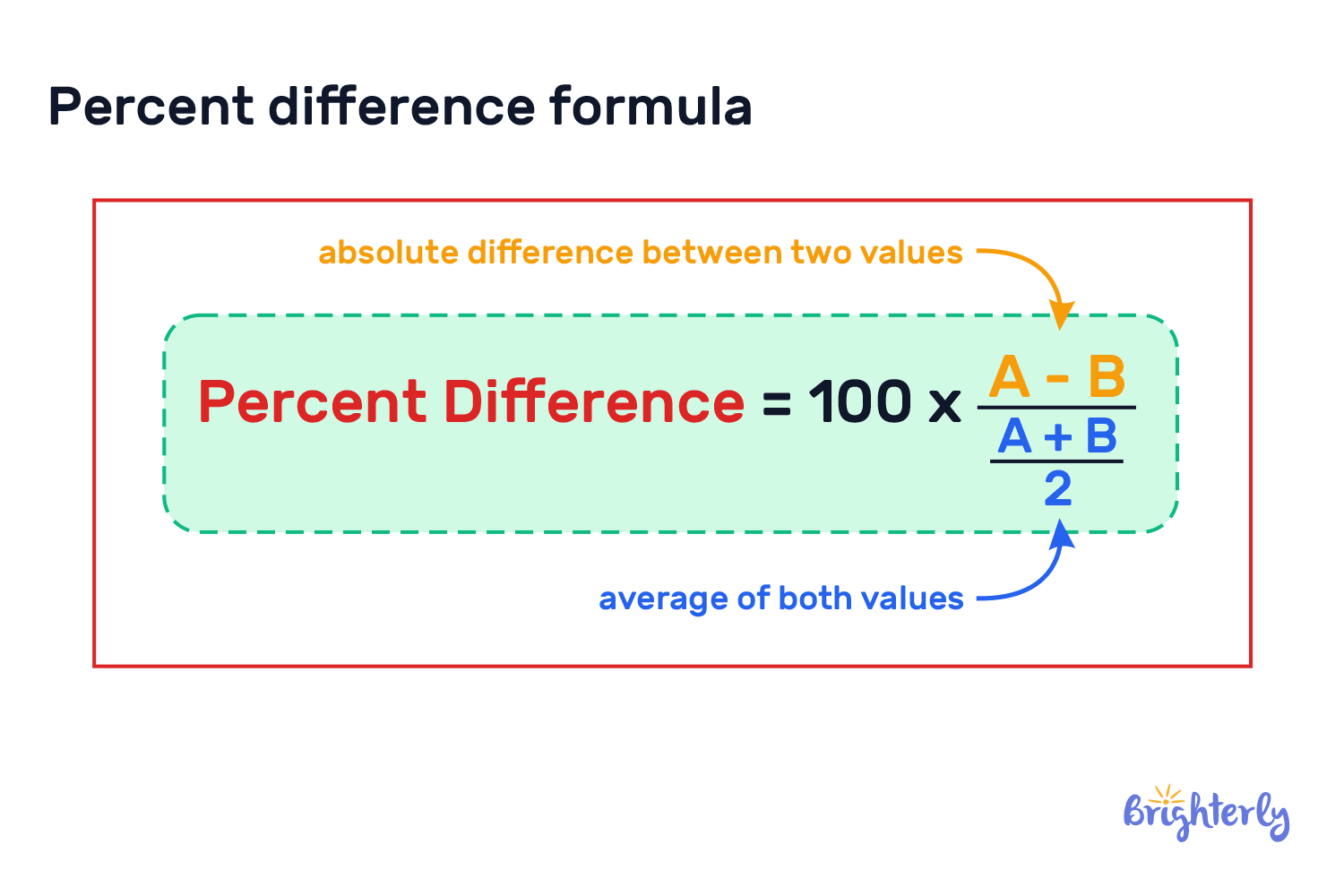
$text{Percentage Increase} = left( frac{text{New Value} – text{Old Value}}{text{Old Value}} right) times 100$
Example: Investment Growth
You invested $5,000 in a stock, and it grew to $6,250 over a year.
-
Identify Values:
-
Old Value = $5,000
-
New Value = $6,250
-
-
Calculate the Difference:
- $6,250 – 5,000 = $1,250
-
Divide by the Old Value:
- $1,250 div 5,000 = 0.25$
-
Multiply by 100:
-
$0.25 times 100 = 25%$
-
Conclusion: Your investment saw a 25% increase.
-
Understanding Percentage Decrease
Conversely, a percentage decrease measures how much a value has shrunk relative to its initial amount. This is useful for tracking losses, understanding depreciation, or observing a reduction in expenses.
The formula for percentage decrease is:
$text{Percentage Decrease} = left( frac{text{Old Value} – text{New Value}}{text{Old Value}} right) times 100$
Example: Stock Price Drop
A stock you own was priced at $120 per share, but it has since dropped to $96 per share.
-
Identify Values:
-
Old Value = $120
-
New Value = $96
-
-
Calculate the Difference:
- $120 – 96 = $24
-
Divide by the Old Value:
- $24 div 120 = 0.20$
-
Multiply by 100:
-
$0.20 times 100 = 20%$
-
Conclusion: The stock price experienced a 20% decrease.
-
Applying to Investments and Expenses
These calculations are paramount in financial analysis. For investments, percentage change provides the Return on Investment (ROI), allowing you to compare the performance of different assets regardless of their initial cost. For expenses, tracking percentage changes year-over-year can highlight areas where costs are spiraling out of control, prompting adjustments in your budget. Understanding percentage change in your income helps you assess your economic progress and how your earnings are keeping pace with inflation or lifestyle changes.
Advanced Applications of Percentages in Money Management
Once you’ve mastered the basics, percentages become powerful tools for navigating more complex financial scenarios.
Discount Calculations and Savings
When shopping, it’s common to encounter multiple discounts, such as “20% off plus an additional 10% for members.” It’s crucial to understand that these discounts are usually applied sequentially, not cumulatively, on the original price.
If an item costs $100:
-
First discount (20% off): $100 – (100 * 0.20) = $80
-
Second discount (additional 10% off the reduced price): $80 – (80 * 0.10) = $72
Your total saving is $100 – $72 = $28, or 28%, not 30%. This distinction helps you accurately gauge your savings and identify truly good deals.
Interest Rates and Loan Repayments
Interest rates, whether on savings, credit cards, or loans, are always expressed as percentages. Understanding Annual Percentage Rate (APR) on a loan tells you the total cost of borrowing over a year, including certain fees. Annual Percentage Yield (APY) on savings accounts reflects the true rate of return, considering compounding interest.
If you have a credit card with a 19% APR and an average daily balance of $1,000, your monthly interest charge (simplified) would be approximately:
- $1,000 times (0.19 div 12 text{ months}) approx $15.83
Knowing how to calculate this helps you understand the true cost of carrying debt and incentivizes quicker repayment.
Profit Margins and Business Performance
For entrepreneurs and investors, profit margins are vital metrics.
-
Gross Profit Margin: (Gross Profit / Revenue) x 100. This indicates the percentage of revenue left after subtracting the cost of goods sold, showing production efficiency.
-
Net Profit Margin: (Net Income / Revenue) x 100. This represents the percentage of revenue left after all expenses, including taxes, are deducted, indicating overall profitability.
If a business has $500,000 in revenue and $150,000 in net income:
- Net Profit Margin = ($150,000 / $500,000) x 100 = 30%
Comparing these percentages over time or against industry benchmarks provides a clear picture of a business’s financial health and operational effectiveness.
Leveraging Financial Tools for Percentage Calculations
While understanding the manual calculations is fundamental, financial tools can streamline the process, allowing you to perform complex percentage analyses quickly and accurately.
Spreadsheet Power: Excel and Google Sheets
Spreadsheets are perhaps the most versatile tools for financial calculations. They allow you to set up templates for budgeting, investment tracking, and business analysis where percentages are automatically calculated as you input raw data.
For example, to calculate the percentage of a part in cell A2 out of a whole in cell B2, you would simply type =(A2/B2)*100 into another cell. You can even format cells to display numbers directly as percentages, eliminating the need to multiply by 100. Spreadsheets empower users to build dynamic financial models, conduct “what-if” analyses, and visualize trends, making complex percentage-based scenarios manageable.
Online Calculators and Mobile Apps
For quick, on-the-go calculations, online percentage calculators, financial apps, and even your smartphone’s built-in calculator are incredibly useful. Many specialized calculators exist for specific financial needs:
-
Loan Calculators: Determine monthly payments, total interest paid, and amortization schedules, all heavily reliant on interest rate percentages.
-
Compound Interest Calculators: Show how your savings grow over time based on an initial deposit, regular contributions, and an interest rate percentage.
-
Tip Calculators: Automatically calculate a tip amount and total bill based on a chosen percentage.
These tools are excellent for immediate answers, helping you make informed decisions on the spot without needing to perform manual arithmetic.
Understanding Financial Statements
Public companies and even small businesses present financial information using percentages in their statements. Analysts use “common-size” financial statements where every line item is expressed as a percentage of a base figure (e.g., every asset as a percentage of total assets on a balance sheet, or every expense as a percentage of revenue on an income statement). This standardized format allows for easy comparison between companies of different sizes or tracking performance trends over multiple periods. While not a tool for calculating percentages directly, understanding how these percentages are derived and presented is crucial for interpreting financial health and making investment decisions.

Conclusion
The ability to calculate the percentage of two numbers is far more than a simple arithmetic skill; it is a vital component of financial literacy. From making smart daily spending choices to analyzing sophisticated investment opportunities and understanding the intricacies of business performance, percentages provide the clarity and context needed to navigate the financial world confidently. By mastering the fundamental formulas, applying them to real-world financial scenarios, and leveraging available tools, you empower yourself to make more informed decisions, identify opportunities, and achieve greater financial control. Embrace the power of percentages, and unlock a clearer, more insightful perspective on your money.
aViewFromTheCave is a participant in the Amazon Services LLC Associates Program, an affiliate advertising program designed to provide a means for sites to earn advertising fees by advertising and linking to Amazon.com. Amazon, the Amazon logo, AmazonSupply, and the AmazonSupply logo are trademarks of Amazon.com, Inc. or its affiliates. As an Amazon Associate we earn affiliate commissions from qualifying purchases.