
In a world increasingly driven by numbers, understanding percentages is not just a mathematical convenience—it’s a critical life skill, especially when it comes to managing your money. From decoding loan interest rates to maximizing sales discounts, calculating percentage changes in investments, or simply understanding your budget allocations, proficiency in percentages empowers you to make smarter, more informed financial decisions. This guide will demystify percentages, breaking down how to find them and, more importantly, how to apply this knowledge to cultivate robust financial health.
Understanding the Essence of Percentages in Finance
At its core, a percentage is a way of expressing a number as a fraction of 100. The word “percent” literally means “per hundred” or “out of one hundred,” denoted by the symbol ‘%’. It allows us to compare different quantities or understand parts of a whole in a standardized, easily digestible format. Instead of saying “you spent 12 out of every 50 dollars on groceries,” it’s far clearer and more intuitive to say “you spent 24% of your money on groceries.”
What is a Percentage? A Core Concept
A percentage simplifies ratios and fractions by scaling them to a base of 100. For instance, 75% signifies 75 parts out of a total of 100, which can also be expressed as the fraction 3/4 or the decimal 0.75. This standardization makes comparisons straightforward, whether you’re looking at a bank’s interest rate, a sales tax, or the allocation of your investment portfolio. Without this common ground, comparing disparate financial figures would be significantly more complex and prone to misinterpretation.
Why Percentages Matter in Your Financial Life
The relevance of percentages in personal and business finance cannot be overstated. They are the bedrock upon which numerous financial concepts are built:
-
Interest Rates: Whether it’s the interest you earn on savings or pay on a mortgage, credit card, or personal loan, interest is almost always expressed as an annual percentage rate (APR). Understanding how to calculate and interpret these percentages is crucial for assessing the true cost of borrowing or the real return on savings.
-
Discounts & Sales: Every “25% off!” or “Buy One Get One 50% Off!” sticker requires percentage savvy to determine the actual savings and the final price, helping you budget effectively and spot genuine deals.
-
Investment Returns: The performance of your stocks, bonds, or mutual funds is typically measured in percentage gains or losses, often referred to as Return on Investment (ROI). This helps you compare different investment vehicles and track your portfolio’s growth.
-
Taxes: Income tax brackets, sales tax, property tax, and capital gains tax are all percentage-based, directly impacting your disposable income and financial obligations.
-
Budgeting: Many popular budgeting strategies, like the 50/30/20 rule (50% for needs, 30% for wants, 20% for savings/debt repayment), rely on allocating percentages of your income to various categories.
-
Inflation: The rate at which the general level of prices for goods and services is rising, and subsequently, purchasing power is falling, is always expressed as a percentage. This affects the real value of your savings over time.
The Basic Formula: Part/Whole * 100
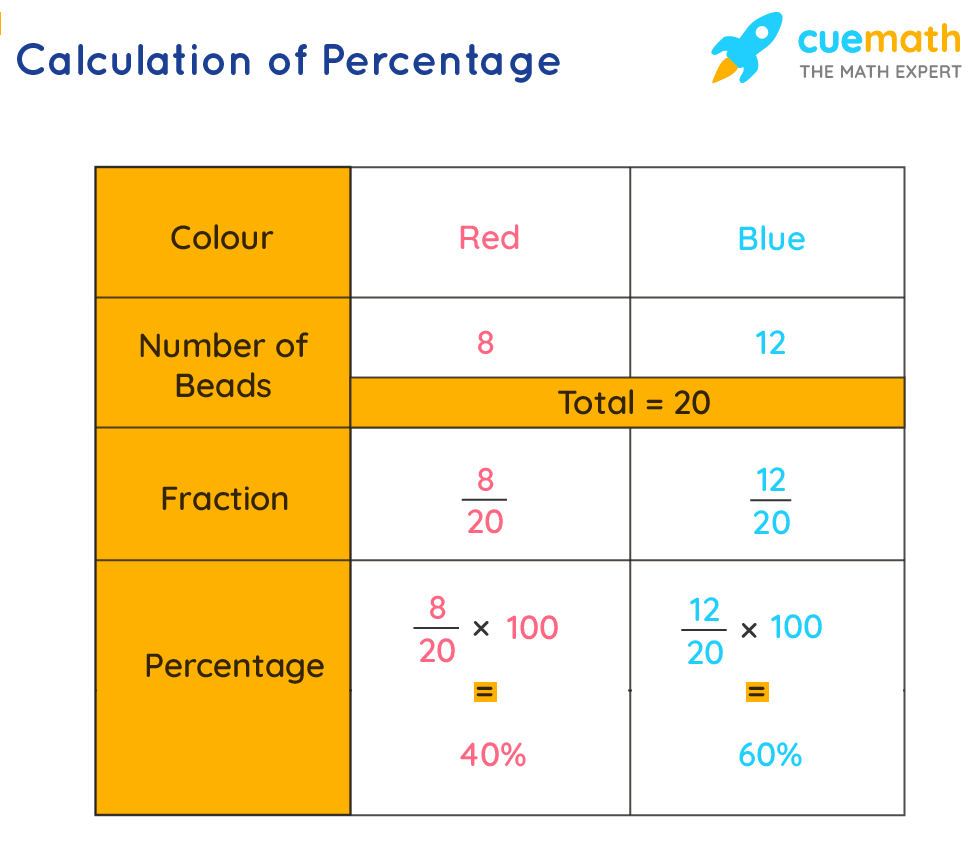
At the heart of every percentage calculation lies a simple, universal formula. To find what percentage one number is of another, you divide the “part” by the “whole” and then multiply the result by 100.
Percentage = (Part / Whole) × 100
Here, the “part” is the specific amount you are interested in, and the “whole” is the total quantity or the base amount against which you are comparing the part. This fundamental formula serves as the starting point for nearly all percentage-related financial calculations.
Practical Applications: Calculating Percentages for Everyday Money Matters
With the basic formula in hand, let’s dive into practical scenarios where percentages become invaluable tools for managing your money.
Finding a Percentage of a Number (Discounts, Taxes, Tips)
This is one of the most common applications, often encountered when shopping or dining out. To find a percentage of a given number, you convert the percentage into its decimal form (by dividing by 100) and then multiply it by the number.
-
Example 1: Calculating a 20% discount on a $150 item.
-
First, convert 20% to a decimal: 20 / 100 = 0.20.
-
Next, multiply the decimal by the original price: $150 × 0.20 = $30.
-
The discount is $30. The final price would be $150 – $30 = $120.
-
-
Example 2: Adding 8% sales tax to a $75 purchase.
-
Convert 8% to a decimal: 8 / 100 = 0.08.
-
Calculate the sales tax: $75 × 0.08 = $6.00.
-
The total cost including tax is $75 + $6.00 = $81.00.
-
-
Example 3: Tipping 18% on a $60 restaurant bill.
-
Convert 18% to a decimal: 18 / 100 = 0.18.
-
Calculate the tip amount: $60 × 0.18 = $10.80.
-
The total amount including tip would be $60 + $10.80 = $70.80.
-
Calculating Percentage Change (Growth, Decline, ROI)
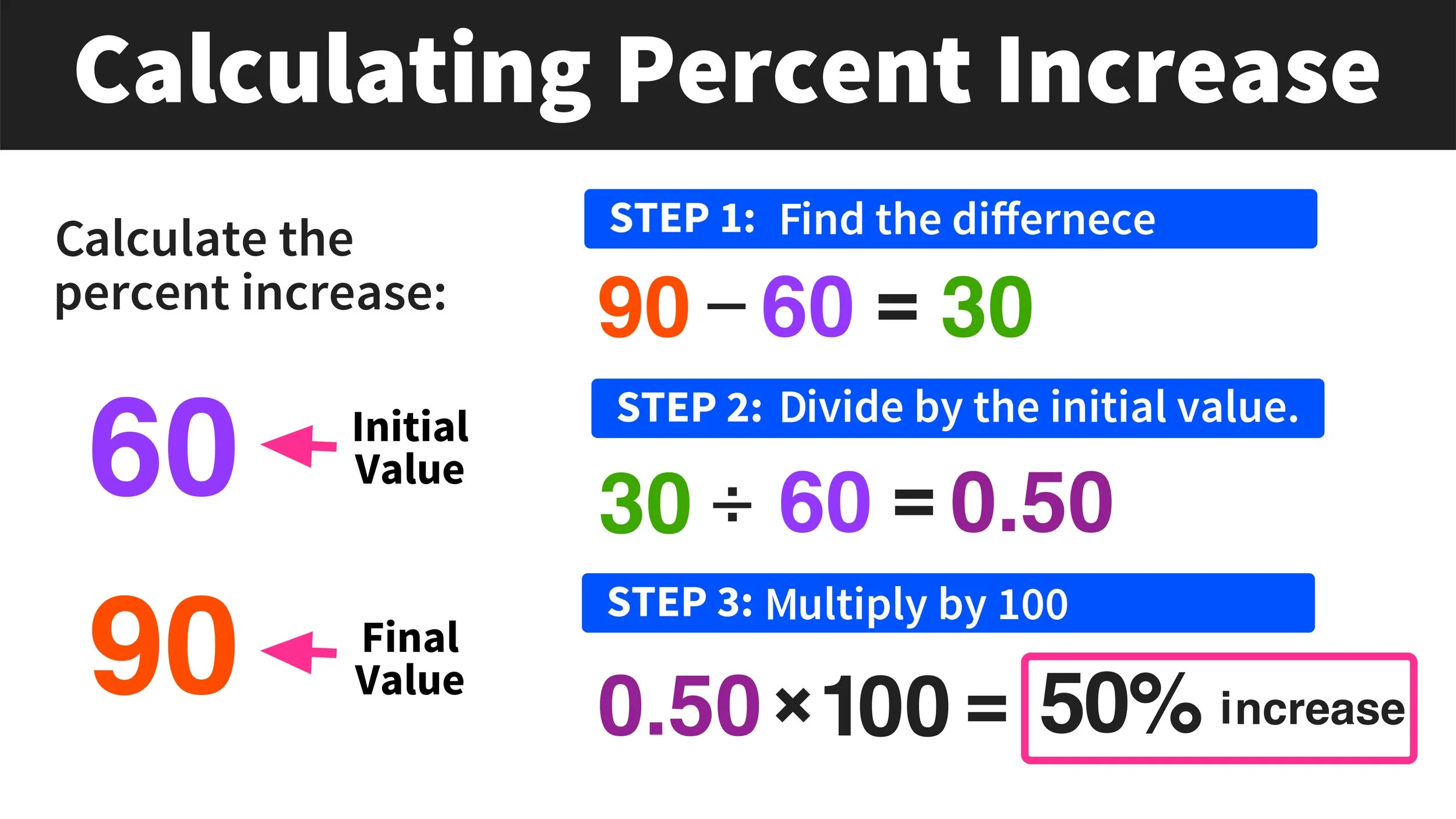
Percentage change is vital for tracking financial performance over time, whether it’s the growth of an investment, the increase in your income, or the decline in an asset’s value. It helps you understand the relative magnitude of change, not just the absolute difference.
The formula for percentage change is:
Percentage Change = ((New Value – Old Value) / Old Value) × 100
-
Example 1: Your investment portfolio grows from $10,000 to $12,000.
-
New Value = $12,000, Old Value = $10,000.
-
Difference = $12,000 – $10,000 = $2,000.
-
Percentage Change = ($2,000 / $10,000) × 100 = 0.20 × 100 = 20% increase.
-
-
Example 2: The price of a stock decreases from $80 to $72.
-
New Value = $72, Old Value = $80.
-
Difference = $72 – $80 = -$8.
-
Percentage Change = (-$8 / $80) × 100 = -0.10 × 100 = -10% decrease.
-
Determining What Percentage One Number is of Another (Expense Ratios, Profit Margins)
This application directly uses the fundamental (Part / Whole) × 100 formula to express a specific component as a proportion of a larger total.
-
Example 1: What percentage of your $4,500 monthly gross income goes towards your $1,350 rent payment?
-
Part (rent) = $1,350. Whole (income) = $4,500.
-
Percentage = ($1,350 / $4,500) × 100 = 0.30 × 100 = 30%. This tells you your housing burden relative to your income.
-

-
Example 2: A small business makes a profit of $25,000 on total revenues of $125,000. What is its profit margin?
-
Part (profit) = $25,000. Whole (revenue) = $125,000.
-
Percentage = ($25,000 / $125,000) × 100 = 0.20 × 100 = 20%. A 20% profit margin.
-
Advanced Scenarios: Leveraging Percentages for Financial Planning
Beyond basic calculations, percentages become sophisticated tools for long-term financial strategy and analysis.
Understanding Interest Rates (Simple vs. Compound Interest)
Interest is the cost of borrowing money or the reward for lending it, and it’s almost always expressed as a percentage rate.
-
Simple Interest: Calculated only on the principal amount. The formula is: Interest (I) = Principal (P) × Rate (R) × Time (T). If you invest $1,000 at 5% simple interest for 3 years, you’d earn $1,000 × 0.05 × 3 = $150 in interest.
-
Compound Interest: The “eighth wonder of the world,” compound interest is calculated on the initial principal and on the accumulated interest from previous periods. This means your money earns interest on itself, leading to exponential growth over time. While the formula is more complex (A = P(1 + r/n)^(nt)), understanding its power is crucial for savings and investments. Conversely, on debt like credit cards, compound interest can rapidly escalate what you owe. The frequency of compounding (annually, monthly, daily) significantly impacts the total return or cost.
Analyzing Financial Ratios (Debt-to-Income, Savings Rate)
Financial ratios, expressed as percentages, provide quick, comparative insights into your financial health.
-
Debt-to-Income (DTI) Ratio: Calculated as (Total Monthly Debt Payments / Gross Monthly Income) × 100. Lenders often use this to assess your ability to manage monthly payments and repay debts. A lower DTI (e.g., typically below 36%) generally indicates healthier financial standing.
-
Savings Rate: (Total Monthly Savings / Gross Monthly Income) × 100. This percentage tells you how much of your income you’re setting aside. A high savings rate (e.g., 15% or more) is key to achieving financial independence and retirement goals.
-
Expense Ratios (Investments): These are percentages of your assets paid annually for fund management and administrative costs. Even a small percentage can significantly erode your investment returns over decades, highlighting the importance of understanding and minimizing these fees.
The Power of Percentage-Based Goals
Setting financial goals in terms of percentages offers flexibility and adaptability that fixed dollar amounts often lack. As your income changes, a percentage-based goal adjusts automatically. For example, aiming to “save 15% of your income” is more resilient than “save $500 per month.” Budgeting frameworks like the 50/30/20 rule naturally align with this approach, helping you consistently allocate funds towards needs, wants, and financial goals, regardless of your current income level.
Tools and Tips for Accurate Percentage Calculations
While the underlying concepts are straightforward, accurate calculations are paramount in finance.
The Role of Calculators and Spreadsheets (Excel/Google Sheets)
-
Basic Calculators: Most modern calculators have a ‘%’ button. For example, to calculate 20% off of $100, you might type
100 - 20% =, which often directly yields 80. Learn how your specific calculator’s percentage function operates. -
Spreadsheets (Excel/Google Sheets): These are indispensable tools for financial analysis.
-
To find a percentage of a number: If a value is in cell A1,
=A1*0.20calculates 20% of A1. -
To calculate percentage change: If your old value is in A2 and new value in B2,
=(B2-A2)/A2gives you the decimal change. You then format the cell as a percentage. -
Spreadsheets allow for complex calculations, scenario planning, and the dynamic tracking of financial metrics, making them ideal for budgeting, investment analysis, and financial planning.
-
Mental Math Shortcuts for Quick Estimates
For everyday financial decisions, quick mental estimates can save time and prevent overspending.
-
Finding 10%: Move the decimal point one place to the left. 10% of $75 is $7.50.
-
Finding 1%: Move the decimal point two places to the left. 1% of $75 is $0.75.
-
Estimating other percentages:
-
20% is 10% multiplied by 2. (20% of $75 is $7.50 × 2 = $15).
-
5% is 10% divided by 2. (5% of $75 is $7.50 / 2 = $3.75).
-
These shortcuts are incredibly useful for quickly assessing tips, sales discounts, or tax implications without reaching for a calculator.
-
Common Pitfalls to Avoid
Even seasoned financial professionals can make errors if they’re not careful.
-
Incorrect Base Value: Always ensure you’re dividing by the correct “whole” or starting amount. For instance, a “20% increase then a 20% decrease” does not bring you back to the original value, because the base for the decrease is different from the base for the increase.
-
Percentage Points vs. Percent Change: This is a crucial distinction, especially in financial news. If an interest rate rises from 2% to 4%, that’s a 2 percentage point increase, but a 100% percent change increase. Misinterpreting this can lead to vastly different conclusions.
-
Rounding Errors: In large-scale or long-term financial calculations, seemingly small rounding differences can compound into significant discrepancies. When precision matters, avoid premature rounding.
Empowering Your Financial Journey with Percentage Proficiency
Mastering how to find and interpret percentages is more than just a mathematical exercise; it’s a foundational step towards achieving genuine financial literacy and empowerment.
Making Informed Decisions (Loans, Investments, Budgeting)
Understanding percentages enables you to critically evaluate financial products, compare loan offers, assess investment risks and returns, and construct a robust budget that truly reflects your financial goals. It provides the clarity needed to see beyond marketing hype and grasp the true cost or benefit of any financial transaction.
Building Financial Confidence
When you’re comfortable with percentages, the seemingly intimidating world of finance becomes much more accessible. You gain the confidence to engage with financial advisors, challenge discrepancies, and take an active role in planning your financial future. This confidence reduces financial stress and replaces it with a sense of control and clarity.
Continuous Learning and Application
The financial landscape is ever-evolving, and so too should your application of percentage knowledge. Regularly apply these calculations to your personal budget, review your investment statements, and stay informed about economic indicators. This continuous learning and practical application will solidify your understanding, making percentage proficiency an invaluable, lifelong asset for financial wellness.
By dedicating time to truly understand “how do I find the percentage,” you’re not just learning a formula; you’re unlocking a powerful tool for navigating the complexities of money, making informed decisions, and ultimately, building a more secure and prosperous financial future.
aViewFromTheCave is a participant in the Amazon Services LLC Associates Program, an affiliate advertising program designed to provide a means for sites to earn advertising fees by advertising and linking to Amazon.com. Amazon, the Amazon logo, AmazonSupply, and the AmazonSupply logo are trademarks of Amazon.com, Inc. or its affiliates. As an Amazon Associate we earn affiliate commissions from qualifying purchases.