
The phrase “compound interest” often evokes images of complex financial equations or the exclusive domain of seasoned investors. Yet, at its heart, compound interest is one of the most straightforward and powerful forces in personal finance, accessible to anyone willing to understand and apply its principles. It’s not just a concept; it’s a fundamental mechanism that can significantly accelerate your journey toward financial independence and wealth accumulation. If you’ve ever wondered how to make your money work harder for you, making your initial investments grow exponentially over time, then understanding and actively “doing” compound interest is your definitive answer.
Understanding the Core Concept of Compound Interest
At its essence, compound interest is the interest you earn not only on your initial principal but also on the accumulated interest from previous periods. It’s often referred to as “interest on interest,” and this seemingly simple idea is what gives it its incredible power.
The Magic of “Interest on Interest”
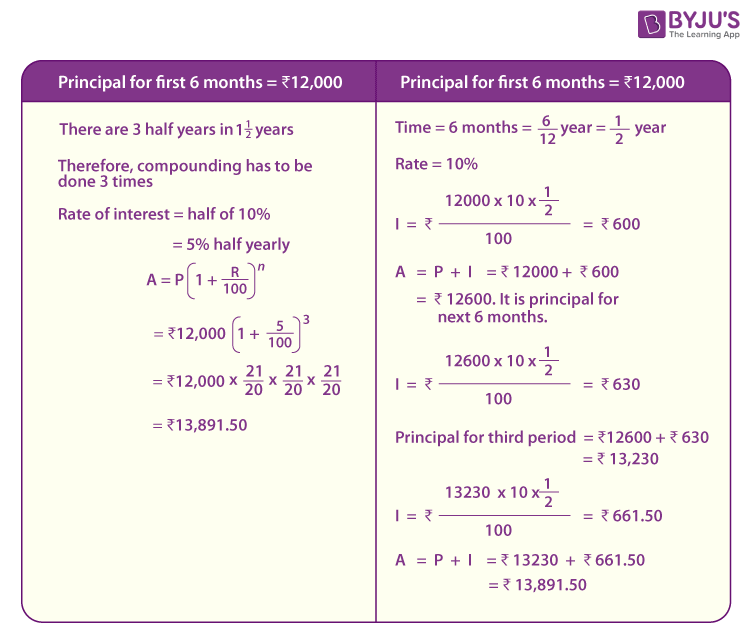
Imagine you invest $1,000 at an annual interest rate of 5%. After one year, you’d earn $50 in interest, bringing your total to $1,050. Simple enough. But with compound interest, in the second year, you wouldn’t just earn 5% on your original $1,000; you’d earn 5% on the new total of $1,050. This means you’d earn $52.50 in interest, bringing your total to $1,102.50. That extra $2.50 might seem negligible, but over decades, with consistent contributions and market growth, these small additions snowball into substantial sums. This self-accelerating growth is the “magic” that makes compounding one of Albert Einstein’s purported “eighth wonders of the world.”
Simple vs. Compound Interest: A Crucial Distinction
To fully appreciate compound interest, it’s vital to differentiate it from simple interest. Simple interest is calculated only on the principal amount of a loan or deposit. For example, if you lend $1,000 at 5% simple interest for three years, you’d earn $50 each year, totaling $150. Your interest earnings are flat and unchanging relative to the original principal.
Compound interest, however, adds the earned interest back to the principal, creating a larger base for the next interest calculation. This is why it’s so potent for investors and so dangerous for borrowers with high-interest debt. The compounding frequency also plays a critical role. Interest can compound annually, semi-annually, quarterly, monthly, or even daily. The more frequently interest is compounded, the faster your money grows, as interest is added to the principal more often, thereby earning interest on that new, larger sum sooner.
The Mechanics: How Compound Interest Works
While the concept is simple, understanding the variables and the formula can help you forecast your potential growth and make informed investment decisions.
Key Variables: Principal, Rate, Time, and Compounding Frequency
Four primary variables dictate the outcome of compound interest:
-
Principal (P): The initial amount of money invested or deposited.
-
Interest Rate (r): The annual rate of return, expressed as a decimal (e.g., 5% is 0.05).
-
Time (t): The number of years the money is invested or borrowed for.
-
Compounding Frequency (n): The number of times the interest is compounded per year (e.g., annually n=1, quarterly n=4, monthly n=12).
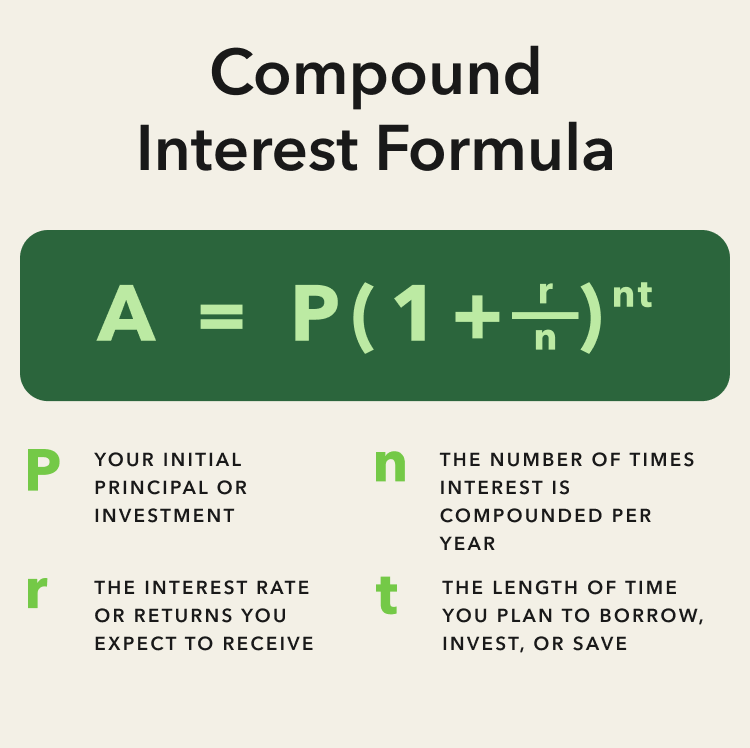
The Compound Interest Formula Explained
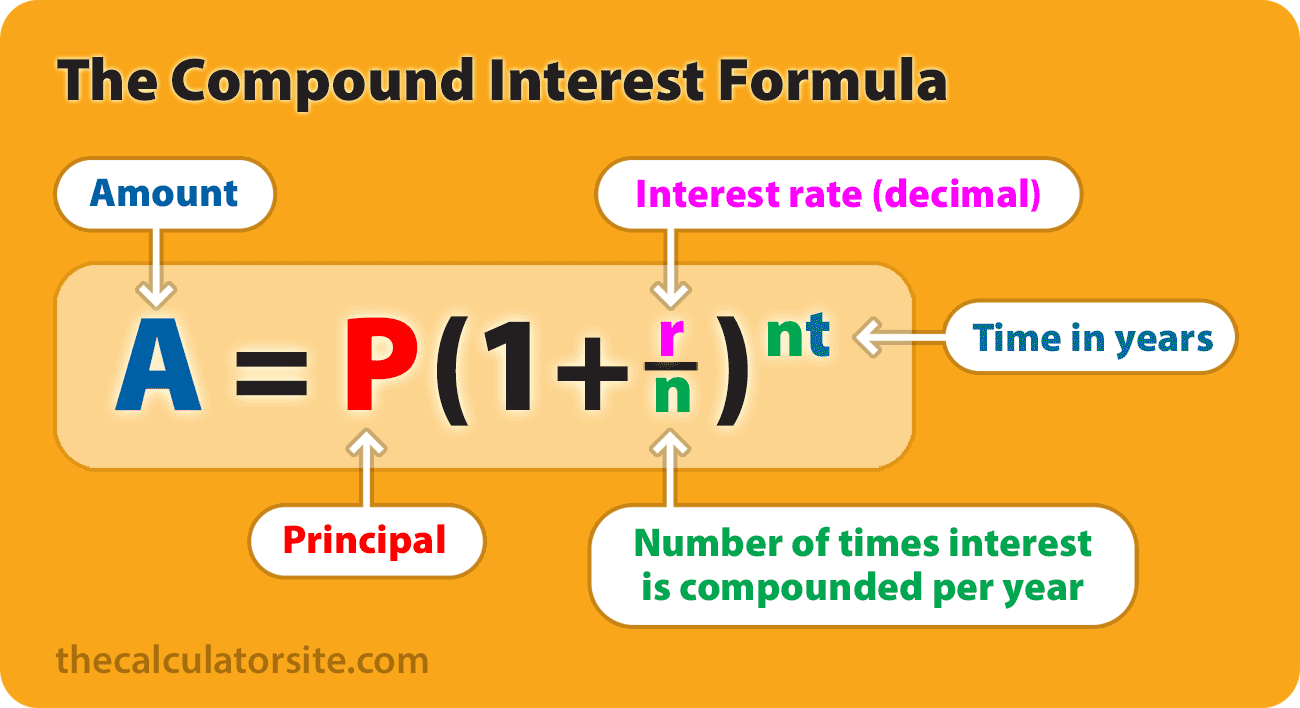
The standard formula for calculating compound interest is:
A = P (1 + r/n)^(nt)
Where:
-
A = the future value of the investment/loan, including interest
-
P = the principal investment amount (the initial deposit or loan amount)
-
r = the annual interest rate (as a decimal)
-
n = the number of times that interest is compounded per year
-
t = the number of years the money is invested or borrowed for
While financial calculators and online tools can do the heavy lifting, understanding this formula empowers you to grasp the drivers of your financial growth. It clearly illustrates how increasing your principal, securing a higher rate, extending the time horizon, or maximizing compounding frequency all contribute to a larger future value.
Practical Examples: Visualizing Growth Over Time
Let’s revisit our $1,000 investment at 5% annual interest.
-
Year 1: $1,000 * (1 + 0.05/1)^(1*1) = $1,050.00
-
Year 5: $1,000 * (1 + 0.05/1)^(1*5) = $1,276.28
-
Year 10: $1,000 * (1 + 0.05/1)^(1*10) = $1,628.89
-
Year 20: $1,000 * (1 + 0.05/1)^(1*20) = $2,653.30
-
Year 30: $1,000 * (1 + 0.05/1)^(1*30) = $4,321.94
Now, imagine if you added just $100 per month consistently, starting from scratch. The effect of compounding on these additional contributions makes the growth truly remarkable, highlighting why regular investing is so critical. This continuous inflow of new principal, coupled with compounding, forms the bedrock of long-term wealth accumulation.
Maximizing the Power of Compounding in Your Investments
Understanding compound interest is one thing; actively harnessing it to your advantage is another. Several strategies can amplify its effect on your financial future.
Starting Early: The Time Advantage
The single most impactful variable in the compound interest formula is time. Due to its exponential nature, the longer your money is invested, the more significant the compounding effect. A person who starts investing $200 a month at age 25 and stops at age 35, letting their money grow, will likely have more at retirement than someone who starts at age 35 and invests $200 a month until age 65. The early starter has fewer total contributions but a much longer period for their initial investments to compound. This illustrates the immense opportunity cost of delaying your investments.
Consistent Contributions: Adding Fuel to the Fire
While starting early is crucial, consistent contributions throughout your investment journey are equally vital. Every dollar you add becomes a new principal that starts compounding. Whether it’s through regular payroll deductions into a retirement account or automated transfers to a brokerage account, making saving and investing a habit will continuously “add fuel to the fire” of your compounding engine. Even small, regular additions can lead to substantial wealth over decades.
Reinvesting Dividends and Earnings
Many investments, particularly stocks and mutual funds, pay out dividends or distribute capital gains. A powerful strategy to supercharge your compounding is to automatically reinvest these earnings back into the same investment. Instead of taking the cash, you use it to buy more shares, which then earn their own dividends and potentially appreciate in value, creating a virtuous cycle of accelerated growth. Most brokerage accounts offer this option, making it an effortless way to enhance your returns.
Choosing the Right Investment Vehicles
The “how” of doing compound interest also involves selecting appropriate investment vehicles.
-
Retirement Accounts (401(k)s, IRAs): These tax-advantaged accounts are designed for long-term growth, making them ideal for compounding. Employer matches in 401(k)s essentially offer free money, which also compounds.
-
Stocks and Stock Mutual Funds/ETFs: Historically, stocks have offered the highest long-term returns, providing fertile ground for compounding, especially when dividends are reinvested.
-
Bonds: While offering lower returns, bonds provide stability and consistent interest payments that can be reinvested.
-
High-Yield Savings Accounts (HYSAs): For shorter-term goals or emergency funds, HYSAs, though offering modest rates, still allow your interest to compound, ensuring your cash grows more than in a traditional checking account.
Strategic Approaches to Leverage Compound Interest
Beyond individual investment choices, compound interest underpins several critical financial planning strategies.
Retirement Planning: 401(k)s and IRAs
These vehicles are perhaps the most common and effective ways individuals “do” compound interest. Contributions grow tax-deferred (Traditional accounts) or tax-free (Roth accounts), allowing your investments to compound untouched by annual tax bills. This amplified compounding, combined with potential employer contributions, makes retirement accounts indispensable for long-term wealth building. The longer you let these accounts grow, the more pronounced the compounding effect.
Emergency Funds and Savings Accounts
While not offering the explosive growth of stock market investments, even your emergency fund benefits from compounding. Keeping it in a high-yield savings account ensures that the interest earned on your savings itself earns interest, however modest. This small but consistent growth prevents your purchasing power from being eroded as quickly by inflation and ensures your liquid assets are also working for you.
Debt Management: The Flip Side of Compounding
It’s critical to acknowledge the dark side of compounding: its effect on debt. Just as interest compounds in your favor for investments, it compounds against you for high-interest debts like credit cards, personal loans, or student loans. The interest you owe also accrues interest, rapidly increasing the total amount you repay. Therefore, strategically “doing” compound interest also means aggressively paying down high-interest debt to stop the negative compounding spiral and free up capital for positive investments.
Long-Term Goal Setting
Whether it’s saving for a down payment on a house, funding a child’s education, or accumulating capital for a business venture, compound interest is the engine for achieving significant long-term financial goals. By setting clear goals, calculating the future value needed, and then investing consistently with compounding in mind, you can systematically build the necessary capital.
Common Pitfalls and How to Avoid Them
Even with a solid understanding, certain traps can derail your compounding journey.
Underestimating the Impact of Inflation
While your money grows through compounding, inflation simultaneously erodes its purchasing power. A 5% annual return might feel good, but if inflation is 3%, your real return is only 2%. Factor inflation into your long-term planning and aim for investments that historically outpace it. Diversification and strategic asset allocation can help mitigate this risk.
Panicking During Market Downturns
Investment values fluctuate, and market corrections or bear markets are inevitable. Selling investments during a downturn not only locks in losses but also prevents your money from being in the market for the subsequent recovery, missing out on crucial compounding opportunities. A long-term perspective and a disciplined investment strategy are essential to ride out market volatility.
Excessive Fees Eroding Returns
High investment fees, even seemingly small percentages, can significantly diminish your compounding returns over decades. A 1% difference in fees can translate to tens or even hundreds of thousands of dollars less at retirement. Opt for low-cost index funds, ETFs, and fee-conscious financial advisors to ensure more of your money is compounding for you.
Not Rebalancing Your Portfolio
Over time, the asset allocation of your portfolio can drift as some investments perform better than others. Periodically rebalancing—selling some assets that have grown significantly and buying more of those that have lagged—helps maintain your desired risk level and can even enhance returns. This ensures your capital is always optimally positioned to compound according to your strategy.
Conclusion
“How do I do compound interest?” is a question that, once answered, unlocks a profound shift in how you view and manage your money. It’s not about complex trading strategies or exclusive access to financial instruments; it’s about disciplined saving, consistent investing, starting as early as possible, and letting time and reinvestment work their magic. By understanding its mechanics, leveraging strategic approaches, and avoiding common pitfalls, you can harness the unparalleled power of compound interest to build substantial wealth and achieve your most ambitious financial aspirations. Begin today, and watch your future self thank you for putting the eighth wonder of the world to work.
aViewFromTheCave is a participant in the Amazon Services LLC Associates Program, an affiliate advertising program designed to provide a means for sites to earn advertising fees by advertising and linking to Amazon.com. Amazon, the Amazon logo, AmazonSupply, and the AmazonSupply logo are trademarks of Amazon.com, Inc. or its affiliates. As an Amazon Associate we earn affiliate commissions from qualifying purchases.