
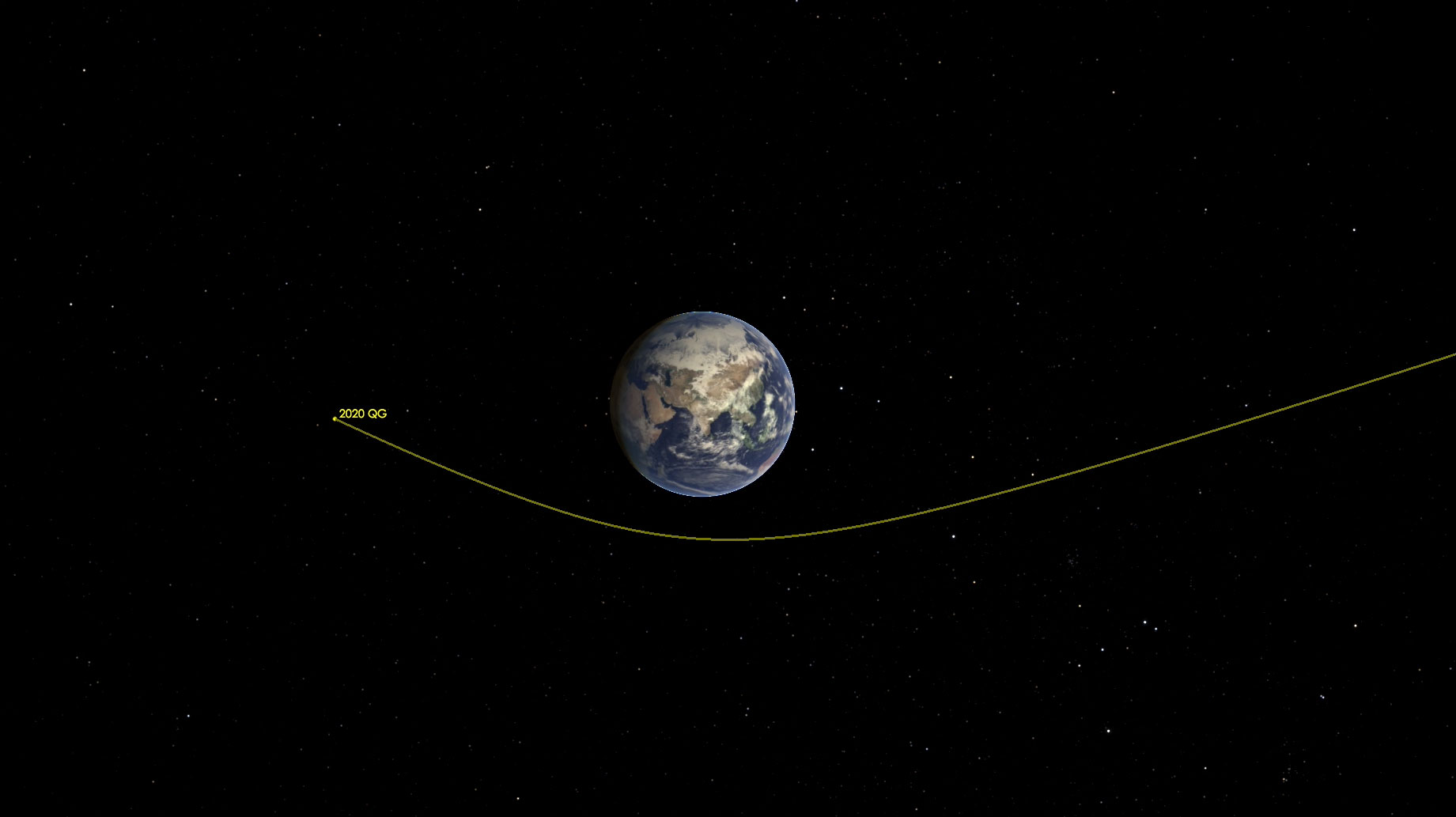
The question of which asteroid is currently the closest to Earth is a moving target—literally. At any given second, thousands of Near-Earth Objects (NEOs) are hurtling through the vacuum of space, monitored by an intricate web of sophisticated software, automated telescopes, and advanced artificial intelligence. While specific objects like 2023 BU or the infamous 99942 Apophis often dominate headlines due to their remarkably close flybys, the real story lies in the technological infrastructure that allows us to identify, track, and predict the trajectory of these cosmic neighbors.

In the digital age, tracking the closest asteroid is no longer just a matter of peering through a glass lens; it is a high-stakes exercise in big data analytics, machine learning, and global digital security.
The Digital Frontier: How AI and Software Identify the Closest Asteroids
Identifying the closest asteroid to Earth requires the processing of massive amounts of visual data. Modern sky surveys, such as the Catalina Sky Survey and Pan-STARRS, generate terabytes of imagery every night. Human astronomers alone cannot sift through these data sets to find the faint, moving dots that signify a potential NEO. This is where cutting-edge software and AI tools take center stage.
Automated Detection Algorithms
The core of modern asteroid detection is the moving object pipeline. Software suites like the Moving Object Processing System (MOPS) are designed to link detections across multiple images taken at different times. By calculating the vector of a moving point against the static background of stars, these algorithms can flag a potential asteroid within minutes of the image being captured. The speed of this software is critical; if an asteroid is on a particularly close trajectory, every hour of lead time is vital for orbital refinement.
Machine Learning and Noise Reduction
One of the greatest challenges in tracking close-range asteroids is “noise”—false positives caused by cosmic rays, satellite glints, or sensor artifacts. To combat this, researchers are increasingly deploying deep learning models. These AI tools are trained on millions of images to distinguish between a legitimate celestial body and a digital glitch. By reducing false positives, machine learning allows planetary defense researchers to focus their computational power on the most significant threats and the closest approaches.
Predictive Orbital Modeling
Once an asteroid is detected, the focus shifts to orbital mechanics. Software such as Sentry-II, developed by NASA’s Jet Propulsion Laboratory (JPL), uses sophisticated mathematical models to calculate the probability of impact over the next century. This isn’t just basic geometry; it involves accounting for the “Yarkovsky effect”—a subtle force where sunlight heats an asteroid, causing it to emit thermal radiation that acts like a tiny thruster, altering its path. Sentry-II uses a genetic algorithm to explore a wide range of possible orbits, ensuring that even the most minute deviations are accounted for in our proximity alerts.
Near-Earth Object (NEO) Surveillance Systems: The Tech Behind the Watch
The global effort to track the closest asteroids is supported by a sophisticated network of hardware and software interfaces that act as Earth’s digital shield. These systems are the backbone of planetary defense tech, providing a transparent, real-time database of our cosmic surroundings.
The Center for Near-Earth Object Studies (CNEOS)
CNEOS is the primary tech hub for NASA’s asteroid tracking efforts. Its digital infrastructure serves as the central clearinghouse for orbital data. The center utilizes a specialized software tool called “Scout,” which provides rapid analysis of newly discovered objects. Even before an asteroid’s orbit is fully confirmed, Scout runs thousands of simulations to determine if a “close approach” is imminent. This real-time processing is what allows scientists to announce the “closest asteroid” to the public with high confidence.
The ESA’s NEO Coordination Centre (NEOCC)
The European Space Agency operates its own suite of digital tools through the NEOCC. Their “Risk List” is a highly specialized database that ranks objects based on their proximity and impact probability. The technical prowess of the NEOCC lies in its “Orbit Visualization Tool,” a web-based application that allows researchers and the public to interact with 3D models of asteroid trajectories. This move toward interactive, browser-based data visualization is a major trend in space tech, making complex astrophysical data accessible to a global audience.
Deep Space Radar and Sensor Fusion
While optical telescopes find asteroids, radar technology provides the precision needed to determine their exact size and shape. Facilities like the Goldstone Solar System Radar use high-power radio waves to “ping” asteroids as they pass close to Earth. The return signal is processed using specialized imaging software to create high-resolution 3D shapes. This sensor fusion—combining optical data with radar precision—is the gold standard in determining exactly how close an asteroid will get.
Real-Time Tracking Apps and Tools for the Modern Astronomer
Technology has democratized the tracking of asteroids. No longer the exclusive domain of government agencies, high-quality data is now available through various apps and web-based platforms, allowing tech-savvy enthusiasts to monitor the “closest asteroid to Earth” from their smartphones.
NASA’s Eyes on Asteroids
One of the most impressive consumer-facing tech tools is NASA’s “Eyes on Asteroids” web application. Built using WebGL, this tool runs directly in a browser and provides a real-time, 3D visualization of every known NEO. Users can scroll through time to see upcoming close approaches, highlighting the technical shift toward high-performance, interactive data delivery. The app pulls live data from the Small-Body Database, ensuring that users are seeing the most current orbital updates.
Asteroid Watch and Mobile Integration
For those who want proactive alerts, several mobile applications and Twitter (X) bots utilize NASA and ESA APIs to provide instant notifications when a new asteroid is discovered or when an object is about to make a close approach. These tools are examples of how API integration can turn complex scientific data into a streamlined user experience, providing “LD” (Lunar Distance) measurements that quantify exactly how close these objects are in relation to the moon.
Amateur Software and Global Collaboration
The Minor Planet Center (MPC) relies on a global network of amateur astronomers who use specialized software like “Astrometrica” to report their observations. This software allows users to calibrate their telescope cameras, identify known stars for reference, and submit precise coordinates to the MPC’s database. This collaborative tech ecosystem ensures that the “closest asteroid” is always being watched by thousands of digital eyes across the globe.
The Future of Planetary Defense Tech: Beyond Just Identification
As we look toward the next decade, the technology used to track and interact with the closest asteroids is evolving from passive observation to active intervention. The success of the DART (Double Asteroid Redirection Test) mission proved that software and hardware can work in tandem to alter a celestial body’s path.
The NEO Surveyor: Next-Gen Infrared Hardware
Current ground-based tech is limited by the daylight and the atmosphere. The upcoming NEO Surveyor mission is a space-based infrared telescope designed specifically to find the “dark” asteroids that are difficult to see with visible light. Its onboard sensors will be optimized for the heat signatures of asteroids, and its data processing suite will be capable of identifying objects that spend most of their time in the glare of the sun.
Autonomous Navigation Software
Future missions to the closest asteroids will require high levels of autonomy. Using “Small Body Maneuvering” software, spacecraft will be able to navigate the weak gravity fields of asteroids without real-time input from Earth. This requires advanced edge computing—processing complex navigational algorithms on the spacecraft’s hardware to make split-second adjustments during a close-approach flyby or landing.
Laser Redirection and Computational Simulations
Researchers are currently using supercomputers to simulate the use of high-powered lasers to deflect asteroids. These simulations involve complex thermomechanical modeling, calculating how much material would be vaporized and how much thrust that would generate. While still in the conceptual phase, the software being developed today will form the basis of the planetary defense systems of tomorrow.
The pursuit of identifying the closest asteroid to Earth is a testament to the power of modern technology. From the AI that spots a faint glimmer in the night sky to the web apps that bring 3D orbital models to our pockets, the intersection of astronomy and tech has never been more vital. As our digital tools become more sophisticated, our ability to monitor, understand, and eventually manipulate our cosmic environment ensures that we are no longer passive observers of the universe, but active participants in our own planetary security.
aViewFromTheCave is a participant in the Amazon Services LLC Associates Program, an affiliate advertising program designed to provide a means for sites to earn advertising fees by advertising and linking to Amazon.com. Amazon, the Amazon logo, AmazonSupply, and the AmazonSupply logo are trademarks of Amazon.com, Inc. or its affiliates. As an Amazon Associate we earn affiliate commissions from qualifying purchases.