
Understanding the average pay in Canada is a critical component of personal financial planning, career mapping, and lifestyle design. Whether you are a newcomer to the country, a recent graduate entering the workforce, or a seasoned professional considering a mid-career pivot, knowing where the national benchmarks lie allows for better negotiation and more realistic budgeting. As the Canadian economy shifts under the pressures of inflation, housing costs, and a changing labor market, the definition of a “good salary” continues to evolve.
The Current Landscape of Canadian Earnings
To accurately assess the average pay in Canada, one must look at data provided by Statistics Canada, which tracks payroll employment, earnings, and hours. As of the most recent quarterly reports, the average annual salary for full-time employees in Canada hovers around $63,000 to $65,000 per year. However, this figure is a broad national average that masks significant variations based on geography, industry, and experience level.

National Statistics and Recent Trends
While the average hourly wage has seen consistent year-over-year growth—often ranging between 4% and 5%—this growth must be viewed through the lens of purchasing power. Wage growth in Canada has recently struggled to outpace the Consumer Price Index (CPI), meaning that while nominal pay is increasing, the real value of those dollars is often stretched thin by the rising costs of essentials like groceries and rent.
The distinction between the “average” (mean) and the “median” is also vital for financial literacy. The mean can be skewed upward by high-earning executives and specialized professionals. The median income, which represents the middle point of the population, often provides a more grounded perspective of what the typical Canadian worker takes home. For many individuals, the median individual income is closer to $45,000 to $55,000 when accounting for both part-time and full-time positions across all age groups.
Provincial Variations: Where the Money Is
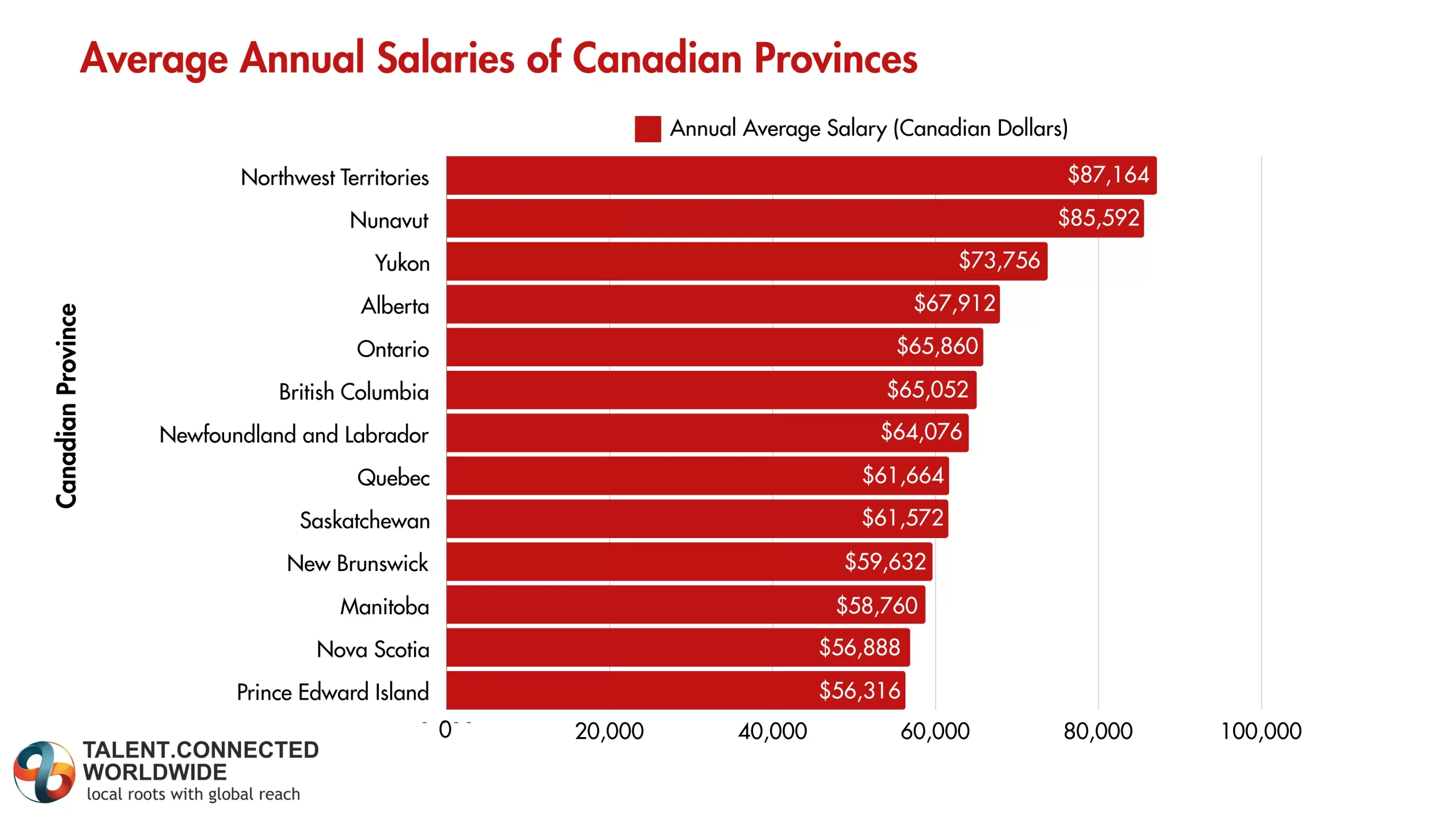
Geography is perhaps the most significant determinant of earning potential in Canada. The “Alberta Advantage” remains a reality in many sectors; Alberta consistently reports the highest average weekly earnings in the country, largely driven by the high-output energy and natural resources sectors. Workers in Alberta often see average annual earnings exceeding $75,000.
In contrast, Ontario and British Columbia offer high salaries in corporate, tech, and financial sectors, but these are frequently offset by the exorbitant cost of living in hubs like Toronto and Vancouver. Meanwhile, the Atlantic provinces—New Brunswick, Nova Scotia, Prince Edward Island, and Newfoundland and Labrador—historically report lower average pay, though the gap is slowly narrowing as remote work allows professionals to maintain high-paying roles in more affordable jurisdictions. Quebec sits in the middle, offering a balance of competitive industrial wages and a lower cost of living compared to its western neighbors.
Industry Deep Dive: Which Sectors Pay the Most?
A person’s chosen field of work is the primary engine of their wealth-building potential. In Canada, certain industries consistently outperform the national average due to high demand, specialized skill requirements, and the capital-intensive nature of the work.
Natural Resources, Mining, and Oil and Gas
The extraction and energy sectors remain the highest-paying industries in Canada. Professionals working in mining, quarrying, and oil and gas extraction can expect average annual salaries well into the six figures. These roles often require working in remote locations or under demanding conditions, which commands a premium. For those focused on maximizing income in a short period, these sectors offer some of the most lucrative “blue-collar” and engineering opportunities in the nation.
Finance, Insurance, and Real Estate
Canada’s financial heart, centered primarily in Toronto’s Bay Street, continues to be a bastion of high earnings. Professionals in investment banking, portfolio management, and actuarial sciences often see base salaries that far exceed the national average, complemented by performance-based bonuses. Even entry-level roles in financial analysis or insurance underwriting tend to start at or above the $60,000 mark, with rapid upward mobility for those who pursue professional designations like the CFA (Chartered Financial Analyst) or CPA (Chartered Professional Accountant).
The Rising Tide of Technology and Engineering
The “Tech North” movement has solidified Canada’s reputation as a global hub for software development, artificial intelligence, and cybersecurity. While Canadian tech salaries have historically trailed those in the United States’ Silicon Valley, the gap is closing for high-level talent. Senior software engineers, data scientists, and DevOps specialists in cities like Kitchener-Waterloo, Montreal, and Ottawa can command salaries ranging from $120,000 to $180,000. Furthermore, the specialized nature of these roles often includes equity stakes or stock options, which can significantly enhance a professional’s long-term net worth.
Beyond the Base Salary: Understanding Total Compensation

When evaluating the average pay in Canada, it is a mistake to focus solely on the gross salary listed in a job offer. Total compensation includes a variety of factors that contribute to financial security and long-term wealth.
The Importance of Benefits and Pensions
In Canada, employer-sponsored benefits can be worth thousands of dollars annually. Health and dental insurance, disability coverage, and life insurance provide a safety net that protects a worker’s primary income stream. Perhaps more importantly, the presence of a Registered Retirement Savings Plan (RRSP) matching program or a Defined Benefit Pension Plan is a massive contributor to financial independence. An employer who matches 5% of your salary in an RRSP is essentially providing a 5% “instant return” on your investment, a perk that should be factored into any comparison of average pay.
Gross vs. Net: Navigating the Canadian Tax System
One of the biggest shocks for those moving into higher income brackets is the impact of Canada’s progressive tax system. A gross salary of $100,000 does not equate to $100,000 in your bank account. Depending on the province of residence, federal and provincial income taxes, along with Canada Pension Plan (CPP) and Employment Insurance (EI) contributions, will significantly reduce take-home pay.
For example, an individual earning $100,000 in Ontario might see a take-home pay of approximately $70,000 to $73,000. Understanding marginal tax rates is essential for financial planning; as you earn more, each additional dollar is taxed at a higher rate. This makes tax-advantaged accounts like the Tax-Free Savings Account (TFSA) and the First Home Savings Account (FHSA) vital tools for Canadians looking to keep more of what they earn.
Strategic Career Growth and Income Optimization
Knowing the average pay is the baseline; exceeding it requires a proactive approach to career management and financial optimization.
The Role of Education and Specialized Certification
Data consistently shows that individuals with post-secondary education earn significantly more over their lifetimes than those with a high school diploma. However, the type of education matters. In the current market, specialized certifications—such as Project Management Professional (PMP) status, specialized nursing credentials, or cloud computing certifications (AWS/Azure)—often provide a higher return on investment than a general master’s degree. Continuous upskilling is no longer optional; it is a requirement for maintaining a salary that stays ahead of inflation.
Negotiation Tactics for the Canadian Job Market
Many Canadians settle for the “average” pay because they fail to negotiate. In a competitive labor market, employers often have a salary range rather than a fixed number. Researching industry-specific benchmarks through tools like the Government of Canada Job Bank or professional associations provides the leverage needed to ask for a higher starting wage. It is also important to negotiate for non-monetary benefits, such as additional vacation weeks or flexible work arrangements, which can improve quality of life and reduce costs related to commuting and childcare.
Financial Management in a High-Cost Environment
Earning the average pay in Canada is only half the battle; the other half is managing that income effectively in an environment where housing and debt costs are high.
Budgeting Based on Real Take-Home Pay
Financial success in Canada requires budgeting based on net income, not gross income. A common mistake is taking on a mortgage or car loan based on a “pre-tax” figure. Financial advisors often recommend the 50/30/20 rule: 50% of take-home pay for needs (housing, utilities), 30% for wants, and 20% for savings and debt repayment. In high-cost cities like Toronto or Vancouver, the “needs” category often exceeds 50%, requiring individuals to be even more disciplined with their discretionary spending.
Building Wealth Through Diversified Income Streams
Given that the average pay may not always provide the lifestyle many desire, more Canadians are turning to side hustles and investment income to supplement their primary earnings. Whether through freelancing, the gig economy, or dividend-paying stocks, diversifying income streams provides a buffer against economic volatility. By investing a portion of the average Canadian salary into a diversified portfolio of low-cost index funds or ETFs, an individual can move from merely “earning a living” to “building a legacy.”
Ultimately, the average pay in Canada serves as a useful barometer for the health of the economy, but it should not be the ceiling for your personal financial goals. By understanding the regional nuances, industry trends, and the realities of the tax system, you can navigate the Canadian financial landscape with confidence and strategic intent.
aViewFromTheCave is a participant in the Amazon Services LLC Associates Program, an affiliate advertising program designed to provide a means for sites to earn advertising fees by advertising and linking to Amazon.com. Amazon, the Amazon logo, AmazonSupply, and the AmazonSupply logo are trademarks of Amazon.com, Inc. or its affiliates. As an Amazon Associate we earn affiliate commissions from qualifying purchases.