
When Nintendo released the Wii in 2006, it revolutionized the concept of interactive entertainment through motion-based gameplay. However, it was the 2009 release of Wii Sports Resort that truly fulfilled the promise of 1:1 motion tracking. As a flagship title designed to showcase the Wii MotionPlus peripheral, Wii Sports Resort remains a landmark in the “Tech” category of gaming history, blending sophisticated hardware integration with accessible software design. To understand what is on Wii Sports Resort, one must look beyond the simple list of mini-games and examine the technical synergy between the hardware, the digital environment of Wuhu Island, and the twelve diverse sporting disciplines it offers.
The Technological Evolution: Wii MotionPlus and Precision Control
The core identity of Wii Sports Resort is defined by its hardware requirement: the Wii MotionPlus. Unlike its predecessor, which relied primarily on three-axis accelerometers to detect “swings” and “shakes,” Wii Sports Resort utilized a dual-sensor approach. The MotionPlus accessory added a micro-electro-mechanical systems (MEMS) gyroscope to the standard Wii Remote.
Bridging the Gap in Motion Sensing
The original Wii Remote was excellent at detecting force and direction, but it often struggled with orientation and subtle rotational movements. The inclusion of the gyroscope allowed the console to track the remote’s position in 3D space with significantly higher fidelity. This technical leap meant that the software could now register the twist of a wrist, the angle of a blade, or the spin on a ball. In Wii Sports Resort, this translated to a level of precision that made the digital interactions feel tactile and authentic.
The Hardware Requirement: A Peripheral Shift
The game was famously bundled with the MotionPlus accessory, a move that signaled Nintendo’s commitment to iterative hardware improvements within a single console generation. This peripheral plugged into the expansion port at the bottom of the remote, effectively lengthening the controller and requiring a new, longer protective silicone jacket. From a technical standpoint, this was a necessary bridge to the future of motion control, paving the way for the complex gestures seen in later titles like The Legend of Zelda: Skyward Sword.
Exploring Wuhu Island: The Comprehensive Sports Catalog
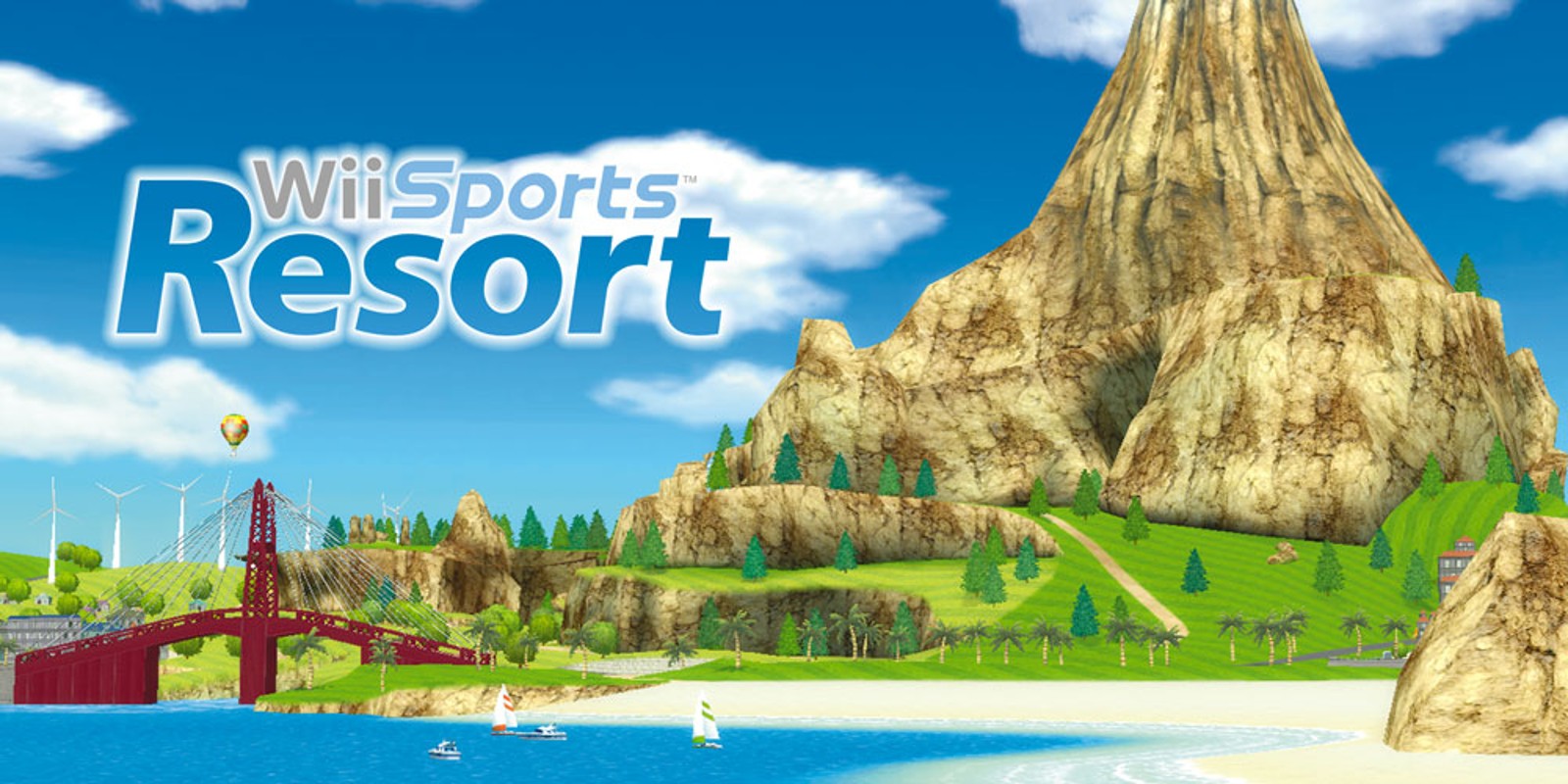
At the heart of the Wii Sports Resort experience is Wuhu Island, a recurring digital location in Nintendo’s ecosystem. The island serves as more than just a menu background; it is a cohesive, persistent environment that hosts twelve distinct sports. Each sport utilizes the MotionPlus technology in unique ways to simulate real-world physics and athletics.
High-Intensity Competitions: Swordplay and Basketball
Swordplay is arguably the most direct demonstration of the game’s technical capabilities. It features three modes: Duel, Speed Slice, and Showdown. In Duel, the 1:1 tracking allows players to hold their wooden sword at any angle, requiring strategic blocking and striking. Speed Slice tests reaction time and rotational precision, while Showdown pits the player against hordes of AI opponents, requiring fluid, continuous motion tracking.
Basketball introduced two primary modes: the 3-Point Contest and Pickup Game. The 3-Point Contest focuses on the “flick” of the wrist, where the release timing and the arc of the arm are calculated to determine the ball’s trajectory. The Pickup Game adds a layer of complexity, requiring players to dribble, pass, and steal through varied motion gestures.
Precision and Finesse: Archery, Golf, and Bowling
Archery is a standout technical achievement in the collection. It requires the player to hold the Wii Remote vertically (as the bow) while pulling back the Nunchuk (as the string). The software accounts for distance, wind speed, and the subtle “tremble” of the player’s hands, making it one of the most immersive simulations on the platform.
Golf and Bowling returned from the original Wii Sports, but with massive technical overhauls. In Golf, the MotionPlus detects the “open” or “closed” face of the club, allowing players to execute draws and fades intentionally. In Bowling, the sensitivity to wrist rotation allows for much more nuanced hook shots, demanding a higher level of skill from the user than the 2006 version.
Aquatic and Aerial Exploration: Wakeboarding and Air Sports
Wakeboarding utilizes the Wii Remote’s tilt sensors to guide the player across the wake of a boat, with the goal of performing flips and rotations in mid-air. The landing requires the remote to be held level, a direct test of the gyroscope’s orientation tracking.

Air Sports is divided into Skydiving, Island Flyover, and Dogfight. The Island Flyover mode is particularly notable for its “open-world” feel. Players hold the Wii Remote like a paper airplane, tilting it to bank, climb, or dive. This mode serves as a technical tour of Wuhu Island, showcasing the console’s ability to render a large, interconnected environment with dozens of interactive “i” points.
The Software Design and User Experience
Beyond the physics and hardware, Wii Sports Resort excelled in its user interface (UI) and progression systems. The game was designed to be “sticky”—to keep players returning long after the initial novelty of the motion controls wore off.
Iterative UI and Mii Integration
The game utilizes Nintendo’s “Mii” avatars, allowing players to see themselves and their friends integrated into the sports. The UI is clean and intuitive, using a “postal stamp” aesthetic for achievements. From a software perspective, the integration of Miis across different sports created a sense of a living community. Even when playing solo, the island is populated with Miis from the user’s console, making the digital world feel inhabited and personal.
Progression Systems and the “Stamps” Achievement Logic
To provide a sense of long-term value, Nintendo implemented a “Stamp” system—a precursor to modern achievement and trophy systems. Each of the twelve sports has five specific stamps to collect, ranging from simple milestones (like playing a certain number of games) to high-skill challenges (like hitting a secret target in Archery). This design choice turned a casual party game into a technical challenge, encouraging players to master the nuances of the MotionPlus hardware.
Legacy and Impact on Motion-Control Gaming
Wii Sports Resort was not just a successful commercial product; it was a proof of concept for the future of human-computer interaction. Its influence can be seen in various sectors of the tech and gaming industries today.
Setting the Standard for Successors
The mechanics perfected in Resort served as the blueprint for Nintendo Switch Sports, which utilizes the more advanced Joy-Con sensors. The Joy-Cons essentially miniaturize the MotionPlus technology, but the fundamental logic of gesture recognition—how a swing is translated into digital force—remains rooted in the work done for Wii Sports Resort.
The Enduring Appeal of Local Multiplayer Tech
In an era increasingly dominated by online matchmaking and cloud gaming, Wii Sports Resort remains a gold standard for local, “couch” multiplayer. The technical accessibility of the game—the fact that a five-year-old and an eighty-year-old can both understand how to swing a digital racket—showcases the power of intuitive interface design.
Furthermore, the game’s emphasis on physical movement served as an early precursor to the “exergaming” trend and the current wave of Virtual Reality (VR) fitness apps. While it lacks the visual immersion of a headset, the fundamental tech—tracking a physical object in 3D space to influence a digital avatar—is exactly what powers modern VR controllers like those found on the Meta Quest or PlayStation VR2.

Conclusion: A Milestone in Interactive Technology
When asking “what is on Wii Sports Resort,” the answer is multifaceted. On the surface, it is a collection of twelve sports: Swordplay, Wakeboarding, Frisbee, Archery, Basketball, Table Tennis, Golf, Bowling, Power Cruising, Canoeing, Cycling, and Air Sports. However, on a deeper level, it is a sophisticated integration of MEMS hardware and software physics.
It transformed Wuhu Island into a legendary digital playground and proved that motion control could be precise, reliable, and deeply engaging. By demanding more from both the hardware and the player, Wii Sports Resort moved the needle for the tech industry, demonstrating that the most successful gadgets are those that bridge the gap between physical human movement and digital response with seamless, invisible complexity.
aViewFromTheCave is a participant in the Amazon Services LLC Associates Program, an affiliate advertising program designed to provide a means for sites to earn advertising fees by advertising and linking to Amazon.com. Amazon, the Amazon logo, AmazonSupply, and the AmazonSupply logo are trademarks of Amazon.com, Inc. or its affiliates. As an Amazon Associate we earn affiliate commissions from qualifying purchases.