
In the current era of high-performance computing, the demand for processing power has outpaced the capabilities of traditional hardware. As we move deeper into the age of artificial intelligence, big data, and complex simulations, a specific type of hardware has emerged as the cornerstone of modern digital infrastructure: the GPU accelerator. While many associate Graphics Processing Units (GPUs) with video games and high-end visual rendering, the “accelerator” designation refers to a fundamental shift in how these processors are utilized to solve some of the world’s most challenging computational problems.
A GPU accelerator is a hardware component designed to work in tandem with a Central Processing Unit (CPU) to accelerate computationally intensive applications. By offloading the most demanding portions of a task to the GPU, systems can achieve throughput levels that were previously unimaginable. This synergy, often referred to as heterogeneous computing, allows for the processing of massive datasets and the execution of complex mathematical models with unprecedented efficiency.
Decoding the Power of Parallel Processing
To understand what makes a GPU accelerator so effective, one must first understand the fundamental difference between the “brain” of the computer—the CPU—and the “muscle”—the GPU.
The Fundamental Difference: CPU vs. GPU
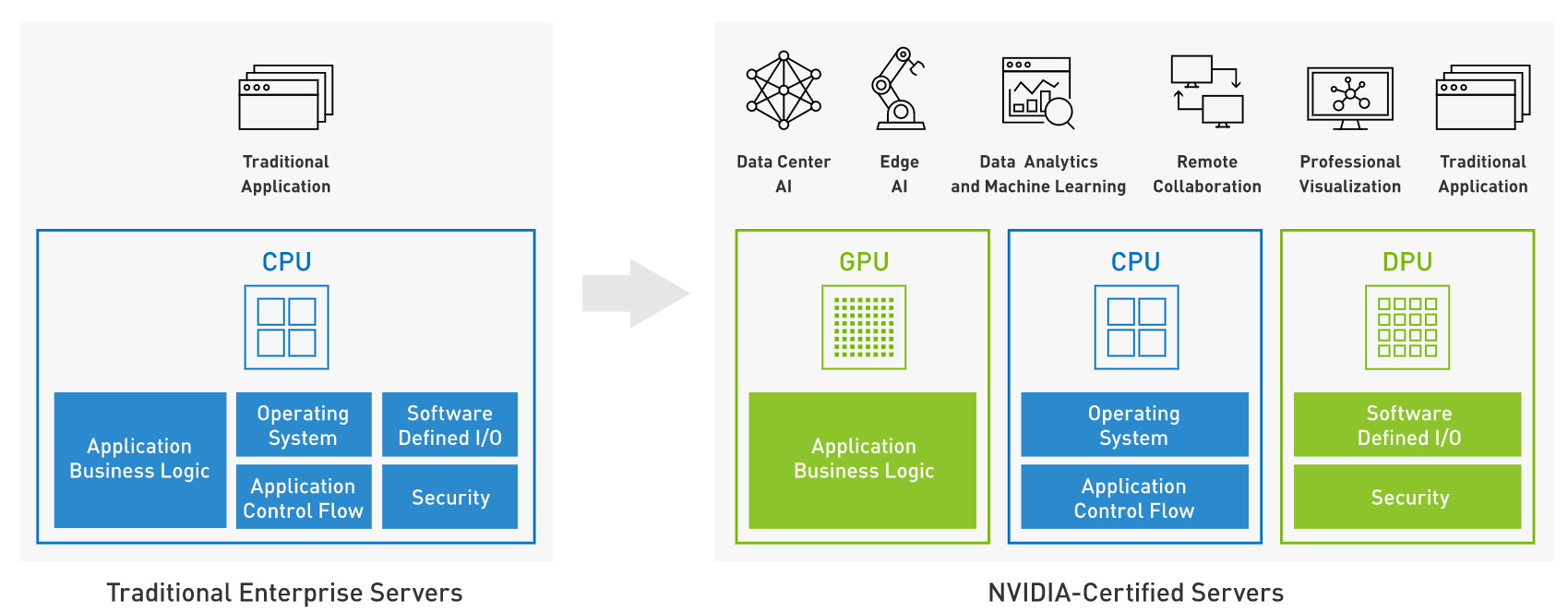
The CPU is designed for general-purpose computing. It is an incredibly sophisticated piece of hardware optimized for serial processing, meaning it handles tasks one after another in a linear fashion. It excels at complex logic, branching operations, and managing the various inputs and outputs of a system. A high-end server CPU might have 32, 64, or even 128 cores, each capable of handling high-frequency, complex instruction sets.
In contrast, a GPU accelerator is built for parallel processing. Instead of a few powerful cores, a GPU contains thousands of smaller, more specialized cores. These cores are designed to handle many tasks simultaneously. While an individual GPU core is significantly less powerful than a CPU core, the sheer volume of cores allows a GPU to perform millions of mathematical operations at once. This is the essence of “throughput” computing—maximizing the amount of work done in a single unit of time rather than minimizing the time it takes for a single task to complete.
How Acceleration Works in Practice
In a typical accelerated application, the CPU remains the primary controller. It handles the operating system, manages memory, and directs the overall flow of the program. However, when the program encounters a “parallelizable” task—such as calculating the trajectories of a million particles in a physics simulation or adjusting the weights of a neural network—the CPU offloads that specific workload to the GPU accelerator.
The GPU processes the data in parallel, completes the calculations, and sends the results back to the CPU. This divide-and-conquer strategy dramatically reduces the time required for data-heavy operations. Without an accelerator, a CPU would have to process each data point sequentially, a bottleneck that can lead to days or weeks of processing time for modern enterprise workloads.
The Anatomy of a GPU Accelerator
Modern GPU accelerators are marvels of engineering, containing billions of transistors and specialized circuitry tailored for specific types of math.
Thousands of Specialized Cores
At the heart of the accelerator are the processing cores. In the Nvidia ecosystem, these are known as CUDA (Compute Unified Device Architecture) cores. In the AMD ecosystem, they are often referred to as Stream Processors. These cores are primarily focused on floating-point arithmetic, which is the mathematical language of graphics, scientific modeling, and AI.
Beyond standard cores, modern accelerators include “Tensor Cores” and “Ray Tracing (RT) Cores.” Tensor Cores are specialized hardware units designed specifically for deep learning matrix multiplication and accumulation. They are the engines that drive modern Large Language Models (LLMs) and generative AI. RT Cores, while initially designed for lighting in games, are used in professional visualization and engineering to simulate the physical behavior of light and sound.
High-Bandwidth Memory (HBM) and Interconnects
Processing power is useless if the data cannot reach the cores fast enough. Standard system RAM is often too slow to keep up with the demands of a GPU accelerator. Consequently, accelerators use specialized memory called High-Bandwidth Memory (HBM) or GDDR (Graphics Double Data Rate) memory. HBM3, the latest standard, offers terabytes per second of bandwidth, ensuring that the thousands of cores are never “starved” for data.
Furthermore, in multi-GPU setups, the way accelerators talk to each other is critical. Technologies like Nvidia’s NVLink or AMD’s Infinity Fabric allow GPUs to share data directly at high speeds without having to go through the slower PCIe bus. This creates a unified pool of memory and processing power that can act as a single, massive supercomputer.

Software Ecosystems: CUDA and OpenCL
The hardware is only half the story. A GPU accelerator requires a software layer to tell it how to handle non-graphical data. Nvidia’s CUDA is the most dominant platform, providing a programming model and a suite of libraries that allow developers to write code in standard languages like C++ or Python and have it run on the GPU. Other open standards like OpenCL and the emerging ROCm platform from AMD provide cross-platform alternatives, ensuring that GPU acceleration is accessible across different hardware vendors.
Transformative Applications in Modern Computing
GPU accelerators have transitioned from niche components for scientists to essential tools for virtually every industry.
Artificial Intelligence and Machine Learning
The most visible impact of GPU accelerators is in the field of Artificial Intelligence. Training a modern AI model requires billions of mathematical operations. Without accelerators, the development of models like GPT-4 or DALL-E would be physically impossible; the training time would span decades. GPU accelerators enable “training,” where the model learns from data, and “inference,” where the model applies its knowledge to answer questions or generate content.
Big Data and Real-Time Analytics
In the corporate world, data is the new oil. However, raw data is useless without analysis. GPU accelerators enable real-time analytics on massive datasets. Whether it is a financial institution detecting fraudulent transactions among millions of daily swipes or a retail giant optimizing its global supply chain, accelerators allow these companies to query data in seconds rather than hours. This speed allows for more agile decision-making and the ability to react to market changes in real time.
High-Performance Computing (HPC) and Simulation
For decades, supercomputing was the domain of massive CPU clusters. Today, almost all of the world’s fastest supercomputers rely on GPU accelerators. They are used for:
- Climate Modeling: Simulating the Earth’s atmosphere to predict weather patterns and climate change.
- Drug Discovery: Simulating the way different molecules interact with proteins to identify potential new medicines.
- Engineering: Conducting “Digital Twin” simulations of jet engines or skyscrapers to test stress and aerodynamics before a physical prototype is ever built.
Implementing GPU Accelerators in the Enterprise
For organizations looking to integrate GPU acceleration into their tech stack, the decision usually comes down to infrastructure and scalability.
On-Premise vs. Cloud-Based GPU Resources
The high cost of GPU accelerators—often tens of thousands of dollars per unit for enterprise-grade cards—has led many to look toward the cloud. Providers like AWS, Microsoft Azure, and Google Cloud offer “GPU-as-a-Service.” This allows companies to rent the power of an Nvidia H100 or A100 by the hour, making high-end computing accessible to startups and researchers who cannot afford the upfront capital expenditure.
However, organizations with constant, heavy workloads often find that on-premise hardware is more cost-effective in the long run. Building an internal “AI Cluster” ensures that data stays within the company’s firewall and provides predictable performance without the latency or variability of the public cloud.
Scalability and the Multi-GPU Configuration
GPU acceleration is rarely about a single card. Modern data centers utilize “nodes,” which are servers containing 8 or more GPU accelerators linked together. These nodes are then clustered into “superpods.” This architecture allows for vertical and horizontal scaling. If a problem is too large for one GPU, the software distributes the workload across hundreds of them, allowing organizations to tackle problems of increasing complexity as their needs grow.
The Horizon: Trends Shaping the Next Decade
As we look toward the future of technology, the role of the GPU accelerator is expanding even further.
The Rise of Specialized AI Silicon
While general-purpose GPUs have led the charge, we are seeing the rise of “ASICs” (Application-Specific Integrated Circuits) that are essentially hyper-specialized accelerators. Google’s TPU (Tensor Processing Unit) and various “AI PCs” with NPUs (Neural Processing Units) are taking the lessons learned from GPU acceleration and baking them into even more efficient, task-specific silicon.
Sustainability and Energy Efficiency in the Data Center
One of the primary challenges of GPU acceleration is power consumption. A single high-end accelerator can consume as much power as a small household. As data centers scale, the tech industry is focusing on “Performance per Watt.” Future trends include more efficient liquid cooling systems and the development of architectures that provide more “FLOPS” (Floating-point Operations Per Second) while using less electricity.
The GPU accelerator is no longer just a “graphics” card; it is the engine of the digital economy. By mastering the art of parallel processing, it has unlocked the potential of artificial intelligence and provided the computational foundation for the next generation of scientific and industrial breakthroughs. Whether integrated into a local workstation or accessed via a massive cloud cluster, the GPU accelerator remains the most critical tool in the modern technologist’s arsenal.
aViewFromTheCave is a participant in the Amazon Services LLC Associates Program, an affiliate advertising program designed to provide a means for sites to earn advertising fees by advertising and linking to Amazon.com. Amazon, the Amazon logo, AmazonSupply, and the AmazonSupply logo are trademarks of Amazon.com, Inc. or its affiliates. As an Amazon Associate we earn affiliate commissions from qualifying purchases.