
In the world of finance, the pursuit of the “perfect” portfolio often feels like chasing a mirage. Investors are constantly bombarded with conflicting advice: take more risk to achieve higher returns, or play it safe to preserve capital. However, the bridge between these two extremes is not found in a hot tip or a speculative stock, but in a mathematical framework known as the Efficient Frontier.
Developed by Nobel Prize laureate Harry Markowitz in 1952 as a cornerstone of Modern Portfolio Theory (MPT), the Efficient Frontier is a set of optimal portfolios that offer the highest expected return for a defined level of risk, or the lowest risk for a given level of expected return. To understand the Efficient Frontier is to understand the very DNA of institutional investing and personal wealth management. It transforms investing from a game of chance into a disciplined exercise in statistical optimization.
The Foundation of Modern Portfolio Theory
Before Markowitz, investors focused primarily on the individual merits of securities. If a stock looked good, you bought it. Markowitz shifted the focus from the individual security to the portfolio as a whole. He demonstrated that the risk of a portfolio isn’t simply the sum of its parts; rather, it is determined by how those parts move in relation to one another.
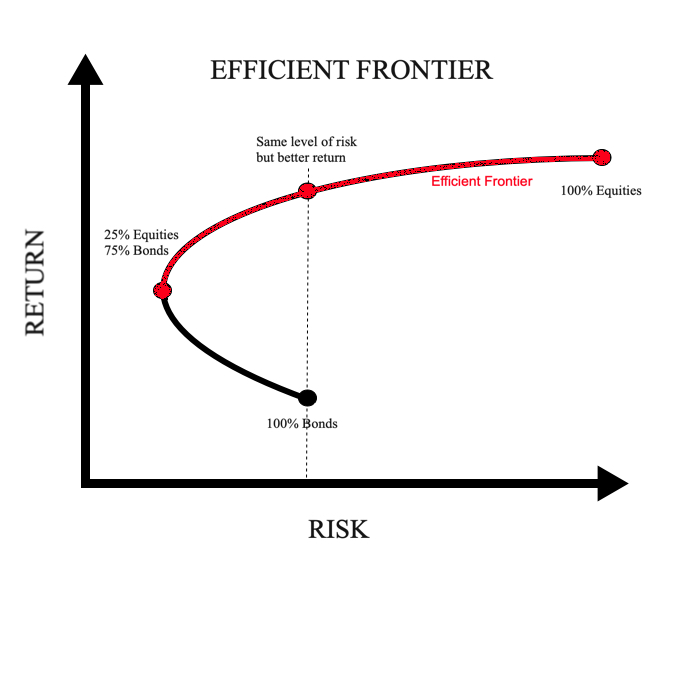
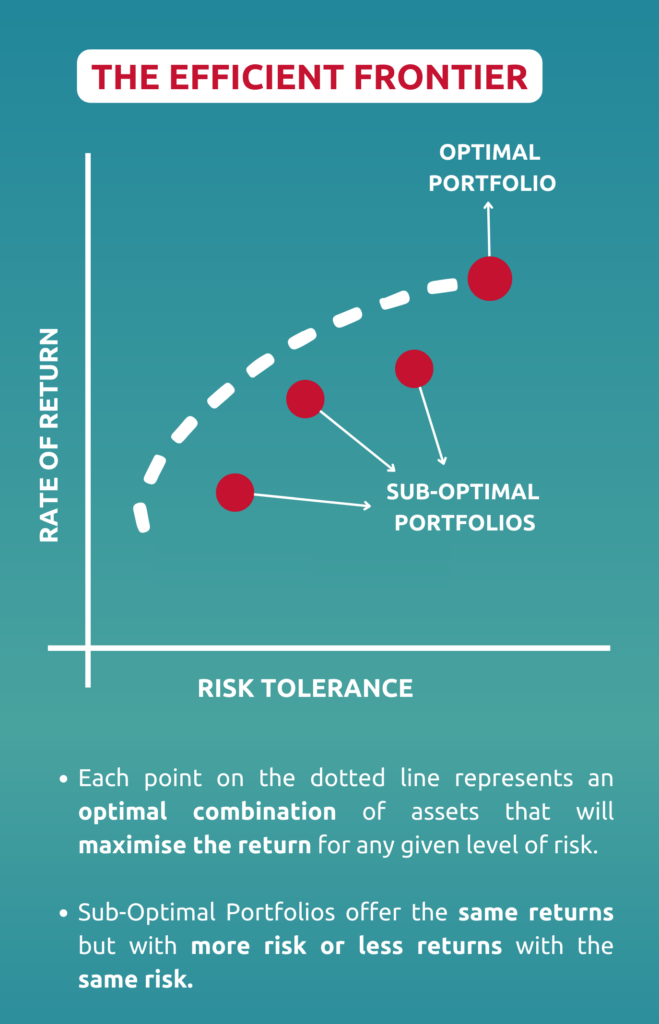
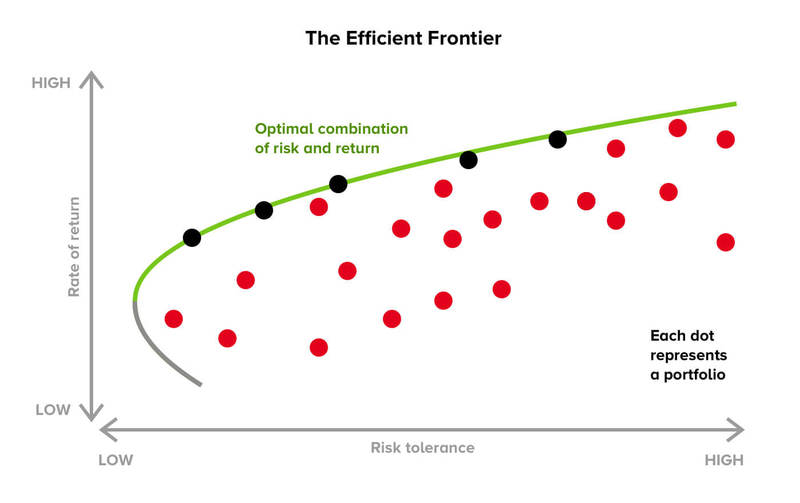
The Efficient Frontier is visually represented as a curved line on a graph, where the Y-axis represents “Expected Return” and the X-axis represents “Risk” (typically measured as standard deviation or volatility). Portfolios that fall on this line are considered “efficient.” Any portfolio that falls below the line is “sub-optimal” because it offers too little return for the amount of risk taken. Conversely, a portfolio cannot exist above the line given the current available assets and market conditions; the frontier represents the absolute limit of what is mathematically possible.
The magic of the frontier lies in diversification. By combining assets that are not perfectly correlated—meaning they don’t move in lockstep—an investor can reduce the overall volatility of their portfolio without necessarily sacrificing returns. This is often referred to as the only “free lunch” in finance.
The Mechanics of Risk, Return, and Correlation
To build an Efficient Frontier, one must analyze three primary inputs for every asset in the pool: expected return, standard deviation, and correlation.
Expected Return and Volatility
Expected return is the weighted average of a portfolio’s possible outcomes based on historical data or forward-looking projections. Volatility, or standard deviation, measures how much the actual return is likely to deviate from that average. In the context of the Efficient Frontier, risk is not defined as “losing money,” but as the uncertainty of the outcome.
The Role of Correlation
Correlation is perhaps the most critical component of the frontier. It is measured on a scale of -1.0 to +1.0. A correlation of +1.0 means two assets move in perfect unison. A correlation of -1.0 means they move in opposite directions.
If you own two stocks that both drop by 20% when interest rates rise, you aren’t diversified; you’ve simply doubled your exposure to a single risk factor. However, if you pair an equity position with an asset class that reacts differently—such as government bonds or gold—the “zig” of one can offset the “zag” of the other. This interaction smooths out the journey, pushing the portfolio’s risk-return profile toward the Efficient Frontier.
The Curvature of the Frontier
The frontier is shaped like a hyperbola, curving upward and to the right. The “Global Minimum Variance Portfolio” sits at the leftmost tip of the curve, representing the lowest possible risk one can take while still being invested in the selected asset classes. As you move along the curve to the right, you are accepting higher volatility in exchange for higher potential gains.
Finding Your Optimal Position on the Curve
While the Efficient Frontier identifies the most efficient portfolios, it does not tell an investor which one to choose. That decision depends entirely on an individual’s risk tolerance, time horizon, and financial goals.
The Risk-Return Trade-off
A young investor with a 30-year time horizon might choose a position further to the right on the frontier. They are willing to endure the stomach-churning swings of an all-equity portfolio because they are compensated with a higher expected return over the long run. Conversely, a retiree may gravitate toward the left side of the curve, prioritizing the Global Minimum Variance Portfolio to ensure their capital remains stable for monthly withdrawals.
The Sharpe Ratio and the Tangency Portfolio
Professional fund managers often look for the “Tangency Portfolio.” This is the point on the Efficient Frontier where the Sharpe Ratio is maximized. The Sharpe Ratio measures excess return per unit of risk. To find this, investors introduce a “Risk-Free Rate”—usually the yield on a 10-year U.S. Treasury bond.
A line drawn from the risk-free rate on the Y-axis that just touches (is tangent to) the Efficient Frontier identifies the portfolio with the highest risk-adjusted return. For many, this is the “sweet spot” of investing. It represents the most efficient use of every percentage point of risk taken.
The Capital Allocation Line (CAL)
Once the Tangency Portfolio is identified, investors can theoretically achieve any risk level they desire by moving along the Capital Allocation Line. This involves mixing the Tangency Portfolio with the risk-free asset. If you want less risk than the Tangency Portfolio provides, you put some money in T-bills. If you want more, you could theoretically use leverage to “double down” on that optimal portfolio.
Practical Challenges and Real-World Application
While the Efficient Frontier is a powerful conceptual tool, applying it to a real-world brokerage account involves several complexities. The theory is mathematically sound, but its accuracy depends entirely on the quality of its inputs.
The “Garbage In, Garbage Out” Problem
The most significant criticism of the Efficient Frontier is its reliance on historical data. To calculate the frontier, you must input the expected returns and correlations of assets. Most investors use the last 10, 20, or 50 years of data as a guide. However, the future rarely looks exactly like the past. If the correlation between stocks and bonds suddenly shifts from negative to positive—as it did during several periods of high inflation—a portfolio that was “efficient” on paper can suddenly become highly risky.
The Impact of “Fat Tails”
Standard MPT assumes that market returns follow a normal distribution (the bell curve). In reality, financial markets are prone to “Black Swan” events—extreme outliers that happen more frequently than a bell curve would suggest. These “fat tails” mean that the actual risk of a portfolio might be higher than the standard deviation suggests.
Dynamic Rebalancing
The Efficient Frontier is not a static map. Asset prices change daily, which means your portfolio’s position on the frontier is constantly drifting. To stay efficient, an investor must practice disciplined rebalancing—selling assets that have performed well (and now carry too much weight) and buying those that have underperformed. This process forces the investor to “sell high and buy low,” maintaining the optimal mathematical balance.
The Modern Investor’s Advantage
Today, you don’t need a PhD in mathematics to benefit from the Efficient Frontier. Technology has democratized these complex calculations. Robo-advisors and sophisticated financial planning software now use Mean-Variance Optimization (MVO) to build portfolios for everyday savers.
When you fill out a risk tolerance questionnaire and are assigned a “Moderate Growth” portfolio consisting of 60% stocks and 40% bonds, you are seeing the Efficient Frontier in action. The provider has calculated that this specific mix sits at a point on the curve that aligns with your stated comfort level for volatility.
Furthermore, the “frontier” of assets has expanded. Modern investors are no longer limited to just domestic stocks and bonds. By adding international equities, real estate investment trusts (REITs), commodities, and even alternative assets like private equity or cryptocurrency, the frontier itself can be shifted. Adding a new, uncorrelated asset class has the effect of pushing the curve upward and to the left, allowing for even better risk-adjusted returns than were possible in Markowitz’s era.
Conclusion
The Efficient Frontier remains one of the most vital concepts in the history of finance because it provides a rational framework for the irrational world of markets. It teaches us that successful investing is not about picking “winners,” but about managing the relationship between different assets.
By focusing on the frontier, investors can move away from the emotional rollercoaster of market timing and toward a structured approach to wealth creation. Whether you are a conservative saver or an aggressive growth seeker, the goal remains the same: to ensure that for every ounce of risk you take, you are positioned to receive the maximum possible reward. Understanding the Efficient Frontier is the first step toward moving your portfolio from a collection of stocks to a finely tuned engine of financial growth.
aViewFromTheCave is a participant in the Amazon Services LLC Associates Program, an affiliate advertising program designed to provide a means for sites to earn advertising fees by advertising and linking to Amazon.com. Amazon, the Amazon logo, AmazonSupply, and the AmazonSupply logo are trademarks of Amazon.com, Inc. or its affiliates. As an Amazon Associate we earn affiliate commissions from qualifying purchases.