
In the rapidly evolving landscape of computer graphics, optical engineering, and spatial computing, the term “solid angle” serves as a foundational pillar. While most people are familiar with the standard two-dimensional angle measured in degrees or radians, the solid angle extends this concept into three-dimensional space. In the tech industry—particularly within the realms of 3D rendering, autonomous vehicle sensors, and virtual reality—understanding the solid angle is essential for simulating how light interacts with the physical world and how digital sensors perceive their surroundings.
The Geometric Foundation: From Radians to Steradians
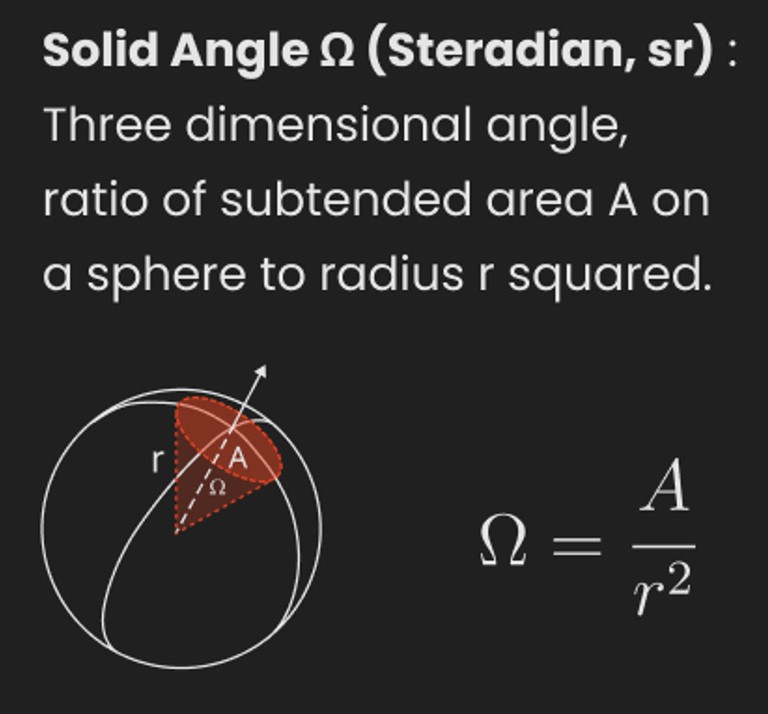
To understand a solid angle, one must first revisit the 2D radian. In a circle, a radian is the angle subtended at the center by an arc whose length is equal to the radius. When we move into the third dimension, we replace the circle with a sphere and the arc with a surface area.

A solid angle is a measure of the “size” of an object as seen from a specific point. It is defined as the area of a portion of a sphere’s surface divided by the square of the radius of that sphere. The SI unit for a solid angle is the steradian (sr). Just as a full circle contains 2π radians, a complete sphere contains 4π steradians (approximately 12.57 sr).
In tech applications, this isn’t just an abstract mathematical curiosity. It provides a standardized way to quantify how much of a field of view is occupied by a light source, a pixel, or a physical object. This measurement is critical for engineers designing everything from LED displays to LiDAR systems for self-driving cars.
The Role of Solid Angles in Computer Graphics and 3D Rendering
In the world of high-end visual effects and game development, the solid angle is the heartbeat of realistic lighting. If you have ever wondered how modern software creates cinematic-quality shadows, reflections, and illumination, the answer lies in how the software calculates light transport across solid angles.
Radiometry and the Rendering Equation
At the core of professional rendering engines—such as the industry-standard Arnold (originally developed by a company aptly named Solid Angle)—is the science of radiometry. Radiometry is the study of the measurement of electromagnetic radiation, including visible light.
When a 3D software calculates the brightness of a point on a virtual surface, it uses the rendering equation. This equation integrates the light arriving at a point from all possible directions. These directions are defined by a hemisphere of solid angles. By calculating the “radiance” (the amount of light passing through a specific solid angle), the software can simulate “global illumination.” This is why modern games look so lifelike; they aren’t just drawing colors on a screen, they are mathematically simulating trillions of light rays as they subtend different solid angles across virtual environments.
The “Solid Angle” Software Legacy
It is impossible to discuss this topic in a tech context without mentioning Arnold, the Monte Carlo ray-tracing renderer. Originally developed by Marcos Fajardo and his team at Solid Angle SL, the software changed how Hollywood movies are made. By focusing on the physical accuracy of solid angles, Arnold allowed artists to move away from “faking” light with complex tricks. Instead, the software used the concept of solid angles to sample light sources naturally, producing soft shadows and realistic “depth of field” effects that were previously too computationally expensive to achieve. Today, owned by Autodesk, the principles of solid angle mathematics remain at the center of its algorithm.
Solid Angles in Hardware: Sensors, Optics, and LiDAR
Moving away from the screen and into physical hardware, the solid angle is a vital metric for sensor technology. In any digital imaging system, the “field of view” (FOV) is essentially a description of the solid angle that the sensor can “see.”
LiDAR and Autonomous Perception
For autonomous vehicles, LiDAR (Light Detection and Ranging) is the “eyes” of the car. A LiDAR sensor pulses lasers in a 360-degree sweep to build a 3D map of the environment. The resolution of this map is determined by the angular resolution of the laser pulses.
Engineers must calculate the solid angle subtended by the laser beam at various distances. As a beam travels further away, the solid angle it covers remains the same, but the physical area it illuminates grows. Understanding this relationship is critical for ensuring that a car can detect a small object, like a traffic cone or a pedestrian, from hundreds of meters away. If the solid angle of the sensor’s “vision” is too wide, small objects might disappear between the gaps of the laser pulses.

Camera Sensors and Irradiance
In digital photography and smartphone technology, the amount of light that hits a single pixel is determined by the solid angle of the lens opening (the aperture) as seen from the sensor’s perspective. This is known as “irradiance.”
When tech companies boast about “larger sensors” or “faster apertures,” they are essentially talking about maximizing the solid angle of light hitting each pixel. A larger solid angle allows more photons to reach the sensor, which reduces noise and improves performance in low-light conditions. This is why the physical size of a lens matters just as much as the software processing the image.
Spatial Computing: VR, AR, and Human Perception
The rise of spatial computing, led by devices like the Apple Vision Pro and Meta Quest 3, has brought the concept of solid angles to the forefront of display tech. In these devices, we no longer talk about “screen size” in inches; we talk about “pixels per degree” (PPD) and total field of view, both of which are rooted in solid angle geometry.
Foveated Rendering and Efficiency
The human eye only sees in high resolution at the very center of its vision, a tiny solid angle called the fovea. Modern VR headsets use “foveated rendering” to save computational power. By using eye-tracking sensors, the hardware identifies exactly which solid angle the user is looking at and renders that specific area in high detail. The rest of the peripheral vision—covering a much larger solid angle—is rendered at a lower resolution. This optimization is only possible because the software can precisely map the user’s gaze to a specific coordinate within the 3D spherical space of the headset.
Designing Immersive Interfaces
In traditional UI/UX design, we think in pixels on a 2D plane. In spatial computing, designers must think in steradians. An interface element in an AR headset doesn’t have a fixed “size”; it has a fixed “angular size.” As the user moves their head or walks closer to a virtual window, the solid angle subtended by that window increases, making it appear larger. Balancing these solid angles is the key to preventing motion sickness and creating a “scale” that feels natural to the human brain.
The Future of Visual Technology
As we look toward the future of technology, the importance of the solid angle will only grow. We are moving toward a world of “neural radiance fields” (NeRFs) and “Gaussian Splatting,” where AI is used to reconstruct 3D scenes from 2D photos. These technologies rely on understanding how light is emitted from every point in space across every possible solid angle.
AI-Driven Ray Tracing
The next generation of GPUs from companies like NVIDIA and AMD are increasingly utilizing AI to “predict” the behavior of light. Instead of calculating every single ray of light across every solid angle, AI models can infer the missing data. This “denoising” process allows for real-time ray tracing in video games, bringing cinematic quality to home consoles. The underlying logic remains the same: accurately representing the distribution of energy across a 3D spherical space.
Environmental Sensing and Global Connectivity
Beyond entertainment, solid angles play a role in satellite communication and environmental monitoring. Satellites orbiting the Earth use directional antennas that must be precisely aligned. The “beamwidth” of these antennas is a measure of the solid angle over which the signal is strongest. As we deploy massive constellations of low-Earth orbit satellites (like Starlink), managing the interference between these overlapping solid angles becomes a complex global challenge in digital security and signal integrity.
Conclusion: Why the Solid Angle is the Architect of Our Digital Reality
While the term “solid angle” might sound like a dry topic from a college physics textbook, it is actually the silent architect behind the most exciting technological advancements of the 21st century. It is the bridge between the physical world we inhabit and the digital worlds we create.
Whether it is a software engineer optimizing a 3D scene, a hardware designer refining a smartphone camera, or a roboticist calibrating a LiDAR sensor, the solid angle provides the mathematical language necessary to describe the 3D world. As technology continues to become more immersive and spatially aware, our ability to measure, manipulate, and master the solid angle will define the limits of what is possible in the digital age. By understanding this concept, we gain a deeper appreciation for the sheer complexity and precision required to make a digital image look “real” or to make a machine “see.”
aViewFromTheCave is a participant in the Amazon Services LLC Associates Program, an affiliate advertising program designed to provide a means for sites to earn advertising fees by advertising and linking to Amazon.com. Amazon, the Amazon logo, AmazonSupply, and the AmazonSupply logo are trademarks of Amazon.com, Inc. or its affiliates. As an Amazon Associate we earn affiliate commissions from qualifying purchases.