
In the modern landscape of software engineering, the ability to build scalable, resilient, and responsive applications is paramount. As systems grow from monolithic structures into complex microservices architectures, the way these individual components communicate becomes a critical factor in overall performance. At the heart of this communication infrastructure lies the Message Queue (MQ).
A Message Queue is a form of asynchronous service-to-service communication used in serverless and microservices architectures. Messages are stored on the queue until they are processed and deleted. Each message is processed only once, by a single consumer. Message queues can be used to decouple heavyweight processing, to buffer or batch work, and to smooth out spiky workloads. To understand the significance of an MQ, one must look past the simple definition and explore how it transforms synchronous, fragile connections into robust, distributed workflows.

Understanding the Fundamentals of Message Queuing
At its most basic level, a message queue is a component that facilitates asynchronous communication between different parts of a system. In a traditional synchronous request-response model, a client sends a request to a server and must wait—blocked—until the server processes the request and returns a response. If the server is slow or down, the client fails.
Message queuing breaks this dependency. In an MQ-based architecture, the “Producer” (the service sending data) does not send the information directly to the “Consumer” (the service receiving data). Instead, the Producer wraps the data into a “Message” and places it into a queue managed by a message broker. The Producer then immediately moves on to its next task without waiting for the Consumer to act.
How Message Queues Work
The lifecycle of a message within an MQ involves several distinct stages. First, the Producer application creates a message containing the payload—this could be a JSON object representing a customer order, a command to resize an image, or a simple log entry. This message is sent to the Message Broker.
The Broker is the middleware responsible for receiving the message and placing it in the correct queue. The queue acts as a temporary holding area, an architectural buffer that persists the data. On the other end of the queue sits the Consumer. The Consumer polls the queue or is notified by the broker when a new message is available. It pulls the message, processes it, and sends an acknowledgment (ACK) back to the broker, signaling that the message can be safely removed from the queue.
Key Components: Producer, Queue, and Consumer
To master MQ technology, one must understand the three primary actors involved:
- The Producer: This is the source of the data. Its sole responsibility is to format the message and ensure it reaches the broker. In a high-traffic web application, the producer might be the front-end API that receives a user’s request.
- The Queue: This is the data structure residing within the message broker. Queues are typically First-In-First-Out (FIFO), ensuring that messages are processed in the order they were received, although various priority settings can alter this behavior.
- The Consumer: This is the worker service that performs the actual logic. For instance, if the message is “send a password reset email,” the Consumer is the service that connects to the SMTP server and transmits the email.
Why Use a Message Queue? Key Benefits for Modern Applications
Implementing an MQ adds a layer of complexity to an infrastructure, so why do the world’s largest tech companies rely on them? The answer lies in the dramatic improvements they offer in terms of system reliability and user experience.
Decoupling Systems for Greater Flexibility
Decoupling is perhaps the most significant advantage of using a Message Queue. In a tightly coupled system, Service A must know the exact location (IP address, port, and API contract) of Service B. If Service B changes its interface or moves to a different server, Service A breaks.
By introducing an MQ, Service A and Service B become completely anonymous to one another. Service A only needs to know how to talk to the queue. This allows developers to update, move, or even replace Service B without ever touching the code in Service A. This separation of concerns simplifies maintenance and allows different teams to work on different parts of a system independently.
Scalability and Handling Traffic Spikes
Web traffic is rarely consistent. An e-commerce site might see a 1,000% increase in traffic during a Black Friday sale. Without a message queue, the surge in orders might overwhelm the database or the payment processing service, leading to system-wide crashes.
An MQ acts as a pressure valve. When traffic spikes, the Producers can continue to accept orders at high speed, dumping them into the queue. The Consumers continue to pull messages at their own maximum capacity. While the processing might take slightly longer during the peak, the system remains stable and no data is lost. Once the traffic dies down, the Consumers eventually catch up and clear the backlog.
Resilience and Fault Tolerance
In a synchronous system, if the receiving service is offline, the transaction fails immediately. This creates a “cascading failure” where one broken component brings down the entire application.
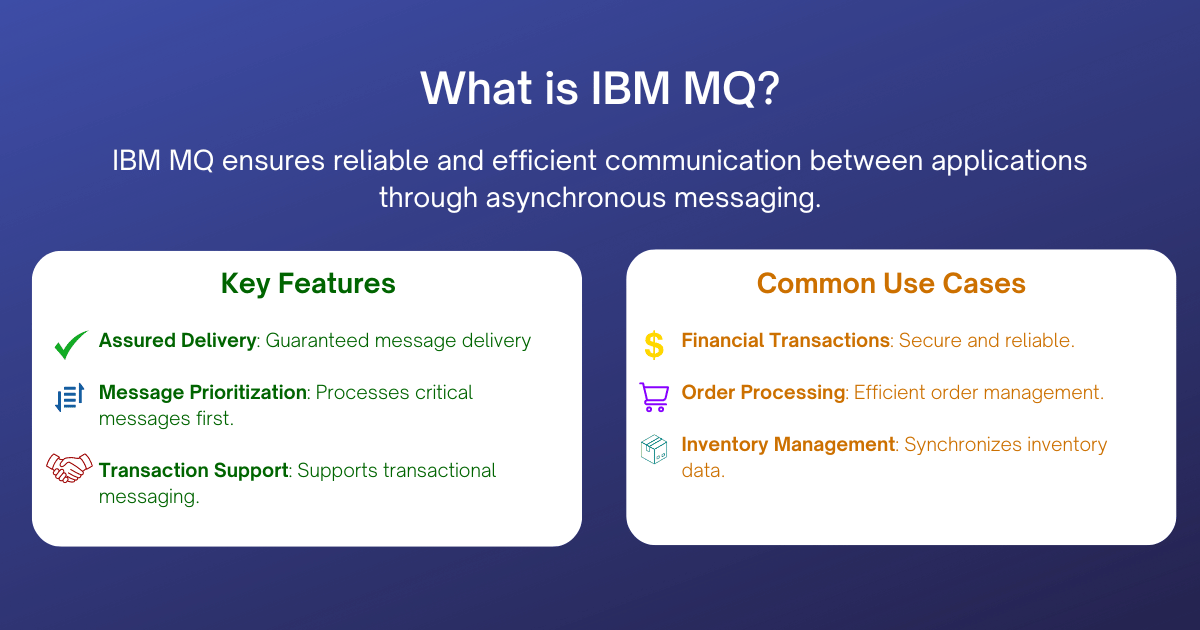
With an MQ, the system is inherently more resilient. If a Consumer service crashes or needs to be taken offline for maintenance, the messages simply sit in the queue, waiting safely. When the Consumer comes back online, it resumes processing from exactly where it left off. This ensures “guaranteed delivery,” a crucial requirement for financial transactions and sensitive data processing.
Common Messaging Patterns and Architectures
Not all message queues operate in the same way. Depending on the business requirements, developers choose between different messaging patterns to control how data flows through the system.
Point-to-Point Messaging
The Point-to-Point (PTP) pattern is the most traditional form of queuing. In this model, a message is sent to exactly one queue and is consumed by exactly one receiver. Even if multiple consumers are listening to the same queue to increase processing speed, the broker ensures that each individual message is handled by only one of them. This is the standard approach for task distribution, such as processing a list of background jobs.
Publish-Subscribe (Pub/Sub)
The Publish-Subscribe pattern is used when a single piece of information needs to be shared with multiple different systems. Instead of a “queue,” the producer sends a message to a “Topic.” Multiple subscribers “listen” to that topic.
When a message is published to the topic, the broker broadcasts a copy of that message to every subscriber. For example, when a user completes a purchase, a “Purchase Completed” message might be published. The Shipping Service, the Analytics Service, and the Email Marketing Service all receive their own copy of that message simultaneously to perform their respective duties.
Top Message Queue Solutions in the Market
The tech industry offers a variety of MQ tools, ranging from lightweight open-source libraries to massive, managed cloud services. Choosing the right one depends on your throughput requirements, latency needs, and existing infrastructure.
RabbitMQ: The Industry Standard for Versatility
RabbitMQ is one of the most widely deployed open-source message brokers. It supports multiple messaging protocols (including AMQP, MQTT, and STOMP) and is known for its reliability and sophisticated routing capabilities. RabbitMQ is an excellent choice for complex routing logic where messages need to be directed to specific queues based on various attributes.
Apache Kafka: High-Throughput Stream Processing
While often categorized as an MQ, Apache Kafka is technically a distributed streaming platform. It is designed for massive scale, capable of handling trillions of events per day. Unlike traditional queues that delete messages once consumed, Kafka keeps a persistent log of all messages, allowing consumers to “replay” the stream if necessary. It is the go-to choice for real-time analytics, log aggregation, and large-scale data pipelines.
Amazon SQS: Managed Cloud Messaging
For teams that do not want to manage their own server infrastructure, Amazon Simple Queue Service (SQS) is a popular choice. It is a fully managed service that scales automatically. SQS eliminates the administrative overhead of managing a broker, providing a highly available and secure queueing system that integrates seamlessly with the rest of the AWS ecosystem.
Best Practices for Implementing MQs in Your Tech Stack
To successfully integrate a Message Queue, engineers must consider several architectural challenges that arise in asynchronous environments.
Choosing the Right Protocol
Selecting the communication protocol is vital for performance. AMQP (Advanced Message Queuing Protocol) is the gold standard for enterprise systems requiring high reliability and security. MQTT (Message Queuing Telemetry Transport) is a lightweight protocol designed for IoT devices and low-bandwidth networks. Understanding the constraints of your environment will dictate which protocol serves your MQ best.

Monitoring and Error Handling
One of the risks of asynchronous systems is “silent failure.” If a consumer fails to process a message, it might simply disappear if not handled correctly. To prevent this, developers implement Dead Letter Queues (DLQ). When a message fails to be processed after a certain number of attempts, the broker moves it to a DLQ. This allows developers to inspect the failed messages, fix the underlying bug, and eventually re-process the data without losing it.
Furthermore, monitoring the “Queue Depth”—the number of messages waiting to be processed—is essential. A rapidly growing queue depth is often an early warning sign that your consumers are under-provisioned or that there is a bottleneck in your database, allowing teams to react before the end-user experiences a delay.
In conclusion, a Message Queue is far more than just a storage bin for data. It is a strategic architectural tool that enables modern applications to remain fast, scalable, and reliable in an increasingly connected and unpredictable digital world. Whether you are building a simple contact form or a global social media platform, understanding and implementing MQ technology is a foundational step in professional software development.
aViewFromTheCave is a participant in the Amazon Services LLC Associates Program, an affiliate advertising program designed to provide a means for sites to earn advertising fees by advertising and linking to Amazon.com. Amazon, the Amazon logo, AmazonSupply, and the AmazonSupply logo are trademarks of Amazon.com, Inc. or its affiliates. As an Amazon Associate we earn affiliate commissions from qualifying purchases.