
In the landscape of modern enterprise software development, the ability for disparate systems to communicate reliably and efficiently is paramount. As organizations transition from monolithic architectures to distributed systems and microservices, the “glue” that holds these components together becomes a critical point of engineering. One of the most enduring and foundational technologies in this space is the Java Message Service, commonly known as JMS.
JMS is a Java-based application programming interface (API) that allows software components to create, send, receive, and read messages. It serves as a standard for message-oriented middleware (MOM), providing a common language for Java applications to exchange data asynchronously. By abstracting the complexities of network communication and message delivery, JMS enables developers to build robust, scalable, and loosely coupled systems.
The Core Architecture of Java Message Service
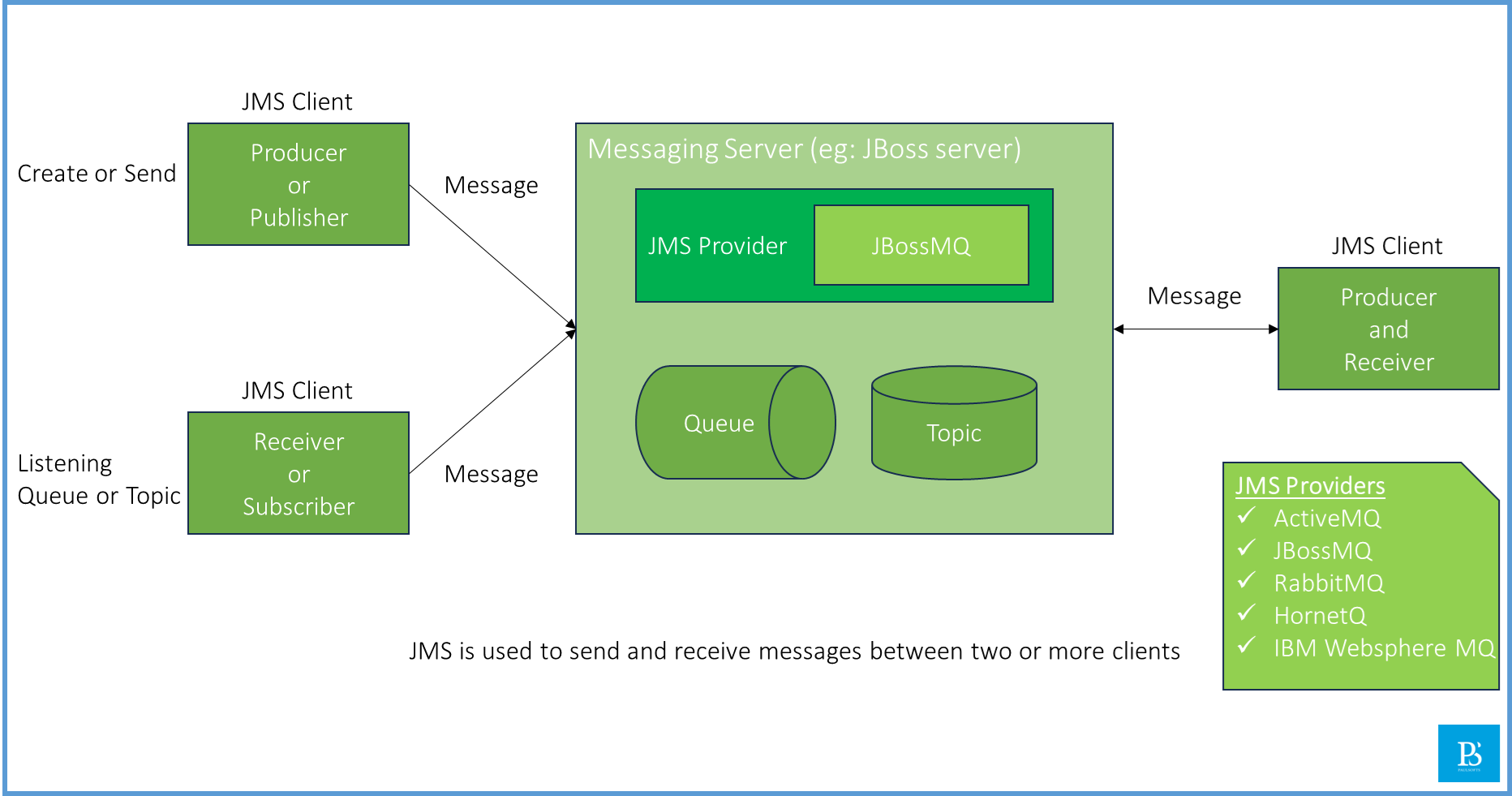
To understand what JMS is, one must first understand its architectural framework. Unlike a simple direct function call between two pieces of code, JMS introduces an intermediary layer. This architecture is designed to handle the “send and forget” nature of enterprise operations, where a producer of information does not need to wait for the consumer to process that information before moving on to its next task.
The JMS Provider and Administered Objects
At the heart of any JMS implementation is the JMS Provider. This is the messaging system that implements the JMS interfaces and provides administrative and control features. Popular examples include Apache ActiveMQ, RabbitMQ (via a JMS client), IBM MQ, and Oracle WebLogic. The provider acts as the traffic controller, ensuring that messages are routed correctly, stored if necessary, and delivered to the intended recipients.
Developers interact with the provider through Administered Objects. These are pre-configured objects—specifically Connection Factories and Destinations—created by an administrator and stored in a JNDI (Java Naming and Directory Interface) namespace. The Connection Factory is what a client uses to create a connection with the provider, while the Destination (a queue or a topic) represents the target for sent messages or the source for received ones.
JMS Clients: Producers and Consumers
The software components that interact with the JMS provider are known as JMS Clients. These are categorized into two roles: Producers and Consumers. A Message Producer is an object created by a Session that is used for sending messages to a destination. Conversely, a Message Consumer is used to receive messages.
A unique strength of JMS is its support for both synchronous and asynchronous message consumption. In a synchronous model, a consumer explicitly asks for the next message and blocks its execution until the message arrives. In an asynchronous model, a client registers a “Message Listener,” which acts similarly to an event handler. When a message arrives at the destination, the JMS provider automatically delivers it by calling the listener’s onMessage method, allowing the application to react in real-time without active polling.
The Anatomy of a JMS Message
JMS is not just about the delivery mechanism; it is also about the data format. A JMS message is composed of three parts:
- Header: Contains metadata used by both clients and providers to identify and route messages (e.g.,
JMSMessageID,JMSPriority,JMSTimestamp). - Properties: Optional additional fields that provide further categorization or filtering capabilities. These are often used for message selectors, which allow a consumer to filter messages based on specific criteria.
- Body: The actual payload. JMS defines several types of message bodies, including
TextMessage(for strings/XML/JSON),MapMessage(for key-value pairs),BytesMessage(for raw binary data), andObjectMessage(for serialized Java objects).
Messaging Models: Point-to-Point and Publish/Subscribe
JMS supports two distinct messaging styles, or “domains,” which dictate how messages are distributed among multiple consumers. Choosing the right model is essential for achieving the desired system behavior and performance.
The Point-to-Point (PTP) Model
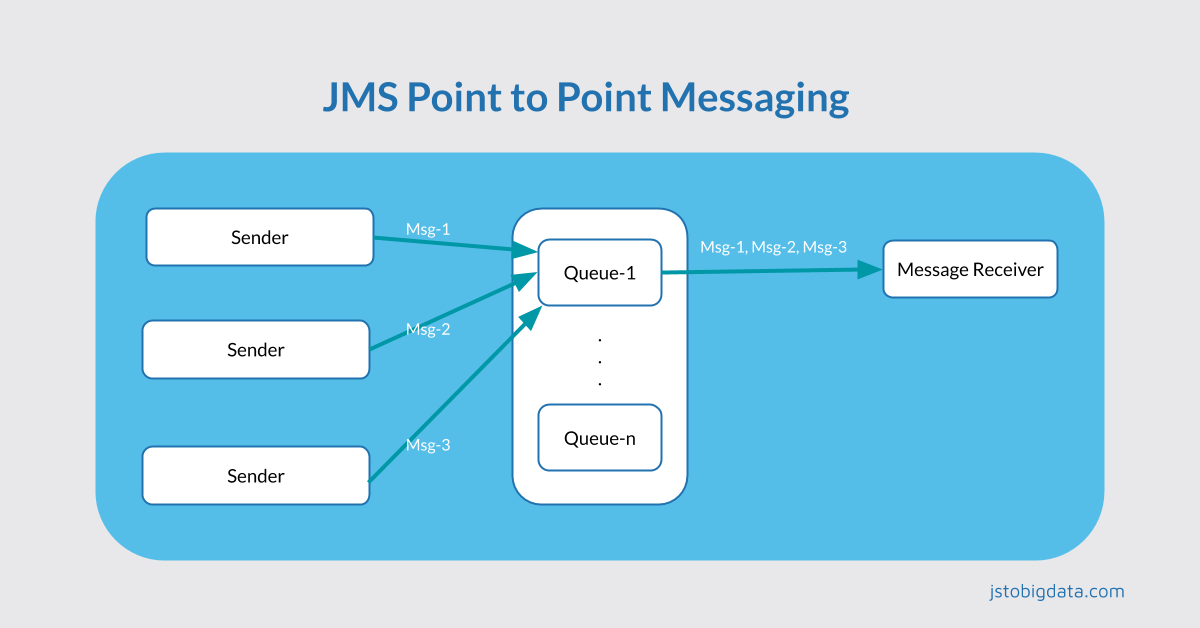
In the Point-to-Point model, the delivery mechanism is built around the concept of a “Queue.” In this scenario, a producer sends a message to a specific queue, and one consumer retrieves it. The defining characteristic of PTP is that each message is addressed to a single queue and is consumed by exactly one consumer.
While multiple consumers can listen to the same queue to distribute the workload (often called “competing consumers”), the JMS provider ensures that any given message is only processed once. This model is ideal for tasks like order processing or payroll systems, where a specific action must be performed exactly once by a single worker component. If no consumers are available when a message is sent, the queue holds the message until a consumer connects.
The Publish-and-Subscribe (Pub/Sub) Model
The Publish-and-Subscribe model utilizes “Topics” instead of queues. In this domain, a producer (the publisher) sends a message to a topic, and the provider broadcasts that message to all active consumers (the subscribers) who have expressed interest in that topic.
This is a one-to-many relationship. It is highly effective for broadcasting information, such as real-time stock price updates or system-wide configuration changes. Within this model, JMS supports “Durable Subscriptions.” Normally, a subscriber only receives messages sent while it is active. A durable subscription, however, instructs the provider to save messages for a subscriber even when it is offline, ensuring that the client can “catch up” on missed broadcasts upon reconnection.
The Strategic Importance of JMS in Enterprise Tech
Why do architects continue to rely on JMS in an era of REST APIs and gRPC? The answer lies in the specific enterprise-grade guarantees that JMS provides, which are often difficult to replicate with simple request-response protocols.
Decoupling and System Resilience
The primary benefit of JMS is decoupling. In a direct-call architecture, if Service A needs to talk to Service B, Service B must be online and responsive. If Service B crashes or experiences latency, Service A is also blocked or fails.
With JMS, Service A sends a message to the middleware and continues its work. The middleware guarantees that the message will eventually reach its destination. This “temporal decoupling” allows systems to remain resilient during peak loads or partial outages. It also allows for “load leveling,” where a sudden burst of messages is buffered in a queue and processed by consumers at a steady, manageable rate.
Reliability and Transactional Integrity
JMS is designed for “mission-critical” data. It offers several layers of reliability:
- Persistence: Producers can specify messages as persistent, meaning the JMS provider must store the message to disk before acknowledging receipt. This ensures that even if the message broker crashes, the data is not lost.
- Acknowledgements: Consumers must acknowledge the receipt and successful processing of a message. If a consumer fails mid-process, the provider can redeliver the message to another instance.
- Transactions: JMS supports local and distributed (XA) transactions. This allows a developer to group a series of message sends and receives into a single atomic unit. If any part of the process fails, the entire transaction can be rolled back, maintaining data integrity across different systems and databases.
Integration with Legacy and Heterogeneous Systems
Large enterprises often operate a mix of modern microservices and legacy mainframe applications. JMS provides a standardized interface that bridges these gaps. Since many enterprise service buses (ESBs) and integration platforms are built on top of JMS, it becomes the lingua franca for connecting a 20-year-old banking backend with a modern cloud-native mobile application.
Implementing JMS: Best Practices and Modern Alternatives
While JMS remains a powerhouse, its implementation requires careful consideration of the environment and the specific requirements of the application.
Choosing the Right Provider
The performance of a JMS-based system is heavily dependent on the underlying provider. When selecting a provider, tech leads must evaluate factors such as message throughput, latency, persistence overhead, and management tooling. For cloud-native environments, many look toward managed services like Amazon MQ (which supports ActiveMQ) or Azure Service Bus, which provide JMS-compliant interfaces while removing the operational burden of managing the broker infrastructure.
The Rise of Kafka and RabbitMQ
It is impossible to discuss JMS without mentioning newer technologies like Apache Kafka or RabbitMQ. While RabbitMQ offers a JMS client, it natively uses the AMQP protocol, which is cross-language and highly flexible. Apache Kafka, on the other hand, represents a shift from “message queuing” to “event streaming.”
Kafka is often preferred for high-volume data pipelines and real-time analytics due to its log-based architecture and massive horizontal scalability. However, JMS still holds an edge in traditional enterprise workflows that require complex distributed transactions (XA), strict message-by-message acknowledgement, and the specific “Point-to-Point” semantics that are native to Java EE environments.
Future Outlook
As the industry moves toward Jakarta EE (the successor to Java EE), JMS continues to evolve. The focus has shifted toward better integration with Dependency Injection (CDI) and simplified APIs (such as JMS 2.0 and 3.0), which significantly reduce the boilerplate code required to send and receive messages.
In conclusion, JMS is more than just a legacy tool; it is a sophisticated messaging standard that provides the reliability, security, and decoupling necessary for complex enterprise operations. Whether it is facilitating a transaction in a global banking network or coordinating microservices in a retail platform, JMS remains a vital component of the modern technologist’s toolkit, ensuring that data moves safely and efficiently across the digital landscape.
aViewFromTheCave is a participant in the Amazon Services LLC Associates Program, an affiliate advertising program designed to provide a means for sites to earn advertising fees by advertising and linking to Amazon.com. Amazon, the Amazon logo, AmazonSupply, and the AmazonSupply logo are trademarks of Amazon.com, Inc. or its affiliates. As an Amazon Associate we earn affiliate commissions from qualifying purchases.