
In the world of global commerce, few entities command as much influence over consumer perception and industrial design as the Volkswagen Group. While the name “Volkswagen” translates literally to “The People’s Car,” the corporate reality is far more complex and strategically layered. The Volkswagen Group is not merely a car manufacturer; it is a sprawling ecosystem of brands, each meticulously positioned to capture a specific demographic, psychological profile, and economic bracket.
To understand the brands VW owns is to understand a masterclass in brand architecture. The group manages a portfolio that spans from budget-conscious daily drivers to multi-million-dollar hypercars, ensuring that as a consumer’s wealth and aspirations grow, they never have to leave the Volkswagen family. This strategy of “cradle-to-grave” brand loyalty is achieved through a sophisticated balance of shared engineering and distinct brand identities.

Defining the Corporate Identity: More Than Just the “People’s Car”
The Volkswagen Group (VWAG) operates under a multi-brand strategy that allows it to achieve massive economies of scale while maintaining the illusion of boutique exclusivity for its high-end labels. By centralizing research, development, and logistics, the group can fund innovations that a standalone brand could never afford. However, the marketing challenge is significant: how does one maintain the prestigious aura of a Lamborghini while sharing components with a more pedestrian Audi or Volkswagen?
The Core Brand: Volkswagen
The Volkswagen brand remains the heartbeat of the group. Its identity is built on reliability, democratic design, and German engineering accessible to the masses. In terms of brand strategy, Volkswagen serves as the “anchor.” It provides the volume necessary to sustain the group’s manufacturing infrastructure. Its marketing focuses on the “New Volkswagen” identity—clean, digital-first, and increasingly focused on environmental responsibility following its strategic pivot toward electrification.
The Value-Driven Entry: Škoda and SEAT/CUPRA
One of the most impressive feats of the VW Group’s brand management is the revitalization of Škoda and the evolution of SEAT.
- Škoda: Originally a Czech brand perceived as a low-cost alternative, Škoda has been repositioned under VW ownership as “Simply Clever.” Its brand identity focuses on functionality, space, and value for money, often outperforming the core VW brand in consumer satisfaction surveys.
- SEAT and CUPRA: Based in Spain, SEAT traditionally targeted a younger, more design-conscious demographic. However, the group’s strategic brilliance was most evident in the spin-off of CUPRA. By taking a performance trim and turning it into a standalone brand, VW successfully moved into the “contemporary premium” space, targeting “tribes” of enthusiasts who find traditional luxury brands too stuffy.
The Luxury and Performance Tier: Strategic Differentiation
As we move up the value chain, the Volkswagen Group’s brand strategy shifts from “utility and value” to “emotion and status.” This is where the group manages some of the most iconic names in automotive history, ensuring that each has a “protected” space in the market to prevent internal cannibalization.
Audi: The Bridge to Innovation
Audi serves as the group’s “Vorsprung durch Technik” (Progress through Technology) flagship. Its brand identity is rooted in sophisticated minimalism and technological leadership. Within the group’s architecture, Audi acts as the laboratory for high-tech features—such as Quattro all-wheel drive and advanced lighting systems—that eventually trickle down to Volkswagen and Škoda. Audi’s marketing strategy positions it as the choice for the modern professional, balancing the prestige of luxury with the restraint of German design.
Porsche: The Financial and Strategic Crown Jewel
Porsche occupies a unique position. It is perhaps the most strategically important brand in the portfolio because of its incredible profit margins. From a branding perspective, Porsche manages a difficult duality: it is both a high-volume luxury manufacturer (via the Macan and Cayenne SUVs) and an exclusive sports car icon (via the 911). Porsche’s brand strategy relies on “heritage-led innovation,” where every new digital feature is marketed as an extension of its racing pedigree.
The Ultra-Luxury Icons: Bentley and Lamborghini
At the pinnacle of the pyramid are Bentley and Lamborghini. The group’s ownership of these brands is a case study in corporate identity preservation.
- Bentley: Represents the “Britishness” of luxury—handcrafted wood, leather, and effortless power. VW’s strategy has been to provide the robust German engineering under the hood while leaving the aesthetic and brand “soul” strictly in Crewe, England.
- Lamborghini: Represents Italian passion and extreme performance. Despite sharing platforms with Audi, Lamborghini’s brand identity remains fiercely independent, focused on “brave, unexpected, and authentic” experiences.
Operational Synergies: The “Platform” Philosophy in Branding
The secret to why the Volkswagen Group owns so many brands lies in the concept of “Platform Sharing.” This is a technical reality with massive implications for brand strategy. By using a single modular chassis (like the MQB for internal combustion or the MEB for electric vehicles) across multiple brands, the group saves billions in development costs.
Economies of Scale vs. Brand Dilution
The danger of owning diverse brands is “brand dilution”—the risk that a consumer will realize their luxury car is essentially a dressed-up economy car. To combat this, VW employs a strategy of “Haptic Differentiation.” While the chassis and electronics might be shared, every touchpoint the consumer interacts with—the steering wheel, the scent of the leather, the sound of the door closing, and the user interface on the screen—is bespoke to the brand’s identity.
Maintaining Heritage in a Modular World
The Group’s management of Ducati (motorcycles) and heavy commercial brands like Scania and MAN (under the Traton Group) further illustrates this. Even in the heavy machinery and two-wheeler markets, the VW Group applies the same logic: utilize shared back-end corporate services while allowing the “front-end” brand to speak its native language to its loyalists. Ducati remains the “Ferrari of motorcycles,” untainted by its association with a German industrial giant.
Future-Proofing the Brand Portfolio: Transitioning to Software and Electrification
The current era of the Volkswagen Group is defined by a massive shift in corporate identity. The transition from being a “hardware company” to a “software-driven mobility provider” is the greatest challenge the group has faced since its inception.
The Shift from Hardware to User Experience
In the digital age, a brand is no longer defined just by the roar of its engine or the curve of its metal. It is defined by its software. The VW Group created Cariad, a standalone software company, to build a unified operating system for all its brands. From a brand strategy perspective, this is a risky move. If every car in the group uses the same software, how does a Porsche feel different from a Volkswagen? The group’s answer lies in “Digital Personalization”—allowing each brand to skin the interface in a way that aligns with its traditional identity.

Sustainability as a Brand Value
Perhaps the most significant shift in the VW Group’s corporate identity is the move toward “Way to Zero.” Following the emissions crises of the past, the group has aggressively rebranded itself as a leader in sustainability. This isn’t just a marketing ploy; it is a survival strategy. By committing to an all-electric future for brands like Audi and eventually the core VW line, the group is repositioning its identity from a 20th-century industrialist to a 21st-century environmental steward.
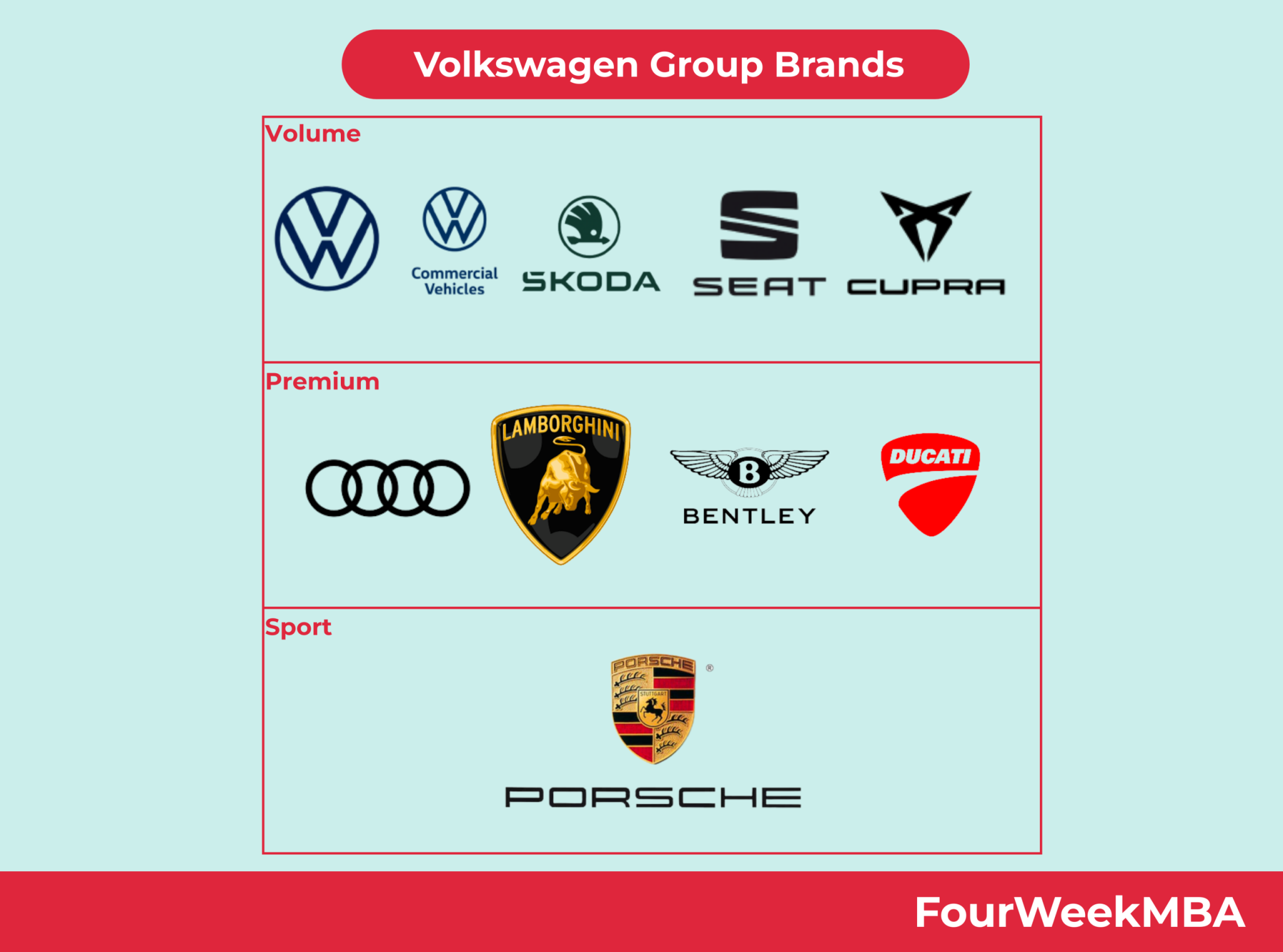
The Volkswagen Group’s portfolio—comprising Volkswagen, Audi, Porsche, Bentley, Lamborghini, SEAT, CUPRA, Škoda, Ducati, Scania, and MAN—is a testament to the power of diversified brand architecture. By understanding exactly who their customers are, from the student buying their first SEAT to the billionaire commissioning a bespoke Bentley, the group has created an inescapable web of brand influence. They have proven that with the right strategy, a single corporate entity can be everything to everyone, without losing the unique soul of the individual brands that make up the whole.
aViewFromTheCave is a participant in the Amazon Services LLC Associates Program, an affiliate advertising program designed to provide a means for sites to earn advertising fees by advertising and linking to Amazon.com. Amazon, the Amazon logo, AmazonSupply, and the AmazonSupply logo are trademarks of Amazon.com, Inc. or its affiliates. As an Amazon Associate we earn affiliate commissions from qualifying purchases.