
In the modern era, the smartphone is an extension of the human self. It serves as a gateway to global information, a primary communication tool, a high-fidelity camera, and a workstation that rivals the processing power of desktop computers from just a decade ago. However, the ubiquitous glass rectangles we carry today did not emerge fully formed from the minds of Silicon Valley engineers in 2007. The journey of the smartphone began much earlier, rooted in the ambitious intersection of cellular telephony and personal computing.
To identify the “first” smartphone, one must look back to 1992, long before the terms “app store” or “touchscreen” were part of the common vernacular. The device that holds the title is the IBM Simon Personal Communicator. While it lacked the sleek aesthetics of modern devices, it established the foundational blueprint for mobile computing.

The IBM Simon: The Progenitor of Mobile Intelligence
The IBM Simon Personal Communicator, often shortened to IBM Simon, was officially debuted as a prototype code-named “Sweetspot” at the COMDEX computer and technology trade show in Las Vegas in November 1992. It was a bold experiment by IBM and BellSouth, aimed at merging the capabilities of a cellular phone with the utility of a Personal Digital Assistant (PDA). When it finally hit the consumer market in 1994, it was a revolution packaged in a bulky, 18-ounce chassis.
Defining the “Smartphone” Before the Term Existed
Although the term “smartphone” was not coined until 1995 (introduced by Ericsson to describe their GS88 prototype), the IBM Simon was the first device to embody the concept. It was more than a phone; it was a handheld computer that could handle tasks previously reserved for office-bound machines. It featured a 4.5-inch by 1.4-inch monochrome backlit LCD touchscreen. In an era where most mobile phones had physical buttons and tiny one-line text displays, the Simon used a stylus and an early predictive text technology called “PredictaKey.”
Features and Specifications of the 1994 Revolution
The technical specifications of the IBM Simon are modest by today’s standards, but they were cutting-edge for the mid-90s. The device ran a 16-bit Vadem processor clocked at 16 MHz and featured 1 MB of RAM. Its operating system was a custom version of ROM-DOS.
What truly separated the Simon from its contemporaries were its built-in features. It offered:
- Email Integration: Users could send and receive emails, though the process required a connection to a physical phone line or a cellular network that was significantly slower than current 5G speeds.
- Faxing Capabilities: Reflecting the business needs of the time, the Simon could send and receive faxes.
- Standard Applications: It came pre-loaded with a calendar, world clock, calculator, address book, and a notepad that allowed for hand-drawn sketches via the stylus.
- Expansion Slots: Through a PCMCIA slot, users could theoretically add more memory or even specialized software, effectively making it the first device with “expandable” software capabilities.
Why the Simon Failed to Gain Mass Market Traction
Despite its visionary design, the IBM Simon was not a commercial juggernaut. It retailed for $899 with a two-year contract (roughly $1,800 today adjusted for inflation) or $1,099 without one. Beyond the high price point, technical limitations hindered its adoption. The battery life was notoriously poor, lasting only about an hour of continuous use. Furthermore, the cellular infrastructure of the early 90s was not yet robust enough to support the data-heavy ambitions of the device. After selling roughly 50,000 units, the Simon was withdrawn from the market, but its legacy as the first true smartphone was cemented.
Bridging the Gap: The PDA and Cell Phone Merger
Following the IBM Simon, the late 1990s and early 2000s saw a fragmented market where two distinct product categories—the mobile phone and the PDA—began to coalesce. This era was defined by manufacturers attempting to find the perfect balance between portability and productivity.
The Rise of Nokia and the Communicator Series
Nokia entered the fray in 1996 with the Nokia 9000 Communicator. While it did not feature a touchscreen, it utilized a unique “clamshell” design. From the outside, it looked like a standard, albeit bulky, brick phone. However, it opened horizontally to reveal a full QWERTY keyboard and a large grayscale display.
The 9000 Communicator was powered by a 24 MHz Intel 386 processor and ran on the GEOS operating system. It was the first device to successfully integrate professional-grade internet browsing and word processing into a mobile form factor. Nokia’s dominance in this era proved that there was a massive appetite for devices that could handle business communications on the go, leading to the Symbian OS, which would dominate the smartphone market for nearly a decade.
Palm OS and the Integration of Digital Assistants
Concurrent with Nokia’s hardware push, Palm Computing was perfecting the PDA. The PalmPilot series became cultural icons for organization. As the 2000s approached, Palm began integrating cellular radios into their handhelds. The Treo series, specifically the Treo 180 and later the Treo 600, were instrumental in popularizing the smartphone among non-enterprise users. By combining the beloved Palm OS—known for its intuitive calendar and contact management—with a cellular phone and a physical keyboard, Palm created a device that felt truly “smart” and accessible.
BlackBerry: The Enterprise Standard
While Nokia and Palm were innovating for general productivity, Research In Motion (RIM) was busy creating the “CrackBerry” phenomenon. The BlackBerry 5810, released in 2002, was the first BlackBerry device with integrated phone capabilities (though it required a headset to make calls). BlackBerry’s killer feature was “push email.” Unlike other devices where users had to manually check for messages, BlackBerry delivered them instantly. This, combined with their highly encrypted network, made BlackBerry the mandatory device for government officials, CEOs, and the global financial elite.
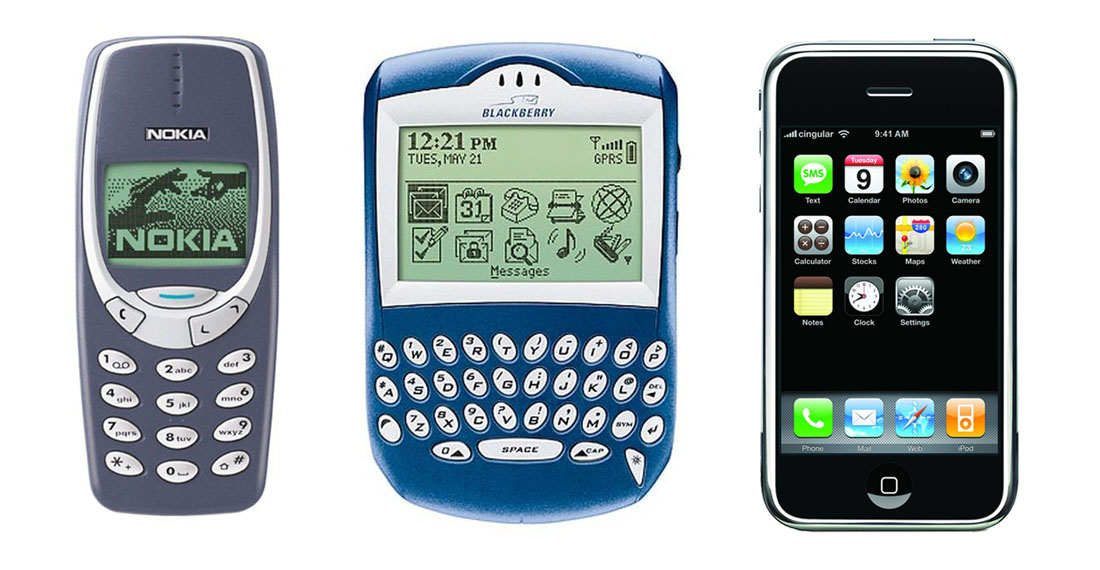
The 2007 Paradigm Shift: The Modern Smartphone Architecture
If the IBM Simon was the birth of the smartphone, the year 2007 represented its rebirth. Up until this point, smartphones were primarily tools for productivity, often featuring resistive touchscreens that required pressure (or a stylus) and cluttered physical keyboards.
Capacitive Touch vs. Stylus-Driven Interfaces
The introduction of the iPhone by Apple shifted the industry from resistive touch to capacitive touch. This change was foundational. Capacitive screens used the electrical properties of the human body to detect touch, allowing for multi-touch gestures like pinching to zoom and fluid scrolling. This transition eliminated the need for a stylus and allowed the software to dictate the interface, rather than being constrained by physical buttons.
The App Store: Turning Hardware into a Platform
In 2008, the launch of the App Store fundamentally changed the definition of a smartphone. A device was no longer defined solely by the features it possessed out of the box. Through a centralized marketplace, third-party developers could build applications that transformed the phone into a gaming console, a GPS navigator, or a social media hub. This created an ecosystem where the hardware was merely a vessel for a constantly evolving suite of software tools.
Android’s Entry and the Open Source Escalation
While Apple focused on a closed, premium ecosystem, Google entered the market with Android. The release of the T-Mobile G1 (HTC Dream) in late 2008 offered a different vision: an open-source operating system that any manufacturer could use. This led to a rapid escalation in hardware specs. Competitors like Samsung, Motorola, and HTC began a “spec war,” pushing the boundaries of screen resolution, processor speeds, and camera quality. This competition accelerated the democratization of smartphone technology, making “smart” devices available at every price point globally.
Technological Breakthroughs That Shaped Today’s Devices
The journey from the IBM Simon to the modern smartphone was fueled by several key technological breakthroughs that allowed manufacturers to cram more power into smaller, more efficient packages.
The Shrinking of Silicon: Moore’s Law in Your Pocket
The most significant driver of smartphone evolution has been the miniaturization of semiconductors. Modern System-on-a-Chip (SoC) designs, such as Apple’s A-series or Qualcomm’s Snapdragon processors, integrate the CPU, GPU, and AI neural engines into a single piece of silicon. These chips are now built on 3-nanometer processes, containing billions of transistors. This efficiency allows modern phones to perform complex video editing and real-time 3D rendering while maintaining reasonable battery life.
Connectivity Standards: From 2G to 5G
The IBM Simon operated on the AMPS (Analog) and early 2G networks, which were primarily designed for voice. The evolution through 3G (the birth of mobile web), 4G LTE (the birth of mobile video streaming), and now 5G (low-latency, high-bandwidth communication) has been essential. Without the corresponding evolution in network infrastructure, the “smart” features of modern phones—such as cloud synchronization, live gaming, and high-definition video calls—would be impossible.
The AI Integration: Moving from Smart to Intelligent
In the last five years, the focus has shifted from raw hardware specs to artificial intelligence. Modern smartphones utilize machine learning for computational photography, which allows small camera sensors to take professional-grade photos by intelligently merging multiple exposures. AI also powers voice assistants like Siri and Google Assistant, manages battery health based on user habits, and provides real-time language translation. The smartphone has moved from being a reactive tool to a proactive assistant.
The Legacy of the First Smartphone in the Modern Era
The IBM Simon may look like an antique today, but its DNA is present in every device we use. It established the core concept that a phone should be more than a voice communication device; it should be a pocketable hub for information management.
The Impact on Global Connectivity
The evolution of the smartphone has done more than provide convenience; it has bridged the digital divide. In many parts of the world, the smartphone is the first and only computer a person will ever own. It has revolutionized banking through mobile money, democratized education through online platforms, and transformed political landscapes by providing a platform for instant, decentralized communication.

Future Trends: Foldables, Wearables, and Neural Links
As we look toward the future, the definition of the smartphone continues to shift. Foldable displays are challenging the traditional slab design, attempting to offer tablet-sized screens in pocketable forms. Meanwhile, the rise of smartwatches and Augmented Reality (AR) glasses suggests a future where the “smartphone” may no longer be a handheld device at all, but a distributed network of wearables.
Regardless of what form the technology takes next, the journey that began with the bulky IBM Simon in 1994 remains one of the most significant chapters in human technological history. We have moved from a world where we had to go “to” a computer to a world where the computer is always with us, intelligently anticipating our needs and connecting us to the sum of human knowledge in the palm of our hand.
aViewFromTheCave is a participant in the Amazon Services LLC Associates Program, an affiliate advertising program designed to provide a means for sites to earn advertising fees by advertising and linking to Amazon.com. Amazon, the Amazon logo, AmazonSupply, and the AmazonSupply logo are trademarks of Amazon.com, Inc. or its affiliates. As an Amazon Associate we earn affiliate commissions from qualifying purchases.