
For over a century, the sinking of the RMS Titanic has been framed as a cautionary tale of human hubris versus the elements. However, in the realms of materials science, naval architecture, and digital forensics, the narrative is far more complex than a simple collision with an iceberg. To understand what really happened to the Titanic, we must look past the romanticized history and examine the specific technological failures, metallurgical shortcomings, and design limitations that converged on the night of April 14, 1912. Modern engineering analysis has allowed us to deconstruct the “unsinkable” myth through the lens of forensic technology, providing a high-definition view of a disaster that changed maritime engineering forever.
The Metallurgy of Failure: Why the Steel Snapped
One of the most persistent questions in the technical community is why a ship of such massive proportions—constructed with what was then state-of-the-art steel—could suffer such catastrophic damage from a glancing blow. Recent laboratory testing of steel recovered from the wreck site has provided a definitive answer: the metallurgy of the early 20th century was ill-equipped for the environmental conditions of the North Atlantic.
Brittle Fracture and Water Temperature
When Titanic’s hull plating was analyzed by materials scientists, they discovered a high concentration of phosphorus and sulfur. While these elements made the steel easier to produce in 1911, they also made the metal susceptible to “brittle fracture” at low temperatures. In the 28-degree Fahrenheit waters where the Titanic met the iceberg, the steel transitioned from being ductile (meaning it would bend or deform under pressure) to being brittle (meaning it would shatter or crack like glass).
In modern shipbuilding, steel is tested for Charpy impact toughness to ensure it can absorb energy without fracturing. Titanic’s steel possessed only a fraction of the impact resistance of modern Grade EH36 steel. When the iceberg struck the hull, the steel plates did not simply dent; they fractured along grain boundaries, creating jagged openings that allowed water to bypass the ship’s primary defenses.
The Role of Wrought Iron Rivets
The hull of the Titanic was held together by over three million rivets. While the central portion of the hull used high-strength steel rivets, the bow and stern—where the hull curved—required the use of wrought iron rivets because they had to be hammered by hand in spaces where hydraulic machinery could not reach.
Technical analysis of the rivets recovered from the bow suggests they contained high levels of slag (a glassy byproduct of the smelting process). This slag made the rivets prone to shearing under extreme pressure. When the iceberg grazed the bow, it didn’t need to pierce the steel plates directly; instead, it applied enough lateral pressure to “pop” the heads off the wrought iron rivets. This caused the seams between the steel plates to unzip, creating six narrow slits that spanned across five of the ship’s watertight compartments.
Architectural Vulnerabilities: The Flaw in the Watertight Design
From a naval architecture perspective, the Titanic was a marvel of its time. It featured a double bottom and sixteen watertight compartments separated by fifteen transverse bulkheads. The design was so advanced that the ship was engineered to stay afloat even if any two of the first four compartments were flooded. However, the tragedy exposed a fundamental flaw in the compartmentalization strategy that modern engineers still study today.
The “Ice Cube Tray” Effect
The fatal flaw in the Titanic’s design was not the presence of the bulkheads, but their height. The bulkheads did not extend all the way to the upper decks. They were capped at “E Deck,” only a few feet above the waterline. While the compartments were “watertight,” they were not “hermetically sealed.”
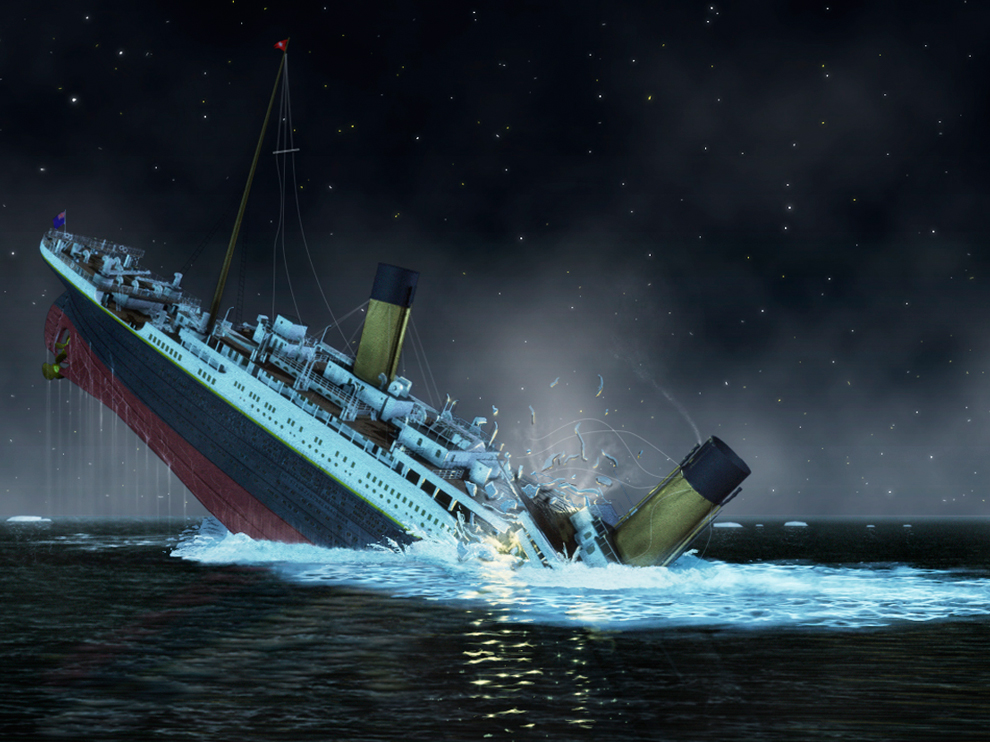
As the bow of the ship began to sink under the weight of the water in the first five compartments, the ship tilted forward. This caused the water in the fifth compartment to spill over the top of the bulkhead into the sixth, much like water filling an ice cube tray tilted at an angle. Once the sixth compartment began to fill, the weight became insurmountable, pulling the bow further down and initiating a chain reaction that doomed the vessel.
The Damage Distribution Theory
Another critical factor was the distribution of the damage. If the Titanic had hit the iceberg head-on, it likely would have survived. The energy of the impact would have been absorbed by the “crush zone” of the bow, flooding only one or two compartments. By attempting to “port around” the iceberg, the crew exposed the side of the ship to a 300-foot-long series of intermittent gashes. This distributed the flooding across five compartments—one more than the ship’s mathematical limit for buoyancy. This specific failure mode—the “longitudinal scraping” impact—is now a standard consideration in hull integrity simulations for modern cruise liners.

Digital Forensics and the 2023 Full-Sized Scan
For decades, our understanding of the wreck was limited to grainy, localized footage and sonar maps. However, in 2023, a groundbreaking technological feat provided the first “digital twin” of the Titanic. Using deep-sea mapping and photogrammetry, a team of scientists captured over 700,000 images to create a 3D reconstruction of the entire wreck site.
Photogrammetry and High-Resolution Mapping
The 2023 scan was conducted using two submersibles, Romeo and Juliet, which spent over 200 hours mapping every inch of the debris field. This technology allows researchers to see the ship as if the water has been drained away. It has revealed subtle details that were previously invisible, such as the serial numbers on the propellers and the exact deformation of the steel where the ship broke apart.
This digital forensics approach has debunked several myths. For instance, it confirmed that the ship did not sink in one piece—a fact that was debated for 73 years until the wreck was found in 1985. The high-resolution models show the immense structural stress the ship endured as the stern rose out of the water, exceeding the tensile strength of the keel and causing the vessel to snap in two before it even began its final descent.
Finite Element Analysis (FEA) of the Break-Up
By feeding the data from these scans into Finite Element Analysis (FEA) software, engineers have been able to simulate the structural collapse of the Titanic with terrifying precision. FEA allows researchers to apply virtual forces to a digital model to see where stress concentrates. These simulations show that the “V-break” occurred because the double bottom was the only thing holding the ship together once the upper decks failed. The resulting structural data has been invaluable in the design of modern mega-ships, ensuring that hulls are reinforced to withstand the catastrophic bending moments associated with localized flooding.
The Evolution of Marine Safety Technology Post-1912
The “what really happened” of the Titanic is not just a story of a sinking; it is the origin story of modern maritime technology. The disaster prompted a global technological overhaul, moving the industry away from visual reliance and toward electronic detection and automated safety systems.
From Visual Spotting to Radar and Sonar
In 1912, the “technology” for detecting icebergs consisted of two men in a crow’s nest with a pair of binoculars (which, in the Titanic’s case, were missing). Today, the International Ice Patrol, established in the wake of the disaster, uses a combination of satellite imagery, aerial reconnaissance, and marine radar to track ice movements.
Modern vessels utilize S-band and X-band radar systems that can detect small objects even in heavy fog or total darkness. Furthermore, sonar technology—originally developed for submarine detection during World War I—is now used to map the seafloor and detect underwater hazards in real-time. The transition from human eyesight to multi-spectral sensor arrays is perhaps the most significant technological legacy of the Titanic.
AI and Predictive Modeling in Modern Navigation
Today’s maritime industry is increasingly reliant on Artificial Intelligence (AI) to prevent a repeat of the Titanic disaster. Modern Integrated Bridge Systems (IBS) use AI to aggregate data from GPS, AIS (Automatic Identification System), and weather sensors to predict potential collision courses hours in advance.
These systems can run thousands of “what-if” scenarios every second, adjusting a ship’s trajectory to avoid ice or storms without human intervention. While the Titanic’s officers had to rely on manual calculations and instinct, modern captains have access to real-time digital twins of their own vessels, allowing them to monitor hull stress and stability with microscopic precision.

Conclusion: The Perpetual Lesson of the Titanic
What really happened to the Titanic was a “perfect storm” of engineering limitations. It was a failure of material science (brittle steel and weak rivets), a failure of architectural design (low bulkhead height), and a failure of detection technology (lack of radar and sonar).
However, the technological autopsy of the Titanic has not been in vain. Every modern cruise ship, cargo vessel, and submersible is a testament to the lessons learned from that night in 1912. We have moved from an era of “unsinkable” hubris to an era of data-driven safety, where digital forensics and AI simulations ensure that we no longer have to guess what happens when a ship meets the ice. The Titanic remains the most important case study in the history of technology, reminding us that engineering is not just about building bigger—it is about understanding the microscopic details that keep the massive structures afloat.
aViewFromTheCave is a participant in the Amazon Services LLC Associates Program, an affiliate advertising program designed to provide a means for sites to earn advertising fees by advertising and linking to Amazon.com. Amazon, the Amazon logo, AmazonSupply, and the AmazonSupply logo are trademarks of Amazon.com, Inc. or its affiliates. As an Amazon Associate we earn affiliate commissions from qualifying purchases.