
The global economy is a complex web of transactions, and at its center remains the United States. While many consumers visualize the U.S. primarily as a destination for foreign-made electronics and textiles, the nation is a powerhouse of production and innovation. Understanding what the United States exports is essential for investors, business owners, and financial analysts who want to grasp the underlying health of the American economy. From the deep wells of the Permian Basin to the high-tech laboratories of Silicon Valley, the U.S. export profile is a diverse portfolio that reflects the nation’s shifting economic priorities.

In the modern financial landscape, exports represent more than just “goods sold abroad.” They are a barometer for global demand, a driver of corporate earnings for S&P 500 companies, and a critical component of the country’s Gross Domestic Product (GDP). By analyzing the major categories of American exports, we can better understand where the “big money” is moving and which sectors are poised for long-term growth.
The Energy Revolution: Refined Petroleum and Natural Gas
For decades, the United States was defined by its dependency on foreign oil. However, the last fifteen years have witnessed a seismic shift in the global energy map. Thanks to the technological breakthroughs in hydraulic fracturing and horizontal drilling, the U.S. has emerged as one of the world’s leading exporters of energy products.
Refined Petroleum Products
Refined petroleum—including gasoline, diesel, and jet fuel—consistently ranks at the top of the U.S. export list. Unlike crude oil, which is a raw commodity, refined products represent “value-added” exports. U.S. refineries, particularly those along the Gulf Coast, are among the most sophisticated in the world. They can process heavy crudes from other nations and export high-quality finished fuels to markets in Mexico, South America, and Europe. For investors, this sector represents a massive capital expenditure play, where the efficiency of the refining process dictates the profit margins of energy giants.
Liquefied Natural Gas (LNG)
The geopolitical shifts of the early 2020s accelerated the U.S. transition into a natural gas superpower. As Europe sought to decouple from Russian energy sources, U.S. Liquefied Natural Gas (LNG) became a critical lifeline. This has turned the U.S. into a top-tier exporter of gas, with billions of dollars flowing into infrastructure projects like export terminals and pipelines. The financial implications are profound: natural gas is no longer a localized commodity but a globalized one, and the U.S. is the primary price-setter for the Atlantic basin.
Aerospace and High-Value Transportation
If energy is the fuel of the American export engine, aerospace is the high-performance frame. The United States remains the undisputed leader in civilian and military aircraft production. This sector is characterized by incredibly high barriers to entry, long-term contracts, and massive capital requirements, making it a cornerstone of the American industrial economy.
Civilian Aircraft and Components
Companies like Boeing and their vast network of suppliers represent a significant portion of the total export value in the “Capital Goods” category. A single wide-body jet can cost hundreds of millions of dollars, meaning a handful of international deliveries can swing the monthly trade balance figures. These exports are not just about the planes themselves but the decades-long service contracts, parts, and software updates that follow, creating a recurring revenue stream for American firms.
Defense and Space Technology
The U.S. defense industry is a major contributor to the nation’s export balance. Advanced fighter jets, missile defense systems, and satellite technology are sought after by allies worldwide. This sector is unique because its “sales” are often dictated by government-to-government agreements and geopolitical alliances. From a financial perspective, defense exports provide a hedge against domestic economic downturns, as foreign military sales (FMS) are often funded by long-term sovereign budgets.
The Digital Frontier: Intellectual Property and Services
While physical goods like oil and planes are easy to track at a shipping port, the most valuable American exports are often invisible. The United States maintains a significant trade surplus in services, a category that includes software, financial services, and intellectual property. In the “Money” niche, this is perhaps the most important area to watch, as it carries the highest profit margins.

Software and Technology Licensing
When a business in Germany uses an American cloud computing platform or a creative agency in Japan licenses design software, that is an American export. Silicon Valley’s greatest product is not necessarily the hardware, but the code and the platforms that power the global digital economy. The export of “Information Services” has grown exponentially, driven by the shift toward Software-as-a-Service (SaaS) models. This creates a highly scalable export business that doesn’t require the logistical overhead of shipping physical containers.
Financial and Management Consulting Services
The U.S. financial sector is a dominant global force. Wall Street banks, insurance firms, and asset management companies export their expertise to every corner of the globe. Whether it is managing a sovereign wealth fund in the Middle East or providing M&A advisory services in Southeast Asia, these “service exports” bring billions of dollars back into the U.S. economy. Furthermore, American management consulting and legal firms are the gold standard for global business operations, reinforcing the U.S. dollar’s role as the primary currency of international trade.
The Entertainment and Royalty Economy
Hollywood, the music industry, and video game developers represent a massive export market in the form of royalties and licensing fees. The “soft power” of American culture translates into hard currency. Every time an American film breaks records in the international box office or a global streaming service pays for the rights to American content, it contributes to the export tally. This sector is highly resistant to traditional manufacturing challenges like supply chain disruptions, relying instead on the strength of intellectual property laws.
Specialized Machinery and Medical Innovation
The “Made in the USA” label is increasingly associated with high-complexity manufacturing rather than mass-market consumer goods. This includes medical devices, laboratory equipment, and specialized industrial machinery that other nations lack the technical infrastructure to produce.
Healthcare and Pharmaceuticals
The U.S. is a global hub for pharmaceutical R&D. While many basic medications are manufactured abroad, the high-end, patented drugs and biological treatments are largely a product of American innovation. Medical instruments—such as MRI machines, robotic surgical tools, and diagnostic equipment—are high-margin exports that serve an aging global population. For investors, this sector offers stability, as healthcare spending is less discretionary than consumer spending.
Integrated Circuits and Semiconductors
While much of the world’s semiconductor fabrication has moved to Asia, the U.S. remains a leader in chip design and the machinery used to make those chips. The export of complex electronic components is vital for the global automotive, telecommunications, and AI industries. As the “arms race” for Artificial Intelligence intensifies, American-designed chips have become some of the most strategically important exports in the world.
The Financial Impact of Trade Dynamics
Understanding the main exports of the United States is only half the battle; one must also understand the financial mechanics behind these movements. The strength of the U.S. dollar, interest rate policies, and trade agreements all play a role in how competitive these exports remain on the global stage.
Currency Fluctuations and Export Pricing
When the U.S. Federal Reserve raises interest rates, the dollar typically strengthens. While a strong dollar is good for American tourists traveling abroad, it can make U.S. exports more expensive for foreign buyers. For example, a Boeing jet or a shipment of U.S. corn becomes more costly in local currency terms, potentially driving buyers to competitors. Investors in multinational corporations must constantly monitor “currency headwinds” that can shave percentages off the bottom line even when sales volume is high.
The Trade Deficit vs. The Service Surplus
It is common to hear about the U.S. trade deficit, which primarily refers to the “Trade in Goods.” However, the U.S. consistently runs a “Trade in Services” surplus. For a modern, post-industrial economy, this is a natural evolution. The U.S. focuses on high-value-added sectors (finance, tech, aerospace) while importing lower-margin consumer goods. From a business finance perspective, this allows the U.S. to capture the most profitable segments of the global value chain.
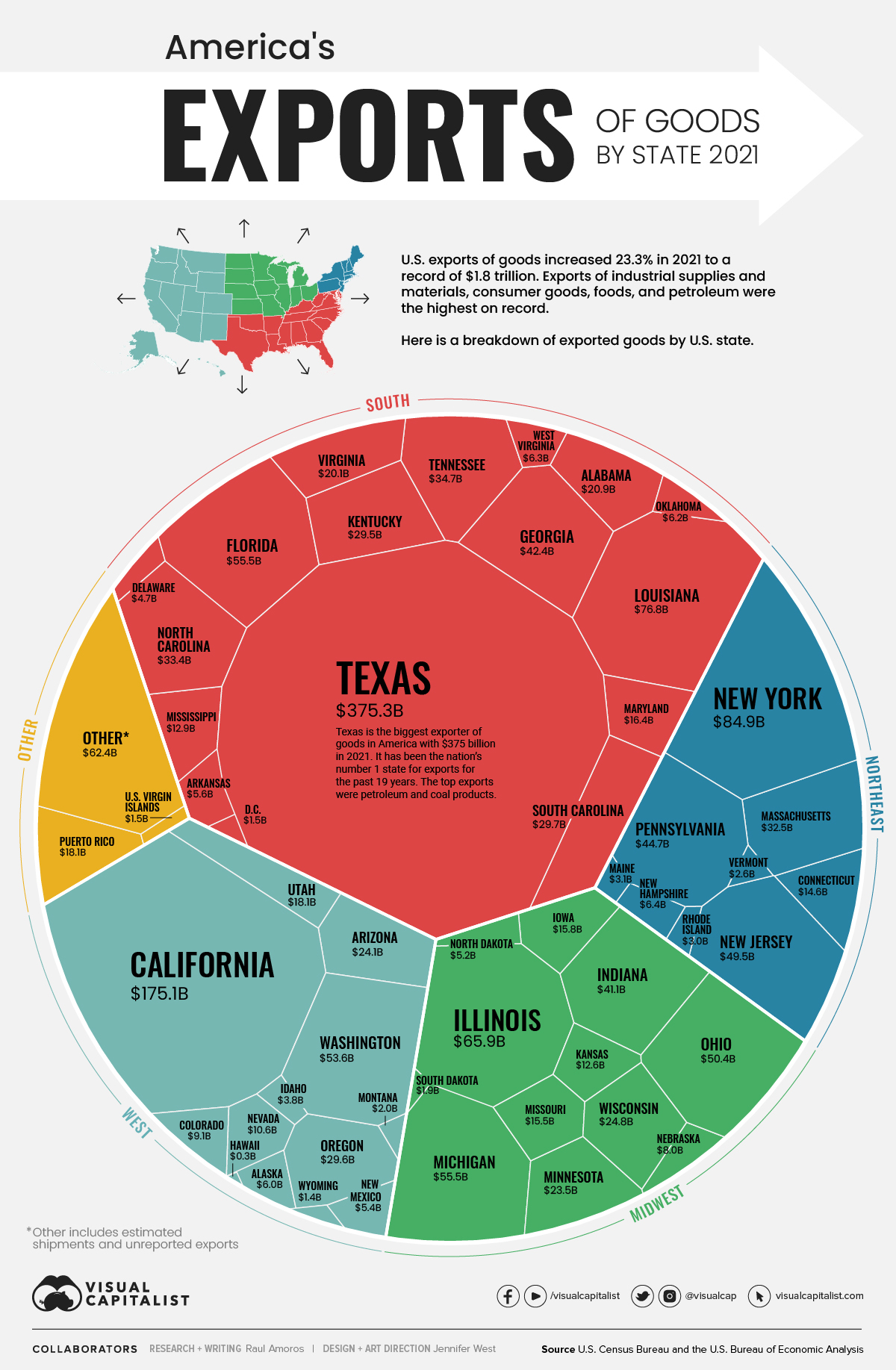
Strategic Investment in Export Sectors
For those looking to align their portfolios with the strengths of the U.S. economy, the export market provides a clear roadmap. The transition to energy independence makes the U.S. energy sector a structural play rather than a cyclical one. The dominance of U.S. tech and services suggests that the “intangible economy” will continue to be the primary driver of wealth.
In conclusion, the main export of the United States is no longer just one thing. It is a sophisticated mix of energy products, high-tech machinery, and intellectual capital. The shift from a manufacturing-based export economy to one driven by energy and high-value services reflects the country’s unique position in the 21st century. By staying informed on these trade patterns, individuals can better navigate the complexities of global markets, identify emerging business trends, and make more informed financial decisions in an increasingly interconnected world.
aViewFromTheCave is a participant in the Amazon Services LLC Associates Program, an affiliate advertising program designed to provide a means for sites to earn advertising fees by advertising and linking to Amazon.com. Amazon, the Amazon logo, AmazonSupply, and the AmazonSupply logo are trademarks of Amazon.com, Inc. or its affiliates. As an Amazon Associate we earn affiliate commissions from qualifying purchases.