
In the world of personal finance, investing, and business strategy, few concepts are as foundational—or as frequently debated—as the free market economy. At its core, a free market is an economic system where the prices of goods and services are determined by the unfettered interaction of supply and demand, rather than by government intervention or central planning. For the modern investor or entrepreneur, understanding the mechanics of this system is not merely an academic exercise; it is a prerequisite for navigating the complexities of wealth creation and financial stability.
A free market operates on the principle of voluntary exchange. In this environment, individuals and businesses make their own decisions about what to produce, how much to charge, and what to buy. This decentralized approach creates a self-regulating ecosystem that, according to proponents, maximizes efficiency and fosters innovation. By stripping away artificial barriers to entry and price controls, the free market allows the “invisible hand”—a term coined by Adam Smith—to guide resources toward their most productive uses.

The Core Mechanics of Free Market Dynamics
To grasp the free market from a financial perspective, one must first understand the primary engine that drives it: the law of supply and demand. In a truly free market, the price of an asset or commodity serves as a critical signal. When demand for a product increases while supply remains constant, prices rise. This price increase serves two functions: it discourages excessive consumption and encourages producers to increase output to capture higher profits. Conversely, if supply outstrips demand, prices fall, signaling to producers that they should reallocate their resources elsewhere.
The Invisible Hand and Price Discovery
The concept of “price discovery” is perhaps the most vital tool in a market-based financial system. It is the process by which the market determines the “fair value” of an asset. For an investor, price discovery is what happens every second the stock market is open. Millions of participants, each with their own information and motivations, buy and sell shares, ultimately arriving at a price that reflects the collective wisdom of the market. This mechanism ensures that capital flows to the companies that are most likely to generate value, thereby driving economic growth.
Self-Interest as a Productive Force
In a free market, self-interest is not viewed as a vice but as a functional necessity. When an entrepreneur starts a business to earn a profit, they are forced to provide value to others to succeed. To earn your money, they must offer a product or service that you value more than the cash in your pocket. This creates a cycle of mutual benefit. From a money-management perspective, this means that wealth is generally created by solving problems or fulfilling needs within the marketplace.
The Pillars of a Free Market Environment
A functioning free market does not exist in a vacuum; it requires a specific set of institutional pillars to remain viable. For individuals looking to build online income or invest in private equity, these pillars represent the “rules of the game” that protect their interests and facilitate growth.
Private Property Rights
Without the legal right to own and control property, the free market collapses. Property rights allow individuals to claim the fruits of their labor. In the context of modern finance, this extends beyond physical land to include intellectual property, stocks, bonds, and digital assets. When property rights are secure, individuals are incentivized to invest in and improve their assets, knowing they will reap the rewards of their efforts.
Competition and Market Entry
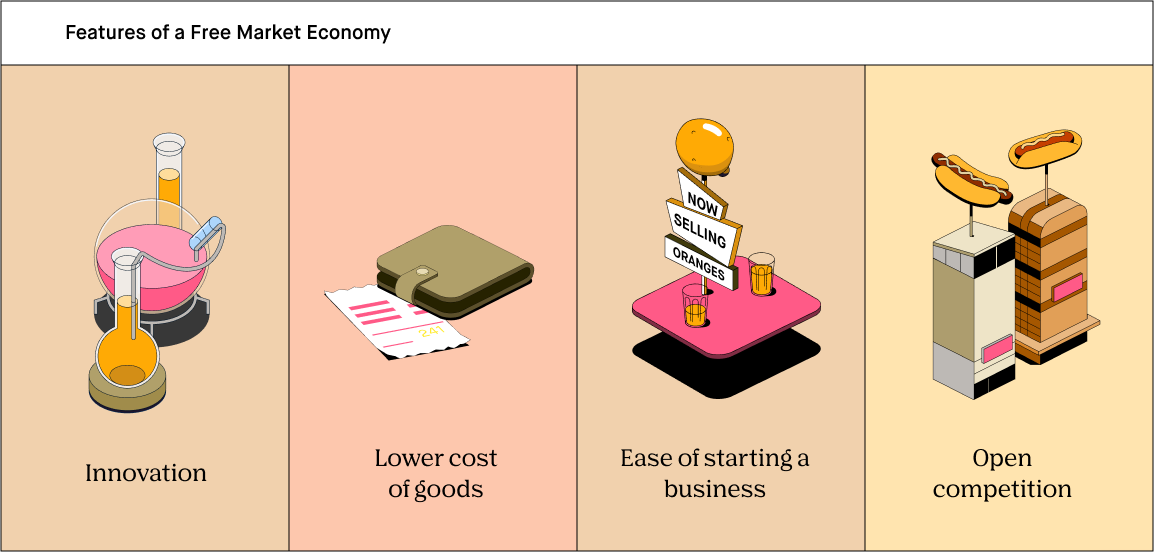
Competition is the disciplinary force of the free market. It prevents any single entity from becoming too complacent or exploitative. When multiple businesses compete for the same pool of consumer dollars, they are forced to innovate, improve quality, and lower prices. For the personal finance enthusiast, competition is a boon; it leads to better financial tools, lower brokerage fees, and a wider array of investment products.
Voluntary Exchange and Minimal Regulation
In a pure free market, every transaction is voluntary. No one is forced to buy a specific product, and no producer is forced to sell at a specific price. This freedom of choice ensures that resources are allocated based on actual preferences rather than bureaucratic mandates. While most modern economies are “mixed”—meaning they have some level of regulation—the closer a system stays to the ideal of voluntary exchange, the more dynamic it tends to be.
How the Free Market Shapes Personal Finance and Investing
Understanding the free market is essential for anyone serious about managing their money. The system directly influences everything from the interest rate on your savings account to the volatility of your retirement portfolio.
Risk, Reward, and Capital Allocation
The free market is inherently a system of risk and reward. Because there is no central authority guaranteeing success, individuals must take calculated risks to achieve financial gains. This is the bedrock of investing. When you buy a stock, you are providing capital to a business in exchange for a claim on its future profits. If the business fails in the competitive marketplace, you lose your capital. If it thrives, your wealth grows. This high-stakes environment forces investors to become disciplined and analytical in their approach to capital allocation.
The Power of Creative Destruction
Economist Joseph Schumpeter famously described the free market’s tendency toward “creative destruction.” This is the process where new innovations constantly replace outdated technologies and business models. For the investor, this means that the “safe” blue-chip company of today may be the bankrupt relic of tomorrow. Staying attuned to market shifts is vital for maintaining a side hustle or an investment portfolio. The free market rewards those who can anticipate where the “destruction” will hit and where the “creation” will flourish.
Inflation and Currency Value
In a free market, even the value of money is subject to supply and demand. While central banks influence the money supply, the market ultimately determines the purchasing power of a currency. If a government prints too much money, the supply of currency exceeds the demand for it, leading to inflation. For those focused on personal finance, understanding this relationship is crucial for hedging against the loss of purchasing power through assets like real estate, equities, or commodities.
Advantages and Challenges for the Modern Wealth Builder
While the free market is a powerful engine for wealth creation, it is not without its complexities. Navigating these requires a balanced perspective on both the opportunities and the inherent instabilities of the system.
The Efficiency Paradox
The primary advantage of the free market is its efficiency. It processes information faster than any government agency could. If a new technology makes manufacturing cheaper, the market reflects this almost instantly through lower prices or higher stock valuations. However, this efficiency can lead to high levels of volatility. For the individual investor, market efficiency means that “beating the market” is incredibly difficult, as most known information is already baked into asset prices.
Market Failures and Externalities
Critics and supporters alike acknowledge that markets are not perfect. Sometimes, the market fails to account for “externalities”—costs or benefits that affect third parties who didn’t choose to be involved in the transaction (such as pollution). From a business finance perspective, increasing regulation around externalities can create new risks and opportunities. For example, the rise of ESG (Environmental, Social, and Governance) investing is a market-driven response to these challenges, as investors vote with their capital for more sustainable business practices.
Income Inequality and Social Mobility
The free market is a meritocracy of value, not necessarily of effort. It rewards those who provide what the market deems valuable. This can lead to significant wealth gaps. However, the free market also provides the highest degree of social mobility. Unlike rigid class systems, a market economy allows someone with a profitable idea or a high-demand skill to build significant wealth regardless of their starting point. This is why side hustles and online businesses have become such popular vehicles for financial independence; they represent the purest expression of market entry and individual agency.
Navigating a Mixed Economy Framework
It is important to note that a 100% “pure” free market does not exist in the modern world. Most nations operate under a mixed economy, which combines free-market principles with government oversight.
The Role of Regulation in Your Portfolio
Regulations, such as those imposed by the SEC in the United States, are designed to prevent fraud and ensure transparency. For the investor, these rules provide a layer of protection that can make the market feel “safer.” However, excessive regulation can also stifle the very innovation that drives market growth. As a result, savvy investors often look for “market-friendly” jurisdictions when deciding where to allocate their capital or start a business.
Preparing for Economic Cycles
Free markets move in cycles: expansion, peak, contraction, and trough. Because the market is driven by human emotion—fear and greed—these cycles are often exaggerated. Understanding that these cycles are a natural part of a free-market system allows individuals to avoid panic-selling during a downturn and over-leveraging during a boom. A sound financial strategy involves building a resilient portfolio that can withstand the inevitable corrections that a free market requires to “clear” inefficient businesses.
The Future of the Free Market in the Digital Age
Technology is currently making the global economy more “free” in many ways. Decentralized Finance (DeFi), the gig economy, and global e-commerce platforms have lowered the barriers to entry for millions of people. We are entering an era where the individual has more power than ever to participate in the free market. Whether it is through trading fractional shares of a company or launching a global service from a laptop, the principles of supply, demand, and voluntary exchange remain the most potent forces for personal financial advancement.
By mastering the nuances of the free market economy, you position yourself not just as a passive participant, but as a strategic actor capable of identifying value, managing risk, and securing long-term financial prosperity.
aViewFromTheCave is a participant in the Amazon Services LLC Associates Program, an affiliate advertising program designed to provide a means for sites to earn advertising fees by advertising and linking to Amazon.com. Amazon, the Amazon logo, AmazonSupply, and the AmazonSupply logo are trademarks of Amazon.com, Inc. or its affiliates. As an Amazon Associate we earn affiliate commissions from qualifying purchases.