
Navigating the landscape of home financing is often a journey through a sea of acronyms, each carrying significant weight for your monthly budget and long-term financial health. For many first-time homebuyers and seasoned investors alike, the two most common hurdles to clear when securing a mortgage with a lower down payment are MIP and PMI. While both serve the primary function of protecting the lender against default, they operate under different rules, apply to different loan types, and carry distinct implications for your exit strategy as a homeowner.
Understanding the nuance between Mortgage Insurance Premium (MIP) and Private Mortgage Insurance (PMI) is not just a matter of semantics; it is a critical component of financial literacy in the real estate market. Choosing the wrong path could result in thousands of dollars in unnecessary fees over the life of a loan. To make an informed decision, one must look closely at how these insurance types are calculated, how long they remain on the loan, and how they impact your overall debt-to-income ratio.
Understanding the Fundamentals of Mortgage Insurance
At its core, mortgage insurance exists to mitigate risk for the lender. When a borrower provides a down payment of less than 20%, the lender views the loan as higher risk. If the borrower defaults and the property value has dropped, the lender might not be able to recoup the full loan amount through a foreclosure sale. Mortgage insurance provides a safety net, compensating the lender for a portion of the loss.
Why Lenders Require Insurance
The traditional 20% down payment has long been the gold standard in the banking industry. This equity cushion ensures that the borrower has significant “skin in the game” and provides a buffer against market fluctuations. However, in modern real estate markets where home prices often outpace wage growth, saving a 20% down payment can take years, if not decades. Mortgage insurance acts as a bridge, allowing buyers to enter the market with as little as 3% or 3.5% down. It effectively trades a higher monthly payment for the ability to build equity sooner.
The Role of the Loan-to-Value (LTV) Ratio
The Loan-to-Value (LTV) ratio is the primary metric used to determine whether mortgage insurance is required. If you buy a $400,000 home and provide an $80,000 down payment, your loan amount is $320,000, resulting in an LTV of 80%. At this threshold, mortgage insurance is typically waived. If your down payment is only $20,000, your LTV is 95%, triggering the requirement for either MIP or PMI depending on the loan product you choose.
PMI (Private Mortgage Insurance) Explained
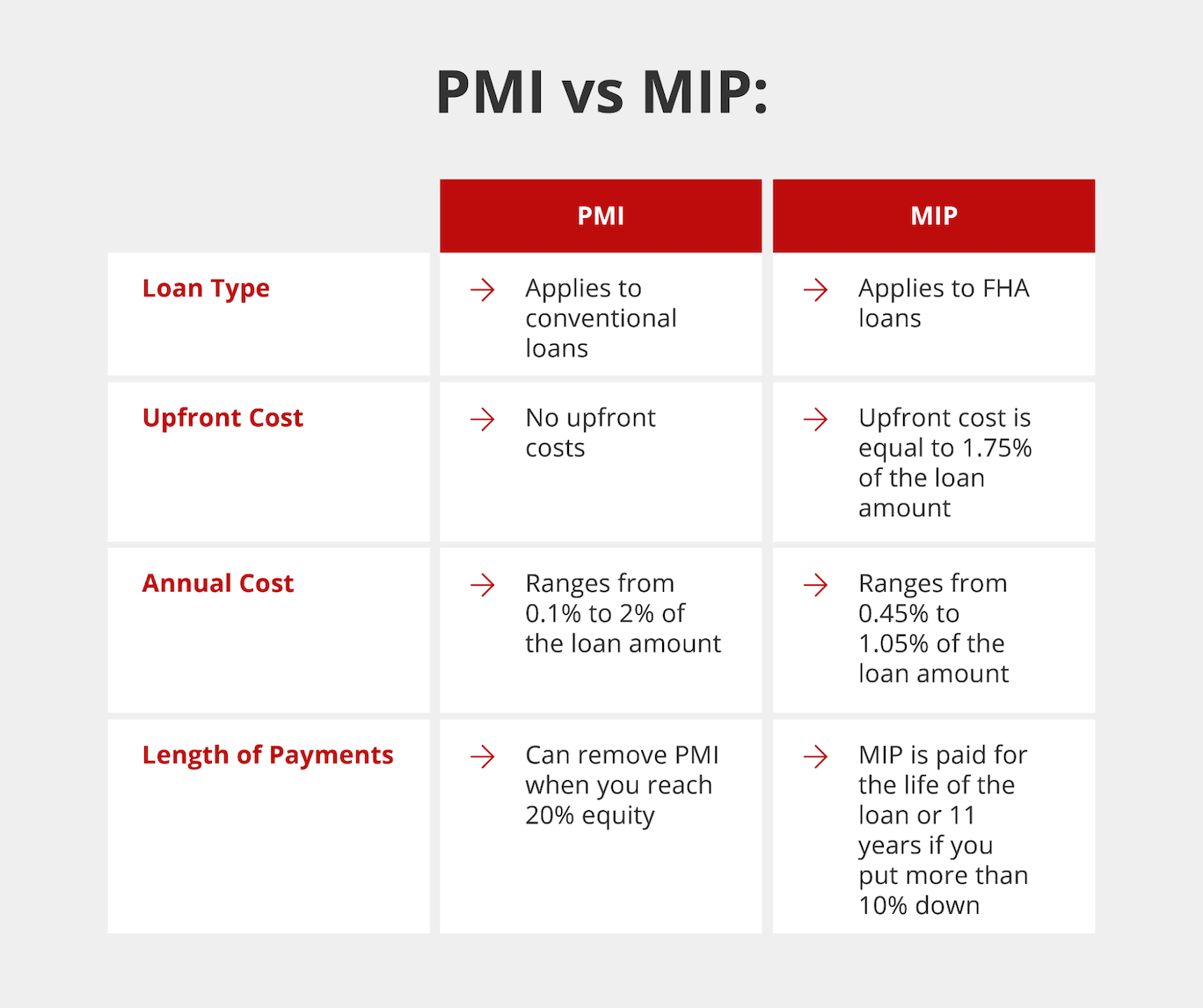
Private Mortgage Insurance, or PMI, is specific to conventional loans. These are mortgages that are not insured or guaranteed by a government agency like the Federal Housing Administration (FHA) or the Department of Veterans Affairs (VA). PMI is provided by private companies and is the most common form of mortgage insurance for borrowers with strong credit scores.
When PMI is Required and How It Is Paid
On a conventional loan, if your down payment is less than 20%, the lender will require PMI. The most common way to pay for this is through a monthly premium added to your mortgage payment. However, some lenders offer “single-premium” PMI, where you pay the entire cost upfront at closing, or “lender-paid” PMI (LPMI), where the lender pays the insurance in exchange for a slightly higher interest rate on your loan.
The cost of PMI is highly sensitive to your credit score and your LTV. A borrower with a 760 credit score will pay significantly less for PMI than a borrower with a 640 score, even if they are buying the same house with the same down payment. Typically, annual PMI costs range from 0.1% to 2% of the original loan amount.
The Homeowners Protection Act and PMI Removal
One of the most significant advantages of PMI over MIP is its cancellability. Under the Homeowners Protection Act of 1998, homeowners have the right to request the cancellation of PMI once their LTV reaches 80% based on the original value of the home. This requires the borrower to be current on payments and have a good payment history.
Furthermore, the law mandates that the lender must automatically terminate PMI once the LTV reaches 78%, provided the borrower is current. In a rising real estate market, homeowners can also request a new appraisal to prove that their equity has reached 20% due to home price appreciation, potentially removing the PMI payment much earlier than scheduled.
MIP (Mortgage Insurance Premium) for Government-Backed Loans
Mortgage Insurance Premium, or MIP, is the insurance requirement specifically associated with FHA loans. Because FHA loans are designed to help borrowers with lower credit scores or limited down payment funds, the government requires a different insurance structure to sustain the program.
The Two-Tiered Structure of MIP
Unlike PMI, which is usually just a monthly fee, MIP consists of two distinct parts. First, there is the Upfront Mortgage Insurance Premium (UFMIP). This is equal to 1.75% of the base loan amount and is due at the time of closing. Most borrowers choose to roll this cost into the total loan amount rather than paying it in cash, which slightly increases the monthly principal and interest.
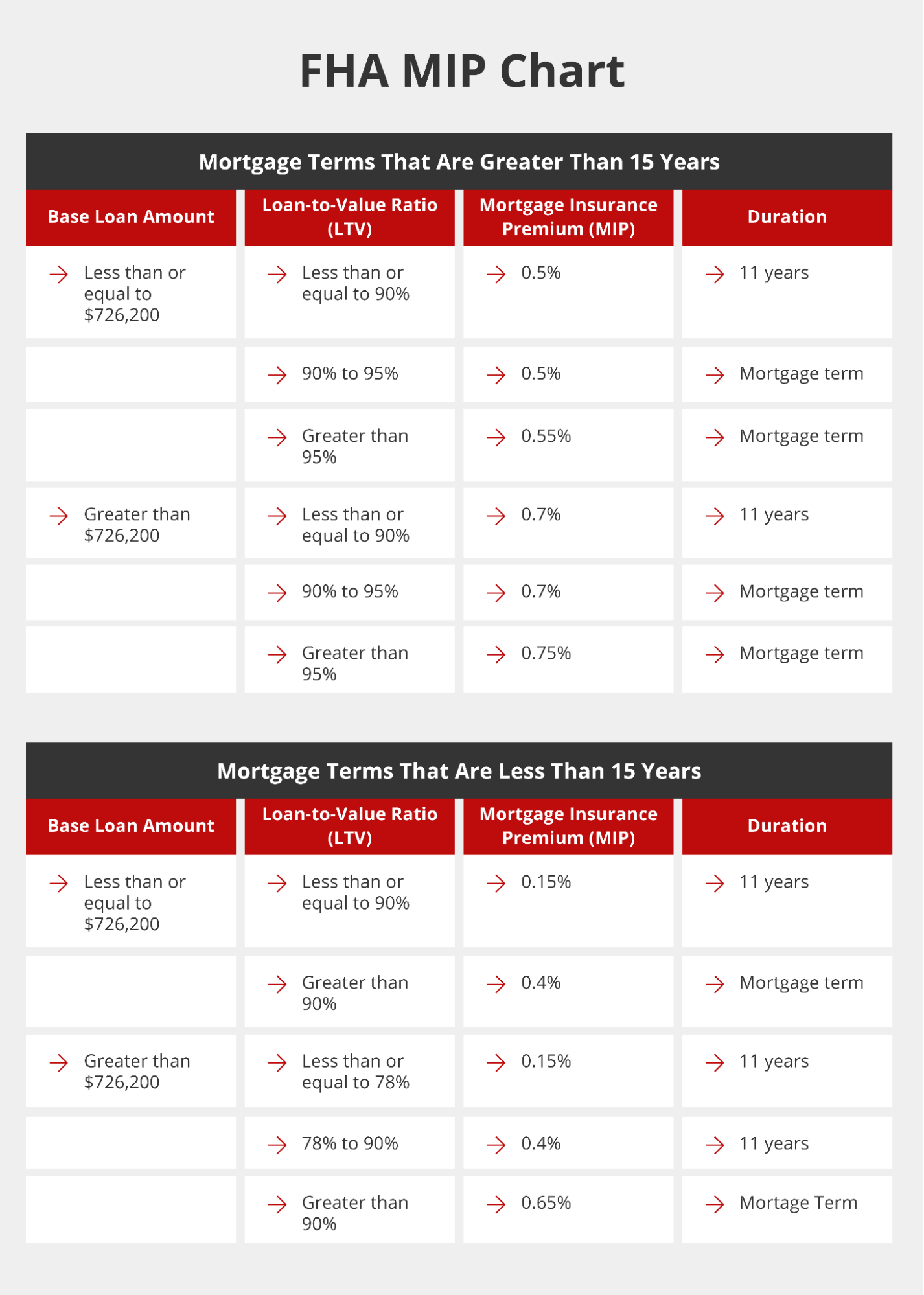
The second part is the Annual Mortgage Insurance Premium (Annual MIP). Despite the name, this is divided by 12 and paid monthly as part of the mortgage installment. The rate for the annual MIP varies based on the loan term and the LTV, but for most 30-year FHA loans with the minimum 3.5% down payment, the rate is currently around 0.55%.
The Permanent Nature of FHA MIP
The most critical distinction for MIP is its duration. For FHA loans originated after June 2013, if you put down less than 10%, the MIP remains on the loan for the entire life of the mortgage. It does not drop off automatically at 78% LTV. The only way to remove MIP in this scenario is to pay off the loan entirely or refinance the FHA loan into a conventional loan once you have reached 20% equity.
If a borrower puts down 10% or more on an FHA loan, the MIP is required for 11 years rather than the full 30-year term. This lack of flexibility makes MIP a long-term financial commitment that can become quite expensive as the years pass.
Key Differences and Comparison
When evaluating MIP versus PMI, the decision often hinges on your current financial profile and your long-term goals for the property. While they serve the same purpose, the financial mechanics differ in ways that can affect your monthly cash flow and your ability to build wealth.
Credit Score Sensitivity
PMI is extremely sensitive to credit scores. If you have a credit score above 720, PMI is often the more affordable choice. Conversely, FHA MIP rates are the same regardless of your credit score. For a borrower with a credit score in the low 600s, an FHA loan with MIP might actually be cheaper on a monthly basis than a conventional loan with high-priced PMI, even though the FHA loan has an upfront fee.
Cancellation Policies and Equity Growth
The ability to cancel PMI is a major financial “win” for homeowners. As you pay down your principal and your home value rises, that extra $100 to $300 a month in PMI eventually disappears, effectively giving you a raise. With an FHA loan, you are locked into that payment unless you undergo the costs of a full refinance. Refinancing requires paying new closing costs, which can range from 2% to 5% of the loan amount, making the exit from MIP a costly endeavor.
Total Cost Over Time
If you plan to stay in your home for 30 years, an FHA loan with a low down payment could be significantly more expensive due to the lifetime MIP requirement. A conventional loan with PMI might have a higher initial interest rate or higher initial monthly costs for some borrowers, but the eventual removal of the insurance premium usually makes it the more cost-effective choice in the long run.
Making the Right Financial Decision for Your Mortgage
Choosing between a loan that requires MIP or PMI should be a calculated financial move based on your “break-even” analysis. There is no one-size-fits-all answer, as the best choice depends on interest rates, credit health, and how long you intend to keep the mortgage.
Weighing the Long-Term Costs
When comparing loan estimates, look past the monthly payment. Calculate the total cost of the mortgage insurance over the first five, ten, and fifteen years. If you expect to reach 20% equity within five years through aggressive payments or market appreciation, the conventional loan with PMI is almost always superior because of the ease of cancellation. If you are struggling to qualify for a conventional loan due to a lower credit score, the FHA loan with MIP serves as a valuable tool to get you into a home, but you should do so with an exit strategy—such as a plan to improve your credit and refinance in a few years.
Strategies to Avoid or Minimize Insurance
For those looking to maximize their investment, there are ways to circumvent these costs entirely. The most obvious is saving for a 20% down payment, though this isn’t always the most efficient use of capital if interest rates are low and home prices are rising. Another strategy is the “piggyback loan” or 80/10/10 arrangement, where you take out a primary mortgage for 80% of the home’s value, a second mortgage (HELOC or home equity loan) for 10%, and provide a 10% cash down payment. This avoids mortgage insurance altogether, though the interest rate on the second mortgage will be higher.
Ultimately, the choice between MIP and PMI is a trade-off between accessibility and long-term cost. By understanding the mechanics of each, you can position yourself to minimize fees and maximize the equity you build in your most significant asset. Whether you choose the cancellable nature of PMI or the accessible entry point of MIP, the goal remains the same: using mortgage insurance as a temporary stepping stone toward full homeownership and financial stability.
aViewFromTheCave is a participant in the Amazon Services LLC Associates Program, an affiliate advertising program designed to provide a means for sites to earn advertising fees by advertising and linking to Amazon.com. Amazon, the Amazon logo, AmazonSupply, and the AmazonSupply logo are trademarks of Amazon.com, Inc. or its affiliates. As an Amazon Associate we earn affiliate commissions from qualifying purchases.