
In the landscape of mobile gaming, few applications have managed to sustain a competitive ecosystem as complex and data-driven as Pokémon GO. While the game initially launched as a casual augmented reality experience centered on exploration, it has evolved into a sophisticated digital sport. At the heart of this evolution is the Pokémon GO Battle League (GBL), where players must navigate intricate algorithms, hidden statistics, and shifting metas. Determining the “best” team is not a static endeavor; it is a technical challenge that requires an understanding of move timing, energy management, and statistical optimization.
To build a championship-caliber team, one must move beyond simple type advantages and delve into the technical mechanics of the software. This involves analyzing “Stat Product,” mastering “Turn-based” combat logic, and utilizing third-party simulators to predict outcomes. Whether you are competing in the Great League, Ultra League, or Master League, the best team is defined by its synergy, its coverage of the current meta, and the technical precision of its movesets.
The Mathematics of the Meta: Understanding IVs and Stat Product
The foundation of any elite team starts with the underlying data of each individual Pokémon. In the tech-heavy environment of competitive play, users must understand Individual Values (IVs). Every Pokémon has three core hidden stats: Attack, Defense, and Stamina, each ranging from 0 to 15.
In leagues with a Combat Power (CP) cap—specifically the Great League (1500 CP) and Ultra League (2500 CP)—the “best” Pokémon often utilize a counter-intuitive IV spread. Because the Attack stat is weighted more heavily in the CP calculation formula, a high Attack IV will cause a Pokémon to reach the CP limit at a lower level. To maximize the “Stat Product” (the total effectiveness of all stats combined), professional players seek Pokémon with low Attack and high Defense/Stamina. This allows the Pokémon to be powered up to a higher level while remaining under the CP cap, resulting in significantly higher bulk and survivability.
Furthermore, players must consider “Breakpoints” and “Bulkpoints.” These are specific technical thresholds where an Attack stat is high enough to deal an extra point of damage per “Fast Move,” or a Defense stat is high enough to reduce incoming damage. Mastering these numbers through software tools like PokeGenie or Calcy IV is the first step in constructing a team that can outlast the competition.
Tier-One Team Compositions for Every League
While the meta shifts with every seasonal update to the game’s move pool, certain team structures have proven to be technologically dominant due to their consistent win rates against the most common threats.
The Great League (1500 CP Limit)
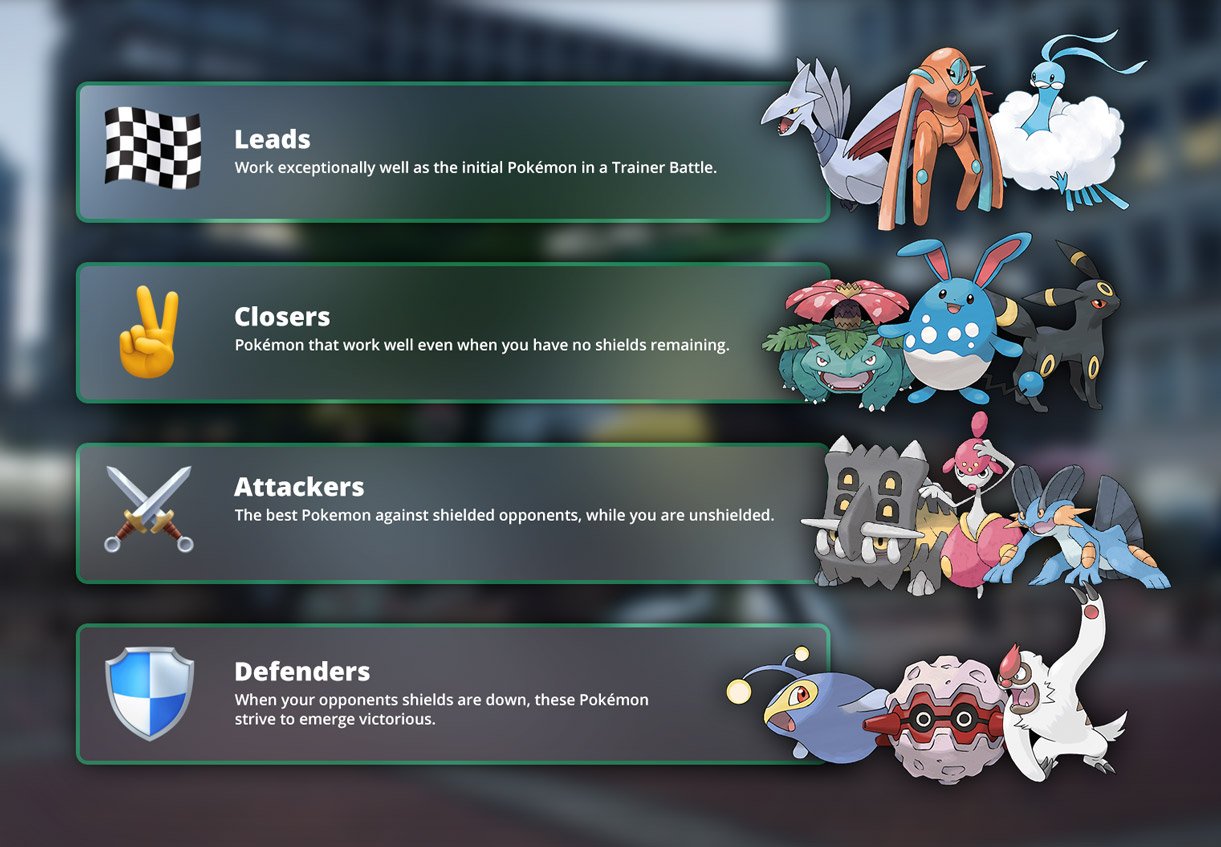
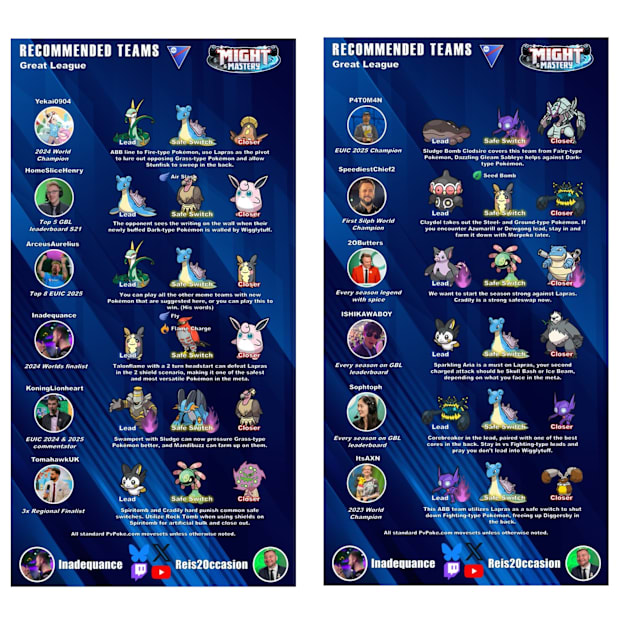
The Great League is the most diverse and technically demanding bracket. Currently, the “best” teams often revolve around a core of high-bulk, versatile attackers.
- The “Medi-Noct” Core: Comprising Medicham (Counter, Ice Punch/Psychic) and Noctowl (Wing Attack, Sky Attack/Shadow Ball). This duo provides incredible coverage against the “Fighting” and “Ghost” types that dominate the upper tiers of play.
- Galarian Stunfisk Lead: Often paired with a “Safe Swap” like Sableye, Galarian Stunfisk’s typing and rapid energy generation make it one of the most resilient leads in the software’s history.
The Ultra League (2500 CP Limit)
In the Ultra League, the meta is characterized by Legendary Pokémon and bulky “XL” Pokémon (those powered up beyond level 40).
- The Steel/Ghost Core: Registeel and Giratina (Altered Forme) represent the gold standard of the Ultra League. Registeel’s Lock-On provides the fastest energy generation in the game, allowing it to reach devastating Charged Moves like Zap Cannon or Focus Blast before the opponent can react.
- Cobalion and Virizion: These “Swords of Justice” have risen to prominence due to their Double Kick fast move, which offers a high-performance balance of damage and energy.
The Master League (No CP Limit)
The Master League is a showcase of raw power and perfect IVs (15/15/15). Here, the best team is often determined by the “Legendary Triangle.”
- Dialga, Zacian, and Lugia: Dialga remains the king of the Master League due to its Steel/Dragon typing. Zacian provides the ultimate utility with access to a wide array of high-damage moves like Close Combat and Play Rough, while Lugia serves as an immovable tank.

Technological Advantages: Using Simulators and Overlay Tools
Building the best team is not just about choosing the right Pokémon; it is about using the right tools to simulate thousands of battle scenarios. The most successful trainers rely on PvPoke, an open-source simulator that ranks Pokémon based on their performance across various “shield scenarios.”
Simulation-Based Strategy
PvPoke allows users to input their team and run a “Team Builder” analysis. The software provides a grade based on four key metrics:
- Coverage: How well the team handles the top 20 most-used Pokémon in the current meta.
- Bulk: The average stat product and survivability of the roster.
- Safety: How vulnerable the team is to being “hard-countered” by a single opponent.
- Consistency: How dependent the team is on winning the initial lead or landing “shield baits.”
By analyzing the “Matrix Battle” data, players can identify the exact moment a match is won or lost. For instance, a player might find that by switching a Fast Move from “Dragon Breath” to “Shadow Claw,” they can turn a losing matchup against a specific meta-threat into a win.
Overlay and Data Tracking
Advanced players often use third-party overlay apps that read the screen’s pixels to track the opponent’s energy. Since every Fast Move in Pokémon GO takes a specific number of “turns” (each turn is 0.5 seconds), a player can technically count how many moves an opponent has performed. This data-driven approach allows players to know exactly when an opponent is ready to fire a Charged Move, enabling “sacrificial swaps” or “under-charging” tactics that define high-level play.
Network Performance and Game Engine Optimization
In a game where a single 0.5-second turn can determine the winner, the technical performance of the device and the network is paramount. To run the “best team” effectively, a player must optimize their hardware.
Native Refresh Rate
A recent update to the Pokémon GO software allowed users to enable “Native Refresh Rate” in the advanced settings. This uncap of the frame rate is essential for competitive play. It provides smoother visual feedback, making it easier to time “Fast Move Refinement”—a technique where a player optimizes their timing to prevent the opponent from “sneaking in” an extra move during a Charged Move animation.
Reducing Latency
Competitive play is highly sensitive to “lag” or packet loss. Serious players often avoid Wi-Fi in favor of a stable 5G connection or even an Ethernet-to-USB adapter for high-stakes tournaments. Understanding the “server-side” nature of the game is vital; since the game processes actions in 0.5-second cycles, any delay in communication between the app and the Niantic servers can result in a “desync,” rendering even the best team useless.
Adapting to the Ever-Evolving Game State
The final component of the “best” team is adaptability. The developers at Niantic frequently implement “Move Rebalances.” A Pokémon that was top-tier in Season 12 might become obsolete in Season 15 due to a nerf in its primary energy-generating move.
The best trainers treat their teams like a software stack—regularly auditing, updating, and patching based on new data. This involves:
- Analyzing Usage Trends: Monitoring community-led data projects that track which Pokémon are being used most frequently at different rank levels (the “Elo” system).
- Counter-Meta Construction: If the meta becomes saturated with “Flyers,” the best team is no longer the one with the highest overall rank, but the one specifically engineered with “Electric” or “Rock” type moves to exploit the trend.
- Resource Management: In the tech-economy of the game, Stardust and Candy are the currency of optimization. The best team is also one that is sustainable to build and power up to level 50 using “XL Candy.”
Ultimately, the best team for Pokémon GO is a synthesis of high-level statistical data, elite hardware performance, and an adaptive strategy that responds to the game’s shifting digital landscape. It is not merely a collection of favorite characters, but a finely-tuned engine designed to exploit the mechanics of the application to their absolute limit.
aViewFromTheCave is a participant in the Amazon Services LLC Associates Program, an affiliate advertising program designed to provide a means for sites to earn advertising fees by advertising and linking to Amazon.com. Amazon, the Amazon logo, AmazonSupply, and the AmazonSupply logo are trademarks of Amazon.com, Inc. or its affiliates. As an Amazon Associate we earn affiliate commissions from qualifying purchases.