
In the rapidly evolving landscape of digital media, accessibility has transitioned from an optional feature to a fundamental pillar of software development and content delivery. Among the various tools designed to make digital content more inclusive, SDH subtitles stand out as a critical technical standard. SDH, which stands for Subtitles for the Deaf and Hard of Hearing, represents a sophisticated intersection of traditional subtitling and closed captioning, optimized for the digital era.
While many casual viewers use the terms “subtitles” and “captions” interchangeably, the technical distinction is significant. Understanding SDH requires a deep dive into how media players, streaming algorithms, and accessibility standards work together to provide an equitable viewing experience for all users, regardless of their auditory capabilities.
Understanding SDH: Beyond Basic Translation
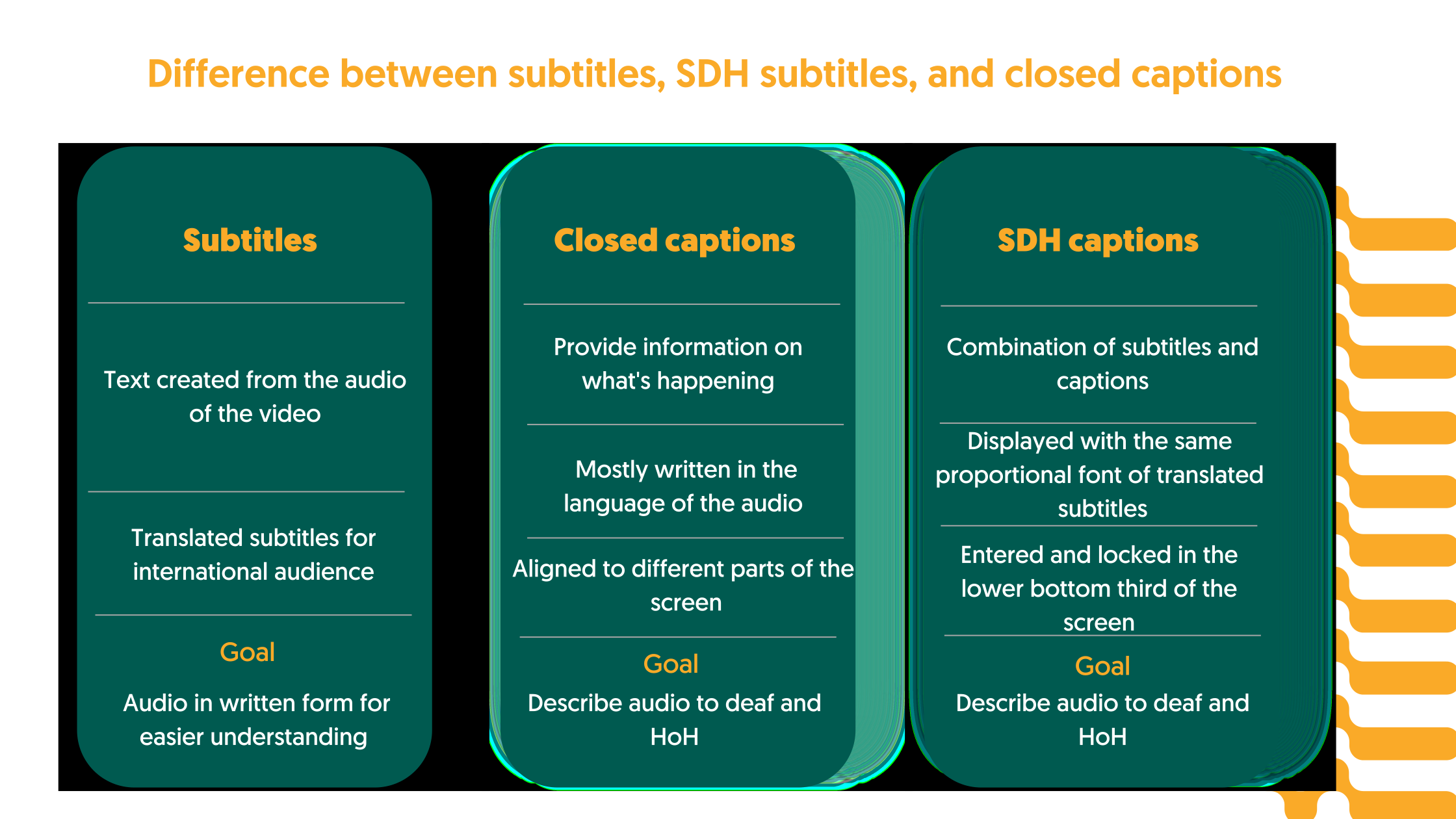
To understand what makes SDH unique, one must first look at the history of media accessibility. Historically, “subtitles” were designed for hearing viewers who did not understand the language being spoken. They focused exclusively on translating dialogue. Conversely, “Closed Captions” (CC) were developed specifically for the deaf and hard-of-hearing community, typically transmitted as a separate data stream (such as Line 21 in analog television) that included non-speech information.
SDH is the digital evolution of these two concepts. It combines the descriptive richness of closed captions with the high-definition aesthetic and technical flexibility of modern digital subtitles.
The Core Definition of SDH
SDH subtitles provide a text-based representation of all meaningful auditory information. This includes not only the spoken dialogue but also sound effects, speaker identification, and musical cues. Unlike traditional subtitles, which assume the viewer can hear the “mood” of a scene through its soundtrack, SDH assumes the viewer may not have access to the audio track at all.
SDH vs. Closed Captions (CC)
The primary difference between SDH and CC lies in the delivery method and technical formatting. Closed captions are often delivered as a data stream that the television or set-top box decodes and renders using its own internal fonts—often resulting in the blocky, white-on-black text associated with legacy broadcasts.
SDH, however, is typically rendered as a graphical overlay or a modern text-based stream that supports a wide range of fonts, sizes, and colors. Because SDH is integrated into digital media formats (like MKV, MP4, or streaming fragments), it can be scaled to fit high-resolution 4K displays without losing clarity. Furthermore, while CC was originally transmitted via specialized hardware, SDH is handled by the software media player, allowing for greater customization and user control.
The Role of Non-Speech Information (NSI)
The defining characteristic of SDH is the inclusion of Non-Speech Information. For a developer or a content creator, this means identifying every sound that is critical to the narrative. Examples include:
- Speaker IDs: Identifying who is speaking when they are off-screen or when multiple people are in a scene.
- Atmospheric Cues: Descriptions like “[tense music builds]” or “[distant siren wails].”
- Sound Effects: Crucial plot points like “[floorboards creak]” or “[gun clicks].”
The Technical Mechanics of SDH Subtitles
From a technical standpoint, implementing SDH involves specific file formats, encoding standards, and rendering engines. The digital architecture of a subtitle file determines how it interacts with the video frame and how much control the end-user has over its appearance.
Encoding and File Formats
There are two primary ways SDH subtitles are stored within a digital file: bitmapped and text-based.
- Bitmapped Subtitles (Image-based): Common in physical media like Blu-ray (PGS) and DVD (VOBSUB). These are essentially a series of small image files that overlay the video. While they ensure the font looks exactly as the creator intended, they are not searchable, and users cannot change the size or color.
- Text-based Subtitles: The modern standard for streaming and digital downloads. Formats like SubRip (.srt), WebVTT (.vtt), and Timed Text Markup Language (TTML) store the SDH data as plain text with timestamps. These are lightweight, easily translatable, and allow the media player’s UI to customize the appearance (e.g., yellow text, semi-transparent background, or increased font size).
Visual Styling and Positioning
In professional SDH production, positioning is a technical requirement. If a character on the left side of the screen is speaking, the SDH text might be justified to the left to provide visual context. If crucial visual information appears at the bottom of the screen (like a news ticker or a character’s nameplate), the SDH system must be programmed to move the text to the top of the frame to avoid overlap. This “active positioning” is a hallmark of high-quality SDH compared to standard translation files.

Integration with Media Containers
Modern media containers like Matroska (.mkv) or MP4 act as wrappers that hold video, multiple audio tracks, and multiple subtitle tracks. In a tech-centric workflow, SDH is flagged within the container’s metadata. This allows the player software (like VLC, Plex, or a built-in Smart TV app) to automatically select the SDH track if the user’s global accessibility settings are enabled.
The Evolution of Digital Accessibility in Streaming and Media
The rise of streaming giants like Netflix, Disney+, and Amazon Prime Video has forced a massive standardization of SDH. In the early days of the internet, subtitles were often an afterthought, but global accessibility laws and UX (User Experience) research have shifted the paradigm.
The Role of UX Design in SDH
For software engineers and UI/UX designers, SDH is a critical component of “Universal Design.” This philosophy suggests that features built for accessibility often benefit the entire user base. Statistics show that a significant percentage of mobile users watch videos with the sound off (e.g., on public transit or in quiet environments). In these scenarios, SDH provides a superior experience over standard subtitles because it conveys the full context of the scene—including the sound effects—without requiring audio.
Regulatory Standards and Compliance
In many jurisdictions, providing SDH or equivalent closed captioning is a legal requirement. In the United States, the Federal Communications Commission (FCC) has strict guidelines for video programming distributors regarding the accuracy, synchronicity, and placement of captions. For tech platforms, failing to provide high-quality SDH can lead to significant legal liabilities and, more importantly, the alienation of a massive demographic.
As content moves from traditional broadcast to IP-based delivery, the technical requirements for SDH have become more complex. Platforms must ensure that their proprietary players can parse TTML or VTT files across various devices, from low-powered mobile phones to high-end gaming consoles.
AI and the Future of SDH Subtitle Generation
The most significant technological shift in the world of SDH is the integration of Artificial Intelligence and Machine Learning. Historically, creating SDH was a labor-intensive manual process involving human stenographers or “re-speakers.” Today, AI is automating much of this pipeline.
Automated Speech Recognition (ASR)
Modern ASR engines, powered by deep learning models, can transcribe dialogue with over 95% accuracy in ideal conditions. However, the “SDH” aspect—identifying the sound effects—remains a more complex challenge for AI.
Contextual Sound Recognition
The next frontier in accessibility tech is the development of AI models that can distinguish between “background noise” and “narrative sound.” An AI must be trained to recognize that a bird chirping in a forest scene is atmospheric and perhaps doesn’t need a tag, whereas a bird chirping inside a high-tech laboratory might be a crucial plot point that requires an SDH tag like “[robotic bird chirping].”
Engineers are currently developing neural networks that analyze audio waveforms to automatically generate NSI tags. When these systems are perfected, the cost of producing SDH will plummet, allowing even small-scale independent creators to offer fully accessible content.
Real-time SDH and Live Streaming
Live streaming presents the ultimate technical hurdle for SDH. For live news or sports, the latency between the audio and the generated text must be minimized to ensure the experience remains cohesive. Emerging technologies in edge computing are allowing for faster processing of live ASR and sound recognition, bringing us closer to a world where live SDH is indistinguishable from pre-recorded quality.

Why SDH is Essential for the Modern Digital Ecosystem
The integration of SDH is no longer just a “nice-to-have” feature; it is a hallmark of a mature digital product. As we look toward the future of media—including Virtual Reality (VR) and Augmented Reality (AR)—the technical challenges of SDH will evolve. In a 360-degree environment, where does the SDH text live? How does it indicate sound coming from behind the user?
These are the questions being tackled by the next generation of accessibility engineers. By treating SDH as a core technical requirement rather than a secondary add-on, developers ensure that their platforms are resilient, inclusive, and prepared for a global audience.
In conclusion, SDH subtitles represent the pinnacle of media accessibility tech. They bridge the gap between simple translation and full-spectrum auditory description, leveraging modern file formats and AI-driven automation to ensure that the digital world remains open to everyone. Whether you are a developer building a new video platform or a consumer looking for the best viewing experience, SDH is a vital component of the modern technological landscape.
aViewFromTheCave is a participant in the Amazon Services LLC Associates Program, an affiliate advertising program designed to provide a means for sites to earn advertising fees by advertising and linking to Amazon.com. Amazon, the Amazon logo, AmazonSupply, and the AmazonSupply logo are trademarks of Amazon.com, Inc. or its affiliates. As an Amazon Associate we earn affiliate commissions from qualifying purchases.