
Understanding family dynamics often leads to the classic riddle: “What is my cousin to my kids?” While traditional family gatherings might involve a confusing debate over “second cousins” versus “cousins once removed,” the modern digital era has provided us with sophisticated tools to answer these questions with mathematical precision. In the world of genealogy technology, defining these relationships is no longer a matter of guesswork; it is a matter of data points, algorithmic mapping, and genomic sequencing.
To answer the specific question: your first cousin is your children’s first cousin once removed. This “removed” status refers to the generational gap between the two individuals. While this terminology has existed for centuries, the rise of genealogy software and DNA analysis has revolutionized how we visualize, track, and verify these intricate branches of the human experience.

The Digital Architecture of Kinship: Defining the First Cousin Once Removed
In the realm of software development for genealogy, the logic used to determine relationship degrees is based on “Consanguinity” algorithms. When you input a family member into a platform like Ancestry.com or MyHeritage, the backend systems are processing your shared ancestors to calculate the exact terminology for your children.
Decoding the Algorithm of “Removed” Generations
The term “removed” is a technical descriptor used in genealogical databases to indicate that two people are from different generations. Your first cousin is in the same generation as you because you both share the same set of grandparents. However, your children belong to the subsequent generation.
Technically, your child and your cousin’s child are second cousins. But the relationship between your child and your cousin is asymmetrical in terms of generational distance. Software logic uses the “Common Ancestor” method to solve this. Because your cousin and your child share a common ancestor (your grandparents, who are your child’s great-grandparents), the software calculates the number of steps to that ancestor. The mismatch in steps results in the “once removed” tag.
Why Precision Matters in Digital Family Records
For users of digital archive tools, precision is paramount. Modern database management systems (DBMS) used in genealogy apps must handle millions of nodes. If a user incorrectly labels a “first cousin once removed” as a “second cousin,” it can create a cascade of errors in the kinship reporting.
Modern tech platforms solve this by using relationship calculators. These are essentially logic engines that allow users to select two people in a digital tree and instantly generate their relationship. This tech is vital for legal documentation, estate software, and medical history tracking, where the degree of biological relatedness (the coefficient of relationship) must be exact to assess genetic risks or inheritance rights.
Leveraging AI and Big Data to Map Complex Relationships
The days of paper charts and hand-drawn trees are being replaced by high-performance computing and Artificial Intelligence. Mapping “what my cousin is to my kids” is now the entry point into a much larger ecosystem of big data.
The Role of Cloud-Based Ancestry Platforms
Cloud computing has enabled the democratization of genealogical research. Platforms now host petabytes of data, including census records, immigration logs, and birth certificates. When you use these platforms to define your cousin’s relationship to your children, the software isn’t just looking at your personal tree; it is cross-referencing millions of other trees to find “hints.”
Artificial Intelligence algorithms scan through historical documents using Optical Character Recognition (OCR) to identify names that might be missing from your records. If the AI finds a record of your cousin’s birth or your child’s baptism, it can automatically suggest a connection, ensuring that the “once removed” relationship is documented with primary source evidence.
Predictive Modeling in Family Heritage Software
Advanced genealogy software now uses predictive modeling to fill in “the gaps.” If you know your cousin but have lost touch with that branch of the family, AI can analyze social graphs and public records to predict where those relatives might be.
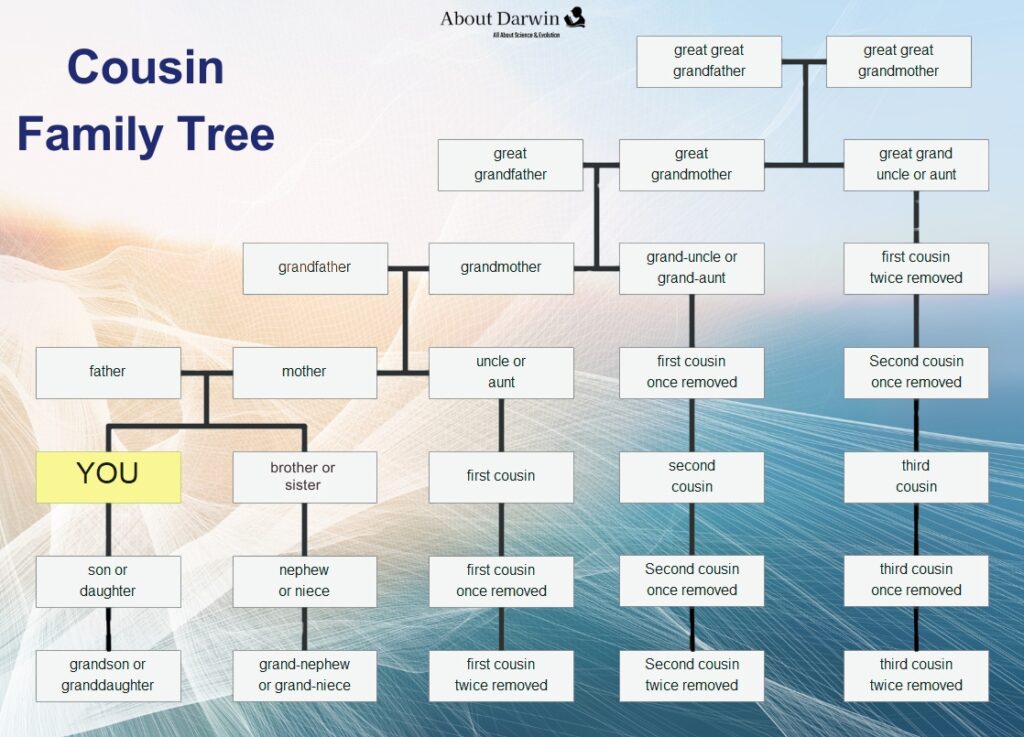
This technology uses graph theory—the study of nodes and links—to visualize how your children are connected to distant relatives. These visualizers can transform a flat list of names into a 3D interactive map, showing the generational “steps” that define the “removed” status. For tech-savvy parents, these tools offer a way to teach children about their heritage through interactive UI/UX design rather than static stories.
DNA Analysis: The High-Tech Answer to Genetic Connections
While software handles the “names and dates” side of family trees, biotechnology handles the biological reality. When you ask what your cousin is to your kids, DNA testing services like 23andMe or FamilyTreeDNA provide a quantitative answer based on shared genetic material.
How Centimorgans Quantify Family Bonds
In the world of genetic tech, relationships are measured in “centimorgans” (cM). A centimorgan is a unit for measuring genetic linkage. When you look at the DNA results for your child and your first cousin, the tech will show a specific range of shared DNA, typically between 215 and 650 cM.
The software uses these metrics to “predict” the relationship. The algorithm will flag the match as “First Cousin, Once Removed” based on the percentage of the genome they share (approximately 6.25%). This provides a level of certainty that traditional paper records cannot match, as it accounts for “non-paternity events” or hidden adoptions that might exist in a family history.
Privacy and Security in the Age of Genomic Data
As we use tech to define these relationships, digital security becomes a critical concern. Genetic data is the most personal form of “Big Data.” Leading tech firms in the genealogy space employ military-grade encryption and two-factor authentication (2FA) to protect the link between your cousin and your children.
The “Relative Finder” features on these apps are built with privacy-by-design principles. Users must opt-in to be seen by “DNA relatives.” This ensures that while you can use tech to identify your cousin’s relationship to your kids, you are doing so within a secure digital sandbox that prevents unauthorized access to your family’s genomic profile.
The Future of Legacy Tech: From Static Trees to Interactive Histories
As we move forward, the question of “what is my cousin to my kids” will be answered by even more immersive technologies. The evolution of “Legacy Tech” is moving toward a synthesis of data, media, and virtual interaction.
Integrating Multimedia into Family Databases
The next generation of genealogy software is moving beyond text-based entries. Digital Asset Management (DAM) systems are being integrated into family trees, allowing users to attach 4K video, voice recordings, and high-resolution scans to specific nodes.
In this context, your child won’t just know that your cousin is their “first cousin once removed” via a label on a screen. They will be able to access a digital vault where that relationship is contextualized with media. AI-driven “story builders” can take the raw data of that relationship and generate a narrative video, explaining the shared ancestry and showing photos of the grandparents who link them together.
Blockchain and the Immutable Family Record
One of the most intriguing developments in tech is the use of blockchain for genealogical records. By using decentralized ledgers, families can create an immutable record of their lineage. In a blockchain-based family tree, the relationship between your cousin and your kids is “minted” as a permanent record that cannot be altered or lost due to a corporate platform shutting down.
This ensures that for generations to come, the technical definitions of kinship remain accurate and accessible. Smart contracts could even be used to manage family trusts or digital inheritances based on these verified relationships, automatically identifying “first cousins once removed” as eligible beneficiaries through code rather than manual legal review.

VR and the Virtual Family Reunion
Virtual Reality (VR) and Augmented Reality (AR) are set to change how we perceive these “removed” relationships. Imagine an AR app where you point your phone at a relative at a wedding, and a digital overlay identifies them: “First Cousin Once Removed – Shared Ancestors: John and Mary Smith.”
This tech bridges the gap between complex genealogical terminology and real-world social interaction. It takes the mathematical “removed” status and turns it into a lived experience, allowing children to visualize their place within a vast, interconnected digital and biological network. Through these technological advancements, the answer to “what is my cousin to my kids” becomes not just a piece of trivia, but a foundational element of a digitally-preserved family legacy.
aViewFromTheCave is a participant in the Amazon Services LLC Associates Program, an affiliate advertising program designed to provide a means for sites to earn advertising fees by advertising and linking to Amazon.com. Amazon, the Amazon logo, AmazonSupply, and the AmazonSupply logo are trademarks of Amazon.com, Inc. or its affiliates. As an Amazon Associate we earn affiliate commissions from qualifying purchases.