
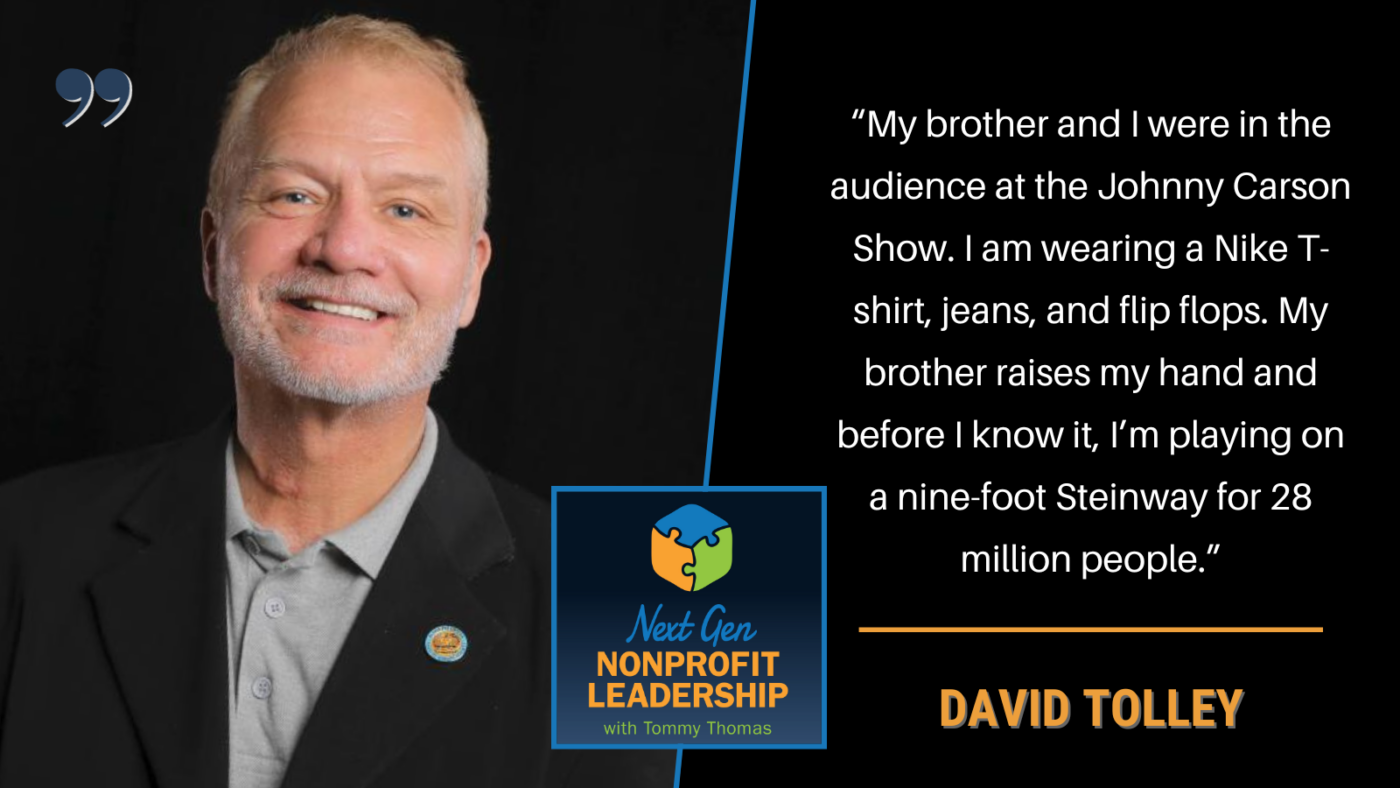
On a cold December night in 1985, the trajectory of personal branding changed forever, though the term was hardly in the popular lexicon at the time. David Tolley, a young man sitting in the audience of The Tonight Show Starring Johnny Carson, was suddenly thrust into the spotlight when a scheduled guest failed to appear. Carson, in a moment of improvisational brilliance, asked if anyone in the audience could play the piano. Tolley, wearing a Nike t-shirt, jeans, and flip-flops, raised his hand.
What happened next—a masterful performance of “Memory” from the musical Cats—became one of the most legendary moments in television history. But while many people remember the viral moment, the true branding lesson lies in what happened afterward. David Tolley’s career provides a rigorous case study in how to transition from an accidental viral sensation to a sustained, multi-decade professional brand.

The Anatomy of a Viral Pivot: The Tonight Show Moment
In modern marketing, we often discuss “moment marketing” or “trend-jacking,” but Tolley’s rise was the organic precursor to the digital viral loop. To understand what happened to David Tolley, one must first analyze the brand equity created in those initial five minutes on NBC.
The Power of Opportunity Readiness
A brand is often defined as the intersection of preparation and opportunity. Before Tolley sat on that bench, he was not merely an “audience member.” He was a classically trained musician who had spent years honing his craft. From a brand strategy perspective, Tolley was “market-ready” even if he wasn’t “market-visible.”
When the opportunity arose, he didn’t just play; he performed. The contrast between his casual attire (the “Everyman” visual identity) and his elite-level skill (the “Expert” product) created a powerful cognitive dissonance for the audience. This contrast is a classic branding tool used to increase memorability. It humanized the brand of a “concert pianist,” making it accessible to a mass audience while retaining the prestige of high art.
From “Guy in the Audience” to a Defined Persona
Immediately following the broadcast, Tolley faced the first major hurdle of any accidental brand: identity definition. Was he a novelty act, or was he a serious artist? In the days following the performance, Tolley was flooded with offers. He could have easily pivoted into a career as a comedic pianist or a talk-show regular, capitalizing on the “flip-flop” gimmick.
Instead, he strategically utilized the momentum to solidify his status as a legitimate musical force. He understood that a brand built solely on a gimmick has a short shelf life. By pivoting the conversation from “the guy Carson found” to “the pianist who happened to be on Carson,” he successfully shifted the brand focus from the event to the individual’s talent.
Engineering Longevity: Beyond the Fifteen Minutes of Fame
The fate of most viral sensations is a slow fade into obscurity. The reason David Tolley’s name still resonates in professional circles is his disciplined approach to brand diversification. Following the initial surge of fame, Tolley didn’t just ride the wave; he built a surfboard.
Diversifying the Professional Portfolio
Tolley’s career post-Carson is an exercise in brand expansion. He didn’t limit himself to live performance. He moved into composition, production, and arrangement. This is a critical lesson in corporate identity: a single revenue stream or a single “product” (in this case, his piano playing) makes a brand vulnerable.
Tolley began composing for massive corporate entities and global events. He wrote music for Disney, including scores for their theme parks and cruise lines. He composed for the Special Olympics and even for the White House. Each of these partnerships acted as a “brand endorsement,” shifting his personal brand from a television curiosity to a trusted industry professional. By aligning himself with blue-chip brands like Disney and the Olympics, he inherited the prestige and reliability associated with those institutions.
The Role of Educational Authority in Branding
One of the most significant moves in Tolley’s career was his transition into academia. He eventually became a professor at Delaware State University, where he led the Music Composition and Music Technology programs.

In the world of personal branding, there is no higher tier than that of the “Educator.” By teaching the next generation of musicians, Tolley effectively “institutionalized” his brand. He was no longer just a practitioner; he was an authority. This move served two purposes: it provided a stable, prestigious base for his professional identity and it allowed him to shape the industry from the inside. For any professional looking to sustain a brand over decades, moving from “Doing” to “Teaching” is a proven strategy for maintaining relevance.
Strategic Branding in the Music Industry: Tolley’s Compositional Identity
As the music industry underwent massive technological shifts in the 90s and 2000s, David Tolley adapted his brand to stay at the cutting edge of music technology. This adaptability is what separates enduring brands from those that become relics of a specific era.
Composing for Media and the Global Stage
Tolley’s work in theater—specifically his original musical Casper—showcased his ability to manage large-scale creative projects. Brand management is essentially project management at scale. When a composer takes on a musical, they are managing a multi-faceted brand that involves actors, producers, set designers, and audiences.
His ability to compose music that translated across cultures and media (from stage to theme park to television) speaks to a “Global Brand Strategy.” He wasn’t just writing songs; he was creating emotional experiences that could be scaled and replicated. This is the essence of a successful product line: consistency and scalability.
Balancing Artistic Integrity with Marketability
A perennial challenge for any personal brand is the tension between “selling out” and staying “authentic.” Tolley managed this by maintaining a high standard of technical excellence while remaining commercially viable. He didn’t shun the commercial world; he mastered it.
His “product” (music) was always technically proficient, satisfying the “connoisseur” segment of his market, while remaining melodic and accessible, satisfying the “mass market” segment. This dual-track brand positioning allowed him to work on high-profile commercial projects without losing his credibility as a serious composer.
Modern Lessons in Personal Branding from the David Tolley Narrative
Looking back at Tolley’s journey through the lens of modern brand strategy reveals several timeless principles that apply to today’s digital landscape.
Controlling the Narrative in the Digital Age
While Tolley’s “viral” moment happened on analog television, the way he managed it is a blueprint for modern influencers. He didn’t let the media define him. He used the media as a megaphone for his pre-existing skills. In today’s economy, where many try to build brands around “lifestyle” rather than “skillset,” Tolley’s story is a reminder that a brand without a core product is hollow.
His “product” was his ability to play and compose. The Carson show was merely the distribution channel. When the channel changed or the buzz died down, the product remained. For modern personal brands, the lesson is clear: invest in the product (skill) more than the distribution (social media).
The Transition from Performer to Mentor
The final phase of the David Tolley brand story is one of legacy. By focusing on his work at Delaware State University and his private production work, he has moved into a “Legacy Brand” phase. He is no longer competing for the spotlight; he is the spotlight for others.
This transition is the ultimate goal of brand strategy: to reach a point where the brand has enough equity that it no longer needs to actively market itself. Tolley’s name is synonymous with a specific type of success—the kind that is earned in an instant but maintained through decades of hard work and strategic positioning.
Conclusion: The Lasting Equity of David Tolley
What happened to David Tolley? He didn’t disappear; he evolved. He took a moment of “luck”—which he famously defined as “preparation meeting opportunity”—and turned it into a masterclass in brand sustainability. From the Nike t-shirt on Johnny Carson’s stage to the halls of academia and the recording studios of Disney, Tolley’s career is a testament to the power of a well-managed personal brand.
He proved that you can start as an “accidental” brand, but you only stay relevant if you become an “intentional” one. His journey from a viral audience member to a respected composer and educator remains one of the most successful examples of long-term personal brand management in the entertainment industry. For anyone looking to build a brand today, the Tolley narrative offers a clear directive: lead with talent, diversify your offerings, and never stop evolving.
aViewFromTheCave is a participant in the Amazon Services LLC Associates Program, an affiliate advertising program designed to provide a means for sites to earn advertising fees by advertising and linking to Amazon.com. Amazon, the Amazon logo, AmazonSupply, and the AmazonSupply logo are trademarks of Amazon.com, Inc. or its affiliates. As an Amazon Associate we earn affiliate commissions from qualifying purchases.