
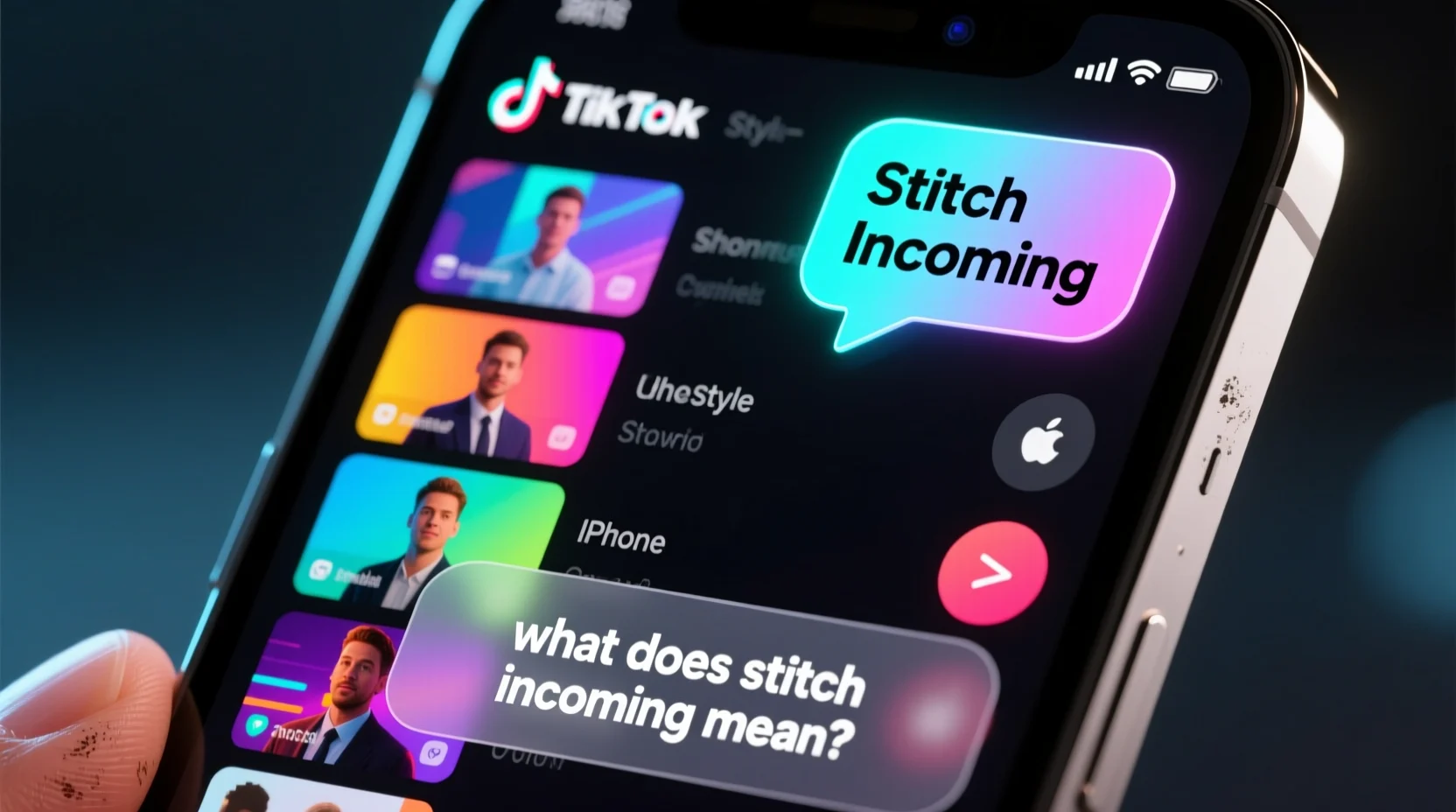
In the rapidly evolving landscape of social media applications, features that facilitate collaborative content creation have become the cornerstone of user engagement. Among these, the “Stitch” feature on TikTok stands out as a sophisticated technical tool that allows users to integrate snippets of another creator’s video into their own. When a user sees the phrase “Incoming Stitch,” they are witnessing a specific digital storytelling mechanism that bridges two distinct pieces of media. Understanding what this means requires a deep dive into the application’s interface, its underlying algorithms, and the broader technological trends governing mobile video editing.

The “Stitch” is essentially a video editing tool built directly into the TikTok application. It allows a creator to clip up to five seconds from another user’s video and use it as the introductory segment for their own content. This creates a seamless transition from the original source to the new commentary, reaction, or expansion. The “Incoming Stitch” label acts as a visual and functional cue, signaling to the viewer that the content following the clip is a direct response or an iterative development of the initial footage.
Decoding the Stitch Feature: How the Technology Works
At its technical core, the Stitch feature is a manifestation of modular video editing. Unlike traditional video editing software that requires manual downloading, clipping, and re-uploading of assets, TikTok’s architecture handles these processes server-side and within its native UI. When a user initiates a Stitch, the app’s internal editor accesses the original video’s source file, allows the user to define a specific timestamp range (up to five seconds), and then caches that segment to be rendered alongside the new footage the user records.
This process involves complex metadata linking. Every Stitched video is digitally tethered to the original creator’s content. This isn’t just for visual credit; it is a structural link within the database. This link ensures that the original creator is automatically tagged in the caption, providing a direct “link back” to the source material. From a technology standpoint, this facilitates a “web of content” where a single viral video can act as a root node for thousands of branched responses, all of which remain programmatically connected.
The “Incoming Stitch” notification—often placed as a text overlay or used as a verbal cue—serves a vital UX (User Experience) function. It prepares the viewer for a shift in perspective. In an era of short-form content where attention spans are measured in seconds, providing a clear contextual framework for why a video is starting with a stranger’s face is essential for maintaining retention rates.
Navigating the User Interface: A Technical Tutorial
For creators and tech enthusiasts, understanding how to deploy this feature is as much about mastering the interface as it is about content strategy. The ability to Stitch is not universal; it is governed by specific privacy settings and application versions.
Enabling the Stitch Capability
To allow others to Stitch your content, you must navigate through the application’s “Settings and Privacy” menu. Under the “Privacy” tab, there is a dedicated “Stitch” section. Here, users can choose between “Everyone,” “Friends” (followers you follow back), or “Only Me.” Enabling this feature at a global level allows the TikTok algorithm to index your videos as “Stitchable,” which can significantly increase the technical reach of your digital footprint.
The Execution Process
- Selection: Locate a video that has Stitch permissions enabled.
- The “Share” Interface: Tap the share icon (the arrow). If the creator allows it, the “Stitch” icon (represented by two overlapping squares) will be active.
- Clipping the Metadata: Once selected, the app opens a trimming interface. The user slides a selection box over the original video’s timeline to choose the exact portion they wish to reference.
- Recording and Integration: After selecting the clip, the user records their own content. The application then merges these two distinct video files into a single output file during the rendering phase.
The brilliance of this technology lies in its simplicity for the end-user, hiding the sophisticated encoding and synchronization occurring in the background. The app must ensure that frame rates, aspect ratios, and audio levels are normalized between the original clip and the new recording to provide a professional-grade final product.

The Algorithm and Engagement: Why Stitches Matter for Reach
From a technology trend perspective, Stitches are a primary driver of the “For You Page” (FYP) algorithm. The TikTok algorithm prioritizes content that generates high levels of interaction. When a video is Stitched frequently, the system interprets this as a high “relevance” signal. Each Stitch acts as a unique data point that reinforces the value of the original video while simultaneously boosting the new creator’s visibility.
The algorithmic impact of an “Incoming Stitch” is twofold:
- Contextual Weighting: The algorithm recognizes the relationship between the two videos. If a user enjoys the original creator’s content, the algorithm is more likely to serve them Stitches of that content, creating a specialized content ecosystem.
- Discoverability: For the person performing the Stitch, they are effectively “piggybacking” on the metadata of a potentially viral video. This increases the probability of their content appearing in search results related to the original video’s keywords and hashtags.
Furthermore, the “Incoming Stitch” format has birthed its own genre of digital content. Tech-savvy creators use this to participate in “Stitch Challenges” or “Open Forums,” where the technology serves as a bridge for global debates, tutorials, and collaborative storytelling. This is a significant shift from the siloed content creation models of previous social media eras.
Digital Privacy, Security, and Content Control
As with any technology that allows for the repurposing of user-generated content, the Stitch feature raises important questions regarding digital security and intellectual property. TikTok has implemented several technical safeguards to ensure that creators maintain control over their digital assets.
Permission Hierarchies
Creators have the granular control to enable or disable Stitches on a per-video basis. Even if a user has global Stitch permissions turned on, they can toggle the feature off for a specific, sensitive video during the upload process. This is managed through the “More Options” menu before posting, where the “Allow Stitch” toggle resides.
Attribution and Protection
One of the most critical tech features of the Stitch is the permanent attribution. The application automatically generates a caption that links to the original creator. This link cannot be removed by the person performing the Stitch. This serves as a digital watermark of sorts, ensuring that the original “data owner” receives credit for their contribution to the collaborative work.
However, from a digital security standpoint, users must be aware that once a video is Stitched, the resulting content exists independently of the original. If the original creator deletes their video, the Stitched versions usually remain on the platform, although the link to the original may become “broken” or lead to a “Video Unavailable” landing page. This persistence of data is a key consideration for anyone concerned with their long-term digital footprint.
The Evolution of Modular Content and Mobile Video Editing
The “Incoming Stitch” phenomenon is representative of a larger trend in technology: the democratization of high-end video editing. We are moving away from linear video consumption toward a modular, interactive experience. In this environment, a video is no longer a static file; it is a versatile asset that can be sliced, remixed, and recontextualized in real-time.
This evolution is supported by advancements in mobile processing power. Modern smartphones are now capable of handling the multi-track rendering required for Stitches and Duets without significant latency. As 5G technology becomes more ubiquitous, the speed at which these collaborative videos are rendered and uploaded will only increase, leading to even more complex forms of digital interaction.
In conclusion, “Incoming Stitch” is more than just a phrase on a screen; it is a symbol of the modern intersection between social interaction and advanced mobile technology. It represents a sophisticated system of video splicing, metadata linking, and algorithmic discovery that has redefined how we communicate in the digital age. By understanding the technical mechanics, privacy controls, and algorithmic advantages of this feature, users and tech professionals alike can better navigate the complex, interconnected world of short-form digital media. Whether you are a creator looking to expand your reach or a technologist interested in the future of UI/UX, the Stitch feature offers a fascinating glimpse into the future of collaborative software.
aViewFromTheCave is a participant in the Amazon Services LLC Associates Program, an affiliate advertising program designed to provide a means for sites to earn advertising fees by advertising and linking to Amazon.com. Amazon, the Amazon logo, AmazonSupply, and the AmazonSupply logo are trademarks of Amazon.com, Inc. or its affiliates. As an Amazon Associate we earn affiliate commissions from qualifying purchases.