
The age-old question of the divine appearance has transitioned from the realm of theological debate into the cutting-edge laboratories of generative artificial intelligence and high-fidelity digital rendering. For centuries, artists relied on oils and canvases to interpret the enigmatic descriptions found in sacred texts. Today, developers and data scientists are utilizing neural networks and advanced software suites to decode the complex, often non-linear visual language of the Bible. By feeding ancient descriptions into modern algorithms, the tech community is uncovering new ways to visualize the “ineffable,” creating a bridge between historical linguistics and synthetic media.
The Intersection of Sacred Text and Synthetic Media
The primary challenge in visualizing biblical descriptions of the divine lies in the abstract nature of the source material. Unlike contemporary literature, which often provides clear physical dimensions, the Bible utilizes metaphorical and symbolic language—descriptions of “bronze,” “lightning,” and “consuming fire.” In the tech landscape, this represents a unique data-parsing problem. How does a machine interpret a description that defies traditional Euclidean geometry?
Prompt Engineering the Ineffable
At the heart of this technological exploration is the art of prompt engineering. When users interact with Large Language Models (LLMs) or image generators like Midjourney and DALL-E 3, they are essentially translating ancient Hebrew and Greek concepts into “tokens” that the machine can understand. To answer what God looks like according to the Bible, tech enthusiasts are moving beyond simple queries. They are using “multi-modal” approaches, feeding the AI specific verses from Ezekiel, Revelation, and Daniel to see how the software interprets phrases like “the appearance of the likeness of the glory of the Lord.”
These AI tools do not simply look for a human face. Because the training data includes a vast history of art, the AI must be carefully guided to avoid medieval clichés. Advanced users employ “negative prompting” to strip away Renaissance-era tropes, forcing the software to focus strictly on the textual data: the multifaceted “wheels within wheels,” the “eyes” covering every surface, and the “radiance” that functions more like a spectrum of light than a physical object.
From Ezekiel to Algorithms: Parsing Complex Data
The Prophet Ezekiel’s visions are perhaps the most difficult to render because they describe four-dimensional concepts in a three-dimensional world. In the tech sector, this has led to a fascinating use of procedural generation software. Instead of static images, developers are using tools like SideFX Houdini to create algorithmic models that can simulate the “living creatures” and the “chariot of fire.”
By treating the biblical text as a set of parameters—a “seed” for the generation—software can create moving, shifting forms that better reflect the “spirit in the wheels.” This approach moves the visualization of God away from a static portrait and toward a dynamic, data-driven event. It highlights the power of modern software to handle “non-linear datasets,” where the visual output must change based on the angle of the observer, much like the descriptions found in the biblical text.
The Role of Generative AI in Visualizing Biblical Accounts
As generative AI continues to evolve, its ability to synthesize disparate concepts has made it the go-to tool for those seeking to visualize the more abstract elements of the Bible. The shift from “text-to-image” to “text-to-video” (via tools like Sora or Runway Gen-2) has allowed for a more immersive look at what these divine appearances might entail, moving beyond a single frame into a cinematic experience of light and sound.
Midjourney and DALL-E: Interpretation via Deep Learning
The latest versions of Midjourney (v6) and DALL-E have shown a remarkable ability to understand texture and light. When programmed with descriptions from the Book of Revelation—such as a figure with “hair white like wool” and “eyes like a flame of fire”—the deep learning models must balance the literal and the metaphorical. The software uses a process called “diffusion,” starting with a field of noise and gradually refining it into a recognizable shape.
Interestingly, when the prompt is restricted strictly to biblical adjectives, the AI often produces images that are more “alien” than “humanoid.” This reflects a shift in digital theology: technology is helping us realize that the biblical description of the divine is often a description of high-energy physics—light, sound, and vibration—rather than a physical anatomy. The AI’s ability to layer these effects through “neural style transfer” allows for a visualization of “glory” that feels more like a cosmic phenomenon than a human appearance.
The Constraints of Hardware in Rendering the Infinite
Rendering these complex visions requires significant computational power. To achieve the “4K, photorealistic, hyper-detailed” outputs that many tech-savvy users seek, the hardware must be capable of intense ray tracing and volumetric calculations. The use of NVIDIA’s H100 or A100 Tensor Core GPUs has become standard for high-level generative tasks, allowing for the real-time processing of light reflections that mimic the “polished bronze” and “sparkling beryl” mentioned in the texts.

Without high-end hardware, the nuances of the biblical descriptions—the way light interacts with “living fire”—become muddy. The “Tech” behind the visualization is just as important as the text itself. In the world of digital rendering, “God” is often a test of a system’s ability to handle infinite light sources and complex refraction patterns, pushing the limits of what current consumer-grade gadgets can display.
Digital Archaeology and Reconstruction Software
While AI handles the abstract, other tech sectors focus on the historical and environmental context of these visions. Digital archaeology uses software to recreate the tabernacle, the temple, and the specific landscapes where these divine encounters were said to occur. This provides a “spatial” answer to what the divine appearance looked like within the context of the physical world.
Rebuilding Biblical Visions in 3D Environments
Using Unreal Engine 5 (UE5), developers are creating “digital twins” of ancient environments. By utilizing the engine’s “Lumen” dynamic global illumination and “Nanite” virtualized geometry, creators can simulate how a “pillar of cloud” or a “burning bush” would interact with the surrounding topography. This isn’t just about art; it’s about physics. UE5 allows researchers to plug in the specific dimensions and materials described in the Bible—gold, acacia wood, fine linen—to see how they would reflect light in a Mediterranean sun.
These 3D environments provide a more grounded perspective. By reconstructing the “Holy of Holies” in a virtual space, users can experience the scales and proportions that the biblical authors used to convey the majesty of God. The software treats the text as a blueprint, turning ancient measurements into a navigable digital reality.
Virtual Reality: Stepping Into the Throne Room
The rise of high-end VR headsets like the Meta Quest 3 and the Apple Vision Pro has enabled a new form of “experiential scripture.” In these immersive environments, the question “What does God look like?” is answered through scale and presence. Developers are building “Scripture VR” apps where users can stand in the middle of Ezekiel’s vision.
In a VR space, the user isn’t just looking at a picture; they are surrounded by the “sounds of many waters” and the “brightness of the firmament.” This use of spatial audio and 360-degree rendering mimics the overwhelming sensory experience described by the prophets. From a tech perspective, this is the ultimate application of haptic feedback and spatial computing—attempting to simulate an experience that, by definition, exceeds human capacity.
The Ethical and Technological Implications of Digitizing the Divine
As we use AI and high-end software to visualize the biblical God, we encounter the same issues found in all areas of digital transformation: bias, security, and the limitations of the training data. The “image” of the divine produced by an AI is heavily dependent on the data it has been fed, which raises significant questions about the future of digital religion.
Bias in the Training Data: Western vs. Global Perspectives
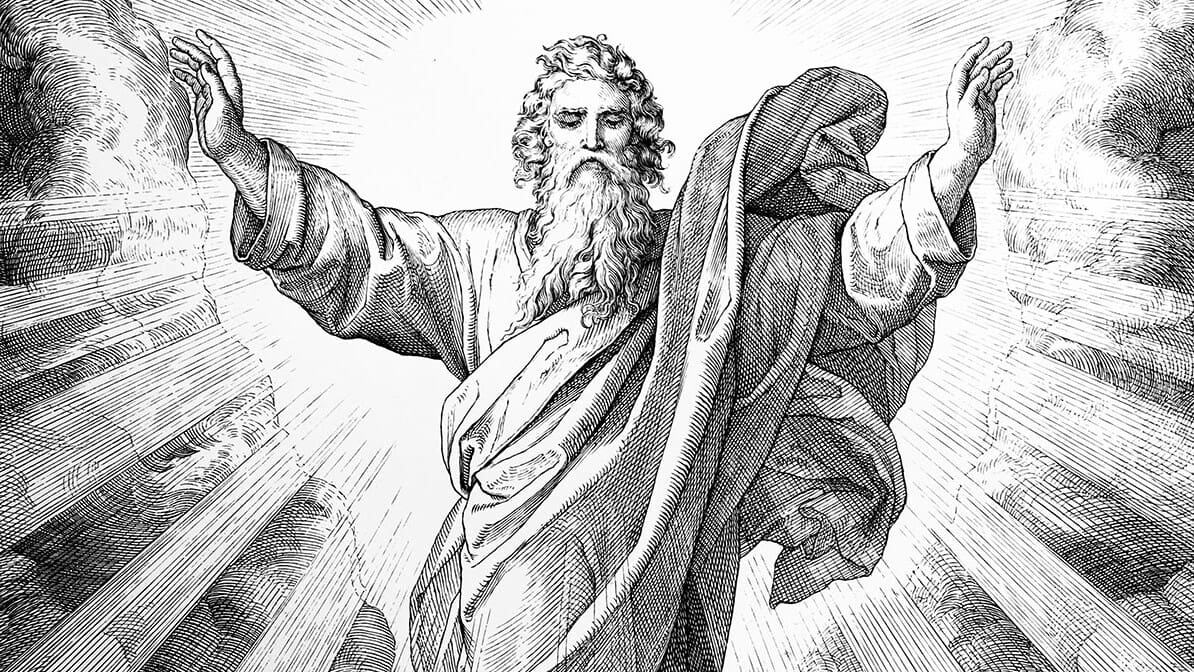
One of the major hurdles in tech today is algorithmic bias. Most AI models are trained on Western art history, which is heavily influenced by the Renaissance and Baroque periods. When an AI is asked to visualize the biblical God, it often defaults to the “Old Man with a White Beard” trope—a depiction that is more Michelangelo than Moses.
To correct this, developers are working on “fine-tuning” models with more diverse datasets, including Eastern Orthodox iconography, Ethiopian manuscripts, and ancient Near Eastern motifs. This technical adjustment is crucial for a more accurate biblical visualization, as the Bible’s descriptions are rooted in a Middle Eastern context that predates the Western artistic tradition by millennia. The tech goal is to move toward a “decolonized” AI that can interpret the text without the filter of 16th-century European aesthetics.

The Future of Spiritual Tech and Immersive Scripture
The trajectory of this technology suggests that we are moving toward a “personalized” visualization of sacred texts. In the near future, we may see AI agents that can generate real-time visualizations of scripture as a user reads it, tailored to their specific hardware and preferences. Digital security will also play a role; as these visualizations become more powerful, protecting the “sanctity” of the data from malicious deepfakes or unauthorized alterations will become a priority for religious organizations utilizing these tools.
Ultimately, the question of what God looks like according to the Bible is being answered by a synergy of ancient linguistics and modern computing. We are no longer limited to our imagination; we have the software to build, render, and explore the most complex visions in human history. As AI continues to bridge the gap between “the word” and “the image,” the digital frontier becomes a new space for exploring the oldest questions of humanity. Through the lens of technology, the divine “likeness” is not a static face, but a magnificent display of data, light, and infinite complexity.
aViewFromTheCave is a participant in the Amazon Services LLC Associates Program, an affiliate advertising program designed to provide a means for sites to earn advertising fees by advertising and linking to Amazon.com. Amazon, the Amazon logo, AmazonSupply, and the AmazonSupply logo are trademarks of Amazon.com, Inc. or its affiliates. As an Amazon Associate we earn affiliate commissions from qualifying purchases.