
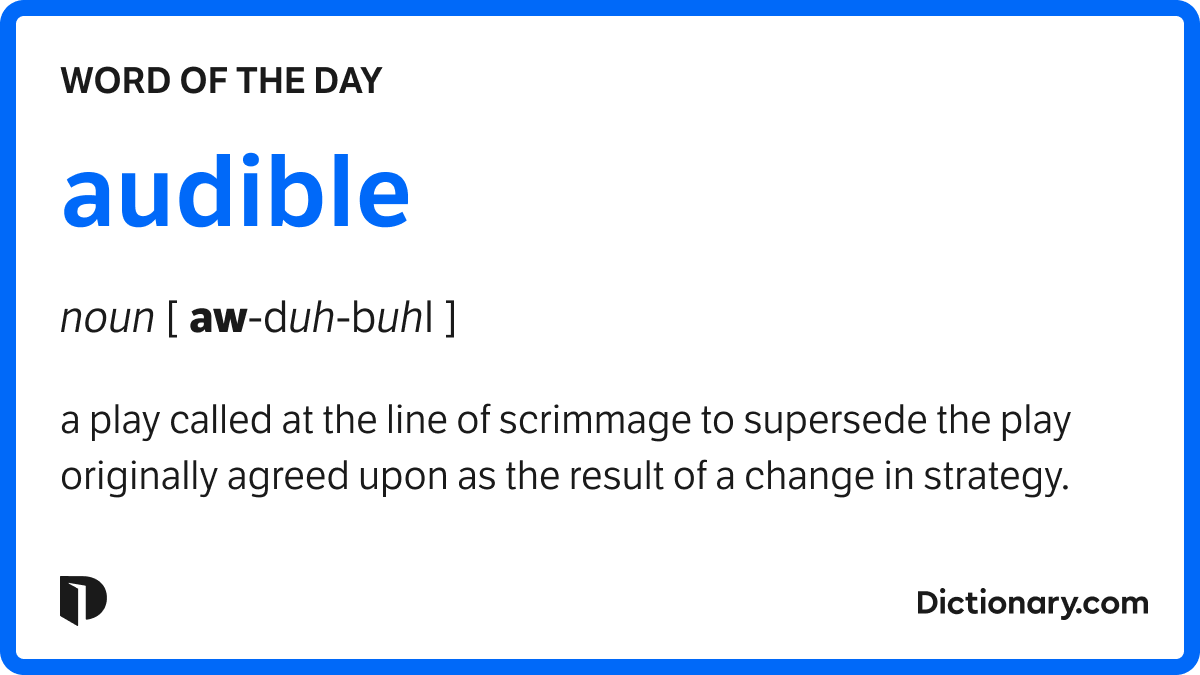
In the high-stakes world of American football, “calling an audible” occurs when a quarterback scans the opposing defense, realizes the pre-planned play is destined for failure, and shouts out a new set of instructions at the line of scrimmage. In the realm of money—encompassing personal finance, professional investing, and corporate strategy—the term carries a remarkably similar weight. To call an audible in your financial life is to recognize that the economic environment has shifted and that sticking to your original script would be a liability rather than an asset.

Financial agility is often the thin line between wealth preservation and catastrophic loss. While “staying the course” is a common mantra for long-term investors, there are specific, critical moments where the ability to pivot is the hallmark of a sophisticated financial mind. Understanding what it means to call an audible is about mastering the balance between disciplined planning and tactical flexibility.
The Financial Quarterback: Defining the Audible in Wealth Management
At its core, calling an audible in finance is the act of making a real-time, data-driven deviation from a primary plan. It is not an act of impulse or an emotional reaction to market noise; rather, it is a calculated response to new information that invalidates previous assumptions.
From the Gridiron to the Ledger
In personal finance, your “playbook” is your budget, your investment policy statement, or your five-year business plan. You enter the market with a strategy—perhaps a heavy tilt toward aggressive growth stocks or a plan to launch a specific e-commerce product. However, the “defense” (the market) rarely stays static. Interest rates may climb, consumer sentiment may sour, or a disruptive technology might render your current project obsolete. Calling an audible means you have the situational awareness to change your tactics before the “snap,” saving your capital from an avoidable loss.
Recognizing the Signs for a Strategy Shift
Identifying the moment to call an audible requires a high level of financial literacy. It involves monitoring leading indicators rather than lagging ones. For a business owner, this might mean noticing a month-over-month decline in customer acquisition costs efficiency before it hits the bottom line. For an investor, it might be recognizing a fundamental shift in a company’s leadership or a structural change in an industry. The audible is the bridge between realizing a plan is failing and implementing the solution.
Navigating Market Volatility: When to Pivot Your Portfolio
One of the most common arenas for calling an audible is the public market. While passive investing and “buy and hold” strategies are effective for many, there are macroeconomic events that demand a change in posture to protect one’s net worth.
The Impact of Macroeconomic Shifts
Economic cycles are inevitable, but their timing is often unpredictable. When the Federal Reserve adjusts interest rates or when geopolitical tensions disrupt global supply chains, the “playing field” changes. For example, an investor who has historically relied on cheap debt to fund real estate acquisitions may need to call an audible when borrowing costs double. This might involve shifting from an acquisition phase to a debt-reduction phase, or pivoting from long-term rentals to short-term corporate housing to increase cash flow.
Rebalancing vs. Calling an Audible
It is important to distinguish between routine rebalancing and calling an audible. Rebalancing is a scheduled, mechanical process of selling winners and buying losers to maintain a target asset allocation. Calling an audible is a tactical intervention. It is the decision to move to cash during extreme overvaluation, or the choice to hedge a portfolio with options when volatility spikes. It is an active decision to override the default settings of your financial plan because the current conditions are no longer conducive to the original strategy.
Business Finance and Entrepreneurship: The Art of the Strategic Pivot
For entrepreneurs and side hustlers, the ability to call an audible is often a prerequisite for survival. The startup world is littered with the remains of companies that refused to change their “play” even as it became clear the market didn’t want what they were selling.

Scaling Side Hustles: When the Original Plan Fails
Many successful businesses began as something entirely different. A freelancer might start by offering graphic design services, only to realize that their clients are actually desperate for brand strategy and consulting. Calling an audible in this scenario means abandoning the design-heavy business model to focus on high-ticket consulting. This shift requires the ego to be set aside in favor of market demand. By listening to what the “defense” is giving you, you can move the ball down the field much faster than by forcing a failing strategy.
Capital Allocation and Resource Redirection
In corporate finance, calling an audible often relates to how capital is deployed. A company might have a million-dollar budget earmarked for a new product launch. If the beta testing returns poor results, a rigid manager might proceed anyway to satisfy a board’s expectations. A savvy financial leader, however, calls an audible. They halt the launch, recoup the remaining budget, and redirect those funds toward an existing product that is showing unexpected organic growth. This is the essence of capital efficiency: putting your money where it has the highest probability of a strong Return on Investment (ROI).
Psychological Readiness: The Mindset Required for Financial Agility
The hardest part of calling an audible isn’t the math; it’s the psychology. Humans are biologically wired to fear change and to fall victim to several cognitive biases that make pivoting difficult.
Overcoming Sunk Cost Fallacy
The “sunk cost fallacy” is the tendency to continue an endeavor once an investment in money, effort, or time has been made, even if the current costs outweigh the benefits. In finance, this looks like holding onto a losing stock because “I’ve already lost 40%, I might as well wait for it to come back,” or continuing to fund a failing side hustle because you’ve spent two years building it. Calling an audible requires the discipline to view your financial position from “point zero” every day. If you wouldn’t enter the position today with your remaining capital, you shouldn’t be in it.
Developing a “Playbook” for the Unexpected
To call a successful audible, you must have a backup plan. In football, a quarterback doesn’t just make up a play on the spot; they choose from a pre-rehearsed set of alternatives. Financially, this means having “If-Then” scenarios.
- If inflation exceeds 5%, then I will increase my exposure to commodities or inflation-protected securities.
- If my primary client accounts for more than 50% of my income and they leave, then I will immediately pivot to a pre-defined outreach strategy for new industries.
Having these contingencies ready allows you to execute an audible with confidence rather than panic.
Implementing the Change: Best Practices for Financial Course Correction
Once you’ve decided that a change is necessary, the execution must be swift and precise. A poorly executed audible can be just as damaging as a failing plan.
Data-Driven Decision Making
The difference between a “hail Mary” and an “audible” is data. When you change your financial strategy, it should be based on quantifiable metrics. This might include Price-to-Earnings (P/E) ratios, debt-to-equity markers, or conversion rate trends. By grounding your pivot in data, you remove the emotional volatility that often leads to “buying high and selling low.”
The Role of Emergency Funds and Liquidity
You cannot call an audible if you are stuck in the mud. In financial terms, “mud” is illiquidity. If all your wealth is tied up in long-term, non-liquid assets like certain types of real estate or locked-in retirement accounts, your ability to pivot is limited. Maintaining a robust emergency fund and a portion of your portfolio in liquid assets provides the “maneuverability” needed to change course. Liquidity is the fuel that allows your financial strategy to be dynamic rather than static.
Conclusion: The Mastery of Adaptive Finance
In the final analysis, calling an audible is about acknowledging that the world is a complex, non-linear system. The most successful investors and business owners are those who remain humble enough to admit when a plan is no longer working and courageous enough to change it mid-stream.
Whether you are managing a personal brokerage account, a growing side hustle, or a corporate budget, the ability to read the field and adjust your strategy is your greatest competitive advantage. Financial success is not about having a perfect plan that never changes; it is about having the intelligence and the agility to call the right play at the right time, regardless of what was originally written in the playbook. By mastering the art of the audible, you transform volatility from a threat into an opportunity, ensuring that your financial goals remain within reach no matter how the defense lines up.
aViewFromTheCave is a participant in the Amazon Services LLC Associates Program, an affiliate advertising program designed to provide a means for sites to earn advertising fees by advertising and linking to Amazon.com. Amazon, the Amazon logo, AmazonSupply, and the AmazonSupply logo are trademarks of Amazon.com, Inc. or its affiliates. As an Amazon Associate we earn affiliate commissions from qualifying purchases.