
For the average smartphone user, the Subscriber Identity Module, or SIM card, is a small piece of plastic and metal that is inserted into a device to enable cellular service. However, from a technical perspective, the SIM card is a sophisticated microcomputer that serves as the cornerstone of mobile security and network authentication. Despite its diminutive size, it contains an intricate architecture of hardware, software, and highly sensitive data sets that facilitate everything from basic voice calls to high-speed 5G data transitions. Understanding what a SIM card contains requires a deep dive into the hardware components, the file systems, and the cryptographic identifiers that define our digital identities in the mobile ecosystem.

The Physical and Logical Architecture: A Computer in Miniature
To understand what is inside a SIM card, one must first recognize that it is a specialized type of Smart Card. It follows the ISO/IEC 7816 standards, which govern identification cards with integrated circuits. It is not merely a storage flash drive; it is a complete computing system.
The Integrated Circuit (IC)
At the heart of the SIM card is the integrated circuit, usually visible as the gold-plated contact pad on the surface. Beneath this pad lies a silicon chip consisting of a Central Processing Unit (CPU), various types of memory, and security logic. The CPU is responsible for executing instructions and handling the cryptographic algorithms required to authenticate the device with the cellular network. While the clock speed of a SIM’s CPU is a fraction of what is found in a modern smartphone, it is highly optimized for specific tasks like encryption and data retrieval.
The Memory Hierarchy
The SIM card utilizes three primary types of memory to manage its operations:
- ROM (Read-Only Memory): This section contains the operating system of the SIM card (often a version of Java Card or a proprietary native OS) and the permanent instructions for the microprocessor. This data is written during the manufacturing process and cannot be altered.
- RAM (Random Access Memory): Like any computer, the SIM needs volatile memory to perform calculations and store temporary data during active sessions.
- EEPROM (Electrically Erasable Programmable Read-Only Memory): This is where the “content” most users are familiar with resides. EEPROM stores user-specific data, network configurations, SMS messages, and contact lists. Modern SIM cards typically offer between 64 KB and 256 KB of EEPROM storage. While this sounds minuscule, it is more than sufficient for the text-heavy data it is designed to hold.
Core Data Sets: Authentication and Identification
The primary purpose of a SIM card is to provide a secure way for a mobile network operator (MNO) to identify and authenticate a subscriber. To do this, the SIM contains several unique identifiers and secret keys that are never shared in their raw form over the airwaves.
ICCID: The Serial Number
The Integrated Circuit Card Identifier (ICCID) is a 19- or 20-digit number printed on the back of the SIM card and stored digitally within its memory. This is the globally unique serial number for the hardware itself. It includes the industry identifier (89 for telecommunications), the country code, the issuer identifier (the network provider), and a unique account identification number.
IMSI: The Network Identity
While the ICCID identifies the hardware, the International Mobile Subscriber Identity (IMSI) identifies the specific user on the network. When a phone powers on, it sends the IMSI to the network to request access. To protect privacy, the IMSI is rarely transmitted; instead, a Temporary Mobile Subscriber Identity (TMSI) is used for most communications once the initial connection is established.
The Authentication Key (Ki)
The most critical piece of data inside a SIM card is the Authentication Key, or Ki. This is a 128-bit value used to authenticate the SIM card on the mobile network. The Ki is a closely guarded secret; it is stored on the SIM and in the carrier’s Authentication Center (AuC). During the “challenge-response” handshake, the network sends a random number (RAND) to the SIM. The SIM uses its Ki and an onboard algorithm (such as COMP128 or Milenage) to calculate a Signed Response (SRES). If the SRES generated by the SIM matches the SRES calculated by the network, access is granted. Because the Ki never leaves the SIM, it is incredibly difficult for hackers to “clone” a modern SIM card without physical access to the chip and specialized hardware.
The File System: How Data is Organized

A SIM card organizes its data using a hierarchical file structure, much like the folders and files on a PC. This structure is defined by the ETSI (European Telecommunications Standards Institute) and ensures that different devices can read the data uniformly.
Master Files (MF) and Dedicated Files (DF)
The root of the SIM card is the Master File (MF). Below the MF are Dedicated Files (DFs), which function like folders. There are specific DFs for different functionalities, such as DF_GSM for network-specific settings or DF_TELECOM for user-facing features like contacts and SMS.
Elementary Files (EF)
Inside the folders are Elementary Files (EFs). These are the actual data points. Common EFs include:
- EF_MSISDN: Stores the subscriber’s phone number. Interestingly, the SIM card does not always “know” its own phone number; this file is often left blank by the carrier, which is why some phones display “Unknown Number” in the settings.
- EF_ADN (Abbreviated Dialing Numbers): This is where your SIM contacts are stored. Each entry typically includes a name and a phone number.
- EF_SMS: This file stores text messages. Due to the limited size of EEPROM, a SIM can usually only hold between 20 and 50 messages before the storage is full.
- EF_LOCI (Location Information): This file stores the Location Area Identity (LAI). When you turn your phone off and on, the SIM uses the LAI to reconnect to the last known cell tower quickly, reducing the time it takes to find a signal.
The Evolution of SIM Technology: From Mini to eSIM
As mobile technology has moved from 2G to 5G, the contents and form factors of SIM cards have evolved to meet the demands of smaller gadgets and more robust security requirements.
Physical Shrinkage
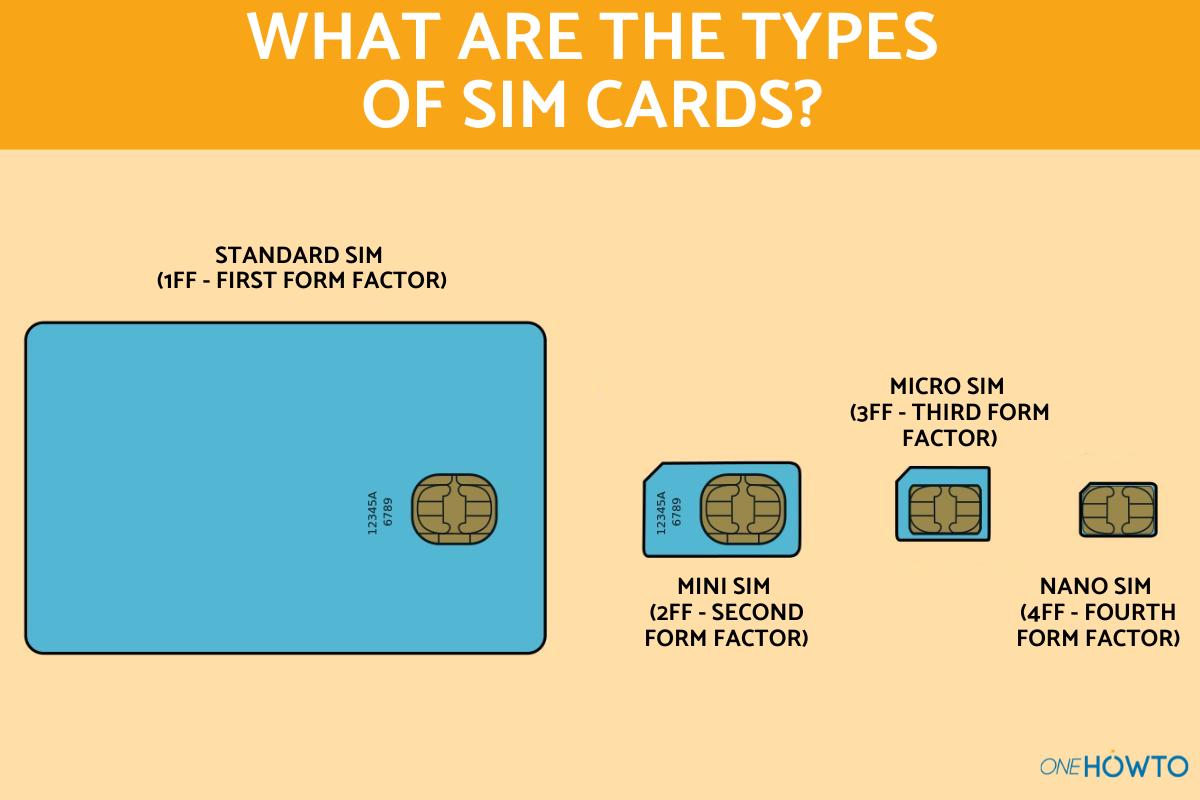
The transition from the original credit-card-sized SIM to the Mini-SIM, Micro-SIM, and eventually the Nano-SIM did not change the internal data structure significantly. The reduction in size was achieved by removing excess plastic, leaving only the essential integrated circuit. The tech inside remained consistent, ensuring backward compatibility across generations of mobile hardware.
The Rise of eSIM and eUICC
The most significant technological shift in recent years is the transition to the eSIM (Embedded SIM). Unlike a removable plastic card, an eSIM is a permanent chip soldered onto the device’s motherboard. Technically known as an eUICC (Embedded Universal Integrated Circuit Card), it contains the same CPU and memory architecture as a physical SIM but with a crucial difference: it can be remotely provisioned.
The “content” of an eSIM is dynamic. Through a process called Over-the-Air (OTA) provisioning, a user can download a “SIM profile” onto the chip. This profile contains the IMSI, Ki, and network configurations previously hard-coded into physical cards. This allows for multiple profiles to be stored on a single chip, enabling users to switch between carriers via software settings rather than physical swapping.
The Future: iSIM and Enhanced Digital Security
As we move deeper into the era of the Internet of Things (IoT) and 5G, the contents of the SIM card are being integrated even further into the device hardware. The next step in this evolution is the iSIM (Integrated SIM).
iSIM Technology
While the eSIM is a dedicated chip on the motherboard, the iSIM integrates the Subscriber Identity Module functionality directly into the device’s System on a Chip (SoC), alongside the main processor and modem. This reduces power consumption and saves even more physical space. Despite this integration, the “contents”—the cryptographic keys and file structures—remain isolated in a “Secure Element” or “Trusted Execution Environment” (TEE) to ensure that the security of the cellular identity is not compromised by malware on the main operating system.
Advanced Encryption and 5G
With the advent of 5G, the data contained within a SIM (now often called a USIM or Universal SIM) has become even more secure. 5G introduces Subscriber Concealed Identifiers (SUCI). In older 2G, 3G, and 4G networks, the IMSI was occasionally sent in plaintext during the initial connection, allowing for “IMSI catching” via fake cell towers (Stingrays). In 5G, the SIM uses public-key encryption to hide the IMSI, ensuring that the identity of the user is never exposed over the airwaves.
The SIM card is a masterclass in efficient engineering. It manages to pack an operating system, a file storage system, and high-level cryptographic tools into a space no larger than a fingernail. Whether it is a physical Nano-SIM or an invisible iSIM, the contents remain the bedrock of mobile security, ensuring that our devices stay connected, our identities remain private, and our communications stay encrypted in an increasingly connected world.
aViewFromTheCave is a participant in the Amazon Services LLC Associates Program, an affiliate advertising program designed to provide a means for sites to earn advertising fees by advertising and linking to Amazon.com. Amazon, the Amazon logo, AmazonSupply, and the AmazonSupply logo are trademarks of Amazon.com, Inc. or its affiliates. As an Amazon Associate we earn affiliate commissions from qualifying purchases.