
The concept of a minimum wage is one of the most significant pillars of modern labor economics and personal finance. It represents the lowest remuneration that employers can legally pay their workers—the price floor below which an employee cannot sell their labor. Understanding what the minimum wage was, how it has evolved, and where it stands today is essential for anyone navigating the realms of business finance, personal wealth management, and macroeconomics.
From its inception as a radical social experiment to its current status as a focal point of intense political and financial debate, the minimum wage has shaped the purchasing power of millions. To understand the current financial landscape, one must first look back at the origins and the shifting value of this fundamental economic benchmark.

The Origins and Evolution of the Federal Minimum Wage
The federal minimum wage in the United States was not a feature of the original founding economy. It was born out of the desperation of the Great Depression. In 1938, President Franklin D. Roosevelt signed the Fair Labor Standards Act (FLSA), a landmark piece of legislation that established the first federal minimum wage at $0.25 per hour. At the time, this was equivalent to roughly $5.00 in today’s inflation-adjusted dollars.
The primary objective of the FLSA was to maintain a “minimum standard of living necessary for health, efficiency, and general well-being.” For business owners of that era, it was a seismic shift in how they calculated their labor costs and operational budgets. For workers, it provided a safety net against the exploitative “sweatshop” conditions that had become common during the industrial era.
The Post-War Boom and Periodic Adjustments
Following the initial 1938 mandate, the minimum wage underwent periodic increases as the American economy expanded. During the 1950s and 1960s, the rate was raised several times, reflecting the robust economic growth of the post-World War II era. By 1968, the minimum wage reached what many economists consider its historical peak in terms of real purchasing power. At $1.60 per hour, the 1968 minimum wage, when adjusted for inflation, would be worth over $14.00 today.
During this period, the minimum wage was more than just a survival metric; it was a tool for expanding the middle class. It allowed entry-level workers to cover basic necessities while still participating in the consumer economy, which in turn drove business profits and investment.
The Stagnation of the Federal Rate
The trajectory of the federal minimum wage slowed significantly in the late 20th and early 21st centuries. The last time the federal minimum wage was increased was in July 2009, when it was set at $7.25 per hour. This mark has remained unchanged for over fifteen years, the longest period without an increase since the wage’s inception. This stagnation has profound implications for personal finance and the broader economy, as the rising cost of housing, education, and healthcare has far outpaced the static federal floor.
The Purchasing Power Gap: Real vs. Nominal Wages
In the world of personal finance and investing, the distinction between “nominal” and “real” value is critical. The nominal minimum wage is the face value of the currency ($7.25), whereas the real minimum wage is the purchasing power of that money after accounting for inflation.
The Impact of Inflation on the Bottom Line
When the minimum wage remains stagnant while the Consumer Price Index (CPI) rises, workers experience a “stealth” pay cut. For a person earning the federal minimum in 2009, $7.25 could buy significantly more groceries, fuel, and rent than it can in the current market. From a financial planning perspective, this gap has forced a shift in how low-income households manage their cash flow.
The erosion of purchasing power means that a minimum wage earner today must work significantly more hours to afford the same standard of living enjoyed by a worker in the 1960s or 70s. This reality has fueled the rise of the “side hustle” economy, as individuals seek additional income streams to bridge the gap between their primary wages and their cost of living.
The “Living Wage” vs. The Minimum Wage
This gap has given rise to the concept of the “Living Wage.” Unlike the statutory minimum wage, a living wage is a theoretical income level that allows an individual or family to afford adequate shelter, food, and other necessities without government assistance. In many high-cost urban areas, the living wage is now double or triple the federal minimum. For financial advisors and business strategists, this disparity is a key metric in assessing regional economic health and labor market stability.
State-Level Dynamics and the Diversification of Earnings
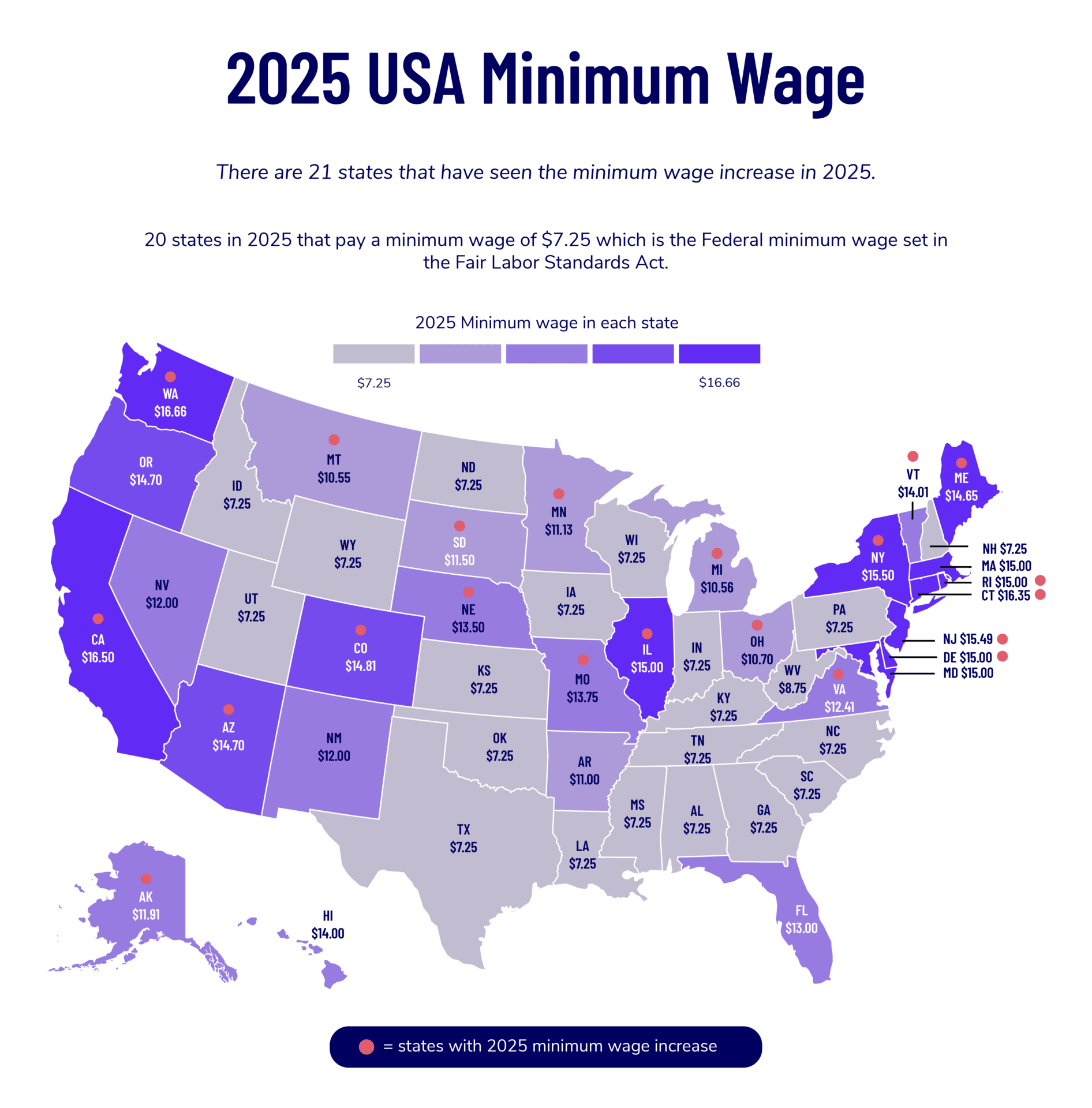
Because the federal minimum wage has remained fixed, the “minimum wage” is no longer a single, unified number across the United States. Instead, we have seen a massive diversification of wage floors driven by state and local legislation. This creates a complex landscape for business finance and corporate strategy.
The Rise of the $15 Minimum
In recent years, several states—including California, New York, and Massachusetts—have implemented paths to a $15.00 minimum wage or higher. These movements, often referred to as “Fight for $15,” were driven by the recognition that the federal rate was no longer sufficient to support a household. For businesses operating across state lines, this geographic variation requires sophisticated payroll and financial modeling to maintain profitability while staying compliant with localized labor laws.
Localized Economic Impact
Proponents of higher state minimum wages argue that putting more money into the hands of low-wage workers stimulates local economies. When lower-income individuals earn more, they tend to spend that money immediately on goods and services, creating a “multiplier effect” that benefits local businesses.
Conversely, some business owners express concern that rapid wage increases can lead to “wage-push inflation,” where companies must raise prices to cover higher labor costs. From a business finance perspective, the challenge lies in balancing competitive wages with the need to maintain margins. In many cases, businesses have turned to technology and automation to offset the increased cost of human labor.
The Impact on Business Finance and Personal Wealth Building
The minimum wage does not just affect those who earn it; it influences the entire ladder of compensation and the broader financial health of corporations.
Labor Costs and Operational Efficiency
For small businesses, labor is often the largest line item in the budget. A change in the minimum wage requires a complete re-evaluation of the financial model. Some businesses respond by increasing efficiency—investing in better training to ensure that every hour of paid labor is more productive. Others may look toward “lean” business models, reducing staff counts or outsourcing non-essential functions.
In the corporate sector, minimum wage increases often trigger “wage compression” issues. If the lowest-paid workers receive a raise, those slightly above them on the corporate ladder often expect a corresponding increase to maintain the pay gap that reflects their experience or seniority. This can lead to a cascading increase in total payroll expenses.
Personal Finance: The Entry-Point for Wealth
For the individual, the minimum wage is often the starting point for personal wealth building. However, at current federal levels, the ability to save or invest is virtually non-existent for those at the bottom of the pay scale. In the context of personal finance, the minimum wage is frequently viewed as a “transition wage”—a starting point from which workers are expected to move upward through skill acquisition and career development.
The difficulty today is that the “gap” between minimum wage and a middle-class income has widened. This has made financial literacy and strategic career planning more important than ever. For many, the minimum wage is the catalyst for seeking “online income” or “side hustles,” leveraging the digital economy to supplement traditional employment.
Future Trends: Automation, Gig Work, and the Economic Outlook
As we look toward the future, the definition of “what was the minimum wage” is likely to undergo further transformation. The intersection of technology and finance is creating new paradigms for how we value work.
The Role of Automation and AI
As the cost of labor increases, the financial incentive for businesses to automate tasks grows. We see this in self-checkout kiosks at grocery stores and AI-driven customer service bots. From a business finance perspective, the “break-even” point for automation becomes more attractive as the minimum wage rises. This creates a complex dynamic: while higher wages improve the lives of those employed, they may also reduce the total number of entry-level positions available.
The Gig Economy and Minimum Wage Protections
The rise of platforms like Uber, DoorDash, and Upwork has challenged the traditional definition of an “employee.” Gig workers are often classified as independent contractors, meaning they are not always covered by minimum wage laws. This has led to new financial debates regarding “guaranteed earnings” and portable benefits. In the coming decade, we will likely see a push to reconcile the flexibility of the gig economy with the financial protections of the traditional minimum wage.
The Shift Toward Universal Basic Income (UBI)
In some economic circles, the stagnation of the minimum wage and the rise of automation have shifted the conversation toward Universal Basic Income (UBI). The argument is that if the labor market can no longer provide a living wage for all through traditional employment, the financial system must provide a floor through direct transfers. While this is a departure from the 1938 FLSA model, it stems from the same core financial concern: ensuring that every participant in the economy has a baseline of purchasing power.
The history of the minimum wage is a history of the American economy’s attempt to balance corporate profitability with the financial well-being of the workforce. From $0.25 to $7.25 and beyond, these numbers represent more than just a paycheck; they represent the evolving value of time, labor, and the social contract in the pursuit of financial stability. Understanding this evolution is paramount for any investor, business owner, or individual looking to master their personal finances in an ever-changing economic world.
aViewFromTheCave is a participant in the Amazon Services LLC Associates Program, an affiliate advertising program designed to provide a means for sites to earn advertising fees by advertising and linking to Amazon.com. Amazon, the Amazon logo, AmazonSupply, and the AmazonSupply logo are trademarks of Amazon.com, Inc. or its affiliates. As an Amazon Associate we earn affiliate commissions from qualifying purchases.